If you're planning to leave California — whether for Texas, Florida, Nevada, or the Mountain West — and you're shopping for an electric vehicle to make the move with, the Tesla Model Y is likely on your shortlist. It's the best-selling EV in America for good reason, but buying a Tesla when you're relocating out of the Golden State introduces questions most reviews ignore: How does the Supercharger network look in your destination state? Will you still qualify for incentives? Does the Model Y's range hold up on long interstate drives through hot or cold climates?
This review breaks down the 2026 Tesla Model Y with relocating buyers in mind — covering real-world range, charging logistics, federal tax-credit eligibility under current IRS §30D rules, and how it stacks up against the competition you'll actually cross-shop.
2026 Tesla Model Y: Quick Verdict for Out-of-State Buyers
The refreshed 2026 Model Y (internally called "Juniper") carries over the core formula that made it a segment leader: strong efficiency, access to Tesla's Supercharger network, and competitive pricing. For buyers leaving California, the biggest advantage is Tesla's charging infrastructure — which extends far beyond the state's borders into regions where Electrify America and other networks remain sparse. The biggest risk? Federal tax-credit eligibility has tightened, and your new state's incentive landscape may look very different from California's CVRP and utility rebates.
| Spec | Long Range AWD | Performance |
|---|---|---|
| EPA Range | 320 miles | 295 miles |
| Battery (usable) | ~75 kWh, NMC | ~75 kWh, NMC |
| Drivetrain | Dual-Motor AWD | Dual-Motor AWD |
| Horsepower | 384 hp | 456 hp |
| 0–60 mph | 4.8 sec | 3.5 sec |
| Peak DC Fast Charge | 250 kW | 250 kW |
| 10–80% DC Time | ~25 min | ~25 min |
| Level 2 Home Rate | 11.5 kW (~44 mi/hr) | 11.5 kW (~44 mi/hr) |
| EPA Efficiency | 122 MPGe (28 kWh/100mi) | 111 MPGe (30 kWh/100mi) |
| Cargo (rear seats up) | 30.2 cu ft | 30.2 cu ft |
| Cargo (rear seats folded) | 72.1 cu ft | 72.1 cu ft |
| Base MSRP | $44,990 | $51,490 |
Real-World Range: What to Expect After You Leave California
The EPA rates the 2026 Model Y Long Range AWD at 320 miles. That number is achievable in moderate city and suburban driving at 55–65 mph in 60–80°F weather. But if you're driving I-10 through the Arizona desert in July or I-70 through Colorado in January, plan for less.
- Mild city/suburban (65°F, 55 mph avg): ~305–320 mi
- Highway cruising (75 mph, 75°F): ~255–280 mi
- Hot-weather highway (95°F+, A/C max): ~240–265 mi
- Cold-weather highway (30°F, heater on): ~210–240 mi
- Cold + highway + headwind (worst case): ~190–215 mi
Source: Aggregated real-world testing data; EPA fueleconomy.gov
For relocating buyers, this matters practically: if you're driving from Los Angeles to Austin (1,230 miles), you'll need roughly 4–5 Supercharger stops in the Long Range. The Model Y's efficiency — 28 kWh per 100 miles combined — is among the best in its class, which means fewer stops and lower charging costs per mile than heavier competitors like the Ford Mustang Mach-E or Hyundai Ioniq 5.
Charging Speed and the Supercharger Advantage Outside California
Tesla's charging ecosystem remains the strongest reason buyers choose the brand, and it's especially relevant when you're moving to a state with less developed public charging infrastructure.
| Charging Level | Power | Speed | Typical Use |
|---|---|---|---|
| Level 1 (120V) | ~1.4 kW | ~5 mi/hr | Emergency / overnight trickle |
| Level 2 (240V, 48A) | 11.5 kW | ~44 mi/hr | Home daily charging |
| DC Fast (V3 Supercharger) | Peak 250 kW | 10–80% in ~25 min | Road trips |
| DC Fast (V4 Supercharger) | Peak 250 kW | 10–80% in ~25 min | Road trips (newer stalls) |
Important charging-curve reality: The Model Y peaks at 250 kW only between roughly 10–30% state of charge (SoC). Above 50%, the rate drops significantly — often below 100 kW. Above 80%, it slows to roughly 40–60 kW. This means charging from 80–100% takes almost as long as 10–80%. On road trips, the optimal strategy is to charge to 80% and go; only charge past 80% if your next stop is more than ~200 miles away.
For buyers relocating to Texas, Florida, or the Southeast, Tesla operates over 1,800 Supercharger stations in the U.S. as of early 2026, with strong coverage along I-10, I-20, I-35, and I-75. By contrast, Electrify America and EVgo coverage in rural stretches of these states remains inconsistent. Tesla's NACS connector is now the industry standard — Ford, GM, Rivian, and others have adopted it — but Tesla owners still get priority pricing and stall availability at Superchargers.
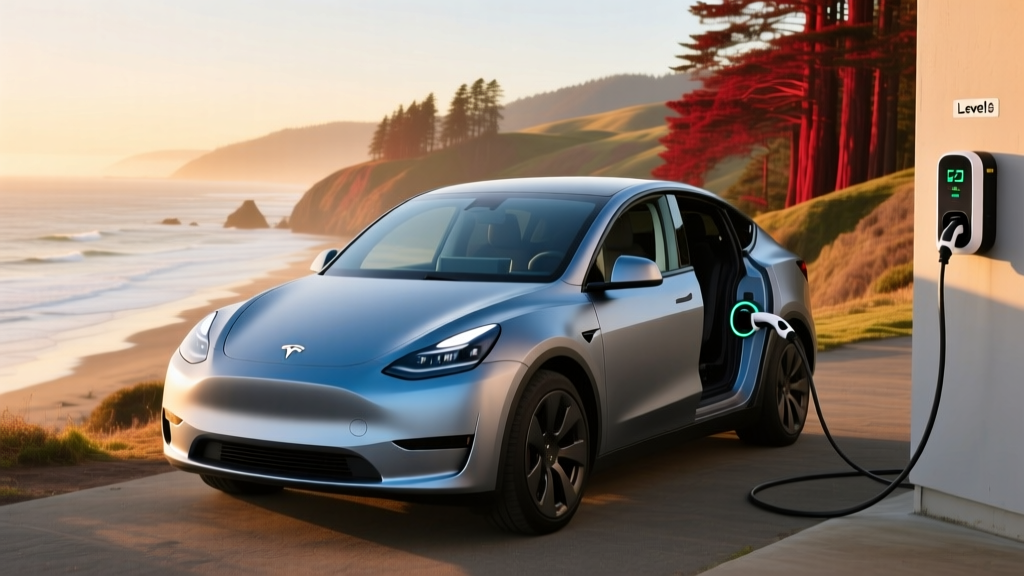
Home charging setup in your new state: A Level 2 home installation using the Tesla Wall Connector (or any J1772/NACS-compatible unit) on a 60A circuit delivers the full 11.5 kW / 44 mi/hr. Expect to pay $500–$1,500 for installation if your panel supports a 240V/60A circuit. Older homes in the South and Midwest may need a panel upgrade ($1,500–$3,500), so budget accordingly before you close on your new house.
Federal Tax Credit: Does the Model Y Qualify in 2026?
The §30D federal EV tax credit remains available for qualifying new EV purchases, but eligibility depends on MSRP caps, buyer income limits, and battery-sourcing requirements that shift annually. Here's what you need to know for the 2026 Model Y:
| Trim | MSRP | SUV MSRP Cap | §30D Eligible? | Est. After Credit |
|---|---|---|---|---|
| Long Range AWD | $44,990 | $80,000 | Partial* (check sourcing) | ~$37,490–$44,990 |
| Performance | $51,490 | $80,000 | Partial* (check sourcing) | ~$43,990–$51,490 |
Key §30D requirements for 2026 (per IRS.gov):
- MSRP cap: SUVs (including Model Y) must be priced at or below $80,000. Both trims qualify on price.
- Income cap: Modified AGI must not exceed $150,000 (single), $225,000 (head of household), or $300,000 (joint).
- Battery sourcing: Critical-minerals and battery-component requirements tighten each year. For 2026, a larger percentage must be sourced from the U.S. or free-trade-agreement partners. Tesla's Fremont and Austin-built Model Y batteries have historically met partial or full requirements, but final 2026 sourcing determinations are published by the IRS each January.
- Point-of-sale transfer: If eligible, you can transfer the credit to the dealer at purchase, reducing your out-of-pocket cost immediately rather than waiting for a tax refund.
California-specific incentive loss: If you're leaving California, you'll lose access to the state's Clean Vehicle Rebate Project (CVRP, up to $2,000 for income-qualified buyers), utility rebates (e.g., PG&E, SCE), and HOV lane stickers. Your new state may offer its own incentives — Texas, for instance, has no state EV rebate but no state income tax either. Colorado offers a state credit up to $5,000 for qualifying EVs. Research your destination state's DMV and energy office before purchasing.
Performance, Tech, and Daily Livability
The 2026 Model Y's dual-motor AWD powertrain delivers confident acceleration — 4.8 seconds to 60 mph for the Long Range, 3.5 seconds for the Performance. The Juniper refresh brought a quieter cabin (acoustic glass, improved seals), a more compliant suspension tune, and ambient interior lighting. The 15.4-inch center touchscreen handles navigation, climate, media, and vehicle settings. A rear 8-inch screen serves rear-seat passengers.
Driver assistance — SAE Level 2, not self-driving: Tesla's Autopilot comes standard and includes adaptive cruise control, lane-centering, and automatic emergency braking. Full Self-Driving (Supervised) adds automated lane changes, traffic-light recognition, and city-street navigation — but it remains an SAE Level 2 system. You must keep your hands on the wheel and eyes on the road at all times. This is not autonomous driving; it's an advanced driver-assist system. FSD costs $8,000 as a one-time purchase or $99/month as of 2026.
Cargo and passenger space: With 30.2 cu ft behind the second row and 72.1 cu ft with seats folded, the Model Y offers class-leading utility. The front trunk (frunk) adds 4.1 cu ft. Rear legroom is 40.5 inches — adequate for adults on long trips. The panoramic glass roof creates an airy cabin but contributes to heat soak in hot Southern states; the Juniper refresh added a power-retractable sunshade, which helps significantly.
Warranty: Tesla covers the Model Y's battery and drive unit for 8 years / 120,000 miles (Long Range) with a guaranteed minimum 70% capacity retention. The basic vehicle warranty is 4 years / 50,000 miles. This is competitive with the segment, though Hyundai's 10-year/100,000-mile powertrain warranty on the Ioniq 5 is longer.
Model Y vs. the Competition: Is It Still the Best Choice?
If you're leaving California and cross-shopping, here's how the Model Y stacks up against its main rivals:
| Spec | Tesla Model Y LR | Ford Mustang Mach-E ER AWD | Hyundai Ioniq 5 Long Range AWD |
|---|---|---|---|
| EPA Range | 320 mi | 305 mi | 290 mi |
| Battery | ~75 kWh NMC | ~88 kWh NMC | 84 kWh NMC |
| Peak DC Charge | 250 kW | 150 kW | 240 kW |
| 10–80% DC Time | ~25 min | ~38 min | ~18 min |
| Efficiency | 28 kWh/100mi | 33 kWh/100mi | 31 kWh/100mi |
| 0–60 mph | 4.8 sec | 5.1 sec | 5.0 sec |
| Base MSRP | $44,990 | $45,995 | $47,500 |
| Charging Network | Supercharger (native) | NACS adapter → Supercharger | NACS adapter → Supercharger |
Key takeaway: The Model Y's efficiency advantage (lowest kWh/100mi) translates to fewer charging stops and lower electricity costs per mile. The Ioniq 5 charges faster (18 vs. 25 minutes 10–80%), which matters on road trips. The Mach-E trails on charging speed but offers a more traditional dealership service experience — relevant if your new state has limited Tesla Service Centers.
Pros
- Best-in-class efficiency (28 kWh/100mi) means lower charging costs
- Supercharger network dominance in non-coastal states
- Class-leading cargo volume (72.1 cu ft)
- Strong over-the-air update cadence keeps the vehicle improving
- Competitive pricing at $44,990 base for Long Range AWD
Cons
- No physical buttons — all controls via touchscreen (wipers, glovebox, mirrors)
- Tesla Service Center availability limited in rural states
- FSD ($8,000) remains Level 2 — expensive for what it delivers
- Insurance premiums 15–30% higher than comparable gas SUVs in many states
- DC fast-charging speed (250 kW peak) trails the Ioniq 5's 800V architecture
Who Should Buy the Model Y When Leaving California?
- You're relocating to a state with limited non-Tesla public charging infrastructure (Texas, the South, rural Mountain West)
- You want the lowest per-mile electricity cost in the segment
- You need maximum cargo flexibility for a family or frequent moves
- You value OTA software updates and a minimal-dealership ownership model
- You want faster DC charging for frequent long road trips (consider the Ioniq 5)
- You prefer traditional dealership service and in-person support (consider Ford or Hyundai)
- You need three rows of seating (consider the Kia EV9 or Tesla Model X)
- Your new state has strong incentives for non-Tesla EVs that shift the value equation
Frequently Asked Questions
What is the real-world range of the 2026 Tesla Model Y?
The EPA rates it at 320 miles (Long Range AWD). In real-world highway driving at 75 mph, expect 255–280 miles in moderate weather, dropping to 210–240 miles in freezing conditions. City driving with regenerative braking can match or slightly exceed the EPA estimate.
How fast does the Model Y charge at home and on the road?
At home on a 240V Level 2 charger, it adds about 44 miles of range per hour (11.5 kW), fully recharging overnight in ~7–8 hours. On DC fast charging, it peaks at 250 kW and reaches 10–80% in approximately 25 minutes, though charging slows significantly above 80%.
How much does the Model Y cost after federal tax credits?
The Long Range AWD starts at $44,990. If you qualify for the full §30D credit ($7,500), your effective cost drops to ~$37,490. However, eligibility depends on income caps ($150K single / $300K joint), battery-sourcing rules, and the vehicle meeting 2026 critical-minerals requirements. Check the IRS clean vehicle credit page for current sourcing determinations.
Does the Model Y qualify for the federal EV tax credit in 2026?
It qualifies on MSRP (under the $80,000 SUV cap) and buyer income (if you meet thresholds). Battery-sourcing compliance varies by production batch and is updated annually by the IRS. As of early 2026, the Austin-built Model Y has historically met partial or full sourcing requirements, but confirm the specific VIN's eligibility at purchase via the IRS portal or your Tesla advisor.
Is the Model Y worth buying vs. the Mach-E or Ioniq 5 if I'm moving out of California?
If your new state has sparse non-Tesla charging infrastructure, the Model Y's Supercharger access is a decisive advantage. If you're moving to a metro area with good Electrify America or EVgo coverage (e.g., Denver, Atlanta), the Ioniq 5's faster charging and longer warranty become more compelling. Test the charging landscape in your destination city before committing.
Will I lose California HOV lane access and state rebates when I move?
Yes. California's Clean Air Vehicle decals and CVRP rebates are state-specific and do not transfer. Register your EV in your new state and research local incentives — some states (Colorado, Oregon, New York) offer their own credits, while others (Texas, Florida) do not but may have lower overall tax burdens.