Why Tesla Lease Takeovers Are Trending in 2026
With new-vehicle transaction prices hovering near $48,000 and Tesla periodically adjusting MSRPs on the Model 3 and Model Y, a Tesla lease takeover (technically a lease assumption or lease transfer) has become an attractive backdoor into EV ownership at below-market monthly payments. Platforms like Swapalease and LeaseTrader list dozens of Tesla leases at any given time, many with monthly payments locked in at 2024 or 2025 money factors that undercut current Tesla Financial Services lease quotes by $100–$250 per month.
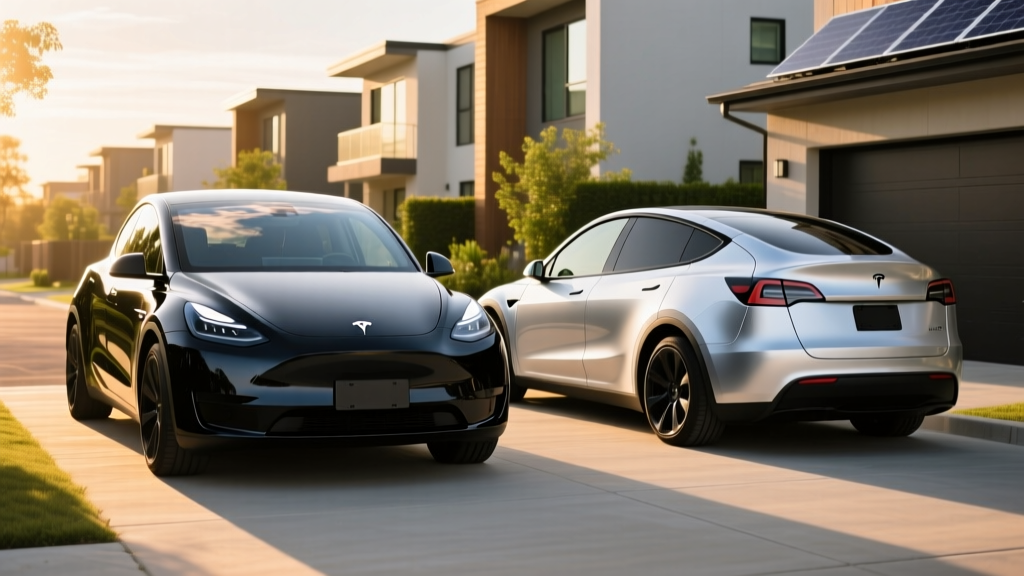
But assuming a Tesla lease is not the same as buying a used EV. You inherit the remaining term, the mileage allowance, the residual obligation, and — critically — the vehicle's battery state of health (SoH). This guide walks you through the real numbers behind the two most commonly transferred Tesla leases: the 2025–2026 Model Y Long Range AWD and the 2025–2026 Model 3 Long Range RWD, so you can evaluate whether a takeover makes financial sense.
Spec Snapshot: Model Y LR AWD vs. Model 3 LR RWD (2026 MY)
| Attribute | 2026 Model Y Long Range AWD | 2026 Model 3 Long Range RWD |
|---|---|---|
| EPA Range | 320 miles | 363 miles |
| Battery (usable) | ~78 kWh (NMC) | ~79 kWh (NMC) |
| Max DC Fast Charge | 250 kW (peak) | 250 kW (peak) |
| 10–80% DCFC Time | ~27 min | ~25 min |
| Level 2 Home Charge | 11.5 kW (~44 mi/hr) | 11.5 kW (~48 mi/hr) |
| 0–60 mph | 4.8 sec | 5.8 sec |
| Horsepower | 384 hp (dual motor) | 271 hp (single motor) |
| MPGe (combined) | 111 MPGe | 132 MPGe |
| kWh / 100 mi | 30 kWh | 25 kWh |
| Cargo Volume | 76 cu ft (seats folded) | 23 cu ft trunk + frunk |
| Rear Legroom | 41.6 in | 35.3 in |
| Base MSRP (2026) | $44,990 | $38,990 |
| Battery Warranty | 8 yr / 120,000 mi | 8 yr / 120,000 mi |
Source: fueleconomy.gov, Tesla spec sheets. Figures reflect 2026 model year.
Real-World Range: What the EPA Sticker Doesn't Tell You
Model 3 LR RWD: EPA 363 mi — expect ~295–320 mi highway; ~240–265 mi in freezing weather. The Model 3's superior efficiency (25 vs. 30 kWh/100 mi) gives it a meaningful real-world buffer.
When evaluating a Tesla lease takeover, check the remaining lease term against your typical annual mileage. Most Tesla leases are structured at 10,000 or 12,000 miles per year. Exceeding the allowance costs $0.20–$0.25 per mile at disposition — a 24-month takeover with 20,000 miles remaining and a 15,000-mile/year driver could trigger a $1,000–$1,500 overage penalty. Request the current odometer reading and original mileage allowance before committing.
Charging Speed and Infrastructure: The Supercharger Advantage
| Level | Power (kW) | Model Y LR (mi/hr added) | Model 3 LR (mi/hr added) |
|---|---|---|---|
| Level 1 (120V) | 1.4 kW | ~5 mi/hr | ~6 mi/hr |
| Level 2 (240V, 48A) | 11.5 kW | ~44 mi/hr | ~48 mi/hr |
| DC Fast (V3 Supercharger) | 250 kW peak | ~1,000 mi/hr (peak taper) | ~1,100 mi/hr (peak taper) |
Charging-curve reality: Both vehicles peak at 250 kW only in the 10–30% SoC window. From 30–60%, expect sustained rates of 130–170 kW; above 80%, the rate tapers sharply to ~40–60 kW. This is why Tesla quotes 10–80% times (~25–27 min) rather than 0–100%.
One ownership advantage of a Tesla lease takeover: full access to the Tesla Supercharger network, which as of 2026 has over 6,500 V3 and V4 stalls across the U.S. Non-Tesla EVs now access many Supercharger locations via the NACS standard, but Tesla vehicles still benefit from native plug-and-charge integration and automatic battery preconditioning when a Supercharger is set as the navigation destination. Preconditioning warms the pack to ~95°F for optimal charge acceptance — skipping it in cold weather can double your 10–80% time.
Pricing, Lease Economics, and the Federal Tax Credit Question
| Cost Factor | Model Y LR AWD | Model 3 LR RWD |
|---|---|---|
| 2026 Base MSRP | $44,990 | $38,990 |
| Typical Lease (36 mo / 12k mi/yr) — current | $499–$589/mo | $399–$479/mo |
| Takeover Listings (assumed 2024–2025 lease) | $349–$499/mo | $279–$399/mo |
| Federal §30D Credit (new purchase) | Up to $7,500* | Up to $7,500* |
| §30D on Lease Takeover? | No — credit belongs to the lessor (Tesla Financial Services), not the lessee assuming the lease | |
*§30D eligibility requires meeting IRS income caps ($150k single / $300k joint), MSRP caps ($55k sedans / $80k SUVs/trucks), and critical-mineral/battery-component sourcing rules per irs.gov. Always verify with a tax professional.
Critical tax-credit nuance: When you assume a Tesla lease, you are not the original purchaser. The §30D credit (if claimed at all) was applied by Tesla Financial Services at lease origination and is typically reflected in the capitalized cost reduction — meaning the lower monthly payment you see on a takeover listing may already incorporate the credit's benefit indirectly. You cannot claim the credit on your own tax return for a lease assumption. This is different from a purchase of a new Tesla, where the point-of-sale transfer option allows the buyer to apply the credit as a down-payment reduction.
Some sellers offer cash incentives ($500–$2,000) to attract takeover buyers — factor these into your effective monthly cost. A $449/mo Model Y lease with a $1,500 seller incentive and 18 months remaining effectively costs ($449 × 18 − $1,500) ÷ 18 = $366/mo.
Battery Health, Warranty Transfer, and What to Inspect
Tesla's battery and drive unit warranty — 8 years / 120,000 miles for Long Range models — transfers fully to subsequent owners and lessees. This is a significant advantage over third-party extended warranties. The warranty guarantees the battery will retain at least 70% of its original capacity during the coverage period.
Before assuming a Tesla lease, request the following:
- Odometer reading and remaining lease term — calculate your effective cost-per-mile
- Service history via the Tesla app — look for battery coolant service, drive unit replacements, or suspension work
- Tire condition — EVs wear tires 20–30% faster than ICE vehicles due to instant torque and heavier curb weight; a replacement set of Michelin Pilot Sport EV or Hankton iON tires runs $1,200–$1,800
- Accident history — request a Carfax; structural or battery-pack damage may void portions of the warranty
For battery State of Health, you can use third-party tools like Tessie or TeslaFi (if the seller grants access) to pull charge-logs and estimate degradation. A 2-year-old Model Y with 25,000 miles typically shows 3–6% degradation from its original range — well within normal parameters.
Tech, ADAS, and the Autopilot Licensing Question
Both the Model Y and Model 3 come standard with Basic Autopilot (Traffic-Aware Cruise Control and Autosteer). Enhanced Autopilot ($6,000 one-time or $99/mo) adds Auto Lane Change, Navigate on Autopilot, Autopark, and Summon. FSD (Supervised) is $8,000 one-time or $99/mo and adds city-street traffic light/stop sign recognition and autosteer on surface streets.
Lease-transfer gotcha: FSD purchased as a one-time license is tied to the vehicle's VIN and does transfer with a lease assumption. FSD subscribed monthly does not — the new lessee must activate their own subscription. Confirm with the seller whether FSD is a purchased license or an active subscription before assuming the lease.
The 2025–2026 Model 3 "Highland" refresh brought a significantly improved interior (ventilated seats, ambient lighting, rear touchscreen, improved NVH) and Hardware 4.0 cameras. The 2025–2026 Model Y "Juniper" refresh followed suit with similar interior upgrades, a front light bar, and revised suspension tuning. If the takeover listing is a pre-refresh (2023–2024) vehicle, expect a noticeably different cabin experience.
Pros and Cons of a Tesla Lease Takeover
Pros
- Monthly payments often $100–$250 below current market lease rates
- No down payment or acquisition fee (seller absorbs or waives)
- Supercharger network access with native preconditioning
- Battery/drive unit warranty fully transfers (8yr/120k mi)
- OTA software updates continue throughout lease term
- Short-term commitment (12–24 months remaining typical)
Cons
- Cannot claim §30D federal tax credit personally
- Mileage overage penalties ($0.20–$0.25/mi) add up fast
- No equity at lease end — you return the vehicle or buy at residual
- Tesla Financial Services transfer fee (~$400–$695)
- Limited ability to customize (wraps, wheels may violate lease terms)
- FSD subscription does not transfer; only purchased licenses do
Decision Framework: Is a Tesla Lease Takeover Right for You?
Choose a Tesla lease takeover if:
- You want a short-term EV commitment (12–24 months) to test EV ownership
- Your annual mileage fits within the remaining lease allowance
- You have reliable home Level 2 charging (or workplace charging)
- You value Supercharger access for road trips
- The effective monthly cost (after seller incentives) undercuts a new lease by ≥$100/mo
Choose a new purchase or new lease instead if:
- You qualify for the full $7,500 §30D credit and can apply it at point of sale
- You drive 15,000+ miles/year and need a high-mileage lease or purchase
- You want to build equity and keep the vehicle 5+ years
- You want the latest hardware refresh with full warranty runway ahead
Frequently Asked Questions
Does Tesla Financial Services allow lease transfers?
Yes. Tesla Financial Services permits third-party lease assumptions through a formal transfer process. Both the current lessee and the assuming party must apply and be credit-approved. The transfer fee is typically $400–$695, and the process takes 2–4 weeks.
Can I buy the Tesla at the end of an assumed lease?
Yes. Most Tesla leases include a purchase option at the stated residual value (often $25,000–$35,000 depending on model and term). You can exercise this at any point during the lease or at maturity. Compare the residual to current used-EV market values before committing — in a declining-price environment, the residual may exceed market value.
What happens if the battery degrades significantly during my assumed lease?
If capacity drops below 70% of original within the 8-year/120,000-mile warranty window, Tesla will repair or replace the battery at no cost. This warranty obligation transfers with the vehicle regardless of ownership changes.
Do I need gap insurance on a lease takeover?
Tesla Financial Services leases typically include gap protection, which covers the difference between the vehicle's actual cash value and the remaining lease obligation in the event of a total loss. Confirm this with TFS before finalizing the transfer.
How do I find Tesla lease takeovers?
Popular platforms include Swapalease, LeaseTrader, and EV-specific forums (Tesla Motors Club, Reddit r/teslamotors). Always verify the listing's legitimacy by cross-referencing the VIN and confirming the lease details directly with Tesla Financial Services before sending any money.
What are the biggest competitors to consider instead?
At similar effective monthly costs, consider a new lease on the Hyundai Ioniq 5 (EPA 318 mi, 800V architecture, 10–80% in ~18 min), the Ford Mustang Mach-E Extended Range (EPA 320 mi), or the Chevrolet Equinox EV (EPA 319 mi, lower MSRP). Each qualifies for §30D on a new purchase, though lease credit passthrough varies by manufacturer.
Safety data: Both the Model Y and Model 3 earned NHTSA 5-Star Overall Safety Ratings and IIHS Top Safety Pick+ (when equipped with acceptable headlights). Always verify the specific model year's ratings at iihs.org.