Why a Tesla Lease Calculator Matters More Than Ever
If you've typed "tesla lease calculator" into a search bar recently, you're not alone. Tesla's shifting prices, evolving federal tax credit rules under IRS §30D, and the introduction of refreshed Model 3 and Model Y variants for 2026 make the lease-vs-buy decision genuinely complex. Leasing a Tesla can sometimes unlock savings that outright purchasing cannot — particularly when Tesla passes the $7,500 federal EV tax credit through as a lease incentive, bypassing buyer income caps and battery-sourcing restrictions that apply to purchases.
This guide breaks down the real numbers behind leasing a 2026 Tesla Model Y or Model 3 — including EPA range, charging speeds, battery chemistry, and total monthly cost — so you can run your own Tesla lease calculation with confidence.
2026 Tesla Model Y: Specs, Range, and Real-World Efficiency
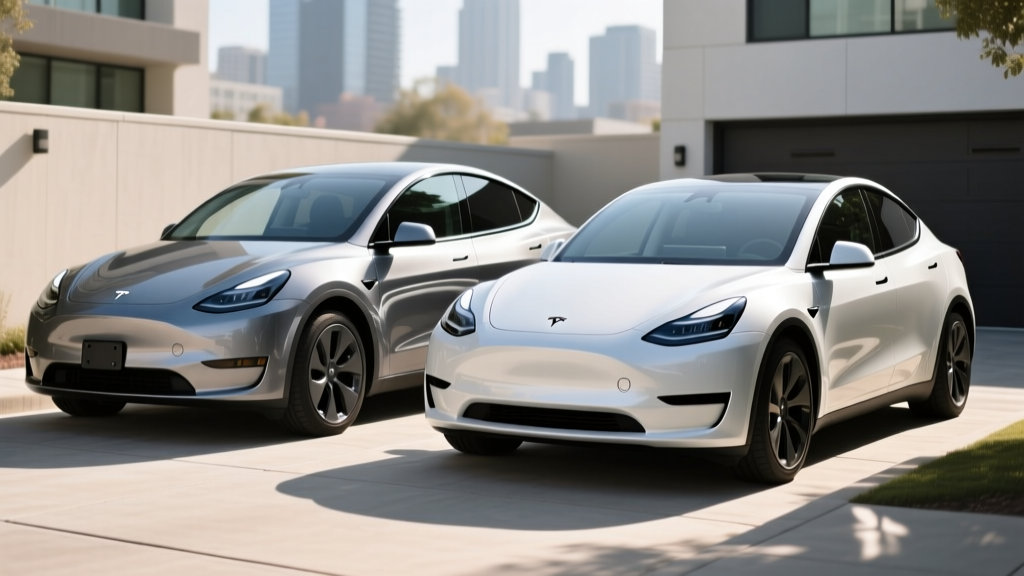
The 2026 Tesla Model Y remains the best-selling EV in the U.S. and one of the most leased. Here's what the numbers actually look like across the current lineup:
| Spec | Long Range AWD | Performance |
|---|---|---|
| EPA Range | 320 miles | 293 miles |
| Battery (usable) | ~75 kWh, NMC | ~75 kWh, NMC |
| Drivetrain | Dual-Motor AWD | Dual-Motor AWD |
| Horsepower | 384 hp | 510 hp |
| 0-60 mph | 4.8 sec | 3.5 sec |
| Max DC Fast Charge | 250 kW | 250 kW |
| 10-80% DC Time | ~27 min | ~27 min |
| Level 2 Home Charge | 11.5 kW (~44 mi/hr) | 11.5 kW (~44 mi/hr) |
| MPGe (combined) | 122 MPGe | 111 MPGe |
| Efficiency | 28 kWh/100 mi | 30 kWh/100 mi |
| Cargo Volume | 72 cu ft (rear seats folded) | 72 cu ft |
| Rear Legroom | 41.6 in | 41.6 in |
| Battery Warranty | 8 yr / 120,000 mi | 8 yr / 120,000 mi |
| Base MSRP | $46,630 | $52,130 |
2026 Tesla Model 3: The Sedan Alternative
The refreshed Model 3 ("Highland" and subsequent updates) continues as Tesla's entry point and a popular lease target for commuters:
| Spec | RWD | Long Range AWD | Performance |
|---|---|---|---|
| EPA Range | 272 miles | 341 miles | 315 miles |
| Battery (usable) | ~57.5 kWh, LFP | ~75 kWh, NMC | ~75 kWh, NMC |
| Drivetrain | Rear-Wheel Drive | Dual-Motor AWD | Dual-Motor AWD |
| Horsepower | 271 hp | 346 hp | 510 hp |
| 0-60 mph | 5.8 sec | 4.2 sec | 2.9 sec |
| Max DC Fast Charge | 170 kW | 250 kW | 250 kW |
| 10-80% DC Time | ~30 min | ~27 min | ~27 min |
| Level 2 Home Charge | 11 kW (~37 mi/hr) | 11.5 kW (~44 mi/hr) | 11.5 kW (~44 mi/hr) |
| MPGe (combined) | 132 MPGe | 125 MPGe | 113 MPGe |
| Cargo Volume | 23 cu ft (trunk + frunk) | 23 cu ft | 23 cu ft |
| Base MSRP | $39,130 | $46,630 | $54,130 |
Battery chemistry note: The Model 3 RWD uses a lithium iron phosphate (LFP) battery, which Tesla recommends charging to 100% regularly. LFP offers slower degradation over time but lower energy density — meaning less range per kilogram. The Long Range and Performance trims use nickel-manganese-cobalt (NMC) chemistry, better suited for frequent DC fast charging and offering higher range, but Tesla recommends daily charging to 80% for longevity. See fueleconomy.gov for official EPA data.
How the Tesla Lease Calculator Actually Works
When you use Tesla's online configurator or a third-party lease calculator, several variables determine your monthly payment. Here's the anatomy of a Tesla lease:
Key Lease Variables
- Capitalized Cost (Cap Cost): The negotiated vehicle price. Tesla rarely negotiates, so cap cost typically equals MSRP minus any lease incentive.
- Residual Value: The projected value at lease end, set by Tesla Finance. Higher residual = lower monthly payment. Tesla residuals tend to be conservative, which can make leases slightly more expensive than some competitors.
- Money Factor: The lease equivalent of an interest rate. Multiply by 2,400 to get the approximate APR. Tesla's money factors in early 2026 have hovered around 0.0025-0.0030 (roughly 6.0-7.2% APR equivalent).
- Lease Term: Typically 24 or 36 months for Tesla.
- Annual Mileage: Standard Tesla leases allow 10,000 or 12,000 miles/year. Excess mileage costs $0.20-$0.25/mile.
- Down Payment (Cap Cost Reduction): Putting money down lowers monthly payments but is at risk if the car is totaled early.
Sample Lease Calculation: 2026 Model Y Long Range
| Variable | Value |
|---|---|
| MSRP | $46,630 |
| Tesla Lease Incentive (passed-through credit) | -$7,500 |
| Adjusted Cap Cost | $39,130 |
| Residual (60% at 36 mo / 10k mi) | $27,978 |
| Depreciation over 36 months | $11,152 |
| Monthly Depreciation | $310 |
| Monthly Finance Charge (MF 0.0028) | ~$188 |
| Estimated Monthly Payment (pre-tax) | ~$498 |
Note: Actual payments vary by state taxes, fees, acquisition fee (~$695), and disposition fee at lease end (~$395). This is an estimate for educational purposes.
The $7,500 Lease Loophole: Why Leasing Can Beat Buying
Under IRS §30D, purchasing a new EV for the federal tax credit requires meeting several conditions: buyer income caps ($150,000 single / $300,000 joint), MSRP caps ($55,000 sedans / $80,000 SUVs and trucks), and critical mineral plus battery component sourcing requirements that shift annually.
However, when you lease a Tesla, the lessor (Tesla Finance) is the entity purchasing the vehicle. The commercial clean vehicle credit under §45W can be claimed by the lessor, who may pass the savings to you as a "lease incentive" or cap cost reduction. This effectively sidesteps:
- Buyer income limitations
- Battery sourcing and critical mineral requirements
- The point-of-sale transfer complexity
- ✔ Buyer AGI under $150K (single) or $300K (joint)
- ✔ Vehicle MSRP under $80K (SUV/truck) or $55K (sedan)
- ✔ Battery meets critical mineral and component sourcing thresholds (percentages increase yearly)
- ✔ Vehicle assembled in North America
- ✔ Vehicle is for personal use, primarily in the U.S.
Charging Speed: What You Need to Know Before You Lease
Charging speed is one of the most consequential specs for daily EV ownership — and one that lease calculators never show you. Here's how Tesla's charging ecosystem breaks down:
| Charging Level | Power (kW) | Miles Added per Hour | Typical Use Case |
|---|---|---|---|
| Level 1 (120V outlet) | 1.4 kW | ~5 mi/hr | Emergency / overnight trickle |
| Level 2 (240V home, 48A) | 11.5 kW | ~44 mi/hr | Daily home charging |
| DC Fast (Supercharger V3) | Up to 250 kW | ~1,000 mi/hr (peak) | Road trips, 10-80% in ~27 min |
| DC Fast (Supercharger V4) | Up to 350 kW (future) | TBD | Next-gen stations, limited availability |
The charging curve reality: A 250 kW peak rate does not mean you charge at 250 kW for the entire session. Tesla's charge curve peaks around 15-20% state of charge and tapers progressively. By 50% SoC, you're typically at 150-180 kW. Above 80%, speeds drop sharply to protect battery health — which is why 10-80% is the standard metric. Plan road-trip stops around 15-25 minute sessions, not the theoretical minimum.
Tesla's Supercharger network — now open to other EV brands via NACS adapters — remains the most reliable public charging infrastructure in the U.S., with over 6,000 stations and 65,000+ connectors nationwide. See Tesla's Supercharger page for network details.
Pros
- Access to Supercharger network — most reliable DC charging in the U.S.
- Over-the-air updates continuously add features
- Class-leading efficiency (kWh/100mi) across trims
- Strong lease incentive potential via §45W pass-through
- Minimal maintenance costs (no oil, spark plugs, transmission fluid)
- Autopilot standard; excellent active safety
Cons
- No physical controls — everything via touchscreen (turn signals, wipers, glovebox)
- Build quality still inconsistent panel-gap-wise vs. German/Korean rivals
- FSD (Supervised) remains SAE Level 2 — requires full driver attention
- Lease residuals can be conservative, raising monthly cost
- Insurance premiums 15-30% higher than comparable gas vehicles
- No Apple CarPlay or Android Auto support
Tech, Driver Assistance, and What's Standard
Every 2026 Tesla comes with Autopilot (SAE Level 2 driver assistance) as standard equipment. This includes adaptive cruise control, lane-keeping, and automatic emergency braking. Tesla's Full Self-Driving (Supervised) package — currently $8,000 to purchase or $99/month — adds automated lane changes, city street navigation, and traffic-light recognition, but it remains a Level 2 system requiring constant driver supervision.
The infotainment system runs on Tesla's proprietary software with a 15.4-inch center display (Model Y/Model 3), integrated navigation, streaming apps, and a mobile companion app for remote preconditioning, location tracking, and charge monitoring. The Model 3 Highland refresh introduced ventilated front seats, ambient lighting, rear-seat touchscreen, and improved cabin noise isolation.
Who Should Lease a Tesla — and Who Shouldn't
Choose a Tesla Lease If:
- You drive 10,000-12,000 miles/year or less (lease mileage fits your habits)
- Your household income exceeds §30D purchase caps, but you want the $7,500 lease incentive
- You want the lowest-risk way to experience EV ownership before committing long-term
- You have reliable home Level 2 charging access (garage or driveway with 240V)
- You value the Supercharger network for road trips
- You prefer upgrading technology every 3 years
Consider Buying (or a Competitor) If:
- You drive 15,000+ miles/year — excess mileage penalties add up fast
- You want to build equity and keep the car 6-10+ years
- You qualify for the full §30D purchase credit and want ownership flexibility
- You want physical buttons, CarPlay, or a more traditional interior (consider Hyundai Ioniq 5 or BMW i4)
- You need a vehicle for heavy towing (Model Y: 3,500 lb max — adequate for light trailers only)
Frequently Asked Questions
What is the real-world range of the 2026 Tesla Model Y?
The Model Y Long Range AWD carries a 320-mile EPA estimate. In real-world highway driving at 70+ mph, expect 265-285 miles. In freezing temperatures, plan for 240-270 miles. The Model 3 Long Range achieves 341 miles EPA and roughly 280-300 miles real-world highway.
How fast does a Tesla charge at home and on the road?
At home on a 240V Level 2 charger (48 amps), the Model Y adds approximately 44 miles of range per hour — a full overnight session (8 hours) restores roughly 350 miles, more than enough for any daily commute. On a V3 Supercharger at 250 kW peak, 10-80% takes about 27 minutes. The Model 3 RWD tops out at 170 kW DC, making its 10-80% time closer to 30 minutes.
How much does a Tesla lease cost after incentives?
Based on current estimates, a 2026 Model Y Long Range can lease for approximately $450-550/month on a 36-month term with $3,000-$4,500 due at signing, factoring in a $7,500 lease incentive. The Model 3 RWD can be as low as $329-399/month depending on Tesla's current promotional offers. Tesla periodically runs lease specials that undercut these estimates significantly.
Does a leased Tesla qualify for the federal EV tax credit?
Not directly to you as the lessee. Under §30D, the credit applies to the purchaser — which in a lease is Tesla Finance (the lessor). Tesla typically passes this benefit through as a lease incentive (cap cost reduction). This means lessees can benefit regardless of personal income level or the battery-sourcing requirements that restrict purchase credits. Always verify current incentive pass-through with Tesla at the time of signing.
Is leasing a Tesla worth it vs. buying or choosing a competitor?
Leasing makes sense if you want to lock in the incentive without worrying about §30D eligibility, prefer predictable monthly costs, and plan to upgrade in 3 years. Buying is better if you drive high mileage, want to customize, or plan to keep the vehicle 5+ years. Against competitors like the Hyundai Ioniq 5 (318 mi EPA, 350 kW max charging on 800V architecture) or the Ford Mustang Mach-E (320 mi EPA, more traditional interior), Tesla's Supercharger network and efficiency remain decisive advantages, while rivals offer better build quality and physical controls.
What's the battery warranty on a leased Tesla?
Tesla covers the battery and drive unit for 8 years or 120,000 miles (Long Range/Performance) or 8 years / 100,000 miles (RWD), whichever comes first, with a minimum 70% capacity retention guarantee. Since most leases run 36 months and 30,000-36,000 miles, the battery warranty far exceeds the lease term — degradation risk is effectively zero during your lease.
Sources: fueleconomy.gov (EPA range and efficiency data), IRS §30D and §45W credit rules, Tesla.com (manufacturer specifications). Tax credit and incentive rules are subject to change; consult a tax professional for eligibility.