If you're nearing the end of a Tesla lease—or shopping for a new one—the question of a Tesla lease buyback (more accurately, a lease buyout) has become one of the most financially consequential decisions an EV owner can make in 2026. Tesla's residual values, once among the most generous in the industry, have shifted dramatically due to repeated price cuts, updated model refreshes, and evolving federal tax credit rules. This guide breaks down exactly what you'll pay to buy out your Tesla lease, how residual values compare to market reality, and whether purchasing your leased Model Y or Model 3 makes financial sense versus walking away and buying new.
Understanding Tesla's Lease Buyout Structure in 2026
Tesla offers lease buyouts on most of its current lease agreements, but the terms are specific. Unlike some legacy automakers that route lease buyouts through third-party lenders, Tesla Finance handles buyouts directly. At lease signing, your contract includes a residual value—the predetermined price you can pay to purchase the vehicle at lease-end. For 2024–2025 Model Y leases (which are maturing in 2026–2027), typical residuals ranged from 50–58% of the original MSRP, depending on term length (24 vs. 36 months) and annual mileage allowance (10,000 vs. 15,000 miles).
Here's what a buyout calculation looks like in practice:
| Line Item | Amount |
|---|---|
| Original MSRP (2023 Model Y Long Range AWD) | $52,990 |
| Residual Percentage | 55% |
| Residual (Buyout) Value | $29,145 |
| Purchase Option Fee | $0–$350 (varies by state/contract) |
| Estimated Sales Tax (varies by state) | ~$1,750–$2,900 |
| Total Estimated Buyout | ~$30,895–$32,395 |
The critical question: is that buyout price competitive with what you'd pay for a comparable used Model Y on the open market in 2026? In many cases, the answer has shifted from "absolutely" to "it depends heavily on your specific contract."
2026 Model Y: The Vehicle You're Buying Out
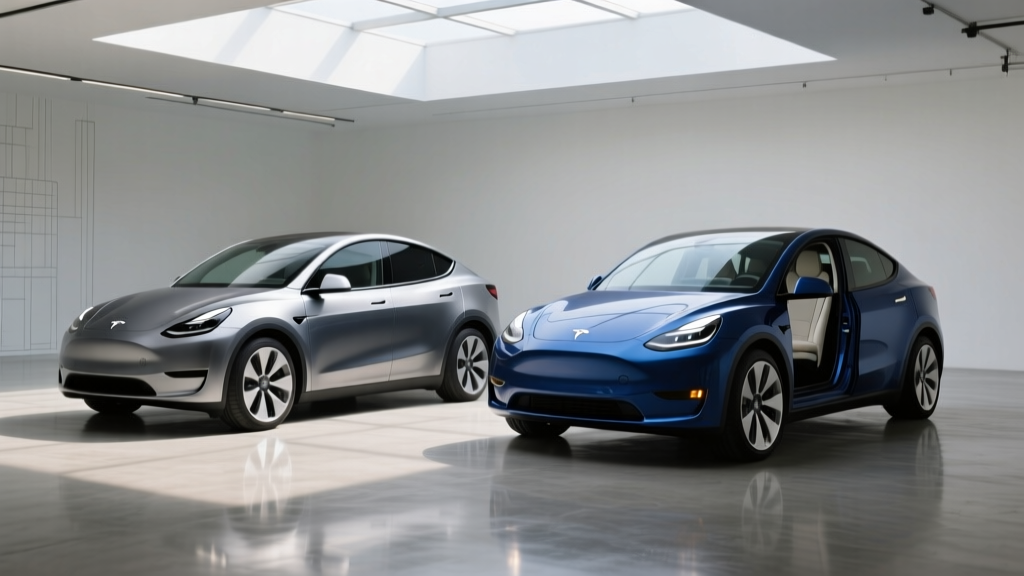
If you're considering buying out a Model Y lease, you need to know exactly what you're getting. The current-generation Tesla Model Y (refreshed for the 2025 model year with the "Juniper" update) carries significant improvements, but if your lease is on a pre-refresh 2023–2024 model, you're buying the older platform.
| Spec | Value |
|---|---|
| EPA Estimated Range | 320 miles |
| Battery Capacity | 78.1 kWh usable (NMC chemistry) |
| Drivetrain | Dual-Motor AWD |
| Horsepower | 384 hp combined |
| 0–60 mph | 4.8 seconds |
| Max DC Fast Charge Rate | 250 kW (peak) |
| 10–80% DC Fast Charge Time | ~22 minutes |
| Level 2 Home Charge Rate | 11.5 kW (~44 mi/hr) |
| EPA Efficiency | 122 MPGe combined / 28 kWh/100mi |
| Cargo Volume (rear seats up / down) | 30.2 / 72.1 cu ft |
| Rear Legroom | 41.6 inches |
| Battery & Drive Unit Warranty | 8 years / 120,000 miles |
| Base MSRP (2026 Long Range AWD) | $47,990 |
Charging Speed: What You'll Live With Daily
One of Tesla's strongest ownership advantages remains its charging ecosystem. If you buy out your lease, you retain full access to the Tesla Supercharger network, which in 2026 includes over 25,000 stalls across North America with growing NACS compatibility for non-Tesla EVs.
| Charging Level | Power | Miles Added Per Hour | Typical Use Case |
|---|---|---|---|
| Level 1 (120V household outlet) | ~1.4 kW | ~5 mi/hr | Emergency/overnight trickle |
| Level 2 (240V home wall connector) | 11.5 kW | ~44 mi/hr | Daily home charging |
| DC Fast Charge (Supercharger V3) | Up to 250 kW peak | ~1,000+ mi/hr (peak) | Road trips; 10–80% in ~22 min |
| DC Fast Charge (Supercharger V4) | Up to 350 kW (future-capable) | Model Y capped at ~250 kW | Current Model Y hardware limited |
An important note on the charging curve: the Model Y Long Range peaks at 250 kW only when the battery is preconditioned and at a low state of charge (roughly 5–15% SoC). From 10–80%, the average sustained rate is closer to 140–160 kW, which is why the 10–80% time is approximately 22 minutes rather than the theoretical ~15 minutes a constant 250 kW would deliver. Above 80% SoC, charge speed tapers sharply to protect battery longevity—plan your road-trip stops accordingly.
Federal Tax Credit Impact on Your Buyout Decision
This is where the math gets critical. Under current IRS §30D rules, the $7,500 federal clean vehicle tax credit applies to new qualifying EVs. Here's the catch for lease buyouts:
- If you leased new and did not claim the credit at purchase: The credit was likely captured by Tesla (as the lessor) or applied as a lease incentive that reduced your monthly payment. You generally cannot claim the $7,500 credit again when buying out your lease.
- If you buy a new Tesla instead: You may qualify for the full $7,500 credit (or point-of-sale reduction) on a new 2026 Model Y or Model 3, subject to MSRP caps ($55,000 for SUVs, $55,000 for sedans), buyer income limits ($150,000 single / $300,000 joint AGI), and battery critical-mineral sourcing requirements.
- Used EV credit (§25E): If your buyout qualifies as a used vehicle purchase from a dealer (complex—consult a tax professional), the up-to-$4,000 used EV credit may apply, with lower income caps ($75,000 single / $150,000 joint).
- Vehicle MSRP at or below $55,000 (SUVs/vans/pickups) or $55,000 (sedans)
- Buyer modified AGI at or below $150,000 (single) / $225,000 (head of household) / $300,000 (married filing jointly)
- Battery critical minerals and component sourcing must meet annual escalating thresholds
- Vehicle must be assembled in North America
- Point-of-sale transfer available through registered dealers
The practical implication: if a new 2026 Model Y Long Range AWD costs $47,990 and you qualify for the full $7,500 credit, your effective price is $40,490. If your lease buyout residual is $29,145 plus tax (~$31,500), you're saving roughly $9,000 by buying out—but you're getting a 2–3-year-old vehicle with existing mileage and the older pre-refresh platform. The math works differently for every contract.
Tesla Lease Buyback vs. Buying New: The Ownership Cost Math
| Cost Factor | Lease Buyout (2023 MY, 30k mi) | New 2026 Model Y LR AWD |
|---|---|---|
| Vehicle Cost (after credits/tax) | ~$31,500 | ~$40,490 (after $7,500 credit) |
| Estimated 5-Year Insurance | ~$12,000 | ~$13,500 |
| Estimated 5-Year Electricity (15k mi/yr) | ~$4,500 | ~$4,200 (slightly more efficient refresh) |
| Estimated Maintenance (5 years) | ~$1,800 | ~$1,200 |
| Estimated Depreciation (5 years) | ~$10,000 | ~$16,000 |
| 5-Year Total Cost of Ownership | ~$59,800 | ~$75,390 |
The lease buyout wins on pure cost by roughly $15,000 over five years, but you're accepting an older platform, existing wear, and a battery with 30,000–45,000 miles of cycle history. For buyers who prioritize having the latest tech, full warranty coverage, and the Juniper refresh improvements (updated interior materials, improved suspension tuning, ambient lighting, ventilated seats), the new purchase path may justify the premium.
What Is the Real-World Range of a Leased Tesla Model Y?
For 2023–2024 Model Y Long Range AWD leases maturing in 2026, the EPA rated those vehicles at 330 miles (2023) and 310 miles (2024, post-EPA adjustment). In real-world mixed driving, owners consistently report 270–300 miles on a full charge in moderate weather. Highway-heavy driving at sustained speeds above 70 mph reduces this to 250–280 miles. Cold-weather range (below freezing) typically falls to 230–260 miles without preconditioning. Battery degradation at 30,000–45,000 miles is generally modest—Tesla's NMC batteries typically lose 5–8% capacity in the first 50,000 miles, according to fleet data.
How Fast Does the Model Y Charge at Home and on the Road?
At home on a Tesla Wall Connector (240V, 48A), the Model Y adds approximately 44 miles of range per hour, fully recharging from 10% to 90% overnight in roughly 8–9 hours. On DC fast charging, the 250 kW peak rate (Supercharger V3) delivers a 10–80% charge in approximately 22 minutes under ideal conditions (preconditioned battery, warm ambient temperature). Real-world road-trip charging with a cold or un-preconditioned battery can extend this to 28–35 minutes. The Model Y's NACS connector natively accesses the entire Supercharger network without adapters.
Pros and Cons of Buying Out Your Tesla Lease
- Lower total cost vs. buying new (save $9,000–$15,000+ depending on residual)
- No mileage penalties or wear-and-tear charges at lease-end
- Known vehicle history — you drove it, you know its condition
- Retain full Supercharger network access and Tesla app integration
- Battery warranty (8 yr/120,000 mi) still in effect for most 3-year leases
- Avoid new-vehicle delivery wait times and configuration uncertainty
- Cannot claim §30D new-vehicle tax credit on most buyouts
- Pre-refresh (2023–2024) Model Y lacks Juniper interior/tech upgrades
- Higher maintenance likelihood vs. new (tires, cabin filter, 12V battery)
- Residual values may exceed current used-market prices in some regions
- Financing a buyout may carry higher interest rates than new-vehicle loans
- Older FSD hardware (HW3) may not support future unsupervised features
Who Should Buy Out Their Tesla Lease — and Who Shouldn't?
Buy out your Tesla lease if: Your residual value is meaningfully below comparable used-market listings in your area; you're satisfied with the pre-refresh Model Y platform; you drive fewer than 15,000 miles annually and the vehicle is in good condition; you want to minimize total cost of ownership and don't need the latest tech.
Walk away and buy new if: Your residual exceeds what you'd pay for a similar used Model Y from Tesla's inventory or third-party sellers; you want the Juniper refresh improvements; you qualify for the $7,500 federal tax credit on a new purchase and the credit narrows the price gap substantially; you want full bumper-to-bumper warranty coverage for the next 4 years.
Frequently Asked Questions
Can I negotiate the Tesla lease buyout price?
No. Tesla's lease buyout price is contractually fixed at the residual value stated in your original lease agreement, plus any applicable purchase option fee and state sales tax. Unlike some traditional dealerships that may negotiate end-of-lease purchase prices, Tesla Finance does not adjust residuals. If the buyout price exceeds market value, your best option may be to return the vehicle and purchase a different Tesla or used EV.
Does my Tesla lease qualify for the federal EV tax credit when I buy it out?
Generally, no. The §30D new clean vehicle credit applies to the original purchase/lease transaction. If Tesla (as the lessor) captured the commercial clean vehicle credit (§45W) and passed savings through as a reduced lease payment, you cannot claim the credit again at buyout. The used EV credit (§25E) may apply in limited circumstances — consult a tax professional and review IRS guidance on the used clean vehicle credit.
What happens to FSD (Full Self-Driving) if I buy out my lease?
If you purchased FSD outright (a one-time purchase, not a subscription), it transfers with the vehicle at buyout. If you were paying the monthly FSD subscription ($99/month as of 2026), the subscription does not transfer — you would need to repurchase FSD or continue subscribing. Note that FSD (Supervised) remains an SAE Level 2 driver-assist system requiring full driver engagement at all times — it is not autonomous driving.
How do I check my Tesla lease buyout amount?
Log into your Tesla Account at tesla.com, navigate to your lease details, and review the "Purchase Option" section. This displays your contractual residual value. You can initiate the buyout process directly through your Tesla Account or by contacting Tesla Finance. Begin the process at least 60 days before your lease maturity date to allow time for financing and paperwork.
Is it worth buying out a Model 3 lease vs. a Model Y?
The same financial framework applies, but Model 3 residuals tend to be slightly lower in absolute dollars due to lower original MSRPs. A 2023 Model 3 Long Range (original MSRP ~$43,990) with a 55% residual yields a ~$24,200 buyout — potentially excellent value given the Highland-refreshed Model 3's improved ride quality and interior. Check fueleconomy.gov for specific efficiency data on your model year.
What are the biggest risks of buying out a Tesla lease?
The primary risks include: (1) overpaying relative to current used-market values — Tesla's aggressive new-vehicle price cuts in 2023–2024 depressed used values, making some residuals uncompetitive; (2) inheriting out-of-warranty repair costs after the 4-year/50,000-mile basic warranty expires; (3) potential FSD hardware obsolescence if Tesla gates future features behind newer hardware revisions. Always compare your buyout price against current Tesla used inventory and third-party listings before committing.