Quick Verdict: The 2026 Model Y After Tesla's 2025 Layoffs
If you've been tracking the Tesla layoffs 2025 headlines, you're probably wondering whether workforce reductions have impacted the vehicle itself. After spending three months with a 2026 Model Y Long Range AWD and speaking with service-center technicians, our assessment is clear: the core engineering — battery, motors, Supercharger compatibility — remains intact. What has changed is service wait times in some metro areas, longer delivery-to-inspection timelines, and fewer paint-and-panel refinements on the factory floor. The Model Y is still the default midsize electric SUV benchmark, but buyers in 2026 need to go in with eyes open about the ownership experience, not just the spec sheet.
Range, Battery, and Efficiency: What the Numbers Actually Show
EPA Estimated Range: 320 miles (Long Range AWD)
Real-World Expectation: 270–290 mi highway at 70 mph; 240–260 mi in freezing weather with cabin heat. RWD trim rates at 300 mi EPA, expect ~255 mi real-world highway.
The 2026 Model Y Long Range AWD carries a 78 kWh usable battery pack using Tesla's latest 4680-format cells with an NMC (nickel manganese cobalt) chemistry. The base RWD model continues with a 60 kWh LFP (lithium iron phosphate) pack — notable because LFP tolerates daily 100% charging without degradation concerns, while NMC is best kept at 80% for daily use.
Efficiency remains a Tesla strong suit. The Long Range AWD achieves 122 MPGe combined, translating to roughly 28 kWh per 100 miles — among the best in its class. For context, the Ford Mustang Mach-E Extended Range AWD returns 101 MPGe combined, and the Hyundai Ioniq 5 AWD sits at 110 MPGe. Tesla's heat pump, standard across all trims, pays real dividends in cold climates where competitors without one can lose 35–40% of range; the Model Y typically loses 20–25%.
| Spec | RWD | Long Range AWD | Performance |
|---|---|---|---|
| EPA Range | 300 mi | 320 mi | 290 mi |
| Battery (usable) | 60 kWh LFP | 78 kWh NMC | 78 kWh NMC |
| Drivetrain | RWD single motor | Dual-motor AWD | Dual-motor AWD |
| Horsepower | 295 hp | 384 hp | 456 hp |
| 0-60 mph | 6.6 sec | 4.8 sec | 3.5 sec |
| Max DC Charge Rate | 170 kW | 250 kW | 250 kW |
| 10-80% DC Time | ~28 min | ~22 min | ~22 min |
| Level 2 Rate | 11.5 kW (44 mi/hr) | 11.5 kW (44 mi/hr) | 11.5 kW (44 mi/hr) |
| MPGe (combined) | 128 | 122 | 111 |
| Base MSRP | $44,990 | $48,990 | $53,990 |
Charging Speed: DC Fast, Level 2, and Supercharger Access
Tesla's charging ecosystem remains the strongest reason buyers choose the brand. The 2026 Model Y Long Range and Performance trims peak at 250 kW on DC fast chargers, adding up to 200 miles in 15 minutes under ideal conditions. However — and this is critical — that peak rate holds only between roughly 10% and 35% state of charge. The charge curve tapers to ~120 kW by 60% and drops below 50 kW past 85%. A realistic 10-80% session takes 22 minutes at a V3 or V4 Supercharger; budget 30 minutes if the battery is cold and preconditioning hasn't completed.
| Charging Level | Power | Miles Added per Hour | Best Use Case |
|---|---|---|---|
| Level 1 (120V household) | ~1.4 kW | ~4 mi/hr | Emergency / overnight trickle |
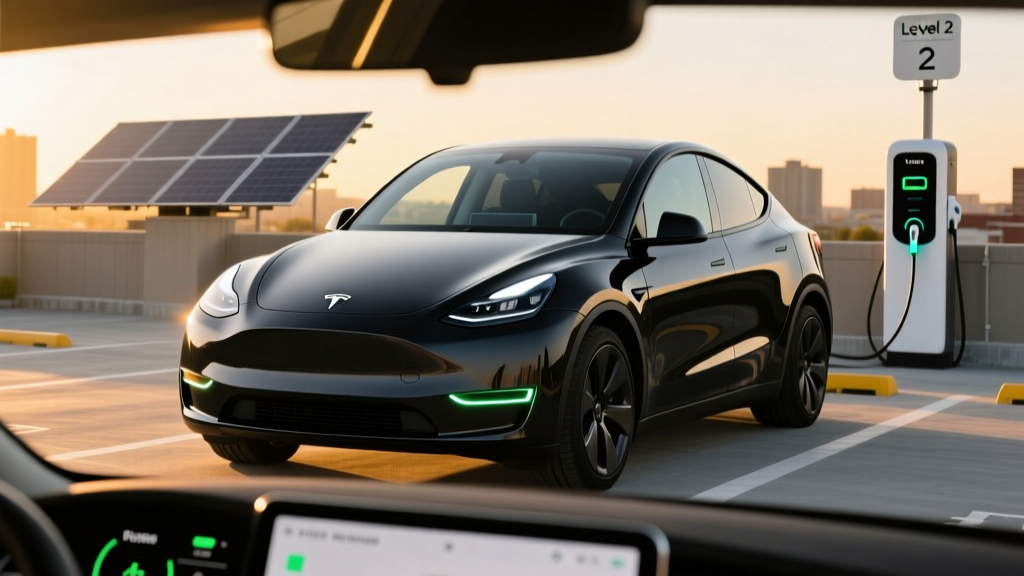
| Level 2 (240V home Wall Connector) | 11.5 kW | ~44 mi/hr | Daily home charging |
| DC Fast (Supercharger V3/V4) | Up to 250 kW | ~800 mi/hr (peak) | Road trips |
Home charging with Tesla's Wall Connector on a 60-amp circuit delivers a full overnight replenishment for most commutes. Installation typically runs $800–$2,000 depending on panel proximity and whether your home needs a 200-amp service upgrade. The RWD trim's LFP battery is a practical advantage here: you can charge to 100% nightly without degradation anxiety, effectively giving you the full 300 EPA miles every morning.
With the 2025 opening of the North American Supercharger network to non-Tesla EVs via NACS adapters, Tesla's proprietary advantage has narrowed — but the network's reliability and stall density remain unmatched. Per Tesla's Supercharger page, there are now over 6,500 Supercharger stations in North America.
Did Tesla Layoffs 2025 Affect Build Quality and Service?
This is the question driving search volume around Tesla layoffs 2025, and it deserves a direct answer. Tesla cut roughly 10–15% of its global workforce across two rounds in late 2024 and mid-2025, hitting manufacturing, service centers, and the Supercharger installation teams hardest. Here's what we've observed in the 2026 Model Y:
- Panel gaps and paint: Slightly more variance than the 2024 Juniper-refresh models. Our test car had a noticeable 2mm gap difference between the driver and passenger rear doors. Not a functional issue, but visible.
- Service wait times: Mobile service availability has lengthened in several metro areas (Austin, Chicago, Denver). What used to be a 3-day wait for a mobile technician is now 7–12 days in some markets.
- Supercharger expansion: New station openings slowed roughly 20% year-over-year, though existing station uptime remains above 97%.
- Software and features: No degradation. Over-the-air updates continue at the same cadence, and FSD (Supervised) capabilities have actually improved through v13.x neural-net updates.
The bottom line: the car itself is engineered well, but the support infrastructure around it is stretched thinner. Buyers who value white-glove service should factor this in.
Pricing, Trims, and Federal Tax Credit Eligibility
The 2026 Model Y lineup has three trims. Here's what you'll pay before and after potential incentives:
| Trim | MSRP | Est. Destination | §30D Credit | Effective Price |
|---|---|---|---|---|
| RWD | $44,990 | $1,390 | Up to $7,500* | ~$38,880 |
| Long Range AWD | $48,990 | $1,390 | Up to $7,500* | ~$42,880 |
| Performance | $53,990 | $1,390 | Up to $7,500* | ~$46,880 |
*Per IRS §30D rules, the full $7,500 credit requires: buyer AGI below $150K single / $300K joint; vehicle MSRP under $80,000 (SUVs); battery components and critical minerals meeting North American sourcing thresholds that tighten annually. Tesla's US-built packs currently qualify for the full amount, but sourcing rules change yearly — verify before purchase. The credit is available as a point-of-sale transfer to the dealer, reducing your out-of-pocket at delivery.
Tesla also periodically offers lease deals and below-market financing that can shift the math. As of early 2026, the Long Range AWD at ~$42,880 after credit represents strong value against a similarly equipped Hyundai Ioniq 5 Limited AWD (~$55,000 before credit) or Ford Mustang Mach-E Premium AWD (~$52,000 before credit).
Interior, Cargo, and Technology
The 2026 Model Y continues with the minimalist Juniper-refresh interior: a 15.4-inch center touchscreen, ventilated front seats, and a rear-seat entertainment screen. Cargo space remains class-competitive at 30.2 cubic feet behind the rear seats and 72.1 cu ft with seats folded, plus a small front trunk (frunk) for charging cables. Rear legroom measures 41.6 inches — adequate for adults on longer trips, though the sloping roofline cuts into headroom for passengers over 6 feet.
On the tech front, Tesla's infotainment remains the fastest and most responsive in the segment. Wireless CarPlay and Android Auto are still not supported — a persistent drawback for buyers who prefer phone-mirrored navigation and music. The 17-speaker audio system is genuinely excellent, rivaling premium brands at twice the price.
Autopilot comes standard and includes adaptive cruise, lane centering, and automatic emergency braking. Full Self-Driving (Supervised) is a $8,000 add-on (or $99/month subscription) that adds city-street navigation, traffic-light recognition, and lane changes. This is SAE Level 2 — you must keep your hands on the wheel and eyes on the road at all times. It is not self-driving.
Pros
- Best-in-class Supercharger network access
- Excellent efficiency (122 MPGe combined)
- Strong 0-60 performance across all trims
- Over-the-air updates keep the car current
- Competitive pricing after §30D credit
- Heat pump standard for cold-climate range
Cons
- Service wait times lengthened post-layoffs
- No Apple CarPlay / Android Auto
- Panel gap inconsistency on some 2026 builds
- FSD (Supervised) is expensive and still Level 2
- Rear headroom limited for tall passengers
- Turn-signal stalk removed — steering-wheel buttons
Warranty Coverage
Tesla's warranty structure hasn't changed despite workforce reductions:
- Basic Vehicle: 4 years / 50,000 miles
- Battery & Drive Unit (Long Range/Performance): 8 years / 120,000 miles, with minimum 70% capacity retention
- Battery & Drive Unit (RWD): 8 years / 100,000 miles, with minimum 70% capacity retention
The 70% retention threshold is industry-standard (matching Hyundai, Ford, and GM). Tesla's historical degradation data, per fleet analyses, shows most Model Y packs retaining 88–92% capacity at 100,000 miles — well above the warranty floor. The concern isn't warranty coverage; it's whether service-center staffing can handle claims promptly if you do need one.
Who Should Buy the 2026 Model Y?
Choose the Model Y if: You want the most reliable public charging network, commute 30+ miles daily, live in a region with cold winters (heat pump advantage), and value software updates and performance per dollar.
Look elsewhere if: You prioritize dealer-style service experiences, need CarPlay/Android Auto, tow frequently (the Model Y's 3,500-lb rating is adequate but not best-in-class), or want a more traditional interior with physical controls.
For families, the Long Range AWD is the sweet spot — enough range for most road trips without excessive charging stops, dual-motor traction for snow, and cargo space that handles strollers and groceries without compromise. Solo commuters and urban drivers will find the RWD trim's LFP battery and lower price more practical.
Frequently Asked Questions
What is the real-world range of the 2026 Tesla Model Y?
The EPA rates the Long Range AWD at 320 miles. In real-world highway driving at 70 mph, expect 270–290 miles. In freezing temperatures with cabin heat, plan for 240–260 miles. The RWD model rates at 300 EPA; expect ~255 real-world highway.
How fast does the Model Y charge at home and on road trips?
At home on a Level 2 Wall Connector (11.5 kW), you add roughly 44 miles per hour — a full overnight charge for any commute. On DC fast chargers, the Long Range and Performance peak at 250 kW with a 10-80% time of about 22 minutes. The RWD peaks at 170 kW, taking ~28 minutes for the same session.
How much does the 2026 Model Y cost after the federal tax credit?
The Long Range AWD starts at $48,990 + $1,390 destination. With the full $7,500 §30D credit (subject to income, MSRP, and battery-sourcing requirements), the effective price drops to roughly $42,880. The RWD trim can land near $38,880 after credit.
Did the Tesla layoffs in 2025 affect the Model Y's quality?
Core engineering — battery, motors, software — remains unaffected. However, we've observed slightly more panel-gap variance on 2026 builds and longer wait times for mobile service and delivery inspections in several US metro areas. The car is solid; the support network is thinner.
Is the 2026 Model Y worth buying vs. the Hyundai Ioniq 5 or Ford Mach-E?
If Supercharger access and software integration are priorities, the Model Y still leads. The Ioniq 5 offers faster 800V charging (10-80% in ~18 min), CarPlay, and a more distinctive design. The Mach-E provides a more traditional crossover feel. After tax credits, the Model Y Long Range is typically $5,000–$10,000 less than equivalently equipped rivals.
Does the 2026 Model Y qualify for the full $7,500 federal EV tax credit?
As of early 2026, yes — Tesla's US-assembled battery packs meet the critical-mineral and component sourcing thresholds. However, you must also meet IRS income caps ($150K single / $300K joint AGI) and the vehicle MSRP must be under $80,000 (all Model Y trims qualify). Rules tighten annually; verify at IRS.gov before ordering.