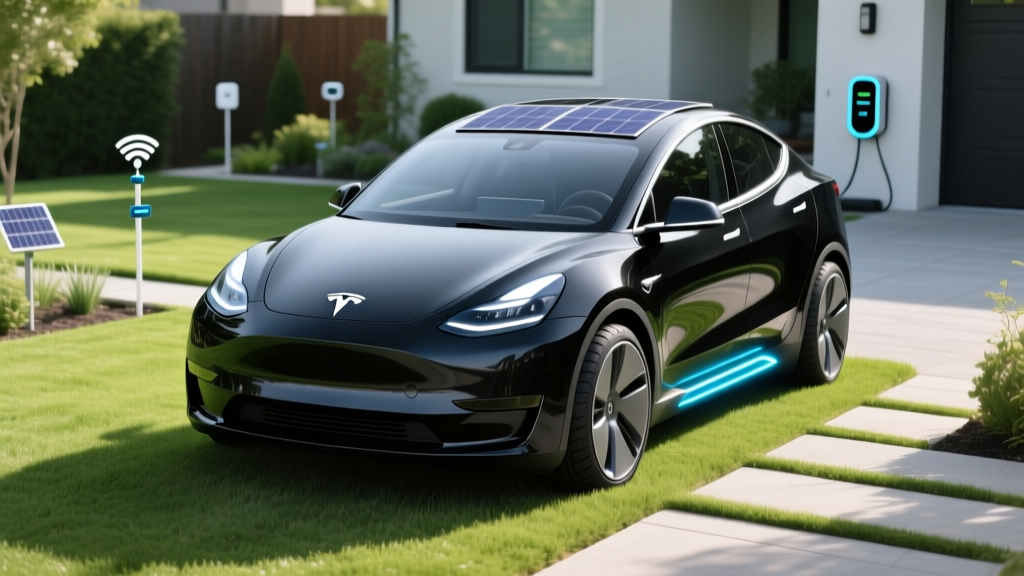
If you've searched "Tesla lawnmower" recently, you're not alone. The query surfaces periodically on forums, social media, and even in Tesla investor threads — usually accompanied by render images of a sleek, Cybertruck-styled riding mower. But here's the definitive answer as of 2026: Tesla does not manufacture, sell, or officially announce any lawnmower, riding mower, or landscaping equipment.
That hasn't stopped speculation. Elon Musk has historically expanded Tesla's product scope beyond cars — the Tesla Bot (Optimus), solar roof tiles, and the Powerwall all seemed unlikely before they launched. So the question deserves a serious, data-driven examination: What would a Tesla-branded electric lawnmower require from a battery, motor, and charging standpoint? What electric mowers actually exist on the market today? And if Tesla ever did enter this space, how would it stack up?
This article breaks down the rumor, the real-world EV mower landscape, and the battery and charging tech that would power such a machine — with the same spec-level rigor we apply to every EV we review.
Is There an Official Tesla Lawnmower in 2026?
No. Tesla's current product lineup, as listed on tesla.com, includes the Model S, Model 3, Model X, Model Y, Cybertruck, Semi, Tesla Solar, Powerwall, Megapack, and Optimus. There is no mower, tractor, or outdoor power equipment category. Tesla has filed no patents specifically targeting robotic lawn mowing as of early 2026, and no filings with the Consumer Product Safety Commission (CPSC) for outdoor power equipment have appeared under Tesla's name.
The "Tesla lawnmower" rumor appears to originate from three sources:
- Fan renders: Digital artists have created convincing Cybertruck-aesthetic mower concepts that circulate on Reddit and X (formerly Twitter).
- Brand confusion: Tesla's expansion into energy storage (Powerwall, Megapack) leads some consumers to assume the company makes all electric outdoor equipment.
- Autonomous mower overlap: Because Tesla develops Autopilot and Full Self-Driving (Supervised) for vehicles, some assume those systems could be adapted to an autonomous mower.
What Would a Tesla Electric Mower Require? Battery & Motor Specs
Even though no Tesla mower exists, we can engineer a realistic spec profile based on Tesla's known battery cell formats (4680 cells), motor technology, and the power requirements of commercial-grade electric riding mowers. This is useful context if you're evaluating real EV mowers or wondering what Tesla could bring to the category.
| Specification | Projected Value | Basis |
|---|---|---|
| Battery Chemistry | LFP (Lithium Iron Phosphate) | Tesla uses LFP in Standard Range models; ideal for daily cycling |
| Battery Capacity | 5–10 kWh usable | Comparable to Mean Green, Gravely electric commercial mowers |
| Motor Type | Brushless DC, hub-mounted | Tesla's permanent magnet motor tech, scaled down |
| Deck Width | 42–54 inches | Standard residential riding mower range |
| Runtime (estimated) | 90–150 minutes per charge | Based on 3–5 kW blade + drive load |
| Charge Time (Level 1, 120V) | 8–12 hours | Standard outdoor equipment charging |
| Autonomy | Potential GPS + vision-based (speculative) | Tesla's FSD neural network, miniaturized |
Key distinction — kW vs kWh: A mower's motor might draw 3–5 kW (kilowatts, the rate of power) while cutting thick grass. A 10 kWh (kilowatt-hours, the energy stored) battery could theoretically sustain that draw for roughly 2 hours. This power-vs-energy distinction matters just as much in outdoor equipment as it does in EVs.
Real Electric Riding Mowers You Can Actually Buy in 2026
The electric outdoor power equipment market is mature and growing fast. Several manufacturers produce battery-electric riding mowers with specs that rival or exceed gas equivalents. Here's how the leading models compare — these are the machines people are actually buying when they search for a "Tesla lawnmower" alternative.
| Model | Battery (kWh) | Deck Width | Runtime | Charge Time | MSRP |
|---|---|---|---|---|---|
| EGO POWER+ Z6 Zero-Turn | 2.5–5.0 (modular 56V ARC) | 42" | ~60–90 min | ~60 min (rapid charger) | $5,999–$7,499 |
| Ryobi 42" Electric Zero-Turn | 4.0 (4× 40V 12Ah) | 42" | ~60–75 min | ~2–3 hours | $4,999 |
| Mean Green EVO 52" (Commercial) | ~8.0 (LFP) | 52" | ~120–150 min | ~4 hours (220V) | $18,000–$22,000 |
| Husqvarna Automower 450XH (Robotic) | ~0.5 (Li-ion) | 22" (mulch) | Autonomous (self-docking) | ~60 min (auto) | $3,299 |
The Husqvarna Automower line is the closest thing to a "Tesla of lawnmowers" that actually exists: it's autonomous, uses GPS-assisted navigation, maps your yard via boundary wire or EPOS (virtual boundary) satellite positioning, and operates at roughly 60 dB — quiet enough to run at night without disturbing neighbors. If Tesla ever entered the mower space, a robotic platform like this is the most likely form factor.
Battery Chemistry: LFP vs NMC for Outdoor Equipment
Whether you're evaluating a hypothetical Tesla mower or a real EGO or Ryobi product, battery chemistry determines lifespan, safety, and real-world performance. Here's how the two dominant chemistries compare for outdoor power equipment use cases:
| Factor | LFP (Lithium Iron Phosphate) | NMC (Nickel Manganese Cobalt) |
|---|---|---|
| Cycle Life | 3,000–5,000+ cycles | 1,000–2,000 cycles |
| Energy Density | Lower (heavier for same kWh) | Higher (lighter, more compact) |
| Thermal Stability | Excellent (very low thermal runaway risk) | Good (requires active BMS) |
| Cold-Weather Performance | Reduced below 32°F (charge restriction) | Better cold-discharge, still reduced |
| Cost per kWh | Lower ($80–100/kWh at scale) | Higher ($120–150/kWh) |
| Best For | Daily-use commercial, long ownership | Weight-sensitive, compact designs |
For a riding mower that sits in a garage and cycles daily during mowing season, LFP is the superior chemistry. The weight penalty is negligible on a riding platform, and the 3,000+ cycle life means the battery could outlast the mower's mechanical components. Tesla's extensive use of LFP in its Standard Range vehicles gives the company deep supply-chain expertise here — another reason a Tesla mower would likely use LFP if it ever materialized.
Charging Electric Mowers: What Homeowners Need to Know
Unlike EVs with standardized NACS or CCS connectors, electric mowers use proprietary battery systems and chargers. Here's what charging looks like in practice:
Electric Mower Charging Levels (Real-World)
| Level | Voltage | Power (kW) | Typical Full Charge |
|---|---|---|---|
| Standard (included) | 120V | 0.3–0.5 kW | 6–12 hours |
| Rapid (optional/EGO) | 120V (high-amperage) | 0.8–1.2 kW | 1–3 hours |
| Commercial (220V) | 240V | 1.5–3.0 kW | 2–4 hours |
Practical tip: If you're running a commercial mowing operation with multiple electric mowers, a dedicated 240V circuit in your garage or shop (similar to a Level 2 EV charger installation) dramatically cuts downtime. Expect to pay $500–$1,500 for a licensed electrician to install a 240V/20A outlet, depending on your panel capacity and run distance — similar to a basic Level 2 EV charger install.
Tax Credits and Incentives for Electric Outdoor Equipment
One common question from searchers: does buying an electric mower qualify for the same federal §30D tax credit that applies to EVs?
No. The IRS §30D Clean Vehicle Credit applies specifically to new qualified plug-in electric drive motor vehicles — meaning on-road vehicles with 4 wheels and a gross vehicle weight rating under 14,000 lbs. Lawnmowers, even large riding mowers, do not qualify.
However, there are alternative incentive paths:
- §25C Energy Efficient Home Improvement Credit: Does not apply to mowers, but may apply if you install a 240V circuit for combined EV + equipment charging (consult a tax professional).
- State and local utility rebates: Some utilities offer $100–$500 rebates for electric outdoor power equipment. Check with your local provider.
- Commercial §179 deduction: For business use, electric mowers may qualify for Section 179 expensing, allowing you to deduct the full purchase price in the year of acquisition. Consult irs.gov or a tax professional for eligibility.
- CARB and EPA compliance: In California and states following CARB regulations, gas-powered small off-road engines (SORE) face increasing restrictions. Going electric future-proofs against pending bans on new gas mower sales in some jurisdictions.
Autonomous Mowers: The Real "Self-Driving" Lawn Care
If the appeal of a "Tesla lawnmower" is autonomy — a mower that cuts your grass without you steering it — that technology already exists and is mature. Here's how autonomous mowers compare to Tesla's SAE Level 2 driver-assist systems:
Leading autonomous mowers in 2026 include:
- Husqvarna Automower 450XH: Handles up to 1.25 acres, GPS navigation, app-controlled, $3,299.
- Husqvarna Automower 535 AWD: Commercial-grade, handles slopes up to 70%, ~$6,500.
- Mammotion LUBA 2 AWD: Wire-free RTK-GPS navigation, up to 5 acres, $3,499–$5,999.
- Segway Navimow i108N: Vision + GPS, no boundary wire, handles 0.5 acres, $1,899.
These units use a combination of RTK-GPS (centimeter-level positioning), ultrasonic sensors, LiDAR (on higher-end models), and vision cameras — a sensor suite conceptually similar to Tesla's camera-based FSD approach, but purpose-built for a far simpler and more controlled environment.
Who Should Buy an Electric Mower (and Who Should Wait)?
✅ Buy Electric Now If:
- Your yard is under 2 acres (residential electric mowers cover this comfortably)
- You have access to a standard 120V or 240V outlet in your garage
- You want to eliminate gas, oil, spark plug, and belt maintenance
- Noise is a concern (electric mowers run 55–75 dB vs 85–95 dB for gas)
- You live in a CARB state where gas mower restrictions are pending
- You already use a battery ecosystem (EGO 56V, Ryobi 40V) for other tools
❌ Wait or Choose Gas If:
- You manage 5+ acres of thick, overgrown, or commercial property
- You need to tow heavy attachments (aerators, spreaders) — torque is still a gas advantage at the top end
- You operate in extreme cold where battery discharge is significantly reduced
- You need 8+ hours of continuous runtime without charging breaks
- You're waiting for a Tesla-branded product — it doesn't exist and isn't announced
Frequently Asked Questions
Does Tesla make a lawnmower?
No. As of 2026, Tesla does not manufacture or sell any lawnmower, riding mower, or outdoor power equipment. Tesla's product lineup consists of electric vehicles (Model S, 3, X, Y, Cybertruck, Semi), solar products, and energy storage (Powerwall, Megapack). Any product marketed as a "Tesla lawnmower" is unauthorized.
Has Elon Musk ever mentioned a Tesla mower?
There is no public record of Elon Musk or Tesla executives announcing, teasing, or discussing a Tesla-branded lawnmower in earnings calls, product events, or social media posts as of early 2026.
What is the best electric riding mower in 2026?
For residential use, the EGO POWER+ Z6 Zero-Turn (42" deck, 56V ARC lithium system, ~$6,000–$7,500) is widely regarded as the top pick for its modular battery system, rapid charging, and cut quality. For commercial use, Mean Green offers LFP-powered zero-turn mowers with 2+ hour runtimes. For autonomous mowing, the Husqvarna Automower and Mammotion LUBA 2 lead the category.
Do electric mowers qualify for a federal tax credit?
No. The IRS §30D Clean Vehicle Credit applies only to on-road plug-in electric vehicles meeting specific MSRP, income, and battery-sourcing requirements. Electric lawnmowers do not qualify. However, commercial users may be eligible for §179 business deductions, and some state/utility rebates apply.
How long do electric mower batteries last?
LFP-based mower batteries (found in commercial models) typically last 3,000–5,000 charge cycles, translating to 8–15 years of seasonal residential use. NMC and standard lithium-ion batteries in consumer models (EGO, Ryobi) typically deliver 800–1,500 cycles, or 5–10 years with proper storage and care. Most manufacturers offer 3–5 year battery warranties.
Could Tesla enter the mower market in the future?
It's theoretically possible but unlikely in the near term. Tesla's current manufacturing capacity is focused on scaling vehicle production (especially the next-gen platform), Semi, and energy storage. Outdoor power equipment would represent a significant diversification with different distribution, service, and regulatory requirements. If Tesla ever did enter the space, an autonomous robotic mower leveraging its vision-based AI would be the most logical product — but this remains pure speculation.
Sources: Tesla.com product lineup, IRS §30D Clean Vehicle Credit rules, manufacturer specification pages for EGO, Ryobi, Mean Green, Husqvarna, and Mammotion (2025–2026 model year data).