Why Families Are Searching for a "Tesla Kid Car" in 2026
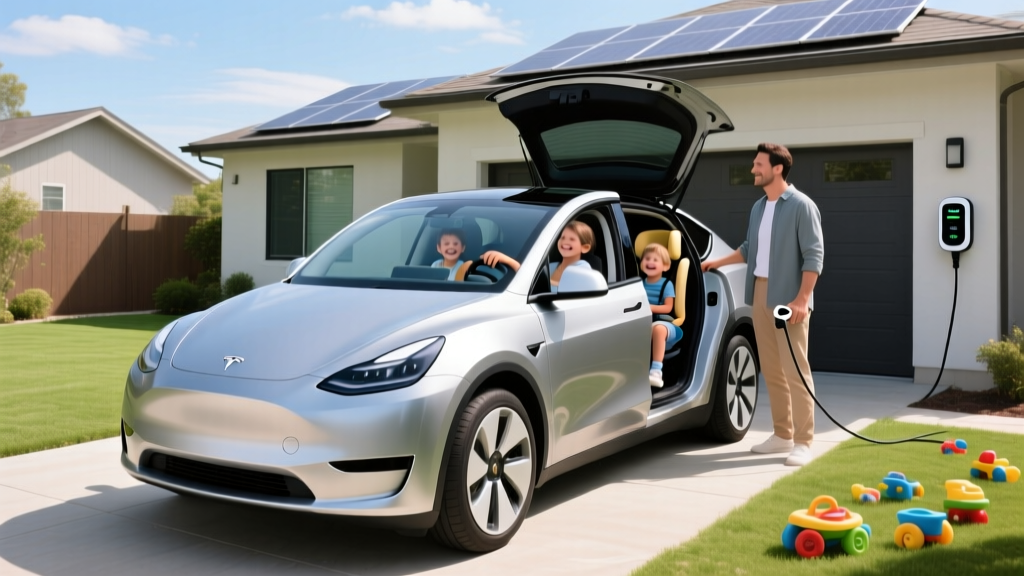
When parents type "Tesla kid car" into a search bar, they're usually looking for one of two things: a ride-on toy replica for toddlers, or — far more often — the most family-friendly Tesla to haul children, car seats, strollers, and groceries without compromise. This review focuses squarely on the second meaning: the 2026 Tesla Model Y, the midsize electric crossover that has become the default Tesla for families who need real utility, real range, and real safety for the smallest passengers.
The 2026 Model Y (refreshed for the Juniper generation) brings a quieter cabin, revised suspension tuning, a rear-seat entertainment screen, and improved efficiency over its predecessor. It remains Tesla's best-selling vehicle globally, and for good reason: it threads the needle between the compact Model 3 and the premium Model X in both price and practicality. Below, we break down every spec that matters to a parent shopping for a family EV.
2026 Tesla Model Y: Full Spec Sheet at a Glance
| Spec | Long Range RWD | Long Range AWD | Performance AWD |
|---|---|---|---|
| EPA Range | 320 mi | 295 mi | 277 mi |
| Battery (usable) | 75 kWh (est.) NMC | 75 kWh (est.) NMC | 75 kWh (est.) NMC |
| Peak DC Fast Charge | 250 kW | 250 kW | 250 kW |
| 10–80% DC Time | ~25 min | ~25 min | ~25 min |
| Level 2 Home Charge | 11.5 kW (~44 mi/hr) | 11.5 kW (~44 mi/hr) | 11.5 kW (~44 mi/hr) |
| 0–60 mph | 5.8 sec | 4.8 sec | 3.5 sec |
| Horsepower | 295 hp | 384 hp | 456 hp |
| Drivetrain | RWD (single motor) | AWD (dual motor) | AWD (dual motor) |
| EPA Efficiency | 123 MPGe (28 kWh/100mi) | 117 MPGe (29 kWh/100mi) | 111 MPGe (30 kWh/100mi) |
| Cargo (rear seats up) | 30.2 cu ft (76.2 cu ft max) | ||
| 2nd-Row Legroom | 41.6 in | ||
| Base MSRP | $44,990 | $47,990 | $52,490 |
| Battery Warranty | 8 yr / 120,000 mi | ||
Real-World Range: What the EPA Sticker Doesn't Tell You
EPA Estimated Range: 320 mi (Long Range RWD) / 295 mi (Long Range AWD)
Real-World Expectation: Plan for 250–275 mi on highway-heavy trips at 70–80 mph. In freezing weather (below 32°F), expect 15–25% range loss, bringing effective range down to roughly 210–240 mi for the AWD variant. City driving with regenerative braking recovers more energy and typically lands closer to the EPA figure.
The Model Y uses an NMC (nickel manganese cobalt) lithium-ion pack, which offers higher energy density than LFP chemistry but is more sensitive to sustained 100% state-of-charge storage. Tesla recommends daily charging to 80–90% for NMC packs, which effectively gives you a usable daily range of about 230–260 mi on the Long Range AWD — still ample for most family commutes and school runs. For road trips, preconditioning the battery via the Tesla navigation system warms the cells for optimal charging speed, a feature that matters enormously in cold climates.
Source: EPA Fuel Economy Guide — Tesla Model Y
Charging Speed: Home Level 2 and DC Fast Charging
Charging speed is where the Model Y's 400-volt architecture shows its age versus 800-volt rivals like the Hyundai Ioniq 5 or Kia EV6, but it remains competitive thanks to Tesla's vast Supercharger network.
| Charging Level | Power / Rate | Speed (Approx.) | Use Case |
|---|---|---|---|
| Level 1 (120V household) | 1.4 kW | ~5 mi/hr | Emergency top-ups only |
| Level 2 (240V home Wall Connector) | 11.5 kW | ~44 mi/hr | Overnight daily charging |
| DC Fast (Supercharger V3) | 250 kW peak | 10–80% in ~25 min | Road trips |
| DC Fast (Supercharger V4) | 250 kW (capped by vehicle) | 10–80% in ~25 min | Newer station hardware |
The 250 kW peak charge rate is sustained only up to roughly 40% state of charge, after which the charge curve tapers significantly. From 80–100%, charging slows to under 30 kW — a reality of lithium-ion physics, not a Tesla flaw. For family road trips, the practical pattern is: arrive at a Supercharger at 10–15%, charge to 80% in about 25 minutes, grab snacks, and go. That's a realistic pit stop with kids.
At home, a Tesla Wall Connector on a 60-amp circuit delivers the full 11.5 kW (48 amps), replenishing roughly 350 miles overnight in 8 hours. Most families will never need public charging for daily use if they have Level 2 at home. Installation typically runs $800–$2,000 depending on panel capacity and run length — factor this into your purchase budget.
Safety, Kid-Friendly Tech, and Interior Space
The Model Y has consistently earned top marks from both the NHTSA (5-star overall) and the IIHS (Top Safety Pick+ in prior model years). For parents, the structural safety cell, low center of gravity (battery pack under the floor), and standard automatic emergency braking are compelling.
Family-relevant interior features (2026 Juniper refresh):
- Rear-seat 8-inch touchscreen for rear-seat entertainment and climate control
- Two ISOFIX/LATCH anchors in the second row (outboard seats) with easy-access guides
- 41.6 inches of rear legroom — fits rear-facing car seats without compromising front-seat comfort
- 30.2 cu ft cargo behind the second row; 76.2 cu ft with seats folded (stroller, bikes, Costco runs)
- Ventilated front seats, heated rear seats standard
- Cabin overheat protection (keeps A/C running when parked — critical for pet and child safety awareness)
- Sentry Mode dashcam recording (useful for parking-lot incidents near school zones)
Notable drawbacks for families:
- No third-row seat option in the US market (unlike the Kia EV9 or Rivian R1S)
- Minimalist interior means no physical buttons — everything through the touchscreen, which some parents find distracting while driving
- Panoramic glass roof can make the cabin hot in summer; the 2026 refresh adds a power sunshade, but verify on your build
- Frunk (front trunk) is small at ~4.1 cu ft — enough for a charging cable bag, not a stroller
Pricing, Trim Levels, and Federal Tax Credit Eligibility
| Trim | Base MSRP | Destination | Est. §30D Credit* | Effective Price |
|---|---|---|---|---|
| Long Range RWD | $44,990 | $1,390 | Up to $7,500 | ~$38,880 |
| Long Range AWD | $47,990 | $1,390 | Up to $7,500 | ~$41,880 |
| Performance AWD | $52,490 | $1,390 | Up to $7,500 | ~$46,380 |
*Federal §30D tax credit eligibility for 2026 depends on three hurdles: (1) buyer adjusted gross income must not exceed $150,000 single / $300,000 joint; (2) vehicle MSRP must be at or below the $80,000 SUV cap (all Model Y trims qualify); and (3) battery components and critical minerals must meet escalating domestic-sourcing thresholds that tighten each year. The credit can now be transferred to the dealer at point of sale as an instant discount per IRS guidelines. Always confirm eligibility with a tax professional before purchase — rules shift annually.
All Model Y trims fall well under the $80,000 MSRP cap for SUVs, and Tesla's ongoing efforts to source battery materials from FTA-partner countries have kept most configurations eligible for at least partial credit through early 2026. However, the exact dollar amount ($3,750 vs. $7,500) can change mid-year based on Treasury guidance on critical-mineral sourcing. Check the official fueleconomy.gov tax credit lookup tool before signing.
Autopilot, FSD Supervised, and Driver Assistance
Every Model Y ships with Tesla's Basic Autopilot (traffic-aware cruise control and lane-keeping). Enhanced Autopilot ($6,000) adds auto lane-change, autosteer on highways, and smart summon. Full Self-Driving (Supervised) is available as a $8,000 one-time purchase or $99/month subscription.
SAE Automation Level: Level 2
Despite the "Full Self-Driving" name, Tesla's FSD (Supervised) is an SAE Level 2 driver-assistance system. The driver must remain fully attentive, keep hands available, and be ready to take over at any moment. It is not autonomous driving. Only Level 4 services like Waymo operate without a human driver in geofenced areas.
For family use, Basic Autopilot handles highway commuting admirably, reducing fatigue on long road trips. FSD (Supervised) can navigate city streets and stoplights but requires constant supervision — do not rely on it while turning around to manage children in the back seat.
Pros and Cons: The Honest Family-EV Verdict
Pros
- Class-leading Supercharger network reliability for road trips
- Spacious 2nd row fits rear-facing car seats easily (41.6" legroom)
- Top safety ratings from NHTSA and IIHS
- Low running costs: ~$0.04–$0.06/mi on home charging vs. ~$0.12–$0.15/mi for gas
- Rear entertainment screen keeps kids occupied on long drives
- Over-the-air updates continuously add features
- Strong resale value relative to most EV competitors
Cons
- No third-row option — families needing 3 rows should look at Kia EV9 or Rivian R1S
- 400V architecture means slower peak charging vs. 800V rivals
- Minimalist touchscreen-only controls can frustrate some drivers
- FSD (Supervised) is expensive and still requires full driver attention
- NMC battery should not be stored at 100% daily (unlike LFP options from some competitors)
- Ride quality improved in 2026 refresh but still firm over sharp bumps
Who Should Buy the Model Y as a Family EV?
Choose the Model Y if: You're a family of 2–4 who needs a daily commuter and road-trip EV with the best charging infrastructure available, top safety ratings, and strong cargo space. The Long Range AWD at ~$42,000 after credits is the sweet spot for most families in snow-belt states.
Look elsewhere if: You need a third row (Kia EV9, Rivian R1S), you want the fastest charging in the segment (Hyundai Ioniq 5 / Kia EV6 at 800V), or you prefer physical buttons and a more traditional interior layout (Ford Mustang Mach-E, Volkswagen ID.4).
Frequently Asked Questions
Is there an actual Tesla kid car — a ride-on toy for children?
Tesla has sold branded ride-on toy cars (a miniature Roadster and Model S) through its shop in the past, but these are licensed toys manufactured by third parties like Radio Flyer, not Tesla-produced vehicles. Availability rotates. For the actual full-size "Tesla kid car" — meaning the best Tesla for families with children — the Model Y is the consensus pick for 2026 due to its space, safety, and value.
What is the real-world range of the 2026 Tesla Model Y?
EPA estimates are 320 mi (Long Range RWD) and 295 mi (Long Range AWD). Real-world highway driving at 75 mph yields roughly 250–275 mi. In sub-freezing temperatures, plan for 210–240 mi effective range. Preconditioning via the Tesla app before departure helps mitigate cold-weather loss.
How fast does the Model Y charge at home and on road trips?
At home on a Level 2 Tesla Wall Connector (11.5 kW / 48A), you gain about 44 miles of range per hour, fully replenishing overnight. On a Supercharger, the Model Y peaks at 250 kW and charges from 10–80% in approximately 25 minutes. Charging slows significantly above 80% due to the battery charge curve.
Does the 2026 Tesla Model Y qualify for the federal EV tax credit?
Yes — the Model Y qualifies as an SUV under the $80,000 MSRP cap, and Tesla's battery sourcing has generally met the §30D requirements for at least partial credit in 2026. However, buyer income limits ($150K single / $300K joint AGI) and evolving critical-mineral sourcing rules apply. The credit can be applied at point of sale. Confirm current eligibility on fueleconomy.gov and with your tax professional.
How does the Model Y compare to competitors for family use?
Versus the Hyundai Ioniq 5, the Model Y offers more cargo space and access to the Supercharger network but slower peak charging (250 kW vs. 350 kW on 800V). Versus the Ford Mustang Mach-E, the Model Y has a more spacious rear seat and greater efficiency. Versus the Kia EV9, the Model Y lacks a third row but costs significantly less. The Model Y remains the best all-around family EV for households that don't need three rows.
What is the battery warranty on the 2026 Model Y?
Tesla covers the Model Y battery and drive unit for 8 years or 120,000 miles, whichever comes first, with a guaranteed minimum 70% capacity retention over that period. Real-world data from high-mileage Tesla owners suggests NMC packs typically retain 85–90% capacity at 100,000 miles when charged responsibly (daily limit of 80–90%).