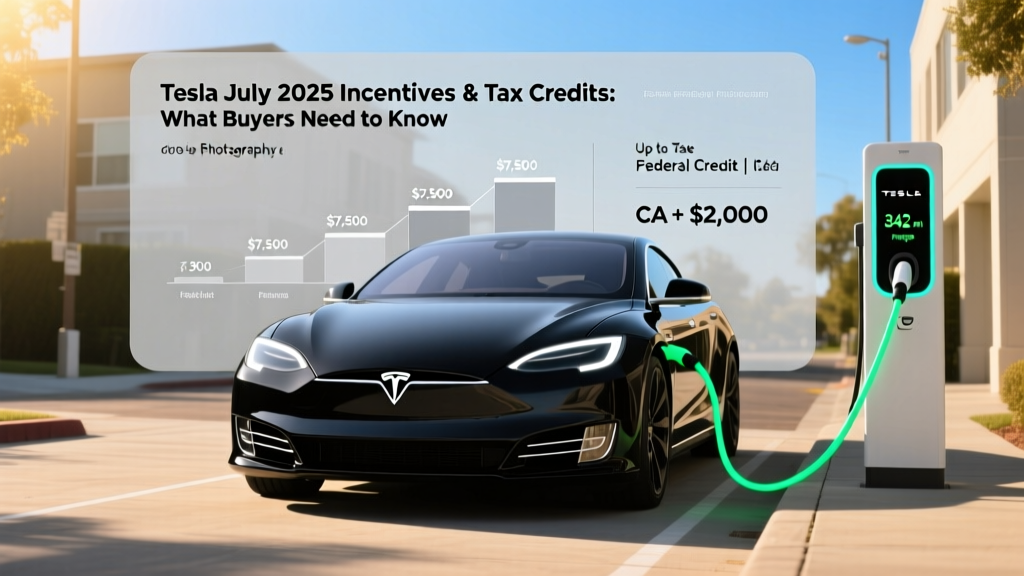
Understanding Tesla's July 2025 Incentive Landscape
If you're researching Tesla July 2025 incentives, you're likely weighing whether now is the right time to buy a Tesla and how much you'll actually save after federal and state incentives. The incentive landscape for Tesla buyers in mid-2025 is more complex than a simple "$7,500 off" headline. Eligibility depends on your income, the specific model and trim you choose, battery component sourcing, and whether you take the credit at point of sale or on your tax return.
This guide breaks down every available incentive for Tesla's current 2025 lineup—the Model 3, Model Y, Model S, and Model X—with exact pricing, real-world range expectations, charging speeds, and the fine print that determines whether you'll actually see those savings.
Tesla 2025 Model Lineup: Pricing and Tax Credit Eligibility
Tesla's four-vehicle lineup spans from the entry-level Model 3 to the flagship Model X. Not every trim qualifies for the full federal tax credit under IRS §30D rules, and MSRP caps play a decisive role.
| Model/Trim | Base MSRP | MSRP Cap (§30D) | Max Federal Credit | Credit Eligible? |
|---|---|---|---|---|
| Model 3 RWD | $38,990 | $55,000 (sedans) | $7,500 | Yes (if income/sourcing met) |
| Model 3 Long Range AWD | $45,490 | $55,000 (sedans) | $7,500 | Yes (if income/sourcing met) |
| Model 3 Performance | $52,990 | $55,000 (sedans) | $7,500 | Yes (if income/sourcing met) |
| Model Y RWD | $44,990 | $80,000 (SUVs) | $7,500 | Yes (if income/sourcing met) |
| Model Y Long Range AWD | $47,490 | $80,000 (SUVs) | $7,500 | Yes (if income/sourcing met) |
| Model Y Performance | $51,490 | $80,000 (SUVs) | $7,500 | Yes (if income/sourcing met) |
| Model S Dual Motor | $79,990 | $55,000 (sedans) | $0 | No (exceeds MSRP cap) |
| Model X Dual Motor | $79,990 | $80,000 (SUVs) | $0 | Borderline (verify final MSRP) |
- Income caps: Modified AGI ≤ $150,000 (single), $225,000 (head of household), $300,000 (joint)
- MSRP caps: $55,000 for sedans (Model 3, Model S); $80,000 for SUVs/trucks/vans (Model Y, Model X)
- Battery sourcing: Critical minerals and battery components must meet escalating domestic-content thresholds. Tesla's North American battery supply chain generally qualifies, but verify at IRS.gov eligible vehicles list before purchasing.
- Point-of-sale transfer: You can transfer the credit to the dealer at purchase for an immediate price reduction rather than waiting to claim it on your tax return.
Source: IRS Clean Vehicle Credit. Rules subject to change—verify current eligibility before purchase.
Tesla Model 3 (2025): Range, Charging, and Performance
The refreshed Model 3 ("Highland" update) continues into 2025 with improved efficiency, a quieter cabin, and updated suspension tuning. It remains Tesla's most affordable vehicle and the most likely to qualify for the full $7,500 federal credit.
| Spec | RWD | Long Range AWD | Performance |
|---|---|---|---|
| EPA Range | 272 mi | 341 mi | 315 mi |
| Battery (usable) | ~57.5 kWh (LFP) | ~75 kWh (NMC) | ~75 kWh (NMC) |
| 0-60 mph | 5.8 sec | 4.2 sec | 2.9 sec |
| Horsepower | 271 hp | 346 hp | 510 hp |
| Drivetrain | RWD | AWD (dual motor) | AWD (dual motor) |
| MPGe (combined) | 132 MPGe | 134 MPGe | 121 MPGe |
| Efficiency | 25 kWh/100mi | 25 kWh/100mi | 28 kWh/100mi |
Charging Speeds
| Charging Level | Max Rate | Speed (miles/hr) | Notes |
|---|---|---|---|
| Level 1 (120V) | ~1.4 kW | ~3-4 mi/hr | Emergency/trickle only |
| Level 2 (240V home) | 11.5 kW | ~37-44 mi/hr | Full charge overnight (8-10 hrs) |
| DC Fast Charge | 170 kW (RWD) / 250 kW (LR/Perf) | — | 10-80% in ~25 min (RWD), ~18 min (LR) |
Charging curve reality: The Model 3 Long Range peaks at 250 kW but sustains that rate only briefly (typically 20-40% SoC). Above 60%, charging tapers significantly—expect 10-80% in roughly 18 minutes at a V3 Supercharger, but 80-100% adds another 15+ minutes. For road trips, plan stops around 10-80% to minimize time at the charger.
Tesla Model Y (2025): The Incentive-Eligible Family SUV
The Model Y is Tesla's best-selling vehicle globally and qualifies for the full $7,500 federal credit across all trims (all fall well under the $80,000 SUV MSRP cap). For families needing cargo space, optional third-row seating, and SUV utility, it's the strongest Tesla incentive play in 2025.
| Spec | RWD | Long Range AWD | Performance |
|---|---|---|---|
| EPA Range | 320 mi | 308 mi | 285 mi |
| Battery (usable) | ~60 kWh (LFP) | ~75 kWh (NMC) | ~75 kWh (NMC) |
| 0-60 mph | 6.6 sec | 4.8 sec | 3.5 sec |
| Horsepower | 295 hp | 384 hp | 456 hp |
| Drivetrain | RWD | AWD (dual motor) | AWD (dual motor) |
| MPGe (combined) | 123 MPGe | 122 MPGe | 115 MPGe |
| Cargo (rear seats up) | 30 cu ft | 30 cu ft | 30 cu ft |
| Cargo (rear seats down) | 72 cu ft | 72 cu ft | 72 cu ft |
Model Y Charging
| Charging Level | Max Rate | Speed | Notes |
|---|---|---|---|
| Level 2 (240V home) | 11.5 kW | ~37-44 mi/hr | Full charge in 8-10 hrs |
| DC Fast Charge | 250 kW (LR/Perf) | — | 10-80% in ~20-22 min at V3 Supercharger |
Model S and Model X: Premium EVs Without Federal Credits
The Model S and Model X represent Tesla's premium tier, but their MSRPs exceed the §30D MSRP caps ($55,000 for sedans, $80,000 for SUVs). The Model S at $79,990 base is ineligible. The Model X at $79,990 sits right at the SUV cap—Tesla has historically classified it as an SUV for credit purposes, but options and destination charges can push the final MSRP above $80,000, disqualifying it. Always verify the exact MSRP on your build before assuming credit eligibility.
State incentives may still apply. California's CVRP (if funded) and utility rebates don't always follow federal MSRP caps, so check your state's specific programs.
State and Utility Incentives: Beyond the Federal Credit
Federal incentives are only part of the picture. Depending on your state and utility, additional savings may stack on top of the §30D credit:
- California: Up to $2,000 CVRP rebate (income-dependent, funding varies—check energy.ca.gov)
- Colorado: $5,000 state tax credit for EVs under $80,000 MSRP
- New York: Up to $2,000 Drive Clean Rebate (point of sale)
- Utility rebates: Many utilities offer $500-$1,500 for home charger installation or off-peak charging credits. Check with your local provider.
- HVHOV access: Several states grant carpool lane access to EVs regardless of occupancy (varies by state and program expiration dates).
State incentive amounts and availability vary by jurisdiction and change frequently. Always verify current programs through official state energy agency websites before making purchase decisions.
Total Cost: What You'll Actually Pay After Incentives
Let's model realistic out-of-pocket costs for the most popular incentive-eligible Tesla configurations:
| Model/Trim | MSRP | Destination | Federal Credit | Effective Price |
|---|---|---|---|---|
| Model 3 RWD | $38,990 | $1,390 | -$7,500 | $32,880 |
| Model 3 Long Range AWD | $45,490 | $1,390 | -$7,500 | $39,380 |
| Model Y Long Range AWD | $47,490 | $1,390 | -$7,500 | $41,380 |
| Model Y Performance | $51,490 | $1,390 | -$7,500 | $45,380 |
Important caveats: These figures assume you qualify for the full $7,500 credit (income within caps, battery sourcing requirements met). The credit is non-refundable—you need sufficient federal tax liability to claim it, unless you use the point-of-sale transfer option (available through registered dealers). Consult a tax professional to verify your specific eligibility.
Who Should Buy a Tesla in July 2025?
Best For:
- Daily commuters with home Level 2 charging—wake up to a full battery every morning
- Tech-forward buyers who want OTA updates, Supercharger network access, and Tesla's driver-assist features
- Families needing cargo space—Model Y offers 72 cu ft with seats folded and optional third row
- Road trippers who value the Supercharger network's reliability and coverage
- Incentive-maximizing buyers—Model 3 and Model Y trims all qualify for the full $7,500 federal credit
Not Ideal For:
- Apartment dwellers without charging access—public charging is more expensive and less convenient than home charging
- Buyers wanting traditional controls—Tesla's minimalist interior and screen-centric controls frustrate some drivers
- Those needing guaranteed Level 4 autonomy—FSD (Supervised) is Level 2 driver-assist, not self-driving; you must remain engaged
- Heavy towing—Model Y towing capacity is 3,500 lbs; Model X is 5,000 lbs, but range drops significantly under load
- Buyers on the tightest budgets—even with credits, Tesla's cheapest option is ~$33K effective
Warranty and Battery Longevity
Tesla's warranty coverage is competitive but not class-leading:
- Basic vehicle: 4 years / 50,000 miles
- Battery and drive unit (Model 3 RWD): 8 years / 100,000 miles
- Battery and drive unit (Model 3 LR, Model Y): 8 years / 120,000 miles
- Battery and drive unit (Model S/X): 8 years / 150,000 miles
- Capacity retention threshold: Tesla warrants batteries to retain at least 70% of original capacity during the warranty period
LFP vs NMC longevity: The LFP batteries in RWD models can be charged to 100% daily without degradation concerns—a significant advantage for commuters. NMC batteries (Long Range, Performance) are best kept between 20-80% for daily use, charging to 100% only before long trips. LFP chemistry also offers better thermal stability and longer cycle life, though with lower energy density (explaining the RWD's shorter range).
Frequently Asked Questions
Does every Tesla qualify for the $7,500 federal tax credit?
No. The Model S is ineligible (exceeds the $55,000 sedan MSRP cap). The Model X is borderline—its $79,990 base MSRP sits at the $80,000 SUV cap, but options and destination fees can push it over. Model 3 and Model Y all qualify on MSRP grounds, but you must also meet income caps and battery-sourcing requirements. Verify eligibility on the IRS eligible vehicles list before purchasing.
Can I get the tax credit as an instant discount?
Yes. Under the point-of-sale transfer provision, you can transfer your §30D credit to Tesla at purchase, reducing your out-of-pocket cost immediately rather than waiting to claim it on your tax return. This requires purchasing through a registered dealer and meeting all eligibility requirements.
What's the real-world range of the Model Y Long Range?
The EPA rates it at 308 miles, but real-world highway driving at 70-75 mph typically yields 260-280 miles. In cold weather (below 30°F), expect 220-250 miles. Preconditioning the battery (via the Tesla app or scheduled departure) can recover some cold-weather range by warming the battery before driving.
How fast does the Model 3 charge at home?
With a 240V Level 2 home charger (Tesla Wall Connector or equivalent), the Model 3 charges at up to 11.5 kW, adding roughly 37-44 miles of range per hour. A full charge from 10-100% takes 8-10 hours—easily accomplished overnight. Installation costs vary ($500-$2,000+) depending on your electrical panel capacity and distance from the panel to the charger location.
Is Tesla's FSD actually self-driving?
No. Full Self-Driving (Supervised) is an SAE Level 2 driver-assist system. It can handle many highway and some city driving scenarios, but the driver must remain fully attentive, hands on the wheel (or providing torque input), and ready to take over at any moment. It is not autonomous driving. Only Level 4 services like Waymo (operating in limited geographic areas) qualify as true self-driving.
Should I buy now or wait for potential 2026 changes?
The §30D tax credit rules are subject to legislative changes, and battery-sourcing requirements tighten annually. If you qualify now and the vehicle meets your needs, locking in the current $7,500 credit is a known quantity. Waiting introduces uncertainty—credits could be reduced, eliminated, or restructured. However, Tesla frequently adjusts pricing and may introduce refreshed models. Consider your timeline, charging access, and whether current range/charging specs meet your driving needs.