Why Irvine's Tesla Showroom Draws Southern California EV Buyers
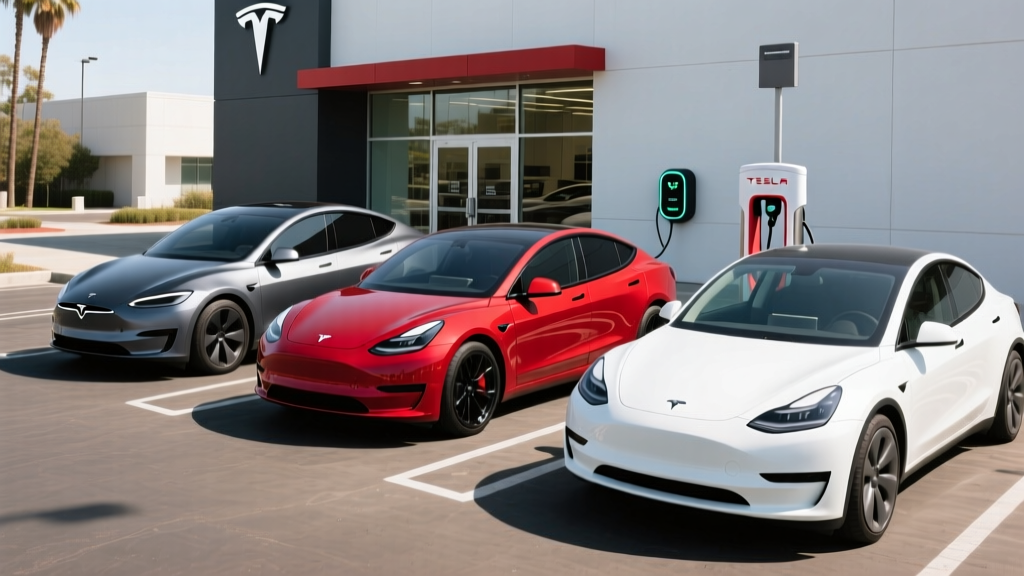
The Tesla showroom and service center at 39 Tesla, Irvine, CA 92618 sits in the Irvine Spectrum retail corridor — one of the highest-volume Tesla locations in Orange County. For buyers researching a Tesla purchase in Southern California, this address is ground zero for test drives, deliveries, and post-sale service. But walking in without a spec-driven shortlist means leaving money (and range) on the table.
This guide breaks down every current 2026 Tesla model you can order or take delivery of at the Irvine location: Model 3, Model Y, Model S, and Model X. We cover EPA range, battery chemistry, real-world efficiency, DC fast-charging curves, pricing, and federal tax credit eligibility under IRS §30D rules — so you arrive informed.
2026 Tesla Lineup at a Glance: Spec Comparison Table
| Spec | Model 3 Long Range AWD | Model Y Long Range AWD | Model S Long Range | Model X Long Range |
|---|---|---|---|---|
| EPA Range | 341 mi | 320 mi | 402 mi | 335 mi |
| Battery (usable) | ~75 kWh (NMC) | ~75 kWh (NMC) | ~95 kWh (NMC) | ~95 kWh (NMC) |
| Peak DC Fast Charge | 250 kW | 250 kW | 250 kW | 250 kW |
| 10–80% DC Time | ~25 min | ~27 min | ~30 min | ~32 min |
| Level 2 Home (48A) | ~44 mi/hr | ~44 mi/hr | ~44 mi/hr | ~40 mi/hr |
| 0–60 mph | 4.2 sec | 4.8 sec | 3.1 sec | 3.8 sec |
| Horsepower | ~346 hp | ~384 hp | ~670 hp | ~670 hp |
| Drivetrain | Dual-Motor AWD | Dual-Motor AWD | Dual-Motor AWD | Dual-Motor AWD |
| MPGe (combined) | 132 MPGe | 122 MPGe | 120 MPGe | 102 MPGe |
| Cargo (rear + frunk) | 23 + 3.1 cu ft | 72 + 4.1 cu ft | 28 + 3.1 cu ft | 88 + 6.5 cu ft |
| Base MSRP | $47,740 | $48,990 | $79,990 | $84,990 |
| Battery Warranty | 8 yr / 120,000 mi | 8 yr / 120,000 mi | 8 yr / 150,000 mi | 8 yr / 150,000 mi |
Sources: fueleconomy.gov, Tesla.com spec pages. MSRP excludes destination fee. Specs reflect 2026 model year.
Real-World Range: What the EPA Sticker Doesn't Tell You
EPA estimates assume a mix of city and highway driving at moderate temperatures. In Irvine's mild climate (rarely below 45°F), you'll see range close to sticker on city commutes. But on I-5 or 405 highway runs at 75+ mph, expect a 10–15% reduction from EPA across all models. Cold-weather road trips to Big Bear or Mammoth (below freezing) can cut range 20–30% due to battery heating demands and cabin climate load.
Model 3 Long Range (EPA 341 mi): Expect ~290–310 mi on mixed SoCal commutes. Sustained 80 mph highway driving drops this to ~260–280 mi. All Teslas use a heat pump (standard since 2021 refresh), which significantly reduces cold-weather HVAC energy draw compared to resistive heaters — but physics still wins at sub-freezing temps.
Model Y Long Range (EPA 320 mi): The taller, heavier crossover profile costs ~20 mi vs. the Model 3 sedan. Real-world highway: ~250–270 mi. Families running HVAC, screens, and phone chargers should budget ~240 mi between stops on road trips.
Model S Long Range (EPA 402 mi): The 402-mi sticker is the highest of any current production EV. Real-world highway at 75 mph: ~330–350 mi. This is the Tesla for Phoenix-to-LA one-shot runs with margin to spare.
Model X Long Range (EPA 335 mi): The heavy, boxy SUV with falcon-wing doors sacrifices efficiency. Expect ~270–290 mi real-world highway. Towing drops this dramatically — plan for 180–220 mi when pulling a trailer near the 5,000-lb limit.
Charging Speed: Supercharger Network and Home Setup
Every 2026 Tesla sold at the Irvine showroom uses the NACS (North American Charging Standard) connector natively — the same plug used across Tesla's Supercharger network. No adapter needed for Tesla chargers, and Teslas now also access select Electrify America and other non-Tesla DC networks with a CCS adapter (sold separately).
| Charging Level | Power | Typical Miles Added/Hour | Where |
|---|---|---|---|
| Level 1 (120V) | ~1.4 kW | ~3–5 mi/hr | Standard outlet (emergency/top-up) |
| Level 2 (240V, 48A) | ~11.5 kW | ~40–44 mi/hr | Home Wall Connector, workplace |
| DC Fast (Supercharger V3) | Up to 250 kW | ~1,000+ mi/hr (peak) | Tesla Supercharger stations |
| DC Fast (V4 Supercharger) | Up to 350 kW* | Faster sustain curve | Select newer stations |
*V4 350 kW capability is station-dependent and vehicle-limited; current Model 3/Y/S/X peak at 250 kW on the vehicle side.
Charge curve reality: The "250 kW peak" number only holds between roughly 10–30% State of Charge. Above 50%, the rate tapers progressively. This is why Tesla quotes 10–80% times rather than 0–100%. Charging from 80–100% can take as long as 10–80%. For road trips, plan stops to leave at ~80% to minimize total trip time.
Home charging in Irvine: A Tesla Wall Connector ($420) on a 60A circuit delivers 48A continuous (~11.5 kW), replenishing a Model 3 from 20–80% overnight in about 5–6 hours. Most Irvine homes have 200A panels that accommodate this. Budget $800–$2,000 for professional installation by a licensed electrician, including permit. If your panel is older or at capacity, a panel upgrade ($1,500–$3,000 additional) may be required.
Preconditioning matters: When navigating to a Supercharger, the car automatically warms the battery to optimal temperature for faster charging. This is especially impactful in cold weather. Always navigate to your charge stop rather than just driving there — it shaves 5–10 minutes off your session.
Pricing, Trims, and Federal Tax Credit Eligibility (IRS §30D)
| Model / Trim | Base MSRP | Est. As-Tested (Popular Config) | §30D Credit Eligible? |
|---|---|---|---|
| Model 3 RWD | $38,990 | ~$39,990 | Yes — up to $7,500 (if sourcing rules met) |
| Model 3 Long Range AWD | $47,740 | ~$50,000 | Yes — up to $7,500 |
| Model 3 Performance | $54,990 | ~$56,500 | Yes — up to $7,500 |
| Model Y Long Range AWD | $48,990 | ~$52,000 | Yes — up to $7,500 |
| Model Y Performance | $52,490 | ~$55,000 | Yes — up to $7,500 |
| Model S Long Range | $79,990 | ~$85,000 | No — exceeds $55,000 sedan MSRP cap |
| Model X Long Range | $84,990 | ~$92,000 | No — exceeds $80,000 SUV MSRP cap |
Key §30D rules for 2026 (cite: IRS.gov §30D):
- MSRP caps: Sedans (Model 3) must be ≤ $55,000. SUVs/trucks (Model Y, X) must be ≤ $80,000. Model S and X exceed their respective caps.
- Income caps: Modified AGI ≤ $300,000 (joint), $225,000 (head of household), $150,000 (single). Exceed these and you're ineligible regardless of vehicle.
- Battery sourcing: The credit splits into two halves — $3,750 for critical minerals and $3,750 for battery component assembly, each with escalating domestic/FRT content thresholds. Not every Tesla configuration qualifies for the full $7,500 in every tax year. Verify current sourcing compliance on the IRS qualified vehicle list before ordering.
- Point-of-sale transfer: Since 2024, you can transfer the credit to the dealer at purchase, reducing your out-of-pocket price immediately rather than waiting for a tax refund.
Tax credit rules are subject to change. Consult a tax professional and check the IRS qualified vehicle list before purchasing. Eligibility is not guaranteed.
Tech, Interior, and Driver-Assist Features
All 2026 Teslas share a common tech architecture centered on a 15.4-inch center touchscreen (Model 3/Y) or 17-inch tilting display (Model S/X). There's no traditional instrument cluster — speed and navigation appear on the main screen or, in the refreshed Model 3, on a compact secondary display for the driver.
Autopilot and FSD (Supervised):
Tesla Autopilot (standard) and Full Self-Driving Supervised ($8,000 option or $99/month) are SAE Level 2 driver-assist systems. The driver must remain attentive, hands on or near the wheel, and ready to intervene at any moment. These systems handle highway lane-keeping, adaptive cruise, and some city-street navigation — but they do not make the vehicle autonomous. Only SAE Level 4 services like Waymo operate without driver supervision in geofenced areas.
Standout features across the lineup:
- Over-the-air (OTA) updates that add features post-purchase
- Sentry Mode (360° parking surveillance with recording)
- Dog Mode / Camp Mode (climate control while parked)
- Tesla Vision (camera-only, no LiDAR or radar) for ADAS
- Phone-as-key with Bluetooth proximity unlock
- 17-speaker premium audio (Model S/X) or 14-speaker immersive audio (Model 3/Y)
- HEPA air filtration with Bioweapon Defense Mode (Model S/X)
Notable drawbacks:
- No Apple CarPlay or Android Auto — Tesla's proprietary infotainment only
- Minimalist interior means most controls (glovebox, mirror adjust, vent direction) are buried in the touchscreen
- No traditional key fob included (phone key or $175 key card)
- Panel gap consistency remains a common owner complaint, though improved post-2024
- FSD (Supervised) at $8,000 is expensive for a Level 2 system — evaluate carefully before adding
Who Should Buy Which Tesla at 39 Tesla Irvine
- You commute solo or with one passenger
- Max range per dollar is the priority (341 mi EPA)
- You want the most affordable entry into Tesla's Supercharger network
- Parking in tight Irvine Spectrum or UCI campus garages
- You need 72 cu ft of cargo space (folding rear seats) for family gear
- You want crossover ride height with sedan-like efficiency
- School runs + weekend road trips are the norm
- You want the best-selling EV in America with strong resale
- 402 mi EPA range is non-negotiable for your SoCal-to-Vegas runs
- You want 3.1-sec 0–60 performance in a luxury sedan
- MSRP above $55K and no federal credit don't concern you
- Executive comfort and 22-speaker audio matter
- You need 3-row seating for up to 7 passengers
- Falcon-wing rear doors ease child-seat loading in tight spots
- You tow up to 5,000 lbs (boat, small trailer)
- Budget is flexible and you accept lower efficiency
Pros and Cons: The Honest Summary
- Supercharger network — the most reliable DC fast-charging ecosystem in the US
- Class-leading efficiency (kWh/100mi) across Model 3 and Y
- OTA updates continuously improve the vehicle post-purchase
- Strong resale value compared to legacy-brand EVs
- Heat pump standard on all models (cold-weather efficiency)
- Extensive Irvine-area Supercharger coverage (Spectrum, Tustin, Laguna Hills)
- No Apple CarPlay / Android Auto — a dealbreaker for some
- Touchscreen-reliant controls frustrate traditionalists
- FSD at $8K is a Level 2 system — expensive for what it delivers
- Model S/X priced out of federal tax credit eligibility
- Insurance premiums run 15–30% higher than comparable ICE vehicles
- Service center wait times in OC can stretch weeks for non-urgent repairs
Frequently Asked Questions
What is the real-world range of a Tesla in Southern California?
In Irvine's temperate climate, expect 90–95% of EPA range on mixed city/highway commutes. Highway-only driving at 75+ mph drops to 80–85% of EPA. Cold mountain trips (Big Bear, Mammoth) can push losses to 20–30% below EPA. The Model 3 Long Range delivers the best real-world range-to-price ratio at ~290–310 mi.
How fast do Teslas charge at Superchargers near Irvine?
Tesla V3 Superchargers (250 kW) deliver a 10–80% charge in roughly 25–32 minutes depending on the model. The Irvine area has multiple Supercharger stations including Irvine Spectrum, Tustin, and Costa Mesa. Peak charging speed is only sustained between ~10–30% SoC; above 50%, the rate tapers significantly.
How much does a Tesla cost after the federal tax credit?
A 2026 Model 3 RWD at $38,990 MSRP could drop to ~$31,490 if you qualify for the full $7,500 §30D credit (income, sourcing, and MSRP rules must all be met). The Model Y Long Range at $48,990 could net ~$41,490. Model S and X do not qualify due to MSRP cap exceedance. Always verify current IRS eligibility before ordering.
Is Tesla worth buying vs. competitors like the Hyundai Ioniq 5 or Ford Mustang Mach-E?
Tesla wins on Supercharger network access, efficiency (MPGe), and software. The Ioniq 5 charges faster at non-Tesla 350 kW stations (10–80% in ~18 min) and offers CarPlay. The Mach-E offers a more traditional interior. For Irvine buyers who road-trip frequently, Tesla's charging infrastructure remains the strongest advantage. For pure city commuting, the competitors are compelling alternatives.
Does a Tesla qualify for the federal EV tax credit in 2026?
Model 3 and Model Y variants under the MSRP cap ($55K sedan / $80K SUV) can qualify for up to $7,500 under IRS §30D, provided the buyer's income is within limits and the battery meets critical-mineral and component-sourcing thresholds. Model S and X do not qualify. Rules evolve annually — check the IRS qualified vehicles list before purchase.
What does service look like at 39 Tesla Irvine?
The Irvine location handles deliveries, test drives, and warranty service. Common service items include tire rotation (every 6,250 mi), cabin air filter replacement, and software-related diagnostics. Tesla's mobile service handles many minor repairs at your home or office. For collision repair, Tesla certifies third-party body shops in the OC area. Plan for potential wait times of 1–3 weeks for non-urgent service appointments during peak periods.
What battery warranty does Tesla offer?
Model 3 and Model Y: 8 years or 120,000 miles (whichever comes first) with a minimum 70% capacity retention guarantee. Model S and Model X: 8 years or 150,000 miles with 70% retention. If the battery degrades below 70% within the warranty period, Tesla will repair or replace it at no cost. Real-world degradation data from high-mileage owners shows most Tesla NMC batteries retain 85–90% capacity at 100,000 miles with normal charging habits (avoiding consistent 100% charges).