2026 Tesla Model Y: The Financing Reality Behind the Sticker Price
When shopping for a Tesla Model Y in 2026, the MSRP is only half the equation. With Tesla interest rates fluctuating alongside the broader Fed funds rate, the true cost of ownership hinges as much on your APR as it does on the vehicle's efficiency. This review dissects the current-generation Model Y (post-2025 "Juniper" refresh) through the lens of a data-driven buyer who cares about real-world range, charging curves, and the monthly payment math that dealerships don't always show you.
| Spec | Value |
|---|---|
| EPA Range | 320 miles |
| Battery Capacity | ~78 kWh usable (NMC chemistry) |
| Max DC Fast Charge | 250 kW peak (V3 Supercharger) |
| 10–80% DC Charge Time | ~27 minutes |
| Level 2 Home Charge Rate | 11.5 kW / ~44 mi/hr |
| 0–60 mph | 4.8 seconds |
| Horsepower | 384 hp (dual motor) |
| Efficiency | 122 MPGe / 28 kWh/100mi |
| Base MSRP | $44,990 (excl. destination) |
| Battery Warranty | 8 yr / 120,000 mi (70% retention) |
Range & Efficiency: EPA Sticker vs. The Real World
The 2026 Model Y Long Range AWD carries an EPA-estimated 320 miles of range. That number is competitive within the mid-size electric crossover segment, but as with every EV, your actual mileage depends heavily on conditions.
- City/Mixed Driving (65°F): ~305–325 miles — regenerative braking recovers significant energy in stop-and-go traffic.
- Highway (75 mph, 65°F): ~265–285 miles — aerodynamic drag dominates at sustained speed.
- Cold Weather (20°F, highway): ~210–240 miles — battery resistance and cabin heating reduce range 25–35%. The standard heat pump mitigates some loss compared to resistive heaters.
Efficiency lands at roughly 28 kWh per 100 miles in mixed driving, making the Model Y one of the more efficient vehicles in its class. The NMC (nickel manganese cobalt) battery chemistry provides high energy density, though it degrades slightly faster than LFP over thousands of cycles — a tradeoff worth understanding for long-term owners.
Charging Speed: Supercharger Network and Home Setup
Tesla's charging ecosystem remains its strongest competitive moat. The Model Y peaks at 250 kW on V3 Superchargers, though the charge curve tapers significantly above 60% state of charge (SoC). Expect the 10–80% session to take approximately 27 minutes under ideal battery preconditioning — but add 5–10 minutes if you arrive at the charger cold.
| Charging Level | Power (kW) | Miles Added per Hour | Typical Use Case |
|---|---|---|---|
| Level 1 (120V) | 1.4 kW | ~5 mi/hr | Emergency/overnight trickle |
| Level 2 (240V, 48A) | 11.5 kW | ~44 mi/hr | Home daily charging (Wall Connector) |
| DC Fast (V3 Supercharger) | 250 kW peak | ~1,000+ mi/hr (peak) | Road trips, 10–80% in ~27 min |
| DC Fast (V4 Supercharger) | 250 kW (current vehicles) | Similar to V3 | Newer stations with cable management |
At home, the Tesla Wall Connector on a 60-amp circuit delivers up to 11.5 kW (44 miles of range per hour). A full charge from 10% takes roughly 7 hours — plug in at night, wake up full. Home installation costs typically run $800–$2,000 depending on panel capacity and conduit distance. Note: Tesla now ships vehicles with a NACS (North American Charging Standard) port natively, and the Supercharger network is open to other brands via adapter, which can increase station congestion in some metro areas.
Tesla Interest Rates in 2026: Financing the Purchase
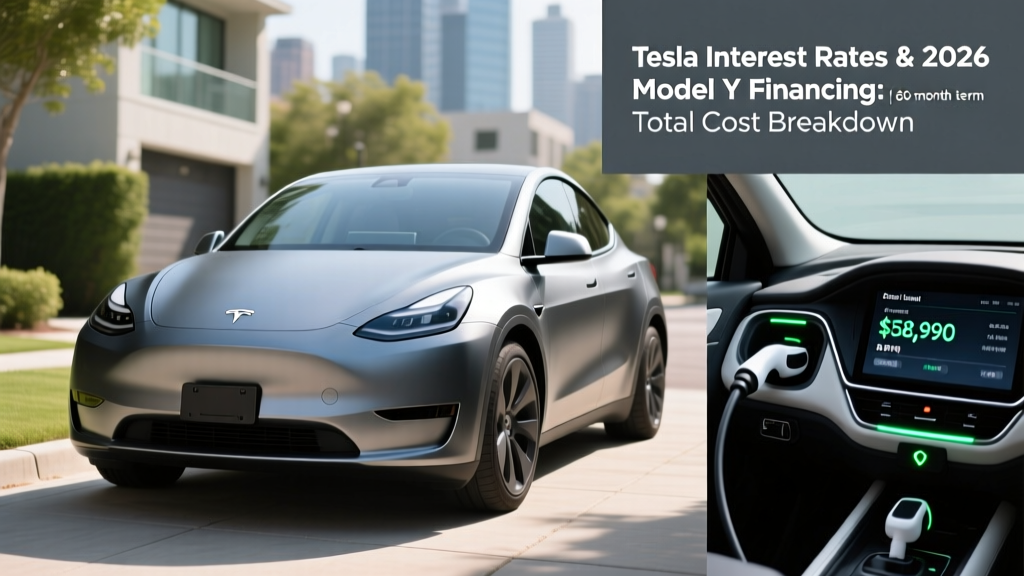
This is where the math gets real. As of early 2026, Tesla interest rates through Tesla's captive financing partners generally range from 5.49% to 8.99% APR depending on credit tier, loan term, and down payment. Buyers with excellent credit (740+) may see promotional rates as low as 4.99% on select inventory, but the average buyer should model their payment at 6.5–7.5%.
| Scenario | Price | Down Payment | APR | Term | Est. Monthly |
|---|---|---|---|---|---|
| Full MSRP, No Credit | $46,630 (incl. dest.) | $5,000 | 6.99% | 72 mo | ~$672 |
| With §30D Credit | $39,130 (after $7,500) | $5,000 | 6.99% | 72 mo | ~$552 |
| Higher Rate Tier | $46,630 | $5,000 | 8.49% | 72 mo | ~$706 |
The gap between a 5.49% and an 8.99% rate over 72 months is roughly $5,800 in total interest paid. Before signing, always compare Tesla's financing offer against a pre-approval from a local credit union — many buyers save 1–2 percentage points by financing externally, especially in the current rate environment.
Federal Tax Credit Eligibility: The §30D Checklist
The Model Y qualifies for the federal EV tax credit under IRS §30D, but eligibility is not universal. The credit can now be transferred at point of sale, effectively reducing your purchase price by up to $7,500 on day one.
- MSRP Cap: SUVs/crossovers must be under $80,000 — Model Y qualifies at ~$46,630 base.
- Buyer Income Limits (MAGI): $150,000 single / $225,000 head of household / $300,000 joint filers.
- Battery Sourcing: Critical minerals and battery components must meet phased-in percentage thresholds from US/FTA countries. Tesla's US-built LFP and NMC packs have progressively met these requirements through 2025–2026 supply chain shifts.
- FEOC Restriction: Vehicles with battery components from Foreign Entities of Concern (primarily Chinese suppliers) may lose partial or full credit. Always verify current status at fueleconomy.gov before purchase.
Consult a tax professional or reference IRS.gov guidance on clean vehicle credits for your specific situation. State-level incentives (Colorado, California, New York, etc.) may stack on top but vary by jurisdiction.
Performance, Interior & Technology
The dual-motor AWD Model Y delivers 384 horsepower and a 4.8-second 0–60 mph time — genuinely quick for a family crossover. The ride quality improved substantially with the Juniper refresh, with revised damping that soaks up highway imperfections better than the pre-2025 model. Steering remains precise if slightly artificial in feel.
Interior dimensions:
- Front legroom: 41.8 inches
- Rear legroom: 41.6 inches (generous for the segment)
- Cargo behind second row: 30.2 cu ft
- Cargo with seats folded: 72.1 cu ft
- Front trunk (frunk): 4.1 cu ft
The minimalist interior centers on a 15.4-inch touchscreen controlling virtually every vehicle function. The updated ambient lighting, ventilated front seats, and power-folding second row add practicality. Tesla's infotainment remains best-in-class for responsiveness, streaming integration, and over-the-air updates — but the lack of physical buttons for climate and wipers continues to frustrate some drivers.
Driver Assistance: Standard Autopilot is a competent SAE Level 2 system with adaptive cruise and lane centering. Full Self-Driving (Supervised) adds automated lane changes, traffic light recognition, and city street navigation — but this is not autonomous driving. You must remain engaged, hands on or near the wheel, with eyes on the road at all times. FSD's monthly subscription ($99/mo) or outright purchase ($8,000) is a personal value call based on your commute.
Competitor Comparison: Model Y vs. The Field
The mid-size electric SUV segment is crowded in 2026. Here's how the Model Y stacks up against key rivals:
| Metric | Tesla Model Y LR | Hyundai Ioniq 5 LR | Ford Mustang Mach-E ER | Kia EV6 LR |
|---|---|---|---|---|
| EPA Range | 320 mi | 305 mi | 320 mi | 310 mi |
| Max DC Charge | 250 kW | 240 kW | 150 kW | 240 kW |
| 10–80% Time | ~27 min | ~18 min (800V) | ~38 min | ~18 min (800V) |
| Base MSRP | $44,990 | $45,500 | $43,995 | $44,500 |
| Charging Network | NACS (Supercharger) | NACS (SC access) | NACS (SC access) | NACS (SC access) |
The Hyundai/Kia 800V architecture charges faster (10–80% in roughly 18 minutes), but Tesla's Supercharger network still leads in reliability and geographic coverage. The Mach-E trails in charging speed but offers a more traditional interior layout with physical controls.
- You prioritize Supercharger network reliability for road trips
- You want best-in-class software, OTA updates, and app integration
- Cargo capacity and rear-seat space are top priorities
- You're comfortable with a touchscreen-centric interior
- You need the absolute fastest DC charging (Ioniq 5/EV6 win)
- You prefer physical buttons and a traditional cockpit (Mach-E, Ioniq 5)
- You want a more engaging driving experience on back roads
Pros, Cons & Verdict
Pros
- Class-leading cargo space and rear-seat comfort
- Supercharger network reliability (20,000+ stalls in North America)
- Excellent software, navigation, and over-the-air feature additions
- Strong efficiency (122 MPGe) keeps charging costs low
- Qualifies for up to $7,500 federal tax credit (verify eligibility)
Cons
- No physical buttons — climate, mirrors, wipers all touchscreen-controlled
- DC charge speed trails 800V competitors (27 min vs. 18 min to 80%)
- Tesla interest rates (5.49–8.99%) can be higher than credit union alternatives
- FSD (Supervised) remains Level 2 — expensive for what it delivers
- Insurance premiums run 15–30% higher than comparable ICE crossovers
Frequently Asked Questions
What are Tesla's current interest rates for Model Y financing?
As of early 2026, Tesla interest rates through their financing partners range from approximately 5.49% to 8.99% APR depending on credit score, loan term (36–72 months), and down payment. Promotional rates occasionally drop to 4.99% for top-tier credit on select inventory. Always compare against external lenders — credit unions often beat captive financing by 1–2%.
Does the 2026 Model Y qualify for the $7,500 federal tax credit?
Yes, the Model Y currently qualifies for the full $7,500 credit under IRS §30D, provided you meet income limits ($150K single / $300K joint), the vehicle MSRP stays under $80,000, and battery sourcing requirements are met. The credit can be applied at point of sale as a price reduction. Verify current eligibility at fueleconomy.gov before purchasing, as sourcing rules can shift.
What is the real-world highway range of the Model Y?
Expect 265–285 miles at 75 mph in moderate temperatures. In cold weather (below 30°F), highway range drops to roughly 210–240 miles due to battery resistance and cabin heating demands. The heat pump helps, but physics wins in deep cold.
How much does home charging cost compared to gas?
At the US average electricity rate of ~$0.17/kWh, fully charging the Model Y's 78 kWh battery costs about $13.30 for 300+ miles — roughly $0.044 per mile. A comparable gas SUV at 25 MPG and $3.40/gallon costs ~$0.136 per mile. Over 15,000 miles annually, that's a savings of approximately $1,380 per year on fuel.
Is the Model Y's battery warranty adequate?
Tesla covers the battery and drive unit for 8 years or 120,000 miles (whichever comes first) with a minimum 70% capacity retention guarantee. Real-world data from high-mileage Teslas shows NMC batteries typically retain 85–90% capacity at 100,000 miles with normal charging habits (avoiding frequent 100% charges and DC fast charging exclusively).
Should I buy or lease the Model Y in 2026?
If Tesla interest rates push your APR above 7.5% and you don't want to commit long-term, leasing may make sense — especially with lease-end residual risk transferred to Tesla. However, leasing disqualifies you from the §30D consumer credit (the leasing company claims it, sometimes passing savings through as a "lease cash" reduction). Run both scenarios with your specific rate before deciding.