The phrase Tesla and Intel doesn't describe a single vehicle — it describes a technology supply-chain relationship that quietly shapes the infotainment, driver-assistance, and computing experience inside some of the most popular EVs on the road. In 2026, as Tesla's Model 3, Model Y, Model S, and Model X continue to dominate U.S. EV sales, understanding what Intel silicon actually does inside a Tesla — and what it doesn't — is essential for buyers who care about tech longevity, over-the-air updates, and real-world feature performance.
This article profiles the current Tesla lineup through the lens of its Intel (and non-Intel) computing hardware, pairs that with the hard EV specs buyers actually need — EPA range, charging speed, pricing, and tax-credit eligibility — and explains why the "Tesla and Intel" search is really a question about how smart a Tesla really is.
Why Buyers Search "Tesla and Intel" in 2026
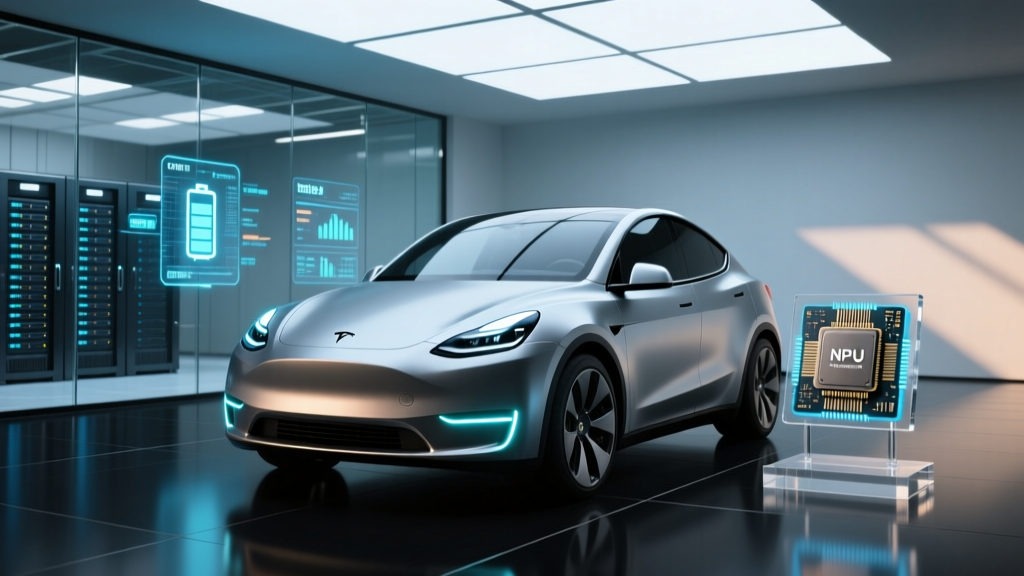
Historically, Tesla used Intel Atom–based processors (the E39xx series) to drive its center touchscreen and infotainment stack. That changed with the introduction of the AMD Ryzen-based MCU (Media Control Unit) starting in late 2021 for the refreshed Model S and Model X, and subsequently rolling into Model 3 and Model Y builds. By the 2026 model year, new Tesla vehicles use AMD silicon for infotainment, not Intel.
So why does "Tesla and Intel" persist as a search query? Three reasons:
- Used-market shoppers are trying to determine whether a pre-2022 Tesla has the older Intel Atom MCU (slower, less capable of running modern UI and games) versus the newer AMD Ryzen MCU.
- FSD Hardware confusion. Tesla's Full Self-Driving computer (HW3 and HW4) is custom Tesla silicon — not Intel, not AMD, not NVIDIA. Buyers conflate the chips.
- Intel's automotive ambitions. Intel, through its Mobileye subsidiary (which Intel spun out but retained a major stake in), supplies ADAS chips to many other automakers. Shoppers cross-referencing Tesla's Autopilot against, say, a BMW or Nissan system are indirectly comparing Tesla's in-house stack against Intel/Mobileye-powered competitors.
2026 Tesla Lineup: The Specs That Actually Matter
Regardless of which chip drives the touchscreen, the EV fundamentals — range, charging, price — are what determine whether a Tesla fits your life. Here's the 2026 lineup at a glance.
| Spec | Model 3 Long Range AWD | Model Y Long Range AWD | Model S Long Range | Model X Long Range |
|---|---|---|---|---|
| EPA Range | 363 mi | 320 mi | 402 mi | 348 mi |
| Battery (usable) | ~75 kWh, NMC | ~75 kWh, NMC | ~95 kWh, NMC | ~95 kWh, NMC |
| Drivetrain | Dual-Motor AWD | Dual-Motor AWD | Dual-Motor AWD | Dual-Motor AWD |
| Horsepower | ~384 hp | ~384 hp | ~670 hp | ~670 hp |
| 0–60 mph | 4.2 sec | 4.8 sec | 3.1 sec | 3.8 sec |
| MPGe (combined) | 134 MPGe | 122 MPGe | 124 MPGe | 109 MPGe |
| Base MSRP | $47,740 | $49,630 | $79,990 | $84,990 |
Sources: fueleconomy.gov, Tesla.com. MSRP reflects 2026 model year and excludes destination fees.
Real-World Range: What the EPA Sticker Doesn't Tell You
Tesla's NMC (nickel-manganese-cobalt) battery chemistry offers higher energy density than LFP (lithium iron phosphate), which is why Long Range variants use it. However, NMC degrades slightly faster over time and benefits from not being held at 100% state of charge daily. Tesla recommends an 80% daily charge limit for NMC packs — which effectively reduces your "daily usable" range to about 80% of the numbers above. Plan accordingly.
Charging Speed: DC Fast Charge and Home Level 2
Charging speed is a top buyer concern, and Tesla's Supercharger network remains a major competitive advantage. Here's what to expect across the 2026 lineup.
| Charge Level | Model 3 / Model Y | Model S / Model X |
|---|---|---|
| Level 1 (120V, 1.4 kW) | ~4 mi/hr | ~4 mi/hr |
| Level 2 (240V, 11.5 kW) | ~44 mi/hr | ~44 mi/hr |
| DC Fast Charge (peak) | 250 kW | 250 kW |
| 10–80% DCFC Time | ~25–28 min | ~30–35 min |
Charge-curve reality check: Peak 250 kW is not sustained. Tesla's charge curve is aggressive in the 10–40% state-of-charge window, then tapers significantly above 60%. If you arrive at a Supercharger at 20% SoC with a preconditioned battery (the car does this automatically when you navigate to a Supercharger), you'll see the fastest speeds. Arriving cold or above 50% SoC will dramatically slow your session.
Home charging on a Level 2 Tesla Wall Connector (up to 11.5 kW / 48 amps) will fully replenish a Model 3 Long Range overnight in roughly 7–8 hours. Installation costs typically range from $800 to $2,500 depending on panel proximity and local permitting — budget for a potential panel upgrade if your home has a 100-amp service.
Pricing, Tax Credits, and What You'll Actually Pay
| Model | Base MSRP | Est. §30D Credit | Effective Price |
|---|---|---|---|
| Model 3 Long Range AWD | $47,740 | $7,500* | ~$40,240 |
| Model Y Long Range AWD | $49,630 | $7,500* | ~$42,130 |
| Model S Long Range | $79,990 | $0† | $79,990 |
| Model X Long Range | $84,990 | $0† | $84,990 |
*§30D credit eligibility is not guaranteed. The IRS §30D Clean Vehicle Credit requires the buyer to meet income caps ($150K single / $300K joint AGI), the vehicle must be under the MSRP cap ($55K for sedans, $80K for SUVs/trucks), and the battery must meet critical-mineral and component-sourcing thresholds that change annually. The Model 3 and Model Y have historically qualified for the full $7,500 when purchased by eligible buyers, but battery-sourcing rules tighten each year. Always verify current eligibility on IRS.gov and consult a tax professional before purchasing. The credit can now be transferred to the dealer at point of sale, reducing your out-of-pocket cost immediately.
† Model S and Model X exceed the MSRP cap for the §30D credit and are not eligible.
The Intel-to-AMD Transition: What It Means for Used-Buyer Tech
If you're shopping the used Tesla market and the "Tesla and Intel" query brought you here, here's the practical breakdown:
- Intel Atom MCU (pre-2022 builds): Adequate for navigation, media, and basic UI. Noticeably slower at loading maps, switching apps, and running the built-in web browser. Cannot run Tesla's in-car gaming library at acceptable frame rates. Does not affect driving, range, or charging.
- AMD Ryzen MCU (late-2021+ for S/X, 2022+ for 3/Y): Significantly faster UI, supports AAA-level in-car gaming, smoother map rendering, better long-term OTA headroom. This is the chip you want if tech responsiveness matters to you.
Tesla offered a paid MCU retrofit for some older Model S/X vehicles (upgrading from Intel to AMD), but availability and pricing vary. Check with a Tesla Service Center for your specific VIN. Model 3/Y vehicles with Intel MCUs generally cannot be retrofitted.
Critically, the MCU chip does not affect Autopilot or FSD performance. Those functions run on Tesla's separate, custom-built FSD Computer (HW3 or HW4, depending on build date). HW4 offers improved camera resolution and processing throughput. If FSD capability matters to you, prioritize a HW4-equipped vehicle (generally 2023+ builds, though the exact cutover varies by model).
Who Should Buy a Tesla in 2026 — and Who Shouldn't
- You want access to the Supercharger network — still the most reliable, widespread DC fast-charging ecosystem in North America.
- You value over-the-air software updates that meaningfully add features over time.
- You prioritize efficiency (MPGe) and range-per-dollar over luxury interior materials.
- You're a tech-forward buyer who enjoys a minimalist, screen-centric interface.
- You want traditional luxury build quality, physical controls, or a plush ride (consider BMW i4/i5, Mercedes EQB/EQE, Genesis Electrified G80).
- You need a sub-$35K new EV (Tesla doesn't offer one yet; consider Chevy Equinox EV or Nissan LEAF).
- You distrust Tesla's service-center wait times or want a traditional dealership experience.
- You need a truck (Rivian R1T, Ford F-150 Lightning) or a 3-row SUV for under $80K (Kia EV9).
Warranty and Long-Term Ownership
Tesla's warranty structure is competitive but not class-leading:
- Basic Vehicle: 4 years / 50,000 miles
- Battery & Drive Unit: 8 years / 120,000 miles (Model 3/Y Long Range) or 8 years / 150,000 miles (Model S/X)
- Capacity retention threshold: Tesla warrants that the battery will retain at least 70% of its original capacity during the warranty period.
Real-world degradation data from owner fleets suggests NMC packs in Teslas lose roughly 5–8% capacity in the first 50,000 miles, then degradation slows considerably. Vehicles with 150,000+ miles commonly report 85–90% state of health. LFP packs (found in the Model 3 RWD Standard Range) tolerate 100% daily charges and may offer longer cycle life, but at the cost of lower energy density and reduced cold-weather performance.
Pros and Cons at a Glance
Pros
- Class-leading efficiency and range-per-kWh
- Supercharger network access (NACS now adopted industry-wide)
- Fast OTA updates add genuine feature value over time
- Strong resale value relative to most EVs
- Model 3/Y qualify for $7,500 §30D credit (eligible buyers)
- AMD Ryzen MCU delivers best-in-class infotainment speed
Cons
- Minimalist interior polarizes; no physical buttons or stalks (turn signals on wheel)
- Panel gaps and paint quality still inconsistent vs. legacy luxury brands
- FSD (Supervised) remains Level 2 — not autonomous, despite the name
- Service center wait times can be lengthy in some metro areas
- No Apple CarPlay or Android Auto
- Model S/X ineligible for federal tax credit due to MSRP cap
Frequently Asked Questions
Does Tesla currently use Intel chips in its 2026 vehicles?
No. Current 2026 Tesla vehicles use AMD Ryzen processors for infotainment (MCU) and Tesla's custom FSD Computer (HW4) for driver-assistance functions. Intel chips were used in Tesla's infotainment systems prior to late 2021/2022, depending on the model.
What is the real-world range of a 2026 Tesla Model 3 Long Range?
The EPA estimates 363 miles. In real-world highway driving at 70–75 mph, expect approximately 290–315 miles. In cold weather (below freezing), that drops to roughly 250–275 miles. Preconditioning the battery and using seat heaters instead of cabin heat can help recover some lost range.
How fast does a Tesla charge at home and on the road?
At home on a Level 2 Tesla Wall Connector (11.5 kW / 48A), a Model 3 Long Range gains about 44 miles of range per hour, fully charging overnight in 7–8 hours. On a V3 Supercharger (250 kW DC), the 10–80% session takes approximately 25–28 minutes with a preconditioned battery. Charging above 80% slows dramatically due to the charge curve taper.
Does the 2026 Tesla Model Y qualify for the $7,500 federal tax credit?
It has historically qualified, but eligibility depends on the buyer's AGI (under $150K single / $300K joint), the vehicle's MSRP (under $80K for SUVs — the Model Y qualifies), and the battery meeting annual critical-mineral and component-sourcing thresholds under IRS §30D rules. Verify current-year eligibility at IRS.gov and consult a tax professional.
Is Tesla's FSD actually self-driving?
No. FSD (Supervised) is an SAE Level 2 driver-assist system. It can handle highway lane-keeping, on-ramp/off-ramp transitions, and some city-street navigation, but the driver must remain fully engaged and ready to take over at any moment. It is not autonomous. Tesla does not currently sell or offer a Level 4 self-driving vehicle.
Is a Tesla worth buying vs. competitors like the Hyundai Ioniq 5 or BMW i4?
It depends on your priorities. Tesla wins on Supercharger network access, efficiency, and software. The Hyundai Ioniq 5 offers faster peak charging (up to 350 kW on 800V architecture), more physical controls, and a competitive price. The BMW i4 delivers superior build quality and a more traditional driving experience at a higher price. Cross-shop all three and test-drive before deciding.
For the latest EPA range and efficiency data, visit fueleconomy.gov. For safety ratings, consult NHTSA and IIHS. Tax-credit rules are subject to change; always confirm at IRS.gov.