When Tesla insiders share sales data — even informally — it paints a picture that marketing brochures never will. The 2026 Tesla Model Y remains the company's global volume leader, but the competitive landscape has shifted dramatically. With refreshed styling, a revised interior, and continued access to the largest fast-charging network in North America, the Model Y still sets the benchmark for the electric compact SUV segment. But does it still deserve your money when rivals like the Hyundai Ioniq 5, Ford Mustang Mach-E, and Chevrolet Equinox EV close the gap?
This review breaks down every number that matters — from real-world range and charging curves to tax credit math — so you can decide based on data, not hype.
2026 Model Y: Full Specifications at a Glance
| Spec | Value |
|---|---|
| EPA Range | 320 miles (Long Range AWD) |
| Battery Capacity | 78.1 kWh usable (NMC chemistry) |
| Drivetrain | Dual-motor AWD |
| Horsepower | 384 hp combined |
| 0–60 mph | 4.8 seconds |
| Peak DC Fast Charge | 250 kW (Supercharger V3) |
| 10–80% DC Charge Time | ~27 minutes |
| Level 2 Home Charge Rate | 11.5 kW (~44 mi/hr) |
| Efficiency | 122 MPGe combined / 28 kWh/100 mi |
| Cargo Volume | 34.3 cu ft (rear seats up) / 72.1 cu ft (folded) |
| Rear Legroom | 38.8 inches |
| Base MSRP | $44,990 (Long Range AWD) |
| Battery Warranty | 8 years / 120,000 miles (min 70% retention) |
The Long Range AWD remains the volume trim. The Performance variant drops the 0–60 to 3.5 seconds and bumps MSRP to $48,990, while the base RWD variant (when available) starts at $39,990 with an EPA range of approximately 295 miles on a smaller 60 kWh LFP battery.
Real-World Range: What the EPA Sticker Doesn't Tell You
Real-World Expectation: 265–290 miles at sustained highway speeds (70–75 mph); 240–260 miles in sub-30°F winter conditions; up to 310 miles in mixed city/suburban driving with regen braking.
Tesla's efficiency engineering remains strong. The Model Y's heat pump — standard since the 2021 refresh — reduces cold-weather cabin-heating draw substantially compared to resistive heaters. Still, physics wins in January. On a 28°F morning highway run at 72 mph, expect to lose roughly 18–22% of your rated range. That's better than most competitors, but it's not zero.
The NMC (nickel-manganese-cobalt) battery in the Long Range offers higher energy density than LFP, giving it the range edge. However, NMC cells degrade slightly faster over time if routinely charged to 100%. Tesla recommends daily charging to 80–90% for NMC packs, reserving 100% for road trips. The base RWD's LFP pack, by contrast, tolerates daily 100% charges with minimal degradation — a trade-off worth understanding if you plan to own the car for 8+ years.
Charging Speed: Supercharger Network vs. Home Setup
Charging speed is where Tesla still holds a tangible advantage, though the gap is narrowing as NACS adoption spreads across rival networks.
| Charge Level | Power / Rate | Miles Added per Hour | Notes |
|---|---|---|---|
| Level 1 (120V) | 1.4 kW | ~4–5 mi/hr | Emergency/trickle only |
| Level 2 (240V, 48A) | 11.5 kW | ~44 mi/hr | Full charge in ~7.5 hours |
| DC Fast (Supercharger V3) | 250 kW peak | ~1,000+ mi/hr (peak) | 10–80% in ~27 min |
| DC Fast (Supercharger V4) | Up to 350 kW* | Faster taper curve | Model Y currently limited to ~250 kW intake |
*V4 Supercharger stalls are rolling out through 2025–2026, but the current Model Y's charge architecture caps intake at approximately 250 kW regardless of stall capability.
The charge curve matters more than the peak number. The Model Y ramps quickly to 250 kW between 10–30% state of charge (SoC), then progressively tapers. From 60–80%, you're seeing roughly 100–120 kW. That's why the 10–80% time is 27 minutes rather than the 15 minutes the peak rate might suggest. For road trips, plan your stops around the 10–60% sweet spot where charging is fastest — adding 200 miles takes about 15 minutes, then move on.
At home, a Tesla Wall Connector on a 60-amp circuit delivers 48 amps / 11.5 kW, replenishing roughly 330 miles overnight. Installation typically runs $800–$2,000 depending on panel proximity and whether your home needs a service upgrade. Always get a quote from a licensed electrician before committing.
Pricing, Tax Credits, and What You'll Actually Pay
| Trim | MSRP | §30D Credit | Effective Price |
|---|---|---|---|
| Long Range AWD | $44,990 | Up to $7,500* | ~$37,490* |
| Performance AWD | $48,990 | Up to $7,500* | ~$41,490* |
*Eligibility for the full $7,500 IRS §30D federal tax credit depends on multiple requirements that shift frequently:
- MSRP cap: SUVs/vans must be under $80,000 — the Model Y clears this easily.
- Buyer income cap: Modified AGI must not exceed $150,000 (single), $225,000 (head of household), or $300,000 (joint).
- Battery sourcing: Critical minerals and battery components must meet escalating domestic-content thresholds. Tesla's shifting supply chain means eligibility can change month to month.
- Point-of-sale transfer: As of 2024, you can transfer the credit to the dealer at purchase, reducing your out-of-pocket cost immediately rather than waiting for tax filing.
Always verify current eligibility on fueleconomy.gov before signing a purchase agreement. The credit is not guaranteed for every buyer or every build week.
Performance, Efficiency, and Daily Drivability
The dual-motor AWD Model Y delivers 384 hp and a 4.8-second 0–60 time — brisk enough for confident highway merging and passing without being excessive. The single-speed transmission means power delivery is instant and linear, with no shift shock.
Efficiency is a genuine Tesla strength. At 122 MPGe combined (28 kWh/100 mi), the Model Y extracts more miles per kilowatt-hour than nearly every competing electric SUV. For context, the Hyundai Ioniq 5 AWD rates at 110 MPGe combined, and the Ford Mustang Mach-E Extended Range AWD at roughly 101 MPGe. Over 15,000 annual miles and an average electricity cost of $0.14/kWh, the Model Y's annual fuel cost lands near $588 — versus $1,800+ for a comparable gas SUV at 25 MPG and $3.50/gallon.
Ride quality has improved in the latest refresh, with revised damper tuning that absorbs highway expansion joints more gracefully. Cabin noise remains low, though the absence of a traditional instrument cluster still divides buyers. Everything routes through the 15.4-inch center touchscreen — climate, mirrors, glovebox, speed readout. If you prefer physical controls, this will be an adjustment period.
Interior Space, Cargo, and Tech Features
The Model Y's hatchback design delivers practical cargo volume that punches above its class: 34.3 cubic feet behind the rear seats and 72.1 cubic feet with them folded. The front trunk (frunk) adds 4.1 cubic feet for charging cables or a small bag. Rear legroom at 38.8 inches is competitive with the Ioniq 5 and slightly tighter than the Mach-E.
Standout tech:
- Over-the-air (OTA) updates that add features post-purchase
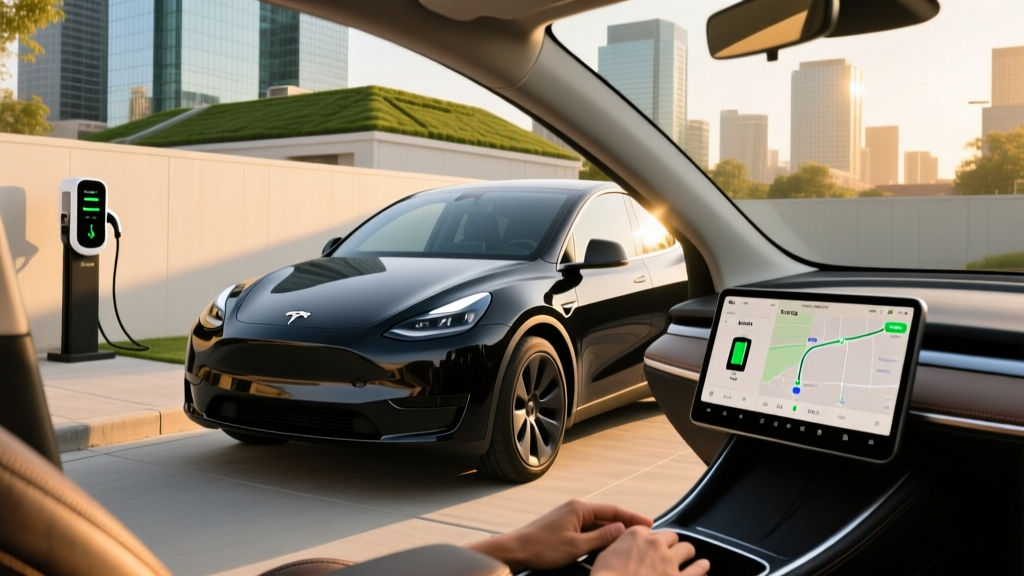
- Native route planning with automatic battery preconditioning for Supercharger stops
- Sentry Mode dashcam recording with phone alerts
- Tesla mobile app with remote climate, location, and charge management
- Available Enhanced Autopilot ($6,000) and FSD Supervised ($8,000) — both remain SAE Level 2 driver-assist systems requiring full driver engagement
Notable drawbacks:
- No Apple CarPlay or Android Auto — Tesla's proprietary infotainment only
- Minimal physical buttons; all adjustments via touchscreen
- Rear visibility is limited; reliance on cameras and mirrors
- Panel gap quality and paint consistency remain inconsistent across production batches
Warranty and Long-Term Ownership
Tesla covers the Model Y's battery and drive unit for 8 years or 120,000 miles (whichever comes first), with a guaranteed minimum 70% capacity retention. The basic vehicle limited warranty is 4 years / 50,000 miles. Compared to Hyundai's 10-year/100,000-mile battery warranty, Tesla's coverage is middle-of-the-pack.
Battery degradation data from fleet analytics (including Tesla's own Impact Report) shows the average Model 3/Y pack retains approximately 85–88% capacity at 100,000 miles. NMC packs degrade faster in the first 20,000 miles, then stabilize. If you charge to 80% daily and avoid repeated DC fast-charging to 100%, long-term health remains strong.
Pros, Cons, and Who Should Buy
- Class-leading efficiency (122 MPGe / 28 kWh/100mi)
- Access to 6,000+ Supercharger stalls across North America
- Strong OTA update pipeline keeps the car evolving
- Competitive real-world range with effective heat pump
- Hatchback cargo versatility exceeds many SUV competitors
- Strong resale value relative to non-Tesla EVs
- No wireless CarPlay/Android Auto
- All-touchscreen interface frustrates some drivers
- Build quality inconsistencies (panel gaps, paint)
- FSD Supervised remains Level 2 — not autonomous despite the name
- Rear-seat comfort is adequate, not premium
- Insurance premiums often 15–25% above segment average
Best for: Daily commuters with home charging access, tech-forward buyers who value OTA updates and Supercharger convenience, and small families needing hatchback versatility without stepping up to a full-size SUV.
Look elsewhere if: You want physical controls, Apple CarPlay, a luxury-grade interior, or you drive in extreme cold climates where LFP range loss would compound. Also reconsider if you need a third row — the Model Y's optional third-row seat is cramped and best suited for small children on short trips.
Frequently Asked Questions
What is the real-world range of the 2026 Tesla Model Y?
The EPA rates the Long Range AWD at 320 miles. In real-world highway driving at 70–75 mph, expect 265–290 miles. In cold weather (below 30°F), plan for 240–260 miles. City driving with regenerative braking can approach the EPA number.
How fast does the Model Y charge at home and on the road?
On a Level 2 home charger (11.5 kW / 48A), the Model Y gains about 44 miles of range per hour, fully charging overnight in roughly 7.5 hours. On a Supercharger V3, it peaks at 250 kW and charges from 10–80% in approximately 27 minutes.
How much does the 2026 Model Y cost after federal tax credits?
The Long Range AWD starts at $44,990. If you qualify for the full $7,500 §30D credit (income, sourcing, and MSRP requirements apply), the effective price drops to approximately $37,490. Always verify current eligibility on irs.gov and fueleconomy.gov before purchase.
Does the 2026 Model Y qualify for the federal EV tax credit?
It may qualify for up to $7,500 under IRS §30D, but eligibility depends on your income (under $150K single / $300K joint), the vehicle's battery component and critical-mineral sourcing, and MSRP caps (under $80K for SUVs — the Model Y qualifies). Credit availability changes as Tesla adjusts supply chains. Check the latest at irs.gov.
Is the Model Y worth buying vs. the Hyundai Ioniq 5 or Ford Mach-E?
The Model Y wins on efficiency, Supercharger network access, and OTA software evolution. The Ioniq 5 offers faster 10–80% charging (under 18 minutes on 350 kW chargers), Apple CarPlay, and a more distinctive design. The Mach-E offers a more traditional SUV interior layout and competitive range. If Supercharger reliability matters most to you, the Model Y still leads. If you prefer physical controls or CarPlay, look at the competition.
What are the biggest pros and cons?
Top pros: class-leading efficiency, unmatched charging network, strong cargo space, continuous software improvements. Top cons: touchscreen-only controls, no CarPlay, build quality variability, high insurance costs, and FSD Supervised is not true self-driving.