Why Tesla's Induction Motor Still Matters in 2026
While most of the EV industry has standardized on permanent-magnet synchronous motors (PMSMs) for their superior low-speed efficiency, Tesla continues to deploy AC induction motors in specific drivetrain positions — most notably as the front motor in dual-motor Model S and Model X configurations. This isn't legacy stubbornness. It's a deliberate engineering trade-off that gives Tesla's flagship sedans and SUVs distinct advantages in highway efficiency, regenerative braking behavior, and long-term reliability that buyers should understand before signing a purchase agreement.
This review covers the 2026 Tesla Model S and Model X — the two vehicles in Tesla's current lineup that utilize the Tesla motors induction motor architecture in their dual-motor all-wheel-drive systems. We'll break down the real-world range, charging performance, pricing after federal tax credits, and whether these aging-but-refined platforms still compete against fresher rivals from Lucid, BMW, and Rivian.
2026 Tesla Model S & X: Core Specifications
| Spec | Model S Long Range | Model S Plaid | Model X Long Range | Model X Plaid |
|---|---|---|---|---|
| EPA Range | 402 mi | 359 mi | 335 mi | 326 mi |
| Battery (usable) | ~100 kWh (NMC) | ~100 kWh (NMC) | ~100 kWh (NMC) | ~100 kWh (NMC) |
| Drivetrain | Dual-Motor AWD | Tri-Motor AWD | Dual-Motor AWD | Tri-Motor AWD |
| Horsepower | 670 hp | 1,020 hp | 670 hp | 1,020 hp |
| 0–60 mph | 3.1 sec | 1.99 sec | 3.8 sec | 2.5 sec |
| Top Speed | 155 mph | 200 mph | 155 mph | 163 mph |
| Peak DC Charge Rate | 250 kW | 250 kW | 250 kW | 250 kW |
| 10–80% DCFC Time | ~30 min | ~30 min | ~31 min | ~31 min |
| Level 2 Rate (11.5 kW) | ~41 mi/hr | ~41 mi/hr | ~34 mi/hr | ~34 mi/hr |
| MPGe (combined) | 120 MPGe | 112 MPGe | 102 MPGe | 98 MPGe |
| Base MSRP | $79,990 | $94,990 | $84,990 | $99,990 |
Sources: fueleconomy.gov, Tesla Model S, Tesla Model X. Specs reflect 2026 model year. Prices exclude $1,390 destination fee.
Real-World Range: What the EPA Sticker Doesn't Tell You
Mixed real-world driving: expect 340–370 miles at moderate temperatures (60–75°F) with a blend of city and suburban driving. Sustained highway travel at 75+ mph drops this to approximately 290–320 miles due to aerodynamic drag scaling with the square of velocity. In cold weather (below 30°F), plan for 260–300 miles of usable range before needing to charge, as cabin heating and battery thermal management consume significant energy. The Model S benefits from Tesla's heat pump, which mitigates cold-weather losses compared to resistive heating, but the 100 kWh NMC pack still loses 20–25% of effective capacity in deep winter conditions.
The Model X, being heavier and less aerodynamic (drag coefficient ~0.26 vs the Model S's ~0.208), sees proportionally larger real-world shortfalls. EPA-rated 335 miles on the Long Range trim translates to roughly 270–300 miles in mixed driving and 230–260 miles on a cold-weather highway run. For road trippers, this means planning Supercharger stops every 220–250 miles to maintain a comfortable state-of-charge buffer — a non-issue on Tesla's Supercharger network but worth noting when routing through rural charging deserts.
The induction motor's role in this efficiency story is nuanced. Because an AC induction motor generates zero drag when de-energized (unlike a permanent-magnet motor, which produces cogging torque), the front motor in Tesla's dual-motor setup can be completely decoupled during steady-state cruising. This "freewheeling" capability reduces parasitic losses on the highway, contributing to the Model S's class-leading highway efficiency for a vehicle of its size and power.
Charging Performance: 250 kW Peak, but Mind the Curve
| Charging Level | Power / Rate | Miles Added per Hour | Notes |
|---|---|---|---|
| Level 1 (120V, 12A) | ~1.4 kW | ~3–4 mi/hr | Emergency/trickle only |
| Level 2 (240V, 48A) | 11.5 kW | ~34–41 mi/hr | Full overnight charge in ~9–10 hrs |
| DC Fast Charge (V3 Supercharger) | Peak 250 kW | ~182 mi in 15 min | 10–80% in ~30 min |
| DC Fast Charge (CCS adapter, non-Tesla) | Up to 250 kW | Varies by station | CCS adapter included since 2024 |
Tesla's 250 kW V3 Supercharger peak rate remains competitive in 2026, though it no longer leads the pack. The Hyundai Ioniq 5 and Porsche Taycan both sustain higher charge rates for longer portions of their charge curves. The critical metric isn't peak kW — it's the charge curve profile. The Model S and X hit 250 kW only between roughly 15–35% state of charge, then taper progressively: ~180 kW at 50%, ~120 kW at 65%, and ~60 kW above 80%. This taper is typical of NMC chemistry and explains why the 10–80% time is approximately 30 minutes despite the impressive peak figure.
For home charging, Tesla's Wall Connector at 48 amps (11.5 kW) on a 60-amp circuit adds roughly 41 miles of range per hour in the Model S — enough to fully replenish a daily commute overnight. Installation costs typically run $800–$2,000 depending on panel proximity and whether a 200-amp service upgrade is needed. Always hire a licensed electrician and pull a permit; a 60-amp circuit requires 6 AWG copper wire in most jurisdictions.
Preconditioning matters. When navigating to a Supercharger via the Tesla navigation system, the vehicle automatically warms the battery to optimal charging temperature. Without preconditioning — for example, arriving at a charger after a short cold-weather trip — peak charge rates can be 30–50% lower for the first several minutes.
The Induction Motor Explained: Engineering Trade-Offs
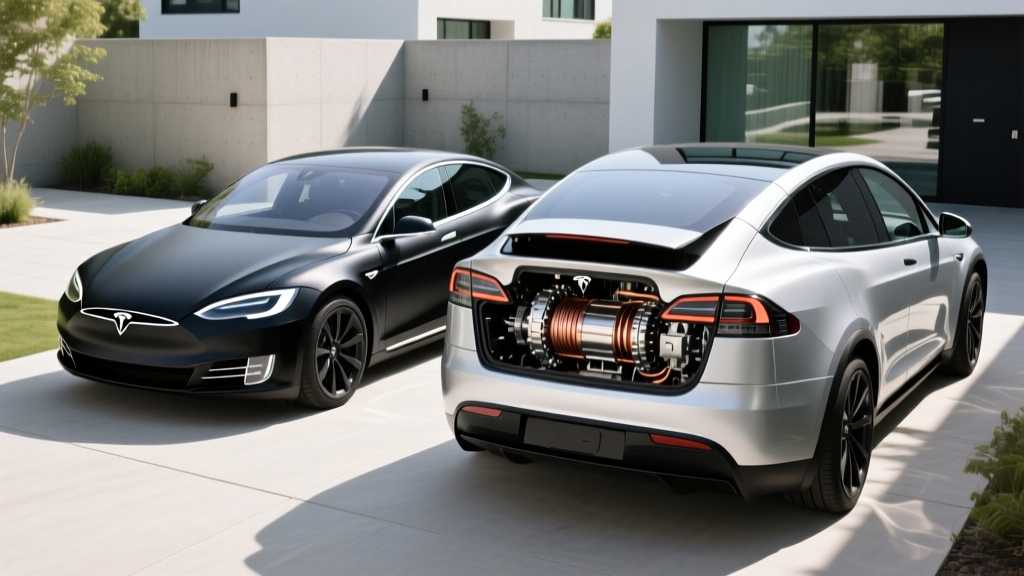
Tesla's dual-motor AWD vehicles pair a permanent-magnet synchronous reluctance motor (PMSRM) on the rear axle with an AC induction motor on the front axle. The Plaid tri-motor variants use one front induction motor and two rear permanent-magnet motors. Here's why Tesla retains induction technology where competitors have abandoned it:
- Zero cogging torque when de-energized: A permanent-magnet motor always produces some magnetic drag, even when not powered. An induction motor, having no permanent magnets in its rotor, spins freely when current is removed. During highway cruising, Tesla's control software can shut off the front induction motor entirely, eliminating drivetrain drag and boosting efficiency.
- No rare-earth dependency: Induction motors use no neodymium or dysprosium, insulating Tesla from supply-chain volatility in permanent-magnet materials. This was a strategic advantage during the 2022–2023 rare-earth price spikes.
- Superior high-RPM performance: Induction motors maintain torque characteristics at very high rotational speeds, which is why the Model S Plaid uses one on the front axle — it complements the permanent-magnet rear motors during the 150+ mph pulls that define the Plaid's performance envelope.
- Robust thermal behavior: Induction motors handle sustained high-load conditions without risk of permanent-magnet demagnetization, making them ideal for repeated hard launches and track use.
The trade-off is lower peak efficiency at low speeds and light loads compared to a permanent-magnet motor. For a city-only commuter, a PMSM-only drivetrain (like the Model 3 RWD or the Hyundai Ioniq 6) will extract slightly more miles per kWh. But for the highway-heavy, high-performance use case that Model S and X buyers represent, the induction motor's advantages are well-matched.
Pricing, Trims, and Federal Tax Credit Eligibility
| Trim | Base MSRP | Federal §30D Credit | Effective Price | Credit Eligible? |
|---|---|---|---|---|
| Model S Long Range | $79,990 | Not eligible | $79,990 | No — exceeds $55,000 sedan MSRP cap |
| Model S Plaid | $94,990 | Not eligible | $94,990 | No — exceeds $55,000 sedan MSRP cap |
| Model X Long Range | $84,990 | Not eligible | $84,990 | No — exceeds $80,000 SUV MSRP cap |
| Model X Plaid | $99,990 | Not eligible | $99,990 | No — exceeds $80,000 SUV MSRP cap |
Critical tax credit note: Neither the Model S nor the Model X qualifies for the IRS §30D federal EV tax credit in 2026. The Model S is classified as a sedan and exceeds the $55,000 MSRP cap. The Model X is classified as an SUV but exceeds the $80,000 MSRP cap. Additionally, buyer income limits apply ($300,000 joint / $150,000 single for new vehicles), and battery critical-mineral and component sourcing requirements must be met regardless of price. Tesla does offer referral credits and occasional promotional financing, but buyers should not factor the $7,500 federal credit into their budget for these models.
Options that push prices higher include Ultra Red paint ($2,500), 21-inch Arachnid wheels on the Model S ($4,500), six-seat interior on the Model X ($6,500), and Full Self-Driving (Supervised) capability ($8,000). A fully optioned Model X Plaid can approach $120,000 before taxes and fees.
Interior, Cargo, and Daily Practicality
Model S: The refreshed interior features a 17-inch center touchscreen (tilting, 2200×1300 resolution), a rear-seat 8-inch touchscreen, a yoke or round steering wheel option, and ventilated front seats. Cargo volume is 28 cu ft behind the rear seats and 79 cu ft with seats folded — augmented by a 5.3 cu ft frunk. Rear legroom measures 35.4 inches, adequate for adults on shorter trips but tighter than a BMW i7 or Lucid Air.
Model X: The falcon-wing rear doors remain the Model X's signature feature, providing excellent overhead clearance for loading children into car seats. Cargo volume is 88 cu ft behind the front seats (five-seat config) or 81.5 cu ft (six-seat), plus a 6.6 cu ft frunk. The available third row is best suited for children — adults will find it cramped beyond short trips. Second-row legroom is a generous 40.9 inches in the five-seat layout.
Both vehicles include Tesla's HEPA air filtration system (Bioweapon Defense Mode), a 22-speaker audio system, wireless phone charging, and USB-C ports throughout. Build quality has improved since the 2023 Highland-inspired refresh, though panel gap consistency still trails German competitors at this price point.
Driver Assistance: Autopilot and FSD (Supervised)
Tesla Autopilot and Full Self-Driving (Supervised) are SAE Level 2 driver-assistance systems. The driver must remain fully attentive, keep hands on the steering wheel (or demonstrate attention via the cabin camera), and be prepared to take over immediately. These are not self-driving systems. Only Level 4 services like Waymo One operate without a human driver in geofenced areas. Tesla's FSD (Supervised) can navigate intersections, change lanes, and follow navigation routes, but it makes errors that require human correction — particularly in construction zones, unmapped areas, and adverse weather.
Standard Autopilot includes Traffic-Aware Cruise Control and Autosteer (lane centering on divided highways). The $8,000 FSD (Supervised) upgrade adds Navigate on Autopilot (highway on-ramp to off-ramp), Auto Lane Change, Autopark, Summon, and traffic light/stop sign recognition. As of 2026, Tesla continues to refine FSD through over-the-air updates, and the system's performance on well-marked highways is genuinely impressive — but urban and suburban driving still requires constant vigilance. For buyers who primarily drive on interstates, FSD reduces fatigue on long trips. For city-heavy commuters, the value proposition is weaker.
Warranty, Ownership Costs, and Longevity
Tesla's warranty coverage for the Model S and X includes:
- Basic vehicle: 4 years / 50,000 miles
- Battery and drive units: 8 years / 150,000 miles (Long Range) or 8 years / 150,000 miles (Plaid), with a minimum 70% capacity retention threshold
- Corrosion: 12 years, unlimited miles
The 150,000-mile battery warranty is competitive with BMW's 8-year/100,000-mile coverage and slightly behind Hyundai's 10-year/100,000-mile policy. Real-world data from Tesla's fleet suggests the 100 kWh NMC packs in the Model S and X degrade approximately 10–12% over the first 100,000 miles, with the degradation curve flattening significantly after that. Owners who regularly charge to 100% and fast-charge daily will see faster degradation than those who maintain a 20–80% daily window and rely primarily on Level 2 home charging.
Insurance costs are a real consideration: the Model S and X consistently rank among the most expensive EVs to insure, with annual premiums averaging $3,200–$4,800 depending on state, driving record, and trim. Tesla Insurance is available in select states and uses real-time driving data to set rates, which can benefit low-mileage, cautious drivers but penalize aggressive ones. Always obtain insurance quotes before purchasing.
Model S & X vs. Key Competitors
| Attribute | Tesla Model S LR | Lucid Air Pure | BMW i7 xDrive50 | Tesla Model X LR |
|---|---|---|---|---|
| EPA Range | 402 mi | 419 mi | 318 mi | 335 mi |
| Base MSRP | $79,990 | $69,900 | $105,700 | $84,990 |
| 0–60 mph | 3.1 sec | 5.2 sec | 4.5 sec | 3.8 sec |
| Peak DC Charge | 250 kW | 200 kW | 195 kW | 250 kW |
| Supercharger Access | Native | NACS adapter | NACS adapter | Native |
| Charging Network | Best-in-class | Good (via adapter) | Good (via adapter) | Best-in-class |
The Lucid Air Pure undercuts the Model S on price and beats it on range, but Tesla's Supercharger network and software ecosystem remain unmatched. The BMW i7 offers vastly superior interior luxury and ride quality at a steep premium. For SUVs, the Model X competes against the Rivian R1S (more off-road capable, shorter range) and the Mercedes EQS SUV (more luxurious, far more expensive). The Model X's falcon-wing doors and tri-motor Plaid performance remain unique in the segment.
Pros and Cons
Pros
- Class-leading range (Model S: 402 mi EPA)
- Access to 19,000+ Tesla Superchargers natively
- Induction motor freewheeling boosts highway efficiency
- Over-the-air updates continuously add features
- Plaid variants offer hypercar performance at sedan/SUV prices
- Strong resale value relative to luxury EV peers
Cons
- No federal tax credit (exceeds MSRP caps)
- Insurance costs significantly above segment average
- 250 kW peak charge rate now mid-pack vs. 350 kW competitors
- Interior quality still trails BMW/Mercedes at this price
- FSD (Supervised) requires $8,000 and constant supervision
- Aging platform design (fundamentally unchanged since 2021 refresh)
Who Should Buy the Model S or Model X?
Decision Framework
Choose the Model S if: You want the longest-range performance sedan available, prioritize Supercharger network access for frequent road trips, and value software-driven feature updates over traditional luxury materials.
Choose the Model X if: You need a three-row electric SUV with distinctive styling, regularly transport children (falcon-wing doors are genuinely useful for car seats), and want Plaid-level acceleration in a family vehicle.
Look elsewhere if: You're budgeting below $75,000 (consider Model 3/Y, Ioniq 5, or EV6), you want the latest-generation interior luxury (BMW i7, Lucid Air), or you need the $7,500 federal tax credit to make the math work.
Frequently Asked Questions
What is the real-world range of the 2026 Tesla Model S?
The EPA rates the Model S Long Range at 402 miles. In real-world mixed driving at moderate temperatures, expect 340–370 miles. Highway-only driving at 75+ mph yields approximately 290–320 miles, and cold weather (below 30°F) reduces effective range to roughly 260–300 miles.
How fast does the Model S charge at home and on the road?
On a Level 2 home charger (11.5 kW / 48A), the Model S adds about 41 miles of range per hour, fully charging in roughly 9–10 hours. On a V3 Supercharger, it peaks at 250 kW and charges from 10–80% in approximately 30 minutes. Actual charge speed depends on battery temperature, state of charge, and station capacity.
Does the Tesla Model S or X qualify for the $7,500 federal EV tax credit?
No. As of 2026, neither qualifies under IRS §30D rules. The Model S exceeds the $55,000 sedan MSRP cap, and the Model X exceeds the $80,000 SUV MSRP cap. Buyer income limits and battery-sourcing requirements also apply to credit eligibility in general.
What's the difference between Tesla's induction motor and permanent-magnet motors?
Tesla uses an AC induction motor on the front axle of dual-motor vehicles. Unlike permanent-magnet motors, induction motors produce zero magnetic drag when de-energized, allowing the front motor to freewheel during highway cruising for improved efficiency. They also avoid rare-earth material dependency and handle sustained high-load conditions well. The trade-off is slightly lower peak efficiency at low speeds compared to permanent-magnet designs.
Is the Model S Plaid worth the premium over Long Range?
The Plaid adds 350 hp, a tri-motor setup, and a 1.99-second 0–60 time for $15,000 more. For track enthusiasts and acceleration junkies, it's one of the fastest production cars ever built. For daily drivers, the Long Range's 3.1-second 0–60 and 43 additional miles of EPA range make it the more rational choice. The Plaid also sacrifices some range (359 vs 402 mi) due to the additional motor weight and more aggressive power delivery.
How long will the Model S battery last?
Tesla warranties the battery for 8 years or 150,000 miles with a minimum 70% capacity retention. Fleet data suggests real-world degradation of 10–12% over the first 100,000 miles. With proper charging habits (daily 20–80% window, minimal DC fast charging), many owners report batteries lasting 200,000+ miles with usable capacity. Full battery replacement, if ever needed outside warranty, currently costs approximately $15,000–$22,000 at Tesla service centers.