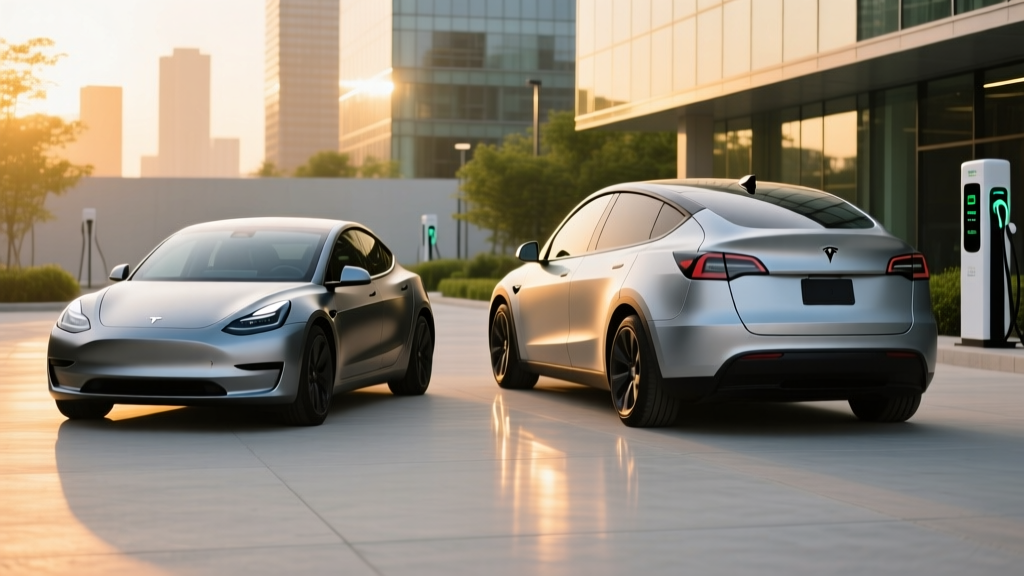
Searches for Tesla incentives August 2025 spiked as buyers tried to time purchases around shifting federal credit rules. Now well into the 2026 model year, the landscape for Tesla's two volume sellers — the refreshed Model 3 and Model Y — has crystallized. This profile breaks down exactly what you'll pay, what you'll drive, and whether the IRS §30D credit still applies to the trim you want.
2026 Tesla Model 3 & Model Y: Quick Verdict
The 2026 Model 3 (Highland refresh) and 2026 Model Y (Juniper refresh) remain the default EVs for American buyers who want a mature Supercharger network, class-leading efficiency, and over-the-air updates. The Model 3 Long Range AWD delivers 341 miles of EPA range for under $48,000 before incentives; the Model Y Long Range AWD offers 320 miles and practical crossover cargo space starting near $50,000. Both qualify for the full $7,500 federal tax credit under current §30D rules — provided you meet income caps and the vehicle's MSRP stays under the SUV/sedan thresholds. That credit can now be transferred at the point of sale, effectively reducing your out-of-pocket cost on delivery day.
Specs at a Glance: Model 3 vs Model Y (2026)
| Spec | Model 3 Long Range AWD | Model Y Long Range AWD |
|---|---|---|
| EPA Range | 341 mi | 320 mi |
| Battery (usable) | ~75 kWh, NMC | ~75 kWh, NMC |
| Efficiency | 132 MPGe / 25 kWh/100mi | 122 MPGe / 28 kWh/100mi |
| Peak DC Fast Charge | 250 kW | 250 kW |
| 10–80% DC Time | ~27 min | ~27 min |
| Level 2 Home Rate | 11.5 kW (~44 mi/hr) | 11.5 kW (~44 mi/hr) |
| 0–60 mph | 4.2 sec | 4.8 sec |
| Horsepower | ~384 hp (dual motor) | ~384 hp (dual motor) |
| Drivetrain | AWD (dual motor) | AWD (dual motor) |
| Cargo Volume | 23 cu ft (trunk+frunk) | 76 cu ft (seats folded) |
| Base MSRP | $47,740 | $49,990 |
| Battery Warranty | 8 yr / 120,000 mi | 8 yr / 120,000 mi |
Source: fueleconomy.gov and Tesla spec sheets. MSRP excludes destination; prices subject to change.
Real-World Range: What the EPA Sticker Doesn't Tell You
Model Y Long Range AWD: EPA 320 mi — expect ~265–285 mi highway; ~225–250 mi in cold conditions.
Tesla's efficiency is among the best in the segment, thanks to the heat pump (standard on both models) and excellent aerodynamics (Model 3's drag coefficient is ~0.219 Cd). However, EPA range assumes a mix of city and highway driving at moderate temperatures. On a 75°F day at 65 mph, you'll get close to sticker. Push 80 mph on the interstate, and energy consumption climbs steeply — EVs are far more speed-sensitive than gas cars because aerodynamic drag scales with the square of velocity. In sub-30°F weather, expect 20–30% range reduction even with the heat pump; preconditioning the battery while plugged in mitigates some of this loss.
Charging Speed: Supercharger Network Advantage
| Level | Power | Miles Added per Hour | Notes |
|---|---|---|---|
| Level 1 (120V) | ~1.4 kW | ~3–5 mi/hr | Emergency/trickle only |
| Level 2 (240V, 48A) | 11.5 kW | ~44 mi/hr | Home Wall Connector; full charge ~7–8 hr |
| DC Fast (Supercharger V3) | Peak 250 kW | ~180 mi in 15 min | 10–80% in ~27 min; tapers sharply above 80% |
| DC Fast (V4 Supercharger) | Peak 250 kW (current vehicles) | Similar to V3 | V4 cabinets support higher power, but 2026 Model 3/Y are capped at 250 kW |
Tesla's NACS connector is now the North American standard, with Ford, GM, Rivian, and others adopting it. For 2026 Model 3 and Model Y owners, this means access to over 6,000 Supercharger stalls in the US plus growing third-party networks that have added NACS cables. The charge curve is the critical detail: both models peak at 250 kW only between roughly 10–30% State of Charge. By 60% SoC, power drops to ~100 kW, and above 80% it slows to under 40 kW. Plan road-trip stops to charge from 10–80% and skip the slow top-off unless you're ending the day's drive.
Federal Tax Credit: Do You Qualify Under §30D?
Both the 2026 Model 3 and Model Y currently qualify for the full $7,500 federal EV tax credit under IRS §30D, assuming you meet all eligibility requirements. The point-of-sale transfer option (available since January 2024) lets you apply the credit as an immediate price reduction at delivery rather than waiting for a tax refund.
- Vehicle MSRP Cap: Model 3 (sedan) must be under $55,000; Model Y (classified as SUV) under $80,000 — both currently qualify on Long Range trims.
- Buyer Income Cap (MAGI): $150,000 single / $225,000 head of household / $300,000 joint filers. Exceed these and you lose the credit entirely.
- Battery Sourcing: Critical minerals and battery components must meet escalating domestic-content thresholds. Tesla's Austin-built packs with US-sourced minerals currently satisfy these requirements — but always verify at fueleconomy.gov before purchasing, as sourcing rules can shift mid-year.
- Final Assembly: Must be in North America (both vehicles are built in Fremont, CA or Austin, TX).
- One-time use: You can only claim the new-vehicle credit once every three years.
| Trim | Base MSRP | After $7,500 Credit | Notes |
|---|---|---|---|
| Model 3 RWD | $39,990 | $32,490 | LFP battery, ~272 mi EPA |
| Model 3 Long Range AWD | $47,740 | $40,240 | NMC, 341 mi EPA |
| Model 3 Performance | $54,990 | $47,490 | Under $55K sedan cap — still qualifies |
| Model Y Long Range AWD | $49,990 | $42,490 | NMC, 320 mi EPA |
| Model Y Performance | $53,490 | $45,990 | Under $80K SUV cap — qualifies |
Credit eligibility depends on your MAGI, the vehicle's exact MSRP as configured, and current battery-sourcing rules. Consult IRS.gov §30D guidance or a tax professional before relying on this credit.
Interior, Tech, and Daily Usability
The 2026 Model 3 Highland refresh brought meaningful improvements: ventilated front seats, ambient lighting, rear touchscreen for passengers, and a noticeably quieter cabin thanks to acoustic glass and better insulation. The 15.4-inch center display handles all controls — there are no physical stalks (turn signals are steering-wheel buttons), which remains polarizing. The Model Y Juniper refresh mirrors these updates with a slightly larger 16-inch screen and improved ride quality from retuned suspension.
Driver Assistance: Basic Autopilot (lane centering + adaptive cruise) is standard. Enhanced Autopilot ($6,000) adds auto lane change and navigate-on-autopilot. Full Self-Driving (Supervised) costs $8,000 or $99/month and enables city-street autosteering — but this is SAE Level 2, meaning you must keep hands on or near the wheel and eyes on the road at all times. It is not self-driving.
Cargo: Model 3's trunk holds 23 cu ft (including the frunk), which is sedan-competitive. Model Y offers 30 cu ft behind the second row and 76 cu ft with seats folded — genuinely SUV-practical for furniture runs or camping gear. Both offer a usable front trunk (frunk) for charging cables or a small bag.
Pros
- Class-leading efficiency (25–28 kWh/100mi)
- Supercharger network — still the most reliable DC fast-charging ecosystem
- Over-the-air updates continuously add features
- $7,500 credit eligible (with point-of-sale transfer)
- Strong resale value relative to EV segment
Cons
- No physical turn-signal stalk — button-based signals frustrate some drivers
- Minimalist interior isn't for everyone; no instrument cluster
- FSD (Supervised) is expensive and still requires full driver attention
- Ride firmness on 19/20-inch wheels (improved with Highland/Juniper but still sporty)
- Insurance premiums often 15–25% above segment average
Competitive Comparison: Is Tesla Still the Default?
The 2026 Hyundai Ioniq 5 (318 mi EPA, ~$53,000 Long Range AWD) charges faster on paper (peak 350 kW with 800V architecture, 10–80% in ~18 min) and offers a more conventional interior with physical controls. The Ford Mustang Mach-E (320 mi Extended Range, ~$51,000) delivers engaging driving dynamics. The Chevrolet Equinox EV (319 mi, ~$43,000) undercuts on price.
Where Tesla still wins: Supercharger access (though competitors are gaining NACS access), efficiency (fewer kWh per mile means cheaper charging), and software integration. Where it loses: interior material quality (Hyundai/Kia feel more premium at this price) and charging speed (400V architecture limits Tesla to 250 kW peak vs 800V competitors at 350 kW).
Who Should Buy the 2026 Model 3 or Model Y?
Choose the Model Y Long Range if: You need hatchback/crossover versatility for kids, dogs, or gear, and can accept ~20 fewer miles of range. The 76 cu ft max cargo volume is the real differentiator.
Look elsewhere if: You prioritize plush ride quality, traditional controls, or want the absolute fastest DC charging (consider Ioniq 5/6 with 800V).
Frequently Asked Questions
What is the real-world range of the 2026 Model 3 Long Range?
EPA rates it at 341 miles. In mixed real-world driving at moderate temperatures, expect 300–320 miles. Sustained 75+ mph highway driving drops this to ~285–305 miles. In freezing weather with cabin heat, plan for 240–265 miles.
How fast does the Model Y charge at home and on the road?
On a Level 2 home charger (Tesla Wall Connector at 11.5 kW / 48A), you'll add ~44 miles per hour — a full charge takes 7–8 hours. On a V3 Supercharger, peak rate is 250 kW, with 10–80% in ~27 minutes. Expect ~180 miles of range added in 15 minutes under ideal conditions.
Does the 2026 Model 3 qualify for the $7,500 federal tax credit?
Yes, as of current 2026 rules — provided your MAGI is under $150K (single) / $300K (joint), the vehicle's MSRP is under $55,000 (sedan cap), and battery-sourcing requirements are met. All current Model 3 trims fall under the cap. Verify at fueleconomy.gov before purchasing.
Is the Tesla Model Y worth it over the Hyundai Ioniq 5?
It depends on your priorities. Model Y wins on Supercharger convenience, cargo volume (76 vs 59 cu ft), and efficiency. Ioniq 5 wins on DC charge speed (350 kW vs 250 kW), interior materials, and physical controls. Both qualify for the $7,500 credit.
What's the battery warranty on the 2026 Model 3 and Model Y?
Tesla covers the battery and drive unit for 8 years or 120,000 miles (whichever comes first) on Long Range and Performance trims, with a minimum 70% capacity retention threshold. The base RWD Model 3 (LFP battery) is covered for 8 years / 100,000 miles.
Is Full Self-Driving actually self-driving?
No. FSD (Supervised) is SAE Level 2 driver-assist. You must remain fully engaged — hands near the wheel, eyes on the road — at all times. The system handles many driving scenarios but can and does make errors requiring immediate human intervention. Level 4 autonomous driving (no human needed) is only available in geofenced robotaxi services like Waymo.