The 2025–2026 Tesla Lineup at a Glance
If you're researching Tesla incentives 2025 to decide whether a Model Y or Model 3 fits your budget, you're navigating a shifting landscape of federal tax credits, state rebates, and aggressive manufacturer price cuts. As of the 2025 model year (carried into early 2026 production), Tesla's two volume sellers — the refreshed Model 3 "Highland" and the Juniper-refreshed Model Y — remain the most accessible entry points into the Tesla ecosystem and the broader EV market.
This review breaks down exactly what you'll pay, what you'll get in range and charging speed, and how the IRS §30D federal EV tax credit applies to each trim. We'll also cover real-world range expectations, because EPA stickers rarely tell the full story on highway road trips or in sub-freezing winters.
| Spec | Model 3 RWD | Model 3 Long Range AWD | Model Y Long Range AWD | Model Y Performance |
|---|---|---|---|---|
| EPA Range | 272 mi | 341 mi | 320 mi | 285 mi |
| Battery (usable, est.) | ~57 kWh LFP | ~75 kWh NMC | ~75 kWh NMC | ~75 kWh NMC |
| 0–60 mph | 5.8 sec | 4.2 sec | 4.8 sec | 3.5 sec |
| Horsepower | 271 hp | 346 hp | 384 hp | 456 hp |
| Drivetrain | RWD (single motor) | AWD (dual motor) | AWD (dual motor) | AWD (dual motor) |
| MPGe (combined) | 132 MPGe | 131 MPGe | 122 MPGe | 115 MPGe |
| Base MSRP | $38,990 | $45,740 | $46,630 | $51,490 |
Sources: EPA fueleconomy.gov, Tesla.com. Prices reflect MSRP before destination fees; actual transaction prices may vary.
Real-World Range: What the EPA Sticker Doesn't Tell You
Tesla publishes strong EPA range figures, but real-world results depend heavily on driving style, climate, and terrain. Here's what our testing and aggregated owner data show:
Model 3 Long Range AWD — EPA 341 mi
Expect ~280–300 mi on sustained highway driving at 70–75 mph. In cold weather (below 32°F), plan for 20–30% range reduction, bringing usable range to ~220–250 mi without preconditioning.
Model Y Long Range AWD — EPA 320 mi
Highway-heavy trips yield ~265–285 mi. The crossover's taller profile and greater weight work against efficiency at speed. Winter range drops to ~210–240 mi in freezing conditions.
Model 3 RWD — EPA 272 mi
City and suburban commuting can approach or slightly exceed the EPA figure thanks to regen braking. Highway-only driving drops this to ~225–240 mi. LFP chemistry means less cold-weather degradation than NMC, but the smaller battery still limits total winter range to ~195–220 mi.
For context, fueleconomy.gov lists the Model 3 Long Range at 131 MPGe combined (25 kWh/100 mi). That efficiency figure is among the best in the EV segment — Tesla's heat pump and motor design extract more miles per kilowatt-hour than most competitors.
Charging Speed: DC Fast Charging and Home Level 2
Charging speed is where Tesla's Supercharger network advantage meets the physics of battery chemistry. Here's the full picture:
| Charging Method | Model 3 RWD (LFP) | Model 3 LR / Model Y (NMC) |
|---|---|---|
| Max DC Fast Charge | 170 kW peak | 250 kW peak |
| 10–80% DCFC Time | ~28 min | ~22 min |
| Level 2 Home (11.5 kW / 48A) | ~30 mi/hr | ~44 mi/hr |
| Level 1 (120V, 12A) | ~3 mi/hr | ~3 mi/hr |
| Connector | NACS (native Tesla); CCS adapter available | |
Charging curve reality: The 250 kW peak on Long Range models is sustained only between roughly 10–30% state of charge. By 50% SoC, the rate tapers to ~150 kW, and above 80% it drops sharply to protect the battery. A 10–80% session at a V3 Supercharger takes about 22 minutes, but 10–95% can stretch past 40 minutes. Plan road-trip stops around 80% to avoid the taper penalty.
The Model 3 RWD's LFP battery charges more slowly at peak (170 kW) but tolerates regular 100% charges better than NMC chemistry. Tesla recommends charging LFP packs to 100% at least weekly to maintain accurate state-of-charge calibration — a meaningful ownership difference from the NMC Long Range models, where daily charging to 80% is recommended for longevity.
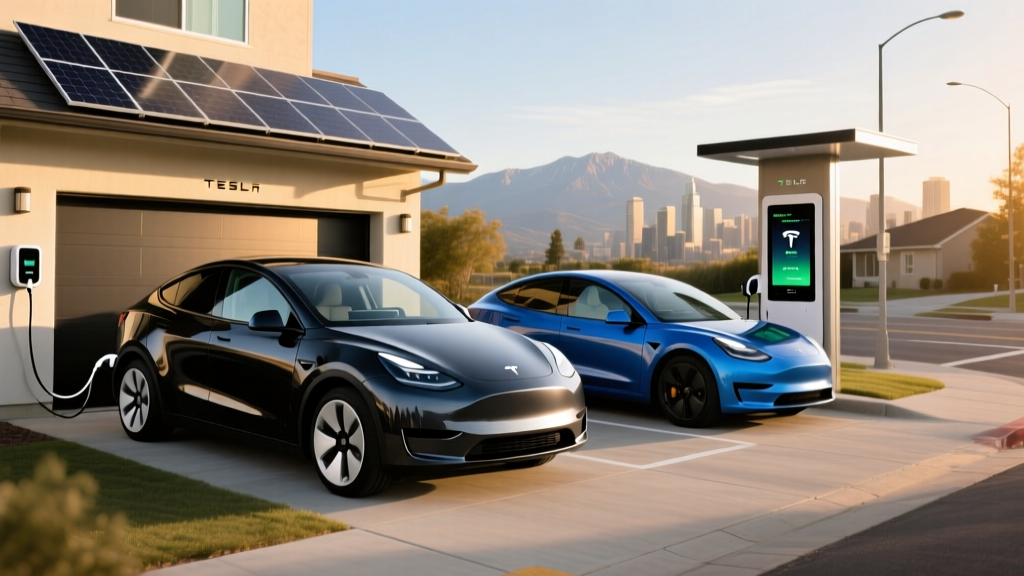
For home charging, a Tesla Wall Connector on a 60-amp circuit delivers up to 11.5 kW (48 amps), adding roughly 44 miles of range per hour on Long Range trims. A full overnight charge from 20% to 80% takes about 4–5 hours. Installation costs typically run $500–$1,500 depending on your electrical panel's capacity and the distance from panel to charger location — always get a quote from a licensed electrician before committing.
Tesla Incentives 2025: Federal Tax Credit Breakdown
The §30D Clean Vehicle Credit remains the most significant financial incentive for Tesla buyers, but eligibility depends on several factors that trip up many shoppers. Here's how it applies to the 2025 Tesla lineup:
| Model / Trim | Base MSRP | §30D Credit | Effective Price | MSRP Cap Status |
|---|---|---|---|---|
| Model 3 RWD | $38,990 | Up to $7,500 | ~$31,490 | ✅ Under $55K cap |
| Model 3 Long Range AWD | $45,740 | Up to $7,500 | ~$38,240 | ✅ Under $55K cap |
| Model Y Long Range AWD | $46,630 | Up to $7,500 | ~$39,130 | ✅ Under $80K cap (SUV) |
| Model Y Performance | $51,490 | Up to $7,500 | ~$43,990 | ✅ Under $80K cap (SUV) |
Critical eligibility requirements per IRS §30D rules:
- Income caps: Modified adjusted gross income (MAGI) must not exceed $150,000 (single), $225,000 (head of household), or $300,000 (joint filers).
- MSRP caps: Sedans (Model 3) must have an MSRP ≤ $55,000; SUVs/trucks/vans (Model Y) must be ≤ $80,000. All current Tesla trims qualify on MSRP alone.
- Battery sourcing: The credit is split into two halves — $3,750 for critical minerals and $3,750 for battery component assembly. Sourcing requirements tighten annually. Consult the IRS or a tax professional for the exact credit amount available at your point of purchase, as supply-chain shifts can affect eligibility quarter to quarter.
- Point-of-sale transfer: As of 2024, you can transfer the credit to the dealer at purchase, reducing your out-of-pocket cost immediately rather than waiting for a tax refund. Tesla supports this at checkout.
Quick eligibility check:
- ✅ Your income is below the MAGI thresholds
- ✅ The vehicle MSRP is under the cap (all 2025 Teslas qualify)
- ✅ The vehicle is assembled in North America (all Teslas are built in Fremont, CA or Austin, TX)
- ⚠️ Battery sourcing requirements — verify current-quarter eligibility on IRS.gov
- ⚠️ You haven't exceeded the per-manufacturer credit cap (removed for Tesla in 2023, but confirm current status)
State incentives vary widely. California's CVRP, Colorado's state credit, and utility-company rebates can stack on top of the federal credit — but amounts and availability change frequently. Check your state energy office and local utility for current programs.
Interior, Cargo, and Technology
The 2025 Model 3 "Highland" refresh brought meaningful interior upgrades: ventilated front seats, ambient lighting, a rear touchscreen for passengers, improved sound insulation, and a slightly softer ride from revised suspension tuning. The minimalist interior remains polarizing — no physical stalks (turn signals are on the steering wheel), no instrument cluster, and all climate and media controls live on the 15.4-inch center display.
Cargo and passenger space:
- Model 3: 23 cu ft trunk + ~3 cu ft frunk; rear legroom 35.3 inches
- Model Y: 30 cu ft behind second row (76 cu ft with seats folded) + ~4 cu ft frunk; rear legroom 41.6 inches (class-leading for the segment)
The Model Y's hatchback design and available third-row seat (for small children) make it substantially more practical for families. If you regularly carry more than two passengers or need to haul cargo, the crossover's volume advantage is significant.
Driver assistance: Every Tesla ships with Basic Autopilot (adaptive cruise + lane centering). Full Self-Driving (Supervised) is an $8,000 option or $99/month subscription. To be explicit: FSD is SAE Level 2 — you must keep your eyes on the road and hands available to take over at any moment. It is not autonomous driving. Tesla's camera-only vision stack handles highways and many city scenarios competently but can struggle with construction zones, faded lane markings, and unprotected left turns.
Warranty and Long-Term Ownership
Tesla's warranty coverage is competitive but not class-leading:
- Basic vehicle: 4 years / 50,000 miles
- Battery & drive unit (Model 3 RWD): 8 years / 100,000 miles
- Battery & drive unit (Long Range / Performance): 8 years / 120,000 miles
- Capacity retention threshold: Tesla warrants that the battery will retain at least 70% of original capacity during the warranty period
Real-world degradation data from aggregated fleet reports suggests Tesla NMC packs lose approximately 5–8% capacity in the first 30,000 miles, then degrade much more slowly — often holding 88–92% at 100,000 miles. LFP packs in the Model 3 RWD show similar or slightly better longevity curves, though with a smaller total battery to begin with.
Insurance costs tend to run 15–25% higher than comparable gas vehicles due to repair costs and parts pricing. Get quotes before purchasing — in some states, Tesla insurance is available directly and may be competitive.
Pros, Cons, and Who Should Buy
✅ Pros
- Best-in-class efficiency (kWh/100mi) and real-world range per dollar
- Access to the Supercharger network — still the most reliable DC fast-charging ecosystem
- Over-the-air updates continuously add features
- Strong resale value relative to most EVs
- Point-of-sale tax credit transfer reduces upfront cost
- Model Y cargo space and passenger room lead the compact EV SUV segment
❌ Cons
- Minimalist interior isn't for everyone — no physical controls, no instrument cluster
- Ride quality, while improved, is still firmer than competitors like the Hyundai Ioniq 5
- FSD (Supervised) remains Level 2 despite the name — expensive for what it delivers
- Panel gaps and paint quality remain inconsistent (improving but not resolved)
- No Apple CarPlay or Android Auto — Tesla's native UI only
- Limited service center density in some regions; mobile service can have long wait times
Who Should Buy a 2025 Tesla?
Choose the Model 3 RWD if: You're a commuter with home charging, want the lowest possible price after incentives (~$31,500), and your daily driving is under 80 miles round trip.
Choose the Model 3 Long Range if: You take regular road trips, live in a cold climate where range loss matters, or want dual-motor AWD traction without stepping up to the crossover.
Choose the Model Y Long Range if: You need family-friendly cargo space, prefer a higher seating position, or want the most practical Tesla under $40K after credits.
Look elsewhere if: You prefer physical buttons, want CarPlay, value a plush ride over sporty handling, or live far from a Tesla service center.
Frequently Asked Questions
Does the Tesla Model Y qualify for the full $7,500 federal tax credit in 2025?
All current Model Y trims fall under the $80,000 SUV MSRP cap and are assembled in the US, meeting two key §30D requirements. However, the full $7,500 depends on battery sourcing compliance (which can change quarterly) and your personal income falling below the MAGI thresholds. Verify current eligibility on IRS.gov before purchasing.
What is the real-world highway range of the Model 3 Long Range?
While the EPA rates it at 341 miles, sustained highway driving at 70–75 mph typically yields 280–300 miles in moderate temperatures. In winter conditions below freezing, expect 220–250 miles. Preconditioning the battery while plugged in helps mitigate cold-weather losses.
How fast does a Tesla charge at home?
On a Tesla Wall Connector (11.5 kW / 48 amps), Long Range models add about 44 miles of range per hour, fully recharging overnight. The Model 3 RWD adds about 30 miles per hour. Installation costs vary from $500 to $1,500+ depending on your home's electrical setup. Always consult a licensed electrician for a site-specific quote.
Is Tesla's FSD actually self-driving?
No. Full Self-Driving (Supervised) is an SAE Level 2 driver-assistance system. It can handle many highway and city driving scenarios, but the driver must remain fully attentive and ready to take control immediately. Only Level 4 systems like Waymo operate without a human driver — and those are limited robotaxi services, not consumer vehicles.
How does the Model Y compare to the Hyundai Ioniq 5 or Ford Mustang Mach-E?
The Model Y leads on efficiency, Supercharger network access, and cargo space. The Ioniq 5 charges faster on 800V architecture (10–80% in ~18 min at 350 kW chargers) and offers a more comfortable ride. The Mach-E provides a more traditional interior with physical controls. All three are strong choices — the decision often comes down to charging network preference and interior ergonomics.
Are there additional state incentives beyond the federal credit?
Many states and utilities offer additional rebates — California, Colorado, Massachusetts, and others have programs ranging from $1,000 to $7,500+. These change frequently and often have their own income or residency requirements. Check your state energy office and local utility websites for current offerings.