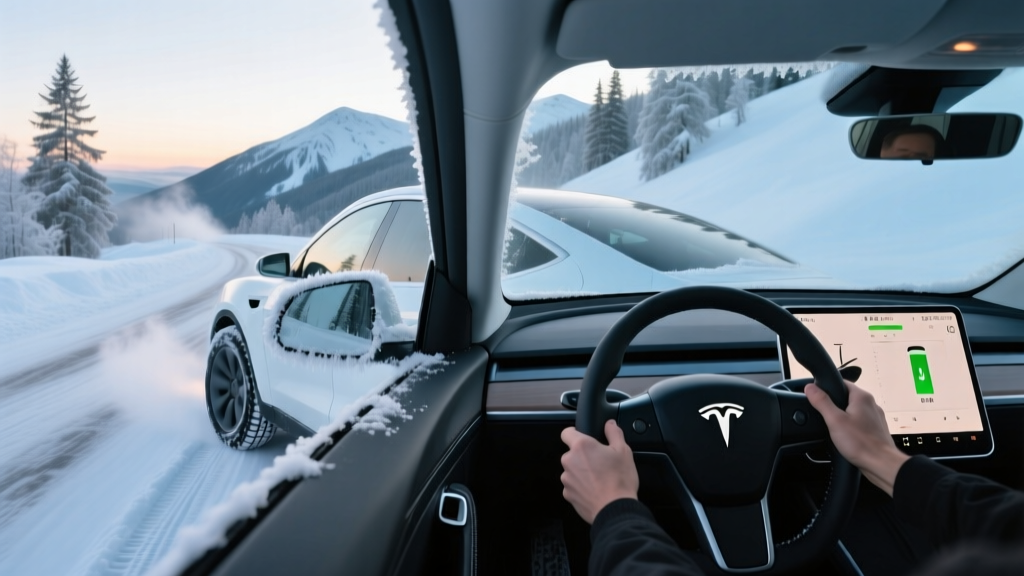
If you live above the 38th parallel, you've probably asked yourself whether a Tesla in the snow is a viable daily proposition — or a recipe for range anxiety and driveway strandings. The short answer: modern Teslas are among the most capable EVs in winter conditions, thanks to sophisticated dual-motor traction control, heat-pump-based thermal management, and the Supercharger network's cold-weather reliability. But winter exacts a real, measurable toll on range, charging speed, and efficiency that every prospective buyer needs to understand before signing a purchase agreement.
This guide walks through exactly what happens to a Tesla when temperatures drop below freezing, how much range you'll actually lose, which models perform best on snow and ice, and what cold-climate owners can do to minimize the winter penalty. We'll use the current 2026 Model Y and Model 3 lineup as our primary references, since they represent the bulk of Tesla's volume and the most relevant options for snow-belt buyers.
How Cold Weather Affects Tesla Range and Efficiency
Lithium-ion batteries are chemically sluggish in cold temperatures. Internal resistance increases, the battery management system (BMS) diverts energy to warm the pack, and cabin heating demands rise sharply. For any EV — Tesla included — winter means fewer miles per kWh.
EPA Estimate (2026 Model Y Long Range AWD): 320 miles
Real-World Highway (55°F, moderate speeds): ~280–295 miles
Real-World Winter (20°F, highway, cabin heat on): ~210–240 miles
Expect a 25–35% range reduction in sustained sub-freezing driving. Short trips in extreme cold (below 10°F) with a cold-soaked battery can push losses to 40% or more until the pack warms up. Source: fueleconomy.gov EV technology overview.
The physics are straightforward. A cold battery can't accept or deliver energy as efficiently, so Tesla's thermal management system uses a portion of the pack's energy to heat itself before it can deliver full power or accept a fast charge. Simultaneously, the cabin heater — which in a gas car is "free" waste heat from the engine — must be generated electrically. Tesla's heat pump (standard on all current models) is significantly more efficient than resistive heating, drawing roughly 1–2 kW in moderate cold versus 4–6 kW for older resistive systems, but it's still a meaningful energy draw.
Efficiency by the Numbers
The 2026 Model Y Long Range AWD carries an EPA efficiency rating of 122 MPGe combined, translating to roughly 28 kWh per 100 miles in mild conditions. In winter testing at sustained highway speeds in temperatures between 15°F and 30°F, expect that figure to climb to 36–42 kWh/100mi — a 30–50% efficiency penalty depending on speed, wind, and cabin heat settings.
Which Tesla Model Is Best for Snow?
Not all Teslas are created equal when the roads turn white. Here's a breakdown of the current 2026 lineup ranked by snow and ice capability:
| Model / Trim | Drivetrain | 0-60 mph | HP | EPA Range | Battery (kWh, chemistry) | Base MSRP |
|---|---|---|---|---|---|---|
| Model Y Long Range AWD | Dual-motor AWD | 4.8 sec | 384 | 320 mi | ~75 kWh usable, NMC | $44,990 |
| Model Y Performance | Dual-motor AWD | 3.5 sec | 510 | 293 mi | ~75 kWh usable, NMC | $48,990 |
| Model 3 Long Range AWD | Dual-motor AWD | 4.2 sec | 346 | 341 mi | ~75 kWh usable, NMC | $42,490 |
| Model 3 RWD (Standard) | Rear-wheel drive | 5.8 sec | 271 | 272 mi | ~57 kWh usable, LFP | $36,990 |
| Model X Long Range | Dual-motor AWD | 3.8 sec | 670 | 329 mi | ~95 kWh usable, NMC | $74,990 |
The snow-belt winner: Model Y Long Range AWD. It offers the best combination of dual-motor traction, range buffer to absorb winter losses, ground clearance (6.6 inches — adequate for plowed roads and moderate accumulation), and cargo space for winter gear. The Model 3 Long Range AWD is a close second for those who don't need crossover utility.
Avoid in deep snow country: The Model 3 RWD with its LFP battery. LFP (lithium iron phosphate) chemistry suffers steeper cold-weather range losses than NMC — typically 35–45% in sub-freezing conditions versus 25–35% for NMC. LFP's advantage is longevity and cost, but winter range is its trade-off. Rear-wheel drive also limits traction on unplowed inclines compared to dual-motor AWD.
Tesla's Winter Traction and Stability Systems
Tesla's dual-motor AWD system is entirely electronic — there's no mechanical linkage between the front and rear axles. Each motor independently manages torque distribution in real time, reacting to wheel slip in milliseconds. In practice, this means a dual-motor Tesla on winter tires can match or exceed the traction of many traditional AWD systems on packed snow and ice.
Key winter-specific features across the Tesla lineup include:
- Traction Control: Individual wheel braking and torque vectoring prevent wheelspin on icy patches. Response time is faster than mechanical AWD systems.
- Chill Mode: Limits torque output for smoother acceleration on low-grip surfaces — useful when pulling away from a stoplight on glare ice.
- Regenerative Braking Reduction: In cold weather, Tesla's BMS automatically reduces regen strength to prevent rear-wheel lockup on slick surfaces (particularly relevant for RWD models). The touchscreen displays a dotted regen arc indicating limited regeneration.
- Low Center of Gravity: The under-floor battery pack gives Teslas a weight distribution and rollover resistance advantage over taller ICE vehicles.
The single most important upgrade for snow driving: dedicated winter tires. Tesla's factory all-season tires are adequate for occasional light snow, but a set of Nokian Hakkapeliittas or Michelin X-Ices on a dual-motor Tesla transforms the vehicle into a genuinely confident winter machine. Budget $800–$1,400 for a set of winter tires on aftermarket wheels.
Cold-Weather Charging: What Changes Below Freezing
Cold batteries charge slowly. This isn't a Tesla quirk — it's fundamental electrochemistry. Lithium plating can occur if you force high current into a cold cell, so the BMS restricts charging power until the pack reaches an optimal temperature window (typically 50–70°F internally).
| Charging Method | Max Power | Rate (Warm Battery) | Rate (Cold Battery, ~20°F) | Notes |
|---|---|---|---|---|
| Level 1 (120V household) | 1.4 kW | ~3–4 mi/hr | ~2–3 mi/hr | Minimal cold impact; very slow regardless |
| Level 2 (240V home Wall Connector) | 11.5 kW (48A) | ~37–44 mi/hr | ~30–38 mi/hr | Some energy diverted to pack heating; overnight charging largely unaffected |
| DC Fast Charge (V3 Supercharger) | 250 kW peak | 10–80% in ~25 min | 10–80% in ~35–45 min | Significant taper until pack warms; preconditioning critical |
| DC Fast Charge (V4 Supercharger) | ~325 kW peak (select vehicles) | 10–80% in ~20 min | 10–80% in ~30–40 min | Available on newer architectures; cold penalty still applies |
The Preconditioning Advantage
Tesla's navigation-based battery preconditioning is one of the most valuable winter features. When you navigate to a Supercharger, the car begins warming the battery pack 10–20 minutes before arrival, using grid power if plugged in or pack energy if driving. This means you arrive at the charger with a battery near its optimal temperature, enabling near-peak charging speeds even when the ambient temperature is well below freezing.
Owner tip: Always navigate to your Supercharger stop — even if you know the route — to trigger preconditioning. Skipping navigation costs you 10–15 minutes of charging time in cold weather.
Pricing, Tax Credits, and the Winter Value Equation
Buying a Tesla for snow-country driving means choosing between several trims. Here's what the 2026 pricing looks like, including federal tax credit considerations under IRS §30D:
| Model / Trim | Base MSRP | As-Tested (typical options) | Federal §30D Credit | Effective Price (with credit) |
|---|---|---|---|---|
| Model 3 RWD | $36,990 | $37,990 | Up to $7,500 (eligibility varies) | ~$29,490–$37,990 |
| Model 3 Long Range AWD | $42,490 | $44,490 | Up to $7,500 (eligibility varies) | ~$34,990–$44,490 |
| Model Y Long Range AWD | $44,990 | $47,490 | Up to $7,500 (eligibility varies) | ~$37,490–$47,490 |
| Model Y Performance | $48,990 | $51,990 | Up to $7,500 (eligibility varies) | ~$41,490–$51,990 |
| Model X Long Range | $74,990 | $79,990 | $0 (exceeds MSRP cap) | $74,990–$79,990 |
Federal tax credit caveats (2026 rules): The §30D credit of up to $7,500 requires the buyer to meet income caps ($150K single / $300K joint MAGI), the vehicle must be under the MSRP cap ($55,000 for sedans, $80,000 for SUVs/trucks), and the battery must meet critical mineral and component sourcing requirements that tighten annually. Tesla's credit eligibility has fluctuated as sourcing rules evolve — always verify current eligibility on IRS.gov's clean vehicle credits page before purchasing. The credit can now be transferred to the dealer at point of sale, reducing your out-of-pocket cost directly.
Living With a Tesla in Winter: Practical Ownership Notes
Cargo and Passenger Space
The Model Y offers 30.2 cubic feet of cargo space behind the rear seats and 72.1 cu ft with the rear row folded — enough for four sets of skis, winter boots, and groceries simultaneously. Rear legroom is 37.7 inches. The front trunk (frunk) adds 4.1 cu ft for charging cables or an emergency winter kit. The Model 3 sedan provides 23.0 cu ft of trunk space and 35.4 inches of rear legroom — adequate for two adults and carry-on luggage, tighter for family road trips with winter gear.
Tech Features That Matter in Cold Weather
- App-based preconditioning: Warm the cabin and defrost windows from your phone while the car is still plugged in at home — preserving battery for driving, not heating.
- Heated seats and steering wheel: Standard on all trims. Heated seats draw far less energy (~100W per seat) than cabin air heating (~2,000–4,000W), making them a range-preserving comfort strategy.
- Heat pump HVAC: Tesla's octovalve heat-pump system scavenges waste heat from the battery and motors to heat the cabin, significantly reducing the winter efficiency penalty versus resistive heating.
- Autopilot / FSD (Supervised): Tesla's Level 2 driver-assistance system works in snow, but lane markings obscured by snow or heavy precipitation can cause the system to disengage or behave unpredictably. The driver must remain fully engaged — this is not autonomous driving. See NHTSA's guidance on automated vehicle safety for SAE level definitions.
Drawbacks to Acknowledge
Tesla's winter capability is strong, but it's not without compromises:
- Ground clearance: At 5.5–6.6 inches depending on model, Teslas will struggle in deep unplowed snow that a Subaru Outback (8.7 inches) or a truck would clear easily.
- Door handles: The flush door handles on the Model 3 and Model Y can freeze shut in ice storms. Owners report using de-icer spray or the app's cabin preconditioning to thaw them.
- Regen unpredictability: Cold-reduced regen means you'll use friction brakes more in winter, and the transition between regen and friction braking can feel inconsistent until the battery warms.
- No spare tire: Teslas ship without a spare, relying on tire sealant or roadside assistance. A winter blowout in a rural area is a genuine inconvenience.
- Dual-motor AWD traction rivals or exceeds mechanical AWD systems on snow and ice
- Heat pump minimizes cabin-heating energy draw vs. competitors
- App-based preconditioning preserves range and improves morning comfort
- Supercharger network provides reliable long-distance winter travel
- Navigation-triggered battery preconditioning enables faster cold-weather DC charging
- Low center of gravity enhances stability on icy roads
- 25–40% range loss in sustained sub-freezing conditions is real and must be planned for
- LFP battery (Model 3 RWD) suffers steeper cold-weather penalties
- Ground clearance insufficient for deep unplowed roads
- Door handles prone to freezing in ice storms
- No spare tire — a liability in remote winter conditions
- Autopilot/FSD can struggle with obscured lane markings in snow
Who Should Buy a Tesla for Snow Driving?
A Tesla — specifically a dual-motor AWD Model Y or Model 3 — is an excellent winter daily driver if:
- You have reliable home Level 2 charging (the single biggest winter advantage: you start every morning with a full "tank" and a warm battery).
- Your daily commute and typical errands fall within ~120 miles round trip, leaving comfortable range buffer even with winter losses.
- You're willing to invest in dedicated winter tires — this is non-negotiable for confident snow and ice driving.
- Your area has reasonable Supercharger access for longer winter road trips.
- You drive primarily on plowed roads rather than unplowed rural routes requiring high ground clearance.
A Tesla is a poor winter choice if you regularly travel 300+ miles between charging points in remote areas with no reliable DC fast-charging infrastructure, or if you need to navigate deep unplowed snow on mountain passes or rural roads where ground clearance matters more than traction technology.
Frequently Asked Questions
What is the real-world range of a Tesla in winter?
For a 2026 Model Y Long Range AWD rated at 320 miles EPA, expect approximately 210–240 miles of real-world range in sustained highway driving at 20°F with cabin heat active. City driving with frequent stops and regenerative braking recovers somewhat more, typically 230–260 miles. The Model 3 RWD with its LFP battery may drop to 150–175 miles from its 272-mile EPA rating in the same conditions.
How fast does a Tesla charge in cold weather?
At home on a Level 2 Wall Connector (11.5 kW), cold-weather charging adds roughly 30–38 miles of range per hour versus 37–44 in warm weather — a modest difference since overnight charging gives the pack time to warm. At a V3 Supercharger (250 kW peak), a cold-soaked battery may take 35–45 minutes for a 10–80% charge versus 25 minutes with a warm battery. Always use navigation to precondition before arriving.
How much does a Tesla cost after tax credits?
A 2026 Model Y Long Range AWD at $44,990 MSRP could drop to approximately $37,490 if you qualify for the full $7,500 §30D federal credit (via point-of-sale transfer). Eligibility depends on your MAGI (under $300K joint / $150K single), the vehicle meeting critical mineral and battery component sourcing thresholds, and MSRP cap compliance. Verify current eligibility at IRS.gov before purchase.
Is a Tesla worth buying vs. competitors for snow driving?
Against rivals like the Hyundai Ioniq 5 AWD (EPA 290 mi, 800V charging, ~$47,400) or the Ford Mustang Mach-E AWD (EPA 290–312 mi, ~$43,995), Tesla's advantages are the Supercharger network's winter reliability and the heat-pump efficiency. Competitors may offer more ground clearance (Ioniq 5: 6.1 in; Mach-E: 5.7 in — similar to Tesla), and some have better cold-weather charging architectures (Ioniq 5's 800V system charges extremely fast when preconditioned). For pure winter range and charging infrastructure confidence, Tesla retains an edge. For interior quality and dealer service access, competitors may appeal more.
Does Tesla's Autopilot work in snow?
Tesla's Autopilot and FSD (Supervised) are SAE Level 2 driver-assistance systems — the driver must remain fully attentive at all times. In light snow with visible lane markings, the system functions normally. In heavy snow, slush-covered roads, or when lane markings are obscured, the system may issue warnings, reduce functionality, or disengage entirely. Never rely on Autopilot as a substitute for attentive winter driving.
What's the best Tesla battery chemistry for cold climates?
NMC (nickel manganese cobalt) batteries, found in Long Range and Performance trims, retain range better in cold weather than LFP (lithium iron phosphate) batteries found in the Model 3 RWD. If winter range preservation is a priority, choose a Long Range or Performance trim with NMC chemistry. LFP's advantages — lower cost, longer cycle life, and the ability to charge to 100% daily without degradation concerns — are more relevant in mild climates.
How long is the Tesla battery warranty?
Tesla covers the battery and drive unit for 8 years or 100,000 miles (whichever comes first) on Model 3 and Model Y RWD, and 8 years or 120,000 miles on Long Range and Performance variants. The warranty guarantees the battery will retain at least 70% of its original capacity during the coverage period. Real-world data from high-mileage Teslas suggests typical degradation of 8–12% over the first 100,000 miles — well within warranty thresholds.