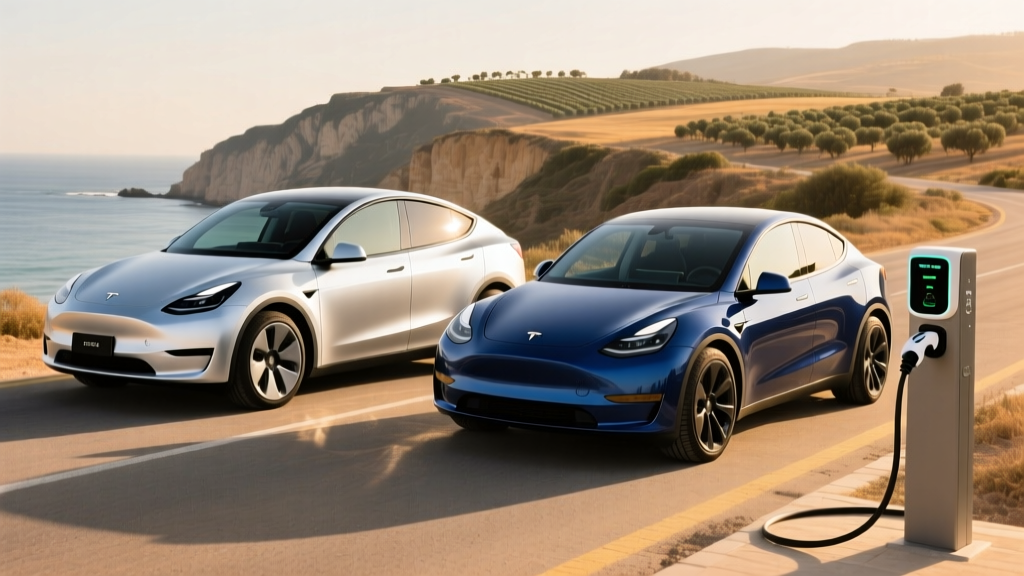
If you've searched for Tesla in Israel, you're likely one of two people: an Israeli buyer evaluating whether a Model 3 or Model Y makes sense in a country smaller than New Jersey, or a US-based EV shopper curious how Tesla's global footprint translates to real-world ownership abroad. Either way, the numbers tell a compelling — and sometimes surprising — story.
Israel has become one of Tesla's most successful per-capita markets. The Model 3 and Model Y dominate registration charts, the Supercharger network spans the country from Eilat to the northern border, and local incentives make EVs financially competitive against ICE vehicles despite high import taxes. This guide breaks down the 2026 Model 3 and Model Y specs, Israeli pricing context, and what US buyers should know before cross-shopping.
2026 Tesla Model 3: The Entry Point for Tesla in Israel
The 2026 Tesla Model 3 (Highland refresh) remains the more affordable gateway into Tesla ownership. In Israel, it's the volume seller — particularly the RWD base trim, which benefits most from local EV tax incentives.
| Spec | RWD | Long Range AWD | Performance |
|---|---|---|---|
| EPA Range | 341 mi | 363 mi | 315 mi |
| Battery (usable) | ~57.5 kWh (LFP) | ~75 kWh (NMC) | ~75 kWh (NMC) |
| Peak DC Charge | 170 kW | 250 kW | 250 kW |
| 10–80% DC Time | ~25 min | ~22 min | ~22 min |
| Level 2 Home Charge | 11.5 kW (~44 mi/hr) | 11.5 kW (~44 mi/hr) | 11.5 kW (~44 mi/hr) |
| 0–60 mph | 5.8 sec | 4.2 sec | 2.9 sec |
| Horsepower | 271 hp | 384 hp | 510 hp |
| Drivetrain | RWD | Dual-Motor AWD | Dual-Motor AWD |
| EPA Efficiency | 132 MPGe (25 kWh/100mi) | 131 MPGe (26 kWh/100mi) | 115 MPGe (29 kWh/100mi) |
| US Base MSRP | $38,990 | $47,740 | $54,990 |
2026 Tesla Model Y: The SUV Israelis Actually Buy
The Model Y is Israel's best-selling EV and consistently ranks among the top-selling vehicles overall. Its crossover form factor, strong cargo capacity, and family-friendly dimensions make it the default choice for Israeli households going electric.
| Spec | RWD | Long Range AWD | Performance |
|---|---|---|---|
| EPA Range | 320 mi | 337 mi | 303 mi |
| Battery (usable) | ~57.5 kWh (LFP) | ~75 kWh (NMC) | ~75 kWh (NMC) |
| Peak DC Charge | 170 kW | 250 kW | 250 kW |
| 10–80% DC Time | ~25 min | ~22 min | ~22 min |
| Level 2 Home Charge | 11.5 kW (~44 mi/hr) | 11.5 kW (~44 mi/hr) | 11.5 kW (~44 mi/hr) |
| 0–60 mph | 6.6 sec | 4.8 sec | 3.5 sec |
| Horsepower | 295 hp | 384 hp | 456 hp |
| Drivetrain | RWD | Dual-Motor AWD | Dual-Motor AWD |
| EPA Efficiency | 125 MPGe (27 kWh/100mi) | 122 MPGe (28 kWh/100mi) | 111 MPGe (30 kWh/100mi) |
| US Base MSRP | $44,990 | $49,990 | $54,490 |
The Model Y's 30.2 cu ft of cargo space behind the second row (76.2 cu ft with seats folded) handles everything from weekly groceries to airport runs. Rear legroom measures 41.6 inches — sufficient for adult passengers on longer drives.
Tesla Pricing in Israel vs. the US: The Tax Reality
Israeli EV buyers face a different tax structure than US shoppers. Israel imposes a purchase tax on vehicles, but EVs benefit from a significantly reduced rate — approximately 10% as of 2025–2026, compared to 83% on many ICE vehicles. This makes Tesla pricing in Israel surprisingly competitive despite shipping and import costs.
For context, a 2026 Model 3 RWD that stickers at $38,990 in the US typically costs around ₪179,000–₪189,000 (~$49,000–$52,000 USD equivalent) in Israel after local taxes and fees. The Model Y Long Range AWD lands around ₪229,000–₪245,000 (~$63,000–$67,000 USD).
Israeli EV owners also benefit from reduced annual licensing fees and, critically, electricity costs roughly 50–60% lower per mile than gasoline — a major factor given Israel's fuel prices exceeding ₪7.50/liter (~$7.80/gallon).
US Federal Tax Credit Context (§30D)
If you're a US buyer cross-shopping Tesla against competitors, the IRS §30D federal tax credit is essential context:
- Max credit: $7,500 (split into $3,750 for critical minerals + $3,750 for battery components)
- MSRP cap: Sedans (Model 3) ≤ $55,000; SUVs/trucks (Model Y) ≤ $80,000
- Buyer income cap: $150K single / $225K head of household / $300K joint (modified AGI)
- Battery sourcing: Critical minerals and components must meet phased domestic-content thresholds — Tesla's US-built vehicles with LFP batteries (often CATL-sourced) may qualify for only $3,750 or the full $7,500 depending on current-year sourcing rules
- Point-of-sale transfer: You can apply the credit at purchase to reduce your down payment, rather than waiting for tax filing
Check the latest eligibility on fueleconomy.gov, as battery-sourcing requirements tighten annually.
Charging a Tesla in Israel: Supercharger Network & Home Setup
One of Tesla's strongest selling points in Israel is the Supercharger network. As of early 2026, Tesla operates 30+ Supercharger stations across Israel with 300+ individual stalls, covering major highways (Route 1, Route 2, Route 6), urban centers (Tel Aviv, Jerusalem, Haifa, Beer Sheva), and tourist destinations (Eilat, the Dead Sea, the Galilee).
| Charging Level | Power | Miles Added Per Hour | Typical Use Case |
|---|---|---|---|
| Level 1 (120V) | ~1.4 kW | ~3–5 mi/hr | Emergency/trickle (rarely used) |
| Level 2 (240V home) | 7.7–11.5 kW | 30–44 mi/hr | Daily home charging |
| DC Fast (V3 Supercharger) | Up to 250 kW | ~1,000 mi/hr (peak) | Road trips; 10–80% in ~22 min |
| DC Fast (V2 Supercharger) | Up to 150 kW | ~600 mi/hr (peak) | Older stations; 10–80% in ~35 min |
Israel's compact geography means most Israelis drive fewer than 50 km (31 miles) daily. A single overnight home charge on Level 2 covers a full week of commuting for most drivers. Road trips from Tel Aviv to Eilat (~350 km / 217 miles) require one Supercharger stop — typically in the Negev region — adding 15–20 minutes to the journey.
Home charging note: Israeli apartments often have dedicated parking with electrical access. Installing a Wall Connector or third-party Level 2 charger typically costs ₪3,000–₪6,000 (~$800–$1,650) including the unit and electrician labor, assuming your building's electrical panel supports a 32A or 48A circuit.
Driver Assistance: Autopilot & FSD in Israel
Tesla's Autopilot (standard) includes adaptive cruise control and lane-keeping. FSD (Supervised), available as a $8,000 add-on or $99/month subscription in the US, adds automatic lane changes, navigation-guided on/off-ramp handling, and traffic-light recognition.
In Israel, FSD functionality is more limited than in the US. Lane-change automation and some intersection features may be restricted or disabled due to local regulatory requirements and mapping differences. Basic Autopilot — adaptive cruise and lane centering — works well on Israel's divided highways (Routes 1, 2, 4, 6) and is the feature most Israeli Tesla owners use daily.
Battery Chemistry, Warranty & Longevity
The 2026 Model 3 and Model Y RWD trims use LFP (lithium iron phosphate) batteries, while Long Range and Performance trims use NMC (nickel manganese cobalt). The chemistry choice matters for ownership:
| Attribute | LFP (RWD trims) | NMC (Long Range / Performance) |
|---|---|---|
| Energy Density | Lower (heavier pack for same range) | Higher (more range per kg) |
| Cycle Life | 3,000+ cycles (excellent longevity) | 1,500–2,000 cycles |
| Charging to 100% | Recommended regularly (helps BMS calibration) | Daily charge to 80%; 100% only for trips |
| Cold-Weather Performance | Greater range loss in cold | Better cold-weather retention |
| Cost | Lower (cheaper to replace) | Higher |
Tesla's battery warranty: 8 years / 100,000 miles (RWD) or 8 years / 120,000 miles (Long Range/Performance), whichever comes first, with a guaranteed minimum 70% capacity retention. Tesla does not publish official battery replacement costs, but third-party estimates place a Model 3/Y pack replacement at $12,000–$16,000 out of warranty.
For Israeli owners in a warm climate, battery degradation tends to be moderate. Heat is a factor, but Tesla's active thermal management system keeps the pack within safe temperature ranges even during July–August heat waves exceeding 40°C (104°F).
Pros, Cons & Verdict: Is Tesla in Israel Worth It?
Pros
- Class-leading Supercharger network — the most reliable public charging in Israel
- Over-the-air updates continuously improve the vehicle
- Low running costs: electricity at ~₪0.60/km vs. ₪1.20+/km for gasoline
- Strong resale value in Israel's hot EV market
- Excellent efficiency: 25–30 kWh/100mi means cheaper per-mile cost
- Minimal maintenance: no oil changes, fewer brake replacements (regen braking)
Cons
- No physical controls — everything through the touchscreen (wipers, mirrors, glove box)
- FSD functionality limited in Israel vs. the US
- Insurance premiums 15–30% higher than comparable ICE vehicles
- Build quality variability: panel gaps and paint imperfections still reported
- Ride quality firm, especially with 19"/20" wheels on rough Israeli roads
- Service center wait times can stretch to 2–3 weeks in busy periods
Choose Tesla Model 3 RWD if:
You commute under 60 km daily, want the lowest entry price, prefer LFP battery longevity, and don't need AWD. Ideal for singles, couples, and urban drivers in Tel Aviv, Haifa, or Jerusalem.
Choose Tesla Model Y Long Range AWD if:
You need family cargo space, take regular road trips to Eilat or the north, want the security of AWD for wet-winter roads, and value maximum range. Best for families of 3–5 and frequent inter-city drivers.
Look at competitors (BYD Atto 3, Hyundai Ioniq 5, Kia EV6) if:
You prefer physical buttons, want a more traditional dealership service experience, or need CCS compatibility with non-Tesla public chargers in areas where Supercharger coverage is thinner.
Frequently Asked Questions
What is the real-world range of a Tesla Model Y in Israel?
In Israel's temperate climate, the Model Y Long Range AWD delivers ~300–320 miles in mixed driving — close to its 337-mile EPA rating. Sustained highway driving at 120 km/h (75 mph) reduces that to ~260–280 miles. Summer heat has minimal impact thanks to Tesla's heat pump and thermal management; winter range loss is under 10% in Israel's mild winters.
How fast does a Tesla charge at Israeli Superchargers?
V3 Superchargers (250 kW) in Israel charge a Long Range Model Y from 10–80% in approximately 22 minutes. V2 stations (150 kW) take ~35 minutes. Most Israeli Supercharger locations have 8–16 stalls, reducing wait times even during holiday travel peaks.
Does the Tesla Model 3 qualify for the US federal EV tax credit?
The 2026 Model 3 RWD ($38,990) and Long Range ($47,740) fall under the $55,000 MSRP sedan cap. Credit eligibility depends on your income (≤$150K single / $300K joint), battery-sourcing compliance, and whether you've already claimed a credit in the same tax year. The RWD's LFP battery may face sourcing limitations — verify current-year status at fueleconomy.gov.
Is Tesla insurance expensive in Israel?
Yes, moderately. Israeli Tesla insurance runs 15–30% higher than comparable ICE crossovers due to higher repair costs and parts pricing. Expect annual premiums of ₪5,000–₪9,000 (~$1,350–$2,450) depending on your age, driving record, and coverage level.
Can I charge a non-Tesla EV at Israeli Superchargers?
Tesla has opened select Supercharger stations in Israel to non-Tesla EVs via the Tesla app, using a built-in CCS adapter cable. Availability varies by station — check the app before planning a trip. The broader Israeli public charging network (Gnrgy, Sonol, EV-Edge) uses CCS2 connectors compatible with all non-Tesla EVs.
How does Tesla service work in Israel?
Tesla operates service centers in Tel Aviv (Herzliya), Jerusalem, Haifa, and Beer Sheva, plus a network of mobile rangers for simpler repairs. Warranty work is handled in-house. Out-of-warranty collision repair goes through Tesla-approved body shops. Wait times for service appointments range from 3–5 days (routine) to 2–3 weeks (complex) depending on demand.