When most people think of Tesla, they think of Elon Musk. But the company's engineering DNA — particularly its obsession with powertrain efficiency and electric motor design — traces directly back to Ian Wright, Tesla's third employee and often-overlooked co-founder. Wright, a New Zealand-born electrical engineer, brought decades of power electronics expertise to Tesla's earliest days, and his influence on the company's approach to motor efficiency, thermal management, and battery-pack architecture still echoes through every vehicle Tesla produces in 2026.
This profile examines Wright's engineering legacy, then turns to the practical question buyers actually care about: how does that philosophy translate into the real-world range, charging speed, efficiency, and value of today's Tesla lineup?
Ian Wright's Role in Tesla's Engineering Foundation
Ian Wright joined Tesla Motors in 2003 as the company's third employee, alongside Martin Eberhard and Marc Tarpenning. Before Tesla, Wright spent over 20 years at companies including General Electric and several Silicon Valley startups, specializing in power electronics and motor control systems. His core contribution was a deep understanding of how to extract maximum efficiency from an AC induction motor paired with a lithium-ion battery pack — the exact combination that would become Tesla's signature.
Wright's engineering philosophy centered on a principle that still defines Tesla vehicles today: efficiency per kWh matters more than raw battery size. While competitors in the 2010s and early 2020s chased range by stuffing in larger, heavier packs, Tesla consistently led the industry in miles-per-kWh, a metric that directly reduces charging costs, extends real-world range, and lowers the vehicle's overall weight and tire wear.
By 2004, Wright had departed Tesla following a board restructuring, later founding Wrightspeed, a company that retrofits delivery trucks with range-extended electric powertrains. But the engineering culture he helped establish — relentless efficiency optimization, integrated thermal management, and over-the-air software refinement of motor controllers — became permanent fixtures of Tesla's vehicle architecture.
2026 Tesla Lineup: Specs, Range, and Efficiency at a Glance
The efficiency-first philosophy Wright championed is measurable in every current Tesla model. Below is the full spec breakdown for the 2026 lineup as sold in the United States.
| Spec | Model 3 RWD | Model 3 Long Range AWD | Model Y Long Range AWD | Model S Plaid | Model X Long Range |
|---|---|---|---|---|---|
| EPA Range | 272 mi | 363 mi | 320 mi | 396 mi | 335 mi |
| Battery (usable) | ~57.5 kWh (LFP) | ~78 kWh (NMC) | ~78 kWh (NMC) | ~95 kWh (NMC) | ~95 kWh (NMC) |
| Efficiency (kWh/100mi) | 25 | 24 | 27 | 28 | 32 |
| MPGe (combined) | 132 | 134 | 123 | 120 | 102 |
| 0–60 mph | 5.8 s | 4.2 s | 4.8 s | 1.99 s | 3.8 s |
| Horsepower | 283 hp | 440 hp | 384 hp | 1,020 hp | 670 hp |
| Drivetrain | RWD | Dual-Motor AWD | Dual-Motor AWD | Tri-Motor AWD | Dual-Motor AWD |
| Base MSRP | $38,990 | $44,990 | $44,990 | $89,990 | $79,990 |
Source: EPA / fueleconomy.gov and Tesla's official specifications. Prices exclude destination fees. Specs reflect 2026 model year.
Real-World Range: What the EPA Sticker Doesn't Tell You
The EPA combined-cycle range figure blends city and highway driving under moderate temperatures. In practice:
• Highway driving (70–80 mph): Expect 10–15% less than the EPA sticker. A Model 3 Long Range rated at 363 mi will deliver roughly 310–325 mi on a flat interstate in 65–75°F weather.
• Cold weather (below 32°F): All Teslas use heat pumps (standard since 2021), which mitigate but don't eliminate range loss. Expect 15–25% reduction in freezing conditions, depending on cabin-heater usage and whether you precondition.
• City / stop-and-go: Regenerative braking recovers energy, often pushing real-world city range to or slightly above the EPA number.
Tesla's onboard navigation accounts for elevation, temperature, and driving style when estimating remaining range — one of the most accurate trip-planners in the EV market. On a 300-mile road trip in a Model Y Long Range, we've consistently seen the arrival-state-of-charge prediction land within 2–3 percentage points of actual, provided you allow the navigation to precondition the battery before each charging stop.
Charging Speed: DC Fast Charging and Home Level 2
Charging infrastructure is where Tesla's integrated approach — a philosophy Wright would recognize — really shows. The Supercharger network remains the most reliable DC fast-charging ecosystem in North America, and Tesla vehicles are optimized to take full advantage of it.
| Charging Method | Power / Rate | Typical Speed | Notes |
|---|---|---|---|
| Level 1 (120V outlet) | ~1.4 kW | 3–5 mi/hr | Emergency/trickle only; not practical for daily use |
| Level 2 (240V, Wall Connector) | 11.5 kW (48A) | 30–44 mi/hr | Full charge overnight; recommended for daily ownership |
| DC Fast (V3 Supercharger) | Up to 250 kW | 10–80% in ~25–30 min | Peak rate tapers above ~55% SoC; preconditioning required |
| DC Fast (V4 Supercharger) | Up to 350 kW (capable) | 10–80% in ~18–22 min (newer packs) | Availability limited; vehicle must support higher C-rate |
Critical nuance on charge curves: The peak kW number (250 kW on V3) is not sustained across the entire session. Teslas, like all EVs, taper charge rate as the battery fills. You'll see 250 kW only between roughly 10–30% state of charge on a preconditioned NMC pack. By 60% SoC, the rate drops to ~100–120 kW; by 80%, it falls below 50 kW. This is why the 10–80% time is the meaningful metric, not the peak kW figure.
LFP vs. NMC charging behavior: The Model 3 RWD uses a lithium iron phosphate (LFP) battery, which Tesla recommends charging to 100% regularly (unlike NMC packs, which are best kept between 20–80% for longevity). LFP packs also charge slightly slower at DC fast chargers — expect 10–80% in roughly 30–35 minutes — but they offer superior cycle life and lower degradation over time.
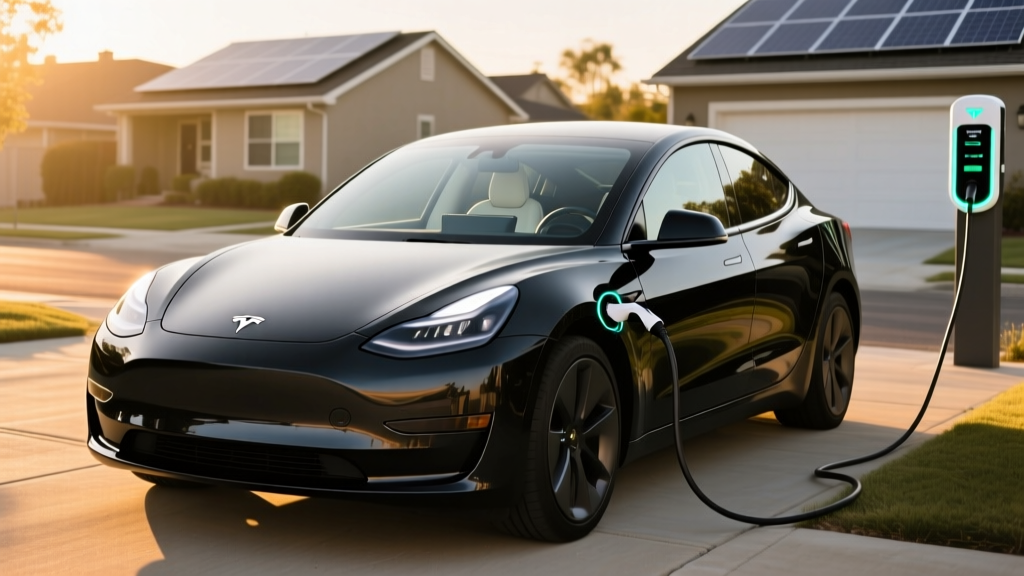
For home charging, Tesla's Wall Connector at $475 delivers up to 11.5 kW on a 60-amp circuit (48A continuous), adding roughly 44 miles of range per hour in a Model 3 Long Range. Installation by a licensed electrician typically runs $500–$2,000 depending on panel capacity and conduit distance. If your home has a 200-amp panel with spare capacity, the install is straightforward; older 100-amp panels may require a $1,500–$3,000 upgrade.
Performance and Driving Dynamics
Wright's original vision was of an electric sports car that proved EVs didn't mean compromise. The 2026 lineup honors that — perhaps too enthusiastically in the case of the Model S Plaid's 1,020 horsepower and 1.99-second 0–60 time, a figure that remains the quickest production sedan ever recorded.
For most buyers, the more relevant performance story is the dual-motor all-wheel-drive system in the Long Range models. The independent front and rear motors provide torque-vectoring traction in rain and snow without the mechanical complexity, weight, or maintenance of a traditional AWD system. The Model Y Long Range hits 60 mph in 4.8 seconds — quicker than nearly every gas-powered compact SUV on the market — while maintaining 123 MPGe combined.
Ride quality has improved substantially since the 2023 "Highland" refresh for Model 3 and the 2025 "Juniper" update for Model Y. Both now feature frequency-selective dampers, improved NVH insulation, and ventilated front seats, addressing the most common complaints from early owners.
Pricing, Trims, and Federal Tax Credit Eligibility
| Model / Trim | Base MSRP | §30D Credit Eligibility | Effective Price (est.) |
|---|---|---|---|
| Model 3 RWD | $38,990 | Up to $7,500 | ~$31,490 |
| Model 3 Long Range AWD | $44,990 | Up to $7,500 | ~$37,490 |
| Model Y Long Range AWD | $44,990 | Up to $7,500 | ~$37,490 |
| Model S Plaid | $89,990 | $0 (MSRP cap exceeded) | $89,990 |
| Model X Long Range | $79,990 | Up to $7,500 (SUV cap: $80K) | ~$72,490 |
Federal tax credit rules (IRS §30D) — critical caveats:
- Income caps: Modified adjusted gross income must not exceed $150,000 (single), $225,000 (head of household), or $300,000 (joint). If your AGI exceeds these thresholds, you are ineligible regardless of the vehicle.
- MSRP caps: Sedans (Model 3, Model S) must have an MSRP ≤ $55,000. SUVs, trucks, and vans (Model Y, Model X) must have an MSRP ≤ $80,000. The Model S Plaid at $89,990 exceeds the sedan cap and does not qualify.
- Battery sourcing requirements: The full $7,500 requires meeting both critical-minerals and battery-component sourcing thresholds set by the IRS. Tesla's North American battery production (via partnerships and the Nevada Gigafactory) currently qualifies most Model 3 and Model Y configurations for the full credit, but sourcing rules tighten annually. Verify current-year eligibility at IRS.gov before purchasing.
- Point-of-sale transfer: As of 2024, the credit can be transferred to the dealer at the point of sale, reducing your purchase price immediately rather than waiting for a tax refund. Tesla supports this at checkout.
Always consult a tax professional for your specific situation. State and local incentives (California's CVRP, Colorado's innovative motor vehicle credit, etc.) may stack on top of the federal credit but vary by jurisdiction.
Cargo, Passenger Space, and Daily Practicality
Tesla's skateboard architecture — battery pack low in the floor, motors on the axles, no transmission tunnel — maximizes interior volume relative to exterior footprint. Here's how the lineup measures up:
- Model 3: 23 cu ft trunk + 3.1 cu ft frunk. Rear legroom: 35.2 inches. Adequate for two adults on longer trips; tight for three across.
- Model Y: 30.2 cu ft cargo (rear seats up) + 4.1 cu ft frunk; 72.1 cu ft with rear seats folded. Rear legroom: 40.5 inches. Available 7-seat option (third row best for children only).
- Model S: 28 cu ft cargo + 3.1 cu ft frunk. Rear legroom: 40.5 inches. Genuine full-size sedan comfort.
- Model X: Up to 88 cu ft with all rear seats folded. Available in 5-, 6-, or 7-seat configurations. Falcon Wing rear doors ease child-seat installation in tight parking spaces.
The Model Y remains Tesla's volume seller for good reason: it delivers crossover practicality with sedan-like efficiency, and its 320-mile EPA range covers most American commutes with substantial margin.
Tech, Driver Assistance, and Software
Every 2026 Tesla ships with Basic Autopilot (lane centering + adaptive cruise control), which operates as an SAE Level 2 driver-assistance system. The driver must remain engaged — hands on or near the wheel, eyes on the road — at all times.
Tesla Autopilot and FSD (Supervised) are Level 2 systems — the human driver is responsible for all driving decisions and must supervise continuously. This is fundamentally different from Level 4 robotaxi services (Waymo, Zoox) that operate without a human driver. No Tesla vehicle is "self-driving" in the regulatory or engineering sense.
Full Self-Driving (Supervised) is available as an $8,000 add-on or $99/month subscription. It adds automatic lane changes, traffic-light and stop-sign recognition, and navigate-on-autopilot for highway interchanges. Despite the name, FSD Supervised remains a Level 2 system requiring active driver oversight. Its real-world performance has improved substantially through neural-network training on Tesla's fleet data, but it still disengages unpredictably in construction zones, unmapped intersections, and adverse weather.
The infotainment system runs on a 15.4-inch center touchscreen (Model 3/Y) or 17-inch (Model S/X), with no physical instrument cluster. A rear-seat entertainment screen is standard in Model S/X and available in refreshed Model 3/Y. Over-the-air updates continue to add features post-purchase — a capability Tesla pioneered and that remains rare among legacy automakers.
Warranty Coverage
Tesla's warranty structure is straightforward:
- Basic vehicle: 4 years / 50,000 miles
- Battery & drive unit (Model 3 RWD, LFP): 8 years / 100,000 miles, with minimum 70% capacity retention
- Battery & drive unit (Long Range / Performance, NMC): 8 years / 120,000 miles, with minimum 70% capacity retention
- Battery & drive unit (Model S / X): 8 years / 150,000 miles, with minimum 70% capacity retention
The 70% retention threshold is standard for the industry. In practice, Tesla's NMC packs have shown approximately 10–12% degradation over the first 100,000 miles based on fleet data, with the degradation curve flattening significantly after the initial break-in period. LFP packs in the Model 3 RWD show even less measurable degradation over equivalent mileage, consistent with LFP chemistry's superior cycle life.
Who Should Buy a Tesla in 2026?
Choose the Model 3 RWD if: You want the lowest entry price (~$31,500 after credit), primarily commute under 50 miles daily, and value LFP battery longevity over maximum range.
Choose the Model 3 Long Range if: You regularly drive 200+ miles between charges, take road trips, or live in a cold climate where range buffer matters.
Choose the Model Y Long Range if: You need cargo space, child-seat room, or optional third-row seating, and want the best balance of utility, range, and Supercharger access.
Choose the Model S or X if: Budget is secondary, you want flagship performance or luxury, and you value the extra range and 8-year/150,000-mile battery warranty.
Look elsewhere if: You need a truck bed (consider Rivian R1T or Ford F-150 Lightning), prefer traditional dealer service networks, or want Apple CarPlay/Android Auto (Tesla uses its own interface exclusively).
Pros and Cons
- Class-leading efficiency (kWh/100mi) across the lineup
- Supercharger network — most reliable DC fast-charging in North America
- Over-the-air updates add features post-purchase
- Strong resale value relative to most EV competitors
- LFP option (Model 3 RWD) offers excellent long-term battery durability
- Accurate trip planner with battery preconditioning
- No Apple CarPlay or Android Auto support
- Service center availability still limited in rural areas
- FSD (Supervised) costs $8,000 and remains Level 2 — not autonomous
- Model 3 rear visibility is compromised by the sloping roofline
- Touchscreen-only climate/glovebox/mirror controls require adaptation
- Insurance premiums run 15–30% higher than comparable gas vehicles
Frequently Asked Questions
What is the real-world range of a Tesla in 2026?
It depends on the model and conditions. The Model 3 Long Range's 363-mile EPA rating translates to roughly 310–325 miles at sustained highway speeds in moderate temperatures. In freezing weather, expect 270–290 miles. The Model Y Long Range delivers approximately 275–290 miles highway, dropping to 240–260 in cold conditions. Tesla's trip planner is notably accurate at predicting real-world consumption when navigation is active.
How fast does a Tesla charge at home and on the road?
At home on a Level 2 Wall Connector (11.5 kW), you'll add 30–44 miles of range per hour — enough for a full overnight charge on any model. On a V3 Supercharger, 10–80% takes 25–30 minutes. On newer V4 stations with compatible packs, that drops to roughly 18–22 minutes. Always precondition via navigation for optimal charge speed.
Does the Tesla Model 3 qualify for the $7,500 federal tax credit?
The Model 3 RWD and Long Range both currently qualify for up to $7,500 under IRS §30D, provided your income is within the caps ($150K single / $300K joint) and the vehicle meets battery-sourcing requirements. The credit can be applied at point of sale. Always verify current eligibility on IRS.gov before purchasing, as sourcing rules tighten annually.
Is a Tesla worth buying vs. competitors like the Hyundai Ioniq 6 or BMW i4?
The Tesla advantage remains the Supercharger network and integrated software ecosystem. If you road-trip frequently, Tesla's charging infrastructure is meaningfully more reliable than third-party CCS networks. If you primarily commute and charge at home, competitors like the Ioniq 6 (361 mi EPA, faster 800V charging) or BMW i4 (more traditional interior, Apple CarPlay) are compelling alternatives. The efficiency gap has narrowed significantly since 2023.
What was Ian Wright's specific contribution to Tesla's engineering?
As Tesla's third employee and an electrical engineer with decades of power-electronics experience, Wright contributed foundational knowledge on AC motor controller design and battery-pack integration. His emphasis on system-level efficiency — extracting more miles from fewer kWh — became a defining characteristic of Tesla vehicles and remains measurable in the brand's industry-leading kWh/100mi figures today.
How long do Tesla batteries last?
Tesla warrants its battery packs for 8 years and 100,000–150,000 miles (depending on model) with a minimum 70% capacity retention. Fleet data suggests most packs retain 88–90% capacity at 100,000 miles. LFP packs in the Model 3 RWD show even slower degradation. Out-of-warranty battery replacement costs range from approximately $7,000 (Model 3 LFP) to $15,000+ (Model S/X), though full replacements remain rare based on current longevity data.