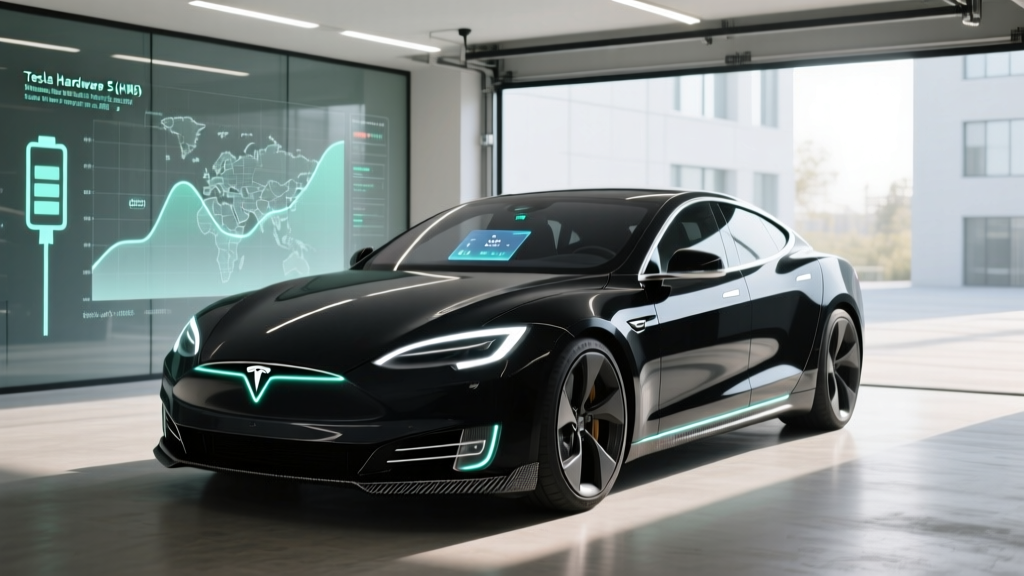
Tesla's Full Self-Driving (Supervised) system has always been bottlenecked less by software ambition and more by the silicon running it. Hardware 4 (HW4), introduced in early 2023, delivered a meaningful leap over the aging HW3 — higher-resolution cameras, a faster neural-network processor, and improved radar integration. But as Tesla pushes deeper into end-to-end neural-net FSD and eyes unsupervised robotaxi operations, the industry is asking: when will HW5 come out from Tesla, and what will it change?
As of mid-2026, Tesla has not officially confirmed a production start date for Hardware 5. However, based on supply-chain reporting, Tesla earnings call commentary, and the cadence of prior hardware refreshes, we can construct a well-informed timeline and spec profile. This article breaks down everything known — and clearly separates confirmed facts from projections.
When Will Tesla HW5 Come Out? The Expected Timeline
Tesla historically refreshes its Autopilot/FSD compute platform roughly every 3–4 years:
- HW2.5: ~2017
- HW3 (FSD Computer): April 2019
- HW4: Early 2023 (debuted in refreshed Model S/X, then Model 3 Highland and Model Y Juniper)
Based on this cadence, HW5 is expected to enter production sometime between late 2026 and mid-2027. Several signals support this window:
- TSMC chip fabrication: Tesla has reportedly taped out its next-generation inference chip on TSMC's 4nm or 3nm process node, a significant jump from HW4's Samsung-fabbed 7nm-equivalent design. Chip qualification and automotive-grade validation typically take 12–18 months post-tapeout.
- Earnings call hints: On Tesla's Q4 2025 and Q1 2026 earnings calls, Elon Musk referenced "next-gen AI hardware" entering vehicles "in the coming quarters" without committing to a specific date — consistent with a late-2026 or early-2027 ramp.
- Vehicle refresh alignment: Tesla typically introduces new compute hardware alongside major vehicle refreshes (as HW4 did with the Model 3 Highland). The anticipated Model Y refresh and potential next-generation platform vehicle are logical HW5 debut candidates.
Projected HW5 Specifications vs. HW4
Here is what we know and project about HW5 compared to the current HW4 platform:
| Spec | HW4 (Current) | HW5 (Projected) |
|---|---|---|
| Process Node | Samsung 7nm-class | TSMC 4nm or 3nm (est.) |
| TOPS (Inference) | ~300–500 TOPS (est.) | ~1,000–2,000+ TOPS (est.) |
| Camera Resolution | 5 MP (front), 1.2 MP (surround) | 8–12 MP across all cameras (est.) |
| Camera Count | 8 (Tesla Vision) | 8–11 (possible additional sensors) |
| Radar | 4D HD radar (some models) | Next-gen 4D imaging radar (likely) |
| Power Draw | ~72W | ~50–65W (better perf/watt at smaller node) |
| Redundancy | Dual ECU | Enhanced failover (expected) |
The headline improvement is raw compute throughput. A move to 4nm or 3nm silicon could deliver 3–5x the inference performance of HW4 at similar or lower power consumption. That matters because Tesla's end-to-end neural network (which replaced the older rules-based + neural hybrid stack in FSD v12+) is compute-hungry — more TOPS means faster inference cycles, higher-resolution camera processing, and potentially the ability to run larger, more capable models in real time.
What HW5 Means for Tesla Vehicles: Range, Charging, and Performance
It is important to understand that HW5 is a compute platform, not a powertrain upgrade. It does not directly change a Tesla's EPA range, battery chemistry, charging speed, or 0–60 time. Those are determined by the battery pack, motor configuration, and vehicle aerodynamics.
However, HW5 does have indirect effects on the ownership experience:
- Efficiency: Lower power draw from a more efficient chip (~10–20W savings) marginally improves range — likely less than 1 mile of EPA range, essentially negligible.
- FSD capability: Higher-resolution camera processing and faster inference could improve FSD (Supervised) smoothness, reaction time, and edge-case handling. This is the primary value proposition.
- Future unsupervised driving: If Tesla ever receives regulatory approval for unsupervised operation (Level 4), HW5's enhanced compute and sensor processing would be the platform enabling it.
For reference, here are the current powertrain specs for Tesla's 2026 lineup — these remain the same regardless of whether a vehicle has HW4 or the future HW5:
| Model (2026) | EPA Range | Battery (kWh/Chemistry) | 0–60 mph | Max DC Charge | Base MSRP |
|---|---|---|---|---|---|
| Model 3 LR AWD | 363 mi | ~79 kWh / NMC | 4.2 sec | 250 kW | $47,740 |
| Model 3 RWD | 272 mi | ~60 kWh / LFP | 5.8 sec | 170 kW | $38,990 |
| Model Y LR AWD | 320 mi | ~79 kWh / NMC | 4.8 sec | 250 kW | $47,990 |
| Model S LR | 402 mi | ~100 kWh / NMC | 3.1 sec | 250 kW | $79,990 |
Will HW5 Be Retrofitted to Existing Teslas?
This is the question current Tesla owners care about most, and the honest answer is: almost certainly not.
When Tesla transitioned from HW2.5 to HW3, it offered a free retrofit to owners who had purchased the FSD package. That retrofit was feasible because HW3 shared a similar physical form factor and wiring harness with HW2.5.
HW4, however, required entirely different camera hardware (higher-resolution sensors, different mounting points, new wiring harnesses). Tesla did not offer HW4 as a retrofit to HW3 vehicles, and the physical incompatibilities made it impractical.
HW5 is expected to follow the same pattern as HW4: new camera modules, potentially different sensor placements, and a redesigned compute board. Retrofitting would require replacing the entire camera suite and wiring harness — a labor-intensive process that Tesla is unlikely to offer at scale, if at all.
What this means for current owners:
- If you own a HW3 vehicle: Tesla has committed to supporting FSD on HW3, though performance will increasingly lag behind newer hardware as software is optimized for higher-compute platforms.
- If you own a HW4 vehicle: You will continue receiving FSD updates, and HW4's capability should remain robust for years. The gap between HW4 and HW5 in daily driving is unlikely to be dramatic at launch.
- If you are considering a new Tesla purchase: Waiting for HW5 may make sense if unsupervised FSD is important to you and you can defer purchase 12–18 months. For current FSD (Supervised) functionality, HW4 is fully capable.
FSD Pricing and the §30D Tax Credit Context
Hardware 5 will not change the fundamental economics of buying a Tesla, but it is worth reviewing the current pricing and incentive landscape for 2026:
| Item | Details |
|---|---|
| FSD (Supervised) Purchase | $8,000 one-time (as of 2026) |
| FSD Monthly Subscription | $99/month |
| §30D Federal Tax Credit | Up to $7,500 (point-of-sale transfer available) |
| MSRP Cap (Sedans) | $55,000 |
| MSRP Cap (SUVs/Trucks) | $80,000 |
| Buyer Income Cap (Joint) | $300,000 AGI |
| Battery Sourcing Requirement | Critical minerals + battery components must meet phased % thresholds per IRS §30D rules |
Key caveat: The §30D credit is not guaranteed for every Tesla buyer or every trim. The Model 3 RWD (LFP battery, with CATL cells historically sourced from China) has faced partial or full credit disqualification in prior years due to battery-component and critical-mineral sourcing rules. The Model 3 Long Range and Model Y (with US-assembled NMC packs) have generally qualified for the full $7,500. Always verify current eligibility at fueleconomy.gov and consult a tax professional before relying on the credit in your purchase decision.
Should You Wait for HW5 or Buy Now?
Buy a HW4 Tesla now if:
- You need a vehicle in the next 6 months
- You primarily use Autopilot for highway commuting and do not plan to purchase FSD
- You want to lock in current §30D tax credit eligibility before potential rule changes
- You are satisfied with FSD (Supervised) as a Level 2 assist system
Wait for HW5 if:
- Your purchase timeline is flexible (12–18+ months)
- You plan to purchase the FSD package and want the best possible hardware for future software improvements
- You are speculating on eventual unsupervised driving capability (recognizing this remains unapproved and uncertain)
- You want higher-resolution camera feeds for dashcam/sentry-mode footage quality
Biggest Pros and Cons of Waiting for HW5
Reasons to Wait for HW5
- 3–5x more compute for FSD neural networks
- Higher-resolution cameras = better perception and dashcam quality
- Better positioned for any future unsupervised driving features
- Likely debuts alongside a vehicle refresh (new interior/exterior)
- More efficient silicon = marginally less parasitic battery drain
Reasons to Buy HW4 Now
- HW5 is unconfirmed — could be delayed past mid-2027
- HW4 FSD is already highly capable for supervised use
- Current §30D credit rules may change; buying now locks in eligibility
- No retrofit path means buying HW4 now doesn't "waste" anything you can later upgrade
- Tesla's track record on hardware timelines is unpredictable — waiting could mean 2+ years
Charging and Efficiency: What Stays the Same Under HW5
Because HW5 is a compute upgrade, not a battery or powertrain change, charging behavior remains dictated by the vehicle's battery pack and thermal management system. For context, here is what current Tesla owners experience:
| Charging Level | Power (kW) | Miles Added/Hour | Notes |
|---|---|---|---|
| Level 1 (120V) | ~1.4 kW | ~3–5 mi/hr | Emergency/trickle only |
| Level 2 (240V, 48A) | ~11.5 kW | ~30–44 mi/hr | Home Wall Connector |
| DC Fast (V3 Supercharger) | Up to 250 kW | ~1,000+ mi/hr (peak) | 10–80% in ~25–30 min |
| DC Fast (V4 Supercharger) | Up to 350 kW (capable) | Vehicle-limited | Current Teslas cap at ~250 kW |
Charge-curve reality check: Tesla's peak 250 kW rate is not sustained across the entire session. The charge curve tapers significantly above 50–60% state of charge. A typical 10–80% session on a V3 Supercharger takes 25–30 minutes for a Model 3 LR. The final 80–100% can take an additional 20+ minutes due to cell-balancing and thermal protection. Always precondition your battery (navigate to a Supercharger in the Tesla app or nav) to achieve peak charge rates — arriving at a Supercharger with a cold battery can cut peak kW in half.
Frequently Asked Questions About Tesla HW5
When will HW5 come out from Tesla?
Based on supply-chain reporting and Tesla's historical hardware cadence, HW5 is projected to enter production between late 2026 and mid-2027. Tesla has not confirmed an official date. The most likely debut vehicles are the next Model Y refresh or Tesla's anticipated next-generation platform vehicle.
Will HW5 make Tesla FSD fully self-driving?
Not automatically. HW5 provides more compute headroom, but unsupervised driving (SAE Level 4) requires regulatory approval, validated safety cases, and geofenced operational domains — not just better hardware. FSD on HW5 will still launch as a supervised Level 2 system. Any unsupervised capability would be a separate regulatory and software milestone.
Can I upgrade my current Tesla to HW5?
Almost certainly not. Like the HW3-to-HW4 transition, the physical differences in cameras, wiring, and compute board make retrofitting impractical. Tesla has not offered HW4 retrofits, and HW5 is expected to follow the same pattern.
Does HW5 affect range or charging speed?
No. HW5 is a compute/AI platform upgrade. Range, battery capacity, and charging speed are determined by the battery pack and powertrain. HW5 may save ~10–20W of parasitic power draw, which is negligible for range (less than 1 mile of EPA range difference).
Is it worth waiting for HW5 before buying a Tesla?
If your purchase is flexible and you plan to buy FSD, waiting 12–18 months is reasonable. If you need a vehicle soon, primarily use basic Autopilot, or want to secure current tax-credit eligibility, buying a HW4 Tesla now is a sound decision. HW4 remains highly capable for all current FSD features.
Does the Tesla §30D tax credit apply regardless of HW version?
Yes. The federal §30D tax credit is based on vehicle MSRP, buyer income, and battery-component/critical-mineral sourcing — not the Autopilot hardware generation. Eligibility is determined per model and trim, not per compute platform. Verify current eligibility at fueleconomy.gov.
What about Tesla's warranty — does HW5 change anything?
Tesla's vehicle warranty structure is expected to remain the same: 4-year/50,000-mile basic warranty and 8-year/100,000-mile (or 120,000-mile for Long Range/Plaid) battery and drive unit warranty. HW5, as a compute component, would fall under the basic warranty initially and would be covered for the duration of that term.
This article reflects information available as of mid-2026. Tesla hardware timelines and specifications are subject to change without notice. For the latest official information, consult Tesla's support pages and NHTSA's automated vehicle safety resources.