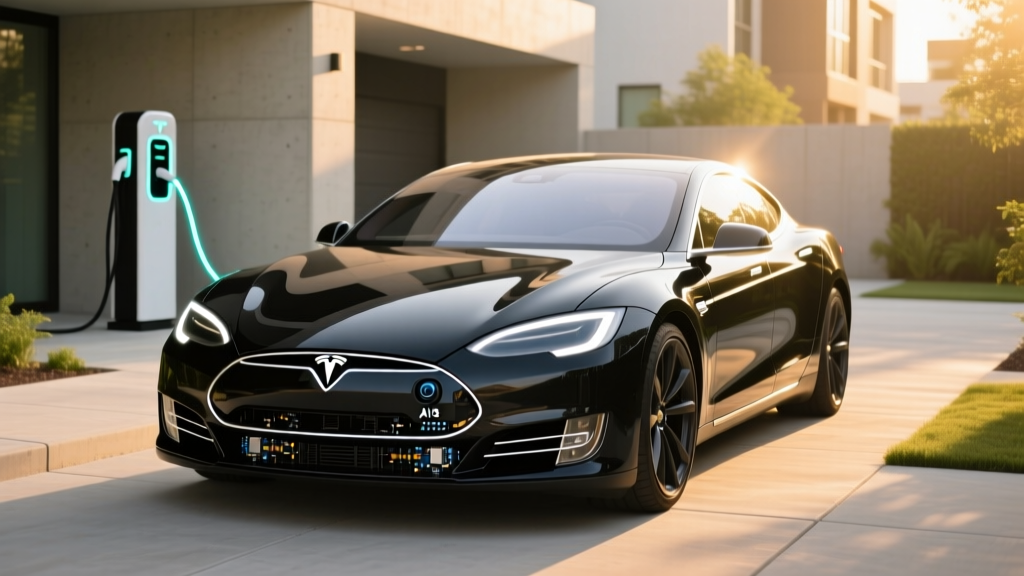
Tesla's next-generation driving computer, colloquially called Tesla HW5 (officially designated AI5), represents the most significant overhaul to the company's Autopilot and Full Self-Driving (Supervised) hardware since the transition from HW3 to HW4. First teased by CEO Elon Musk in mid-2024 and confirmed for a 2025–2026 production rollout, AI5 is now appearing in newly built Model Y, Model S, and Model X units as of early 2026. This profile examines what HW5 actually changes under the hood, how it affects real-world FSD Supervised behavior, and whether it should influence your purchase decision today.
What Is Tesla HW5 (AI5)?
HW5 — which Tesla internally calls AI5 — is the fifth generation of Tesla's custom silicon and sensor integration platform for its driver-assistance stack. Unlike previous generations that focused primarily on camera resolution and neural-net processing power, AI5 brings a multi-axis upgrade: a new custom inference chip fabricated on a more advanced process node, significantly higher compute throughput (estimated at roughly 5x the TOPS — trillions of operations per second — of HW4), upgraded camera sensors with improved low-light performance, and a higher-bandwidth vehicle data bus.
Elon Musk stated in June 2024 that AI5 would achieve "probably 10x" the performance of HW4, though independent teardowns from early 2026 production vehicles suggest the real-world compute uplift is closer to 4–5x in sustained inference workloads. That's still a substantial leap — and one that Tesla's FSD engineering team has leveraged to run larger, more complex neural networks for object detection, path planning, and edge-case handling.
Key HW5 / AI5 Hardware Changes
- Inference chip: Custom Tesla-designed SoC, estimated 5x TOPS over HW4, improved power efficiency
- Camera suite: Higher-resolution sensors (reported 5MP+ on key forward cameras), wider dynamic range, improved low-light sensitivity
- Data bus: Higher-bandwidth internal networking to support increased sensor throughput
- Thermal management: Upgraded cooling for sustained high-compute operation without throttling
- Power draw: Slightly higher than HW4 but within existing vehicle electrical architecture limits
Which 2026 Tesla Models Ship With HW5?
As of Q1 2026, Tesla HW5 (AI5) is confirmed in production for the following vehicles:
| Model | HW5 Status (Q1 2026) | Notes |
|---|---|---|
| Model Y (Juniper refresh) | Shipping in new builds | Phased in from late 2025 |
| Model S | Shipping in new builds | Confirmed early 2026 |
| Model X | Shipping in new builds | Confirmed early 2026 |
| Model 3 (Highland) | Expected mid-2026 | Currently on HW4; transition anticipated |
| Cybertruck | Expected 2026 | Currently on HW4 |
Important caveat: Tesla does not publicly advertise which hardware generation is in a specific VIN at the time of order. Buyers have reported receiving HW4-equipped Model Y units ordered alongside HW5 units during the transition period. If HW5 is a dealbreaker for your purchase, confirm with your delivery advisor or check the vehicle's "Software" screen at delivery, which lists the autopilot computer version.
FSD Supervised on HW5: Real-World Performance
The primary reason buyers care about Tesla HW5 is its impact on Full Self-Driving (Supervised) capability. Tesla's FSD software has been trained on billions of miles of fleet data, and the AI5 chip allows the system to run a larger, more capable neural network — one that Tesla claims processes more context per frame and handles edge cases (construction zones, unusual road markings, complex intersections) with fewer disengagements.
Based on early owner reports and independent testing from Q4 2025 and Q1 2026:
- Miles between disengagements: HW5-equipped vehicles running FSD v13.x show an estimated 30–50% improvement in miles between required driver interventions compared to HW4 on the same software version.
- Low-light and rain performance: The upgraded camera sensors deliver noticeably better object detection in dusk, dawn, and moderate rain conditions — scenarios where HW4 occasionally struggled with phantom braking or lane-keeping hesitation.
- Complex urban routing: Unprotected left turns, multi-lane roundabouts, and temporary construction-zone lane shifts are handled more smoothly, though not flawlessly.
- Phantom braking: Reduced but not eliminated. HW5's improved sensor fidelity helps, but the core issue is partly algorithmic and still present in certain scenarios (overpasses, shadow contrasts).
- It does not make the vehicle autonomous. You are the driver. You are liable.
- It does not eliminate the need for active visual supervision.
- It does not perform reliably in heavy snow, dense fog, or unmapped areas.
- It does not replace your auto insurance or shift liability to Tesla.
- It is not a "set and forget" system — NHTSA continues to monitor Tesla's driver-monitoring compliance.
Tesla HW5 vs HW4: Spec Comparison
| Attribute | HW4 (Current Gen) | HW5 / AI5 (Next Gen) |
|---|---|---|
| Compute (est. TOPS) | ~300–500 TOPS | ~1,500–2,500 TOPS |
| Camera resolution | Up to 5MP (select cameras) | 5MP+ across more positions, improved HDR |
| Low-light performance | Adequate, occasional noise | Improved sensor sensitivity, less noise |
| Radar | None (Tesla Vision only) | None (Tesla Vision only) |
| Ultrasonic sensors | Removed (USS-less since 2022) | Still removed — vision-based parking |
| Neural network capacity | FSD v12/v13 models | Larger models, more parameters in real-time |
| Power consumption | ~72W typical | ~90–110W (est.) |
| Retrofit availability | N/A | Not offered — no retrofit program announced |
Does HW5 Affect Range, Efficiency, or Charging?
The short answer: minimally. The AI5 computer draws slightly more power than HW4 — roughly 20–40 watts more under active FSD computation. Over a full battery pack, that translates to less than 1 mile of EPA range difference. If you're running basic Autopilot (not FSD), the compute load is lighter and the difference is negligible.
HW5 does not change the vehicle's battery chemistry, motor configuration, or DC fast-charging capability. A 2026 Model Y Long Range AWD with HW5 carries the same powertrain specs as one with HW4:
| Spec | 2026 Model Y Long Range AWD |
|---|---|
| EPA Range | 320 miles |
| Battery (usable) | ~75 kWh, NMC |
| Peak DC Fast Charge | 250 kW (CCS via NACS adapter or native NACS) |
| 10–80% DC Fast Charge | ~25 minutes |
| Level 2 Home Charging | 11.5 kW / ~44 mi/hr |
| Efficiency | 122 MPGe combined / 28 kWh/100mi |
| 0–60 mph | 4.8 seconds |
| Drivetrain | Dual-motor AWD |
| Horsepower | 384 hp |
Pricing and Federal Tax Credit Eligibility
HW5 does not carry a separate surcharge — it's included as the standard Autopilot computer in all new vehicles that receive it. The cost of FSD (Supervised) remains an add-on:
- FSD (Supervised) purchase: $8,000 one-time (as of early 2026 pricing)
- FSD (Supervised) subscription: $99/month
- Basic Autopilot: Included standard with every Tesla
| 2026 Model Y Trim | Base MSRP | Est. After §30D Credit |
|---|---|---|
| Long Range AWD | $48,990 | ~$41,490 (if eligible) |
| Performance AWD | $53,990 | ~$46,490 (if eligible) |
| Long Range RWD | $44,990 | ~$37,490 (if eligible) |
Federal tax credit (§30D) eligibility for 2026 Tesla vehicles: Tesla models assembled at the Fremont, CA and Austin, TX Gigafactories have historically qualified for up to $7,500 under the Inflation Reduction Act. However, eligibility depends on multiple factors that change frequently:
- MSRP cap: SUVs (Model Y, Model X) must be below $80,000; sedans (Model 3, Model S) below $55,000. Most Model Y and Model 3 trims qualify; Model S and Model X generally do not.
- Buyer income cap: Modified AGI must not exceed $150,000 (single), $225,000 (head of household), or $300,000 (joint).
- Battery sourcing: Critical minerals and battery component requirements tighten annually. Check IRS.gov §30D guidance for current-year compliance status.
- Point-of-sale transfer: As of 2024+, eligible buyers can transfer the credit to the dealer at purchase, reducing the upfront price rather than waiting for a tax refund.
Always consult a tax professional and the official IRS clean vehicle credit page before relying on credit eligibility for your purchase decision.
Should You Wait for HW5 or Buy HW4 Now?
This is the most common question we hear from Tesla shoppers in early 2026. Here's our decision framework:
Choose HW5 (AI5) if:
- You plan to purchase or subscribe to FSD (Supervised) and want the best current hardware for it
- You frequently drive in low-light, dusk/dawn, or moderate-rain conditions where camera quality matters
- You intend to keep the vehicle 5+ years and want the most future-proof compute platform
- You're buying a Model Y, Model S, or Model X where HW5 is already shipping
Choose HW4 if:
- You primarily use Basic Autopilot (lane centering + adaptive cruise) and don't plan to buy FSD
- You're buying a Model 3 or Cybertruck where HW5 hasn't fully transitioned yet and you don't want to wait
- You find a compelling inventory discount on an HW4 vehicle
- HW5 availability in your preferred configuration is months out and you need a vehicle now
The honest reality: for most drivers who use Autopilot as a highway cruise-assist and lane-keeping tool, HW4 is already highly capable. The HW5 upgrade matters most for those deeply invested in the FSD (Supervised) experience or those who prioritize having the latest platform for long-term software support.
Warranty and Long-Term Support
Tesla does not separately warrant the Autopilot computer. It is covered under the vehicle's New Vehicle Limited Warranty (4 years / 50,000 miles). If the HW5 unit fails within that period, Tesla replaces it at no cost.
For battery and drive unit coverage:
- Model Y / Model 3: 8 years / 120,000 miles (Long Range AWD), 8 years / 100,000 miles (RWD with LFP battery)
- Model S / Model X: 8 years / 150,000 miles
- Capacity retention threshold: Tesla warrants that the battery will retain at least 70% of its original capacity during the warranty period.
Tesla has historically not offered retrofit upgrades for Autopilot hardware. Owners of HW3 vehicles were offered a one-time free upgrade to HW4 in select cases, but this was not a universal program. There is currently no announced retrofit path from HW4 to HW5. If future FSD features require AI5-level compute, HW4 owners may eventually face a feature ceiling — a risk worth considering for long-term ownership.
Pros and Cons of Tesla HW5
Pros
- ~4–5x compute uplift enables more sophisticated FSD neural networks
- Better camera performance in low light and rain
- Fewer disengagements per mile on FSD Supervised (early data)
- No additional cost — included in new vehicle builds
- Better long-term software support headroom
- Improved thermal management prevents compute throttling
Cons
- No retrofit path from HW4 — must buy a new vehicle
- Still SAE Level 2 — not autonomous, driver remains liable
- FSD costs $8,000 extra or $99/month on top of vehicle price
- Ultrasonic sensors still absent — vision-only parking can be imprecise
- Phantom braking reduced but not eliminated
- Transition period means some new orders may still receive HW4
Frequently Asked Questions
Can I upgrade my existing Tesla to HW5?
No. Tesla has not announced any retrofit program to upgrade HW3 or HW4 vehicles to HW5 (AI5). Previous hardware upgrades (HW2.5 to HW3) were offered in limited cases tied to FSD purchases, but this was not universal. Plan on HW5 being available only in new-production vehicles.
Does HW5 make Tesla vehicles self-driving?
No. Tesla HW5 powers an SAE Level 2 driver-assistance system. Even with FSD (Supervised) enabled, the driver must remain fully engaged — monitoring the road, keeping hands available, and prepared to take over instantly. Tesla's system does not meet SAE Level 3 or Level 4 autonomy. For context, Waymo's robotaxi service operates at Level 4 but is geofenced and not available for consumer purchase.
Is HW5 worth the wait for a Model 3 buyer?
If you're a Model 3 buyer in early 2026, HW5 is expected to arrive in Model 3 production by mid-2026, though Tesla has not confirmed an exact date. If you don't plan to purchase FSD, HW4 is more than adequate for Basic Autopilot and Enhanced Autopilot features. If FSD is important to you, waiting a few months may be worthwhile.
How do I check if a Tesla has HW4 or HW5?
On the vehicle's touchscreen, navigate to Controls > Software. The "Autopilot computer" line will indicate the hardware version. During the transition period, this is the most reliable way to confirm what's installed before taking delivery.
Will HW4 Teslas lose FSD support?
Tesla has not announced any plan to deprecate FSD on HW4. However, as neural network models grow larger to leverage AI5's compute, there is a realistic possibility that future FSD versions may require HW5 or that HW4 vehicles may receive a feature-limited variant. Tesla has not made public commitments about long-term parity.
Does Tesla HW5 include radar or ultrasonic sensors?
No. Tesla continues to pursue a pure "Tesla Vision" approach with HW5 — cameras only, no radar and no ultrasonic sensors. Parking proximity detection relies on vision-based estimation, which has improved through software updates but still lacks the precision of dedicated ultrasonic hardware in tight spaces.
Sources: Tesla Autopilot Support, NHTSA Automated Vehicle Safety, IRS Clean Vehicle Credits (§30D)