What Tesla Hardware 4 Actually Changes Under the Hood
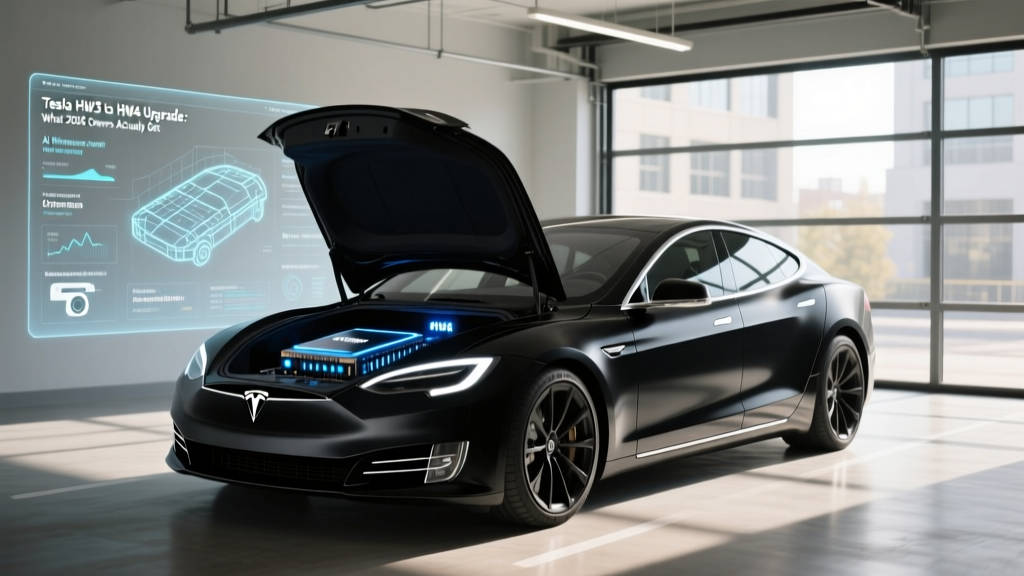
If you've owned a Tesla built between 2019 and early 2023, your car runs on Hardware 3 (HW3) — a vision suite that powered years of Autopilot and Full Self-Driving (Supervised) development. But since mid-2023, every new Model 3, Model Y, Model S, and Model X rolling off the line ships with Hardware 4 (HW4), and the differences go well beyond marketing. For buyers weighing a used HW3 vehicle against a new HW4 model — or owners wondering what they're missing — this guide breaks down the exact sensor, compute, and capability gaps as of the 2026 model year.
HW4 is not a software patch. It's a physical overhaul of the camera array, the onboard computer, and in some trims, the addition of a high-resolution forward radar. Understanding these changes matters because Tesla's FSD (Supervised) stack is increasingly tuned for HW4's sensor fidelity, and the gap between the two platforms will only widen.
HW3 vs HW4: Side-by-Side Spec Comparison
| Attribute | Hardware 3 (HW3) | Hardware 4 (HW4) |
|---|---|---|
| Camera count | 8 cameras | 7–8 cameras (varies by model) |
| Camera resolution | 1.2 megapixels | 5 megapixels |
| Forward camera focal lengths | 3 (narrow, main, wide) | 2 (wide + high-res main with longer range) |
| Onboard computer | FSD Computer (dual SoC, ~144 TOPS) | FSD Computer 2 (estimated 3–5× throughput) |
| Forward radar | None (removed post-2021) | HD 4D imaging radar (select models/regions) |
| Camera heater integration | Basic | Improved defogging/de-icing elements |
| Model years equipped | 2019 – early 2023 | Mid-2023 – present (2026 current) |
The jump from 1.2 MP to 5 MP cameras is the single most impactful change. Higher resolution means Tesla's neural networks can detect lane markings, debris, pedestrians, and traffic signals at significantly greater distances — especially critical at highway speeds where reaction time is measured in fractions of a second.
How HW4 Translates to Real-World FSD Performance
Tesla's FSD (Supervised) remains a SAE Level 2 driver-assist system. You must keep your hands on the wheel and eyes on the road at all times. Neither HW3 nor HW4 makes the car autonomous.
That said, HW4 owners in 2026 report measurably fewer disengagements on FSD (Supervised) compared to HW3 vehicles running the same software branch. The reasons are hardware-rooted:
- Better low-light performance: The 5 MP sensors capture more light per frame, reducing phantom braking and missed lane-detection events at dusk and dawn.
- Longer detection range: HW4's high-resolution main forward camera identifies stopped vehicles and road obstacles roughly 50–80 meters further than HW3's narrow camera at equivalent confidence levels.
- Improved rain and fog clarity: Combined with better camera heaters and the optional HD radar on some models, HW4 maintains vision-system reliability in weather conditions where HW3 cameras struggle with condensation and spray.
- Faster inference: The upgraded FSD Computer 2 processes higher-resolution frames without the latency penalty that would occur if HW3 tried to run the same models.
In practical terms, HW4 doesn't unlock new FSD features that HW3 can't access — both platforms run the same FSD (Supervised) software. But the execution quality is noticeably smoother and more confident on HW4, particularly on unmarked rural roads, construction zones, and complex multi-lane intersections.
Which Tesla Models Ship With HW4 in 2026?
As of the 2026 model year, all new-production Tesla vehicles include HW4:
| Model | HW4 Standard Since | HD Radar Included? |
|---|---|---|
| Model 3 (Highland/refreshed) | Mid-2023 | No (vision-only) |
| Model Y (refreshed Juniper) | Early 2024 | No (vision-only) |
| Model S | Early 2023 | Yes (4D imaging radar) |
| Model X | Early 2023 | Yes (4D imaging radar) |
| Cybertruck | Launch (late 2023) | Yes |
Note that the Model 3 and Model Y — the highest-volume vehicles — remain vision-only without radar. If radar redundancy matters to you, the Model S, Model X, and Cybertruck are the HW4 vehicles that include it.
Can You Retrofit HW3 to HW4?
This is the question existing HW3 owners ask most, and the answer is frustrating: Tesla does not offer an official HW3-to-HW4 retrofit program.
There are structural reasons for this. HW4 uses different camera modules, different wiring harnesses, different mounting points, and a fundamentally different computer. The windshield on HW4-equipped Model 3 Highland vehicles, for example, has a different camera housing cutout. Retrofitting would essentially require replacing the windshield, all cameras, the wiring harness, and the computer — a procedure that would cost thousands and is not supported by Tesla service centers.
Some third-party shops have attempted unofficial retrofits, but these void Tesla's warranty, lack official software calibration support, and may create safety-system reliability issues. We do not recommend them.
Bottom line: If you want HW4, you need to buy a vehicle that shipped with it from the factory.
Tesla Model 3 (2026) — HW4 Reference Specs
Since the Model 3 is the most common HW4 vehicle buyers consider, here are the full 2026 specs for the Long Range AWD trim — the volume configuration most shoppers cross-shop:
| Specification | 2026 Model 3 Long Range AWD |
|---|---|
| EPA-estimated range | 341 miles |
| Battery capacity | ~79 kWh usable (NMC chemistry) |
| Drivetrain | Dual-motor AWD |
| Horsepower | ~384 hp |
| 0–60 mph | 4.2 seconds |
| Max DC fast-charge rate | 250 kW peak |
| 10–80% DC fast charge | ~25 minutes |
| Level 2 home charging | 11.5 kW (~44 mi/hr) |
| Efficiency | 132 MPGe combined / 25 kWh/100mi |
| Cargo volume | 23 cu ft (rear trunk + frunk) |
| Rear legroom | 35.3 inches |
| Battery & drive unit warranty | 8 years / 120,000 miles |
| Base MSRP | $47,740 (before incentives) |
| FSD (Supervised) add-on | $8,000 one-time or $99/mo |
Pricing and Federal Tax Credit Eligibility
| Trim | 2026 MSRP | Est. After §30D Credit |
|---|---|---|
| Model 3 RWD | $38,990 | ~$31,490 (if eligible) |
| Model 3 Long Range AWD | $47,740 | ~$40,240 (if eligible) |
| Model 3 Performance | $52,990 | ~$45,490 (if eligible) |
The federal EV tax credit under IRS §30D offers up to $7,500, but eligibility is not automatic. Requirements for 2026 include:
- MSRP cap: Sedans must be under $55,000 (all Model 3 trims qualify; Model Y qualifies under the $80,000 SUV cap).
- Buyer income cap: Modified AGI must not exceed $150,000 (single), $225,000 (head of household), or $300,000 (joint).
- Battery sourcing: Critical minerals and battery components must meet phased-in domestic/free-trade-partner sourcing thresholds. These thresholds tighten annually — verify current-year compliance on fueleconomy.gov before purchasing.
- Point-of-sale transfer: Eligible buyers can transfer the credit to the dealer at purchase, reducing the out-of-pocket price immediately rather than waiting for tax filing.
Always confirm eligibility with your tax professional and the IRS before relying on the credit in your purchase math.
Pros and Cons of Buying HW4 vs Sticking With HW3
Pros of HW4
- 5 MP cameras deliver sharper object and lane detection at distance
- Noticeably fewer FSD disengagements in complex scenarios
- Better camera heaters for rain, fog, and cold-weather clarity
- HD radar on Model S/X/Cybertruck adds sensor redundancy
- Longer software support runway — Tesla will optimize for HW4 first
- Newer battery packs with lower degradation on 2024+ vehicles
Cons / HW3 Advantages
- HW3 used vehicles are $8,000–$15,000 cheaper than new HW4 equivalents
- HW3 still runs FSD (Supervised) and receives OTA updates
- No official upgrade path — buying HW4 means buying a new or newer car
- HW4's narrower forward camera count (2 vs 3) means Tesla relies more on software cropping
- Insurance premiums on new Teslas remain elevated vs used
Who Should Prioritize HW4?
Buy HW4 (new or certified newer used) if:
- You plan to subscribe to FSD (Supervised) and want the smoothest, safest execution
- You frequently drive in low-light, rain, or fog conditions where camera fidelity matters
- You want the longest remaining software-support horizon for Tesla's neural-net stack
- You're buying a Model S, X, or Cybertruck and value the HD radar redundancy
Stick with HW3 (used market) if:
- You primarily use Autopilot (basic lane-keep + TACC) and rarely engage FSD
- Budget is the priority — a 2021–2022 Model 3 Long Range can be had for under $28,000
- You plan to keep the car 2–3 years and upgrade later when HW5 or next-gen platforms arrive
- Your commute is straightforward highway driving where HW3's vision system performs adequately
Frequently Asked Questions
Does Tesla offer a trade-in program for HW3 owners wanting HW4?
Tesla accepts trade-ins and applies the value toward a new purchase, but there is no special HW3-to-HW4 loyalty credit or subsidized upgrade program. Your trade-in value follows standard market depreciation.
Will HW3 vehicles lose FSD (Supervised) support?
As of 2026, Tesla continues to support FSD (Supervised) on HW3. However, Tesla's neural networks are increasingly trained on HW4's 5 MP data, which means HW3 execution may lag behind in edge-case handling over time. Tesla has not announced an end-of-life date for HW3 FSD support.
Is the HW4 computer faster than HW3's FSD Computer?
Yes. While Tesla has not published official TOPS (trillions of operations per second) figures for the HW4 computer, teardown analyses and inference benchmarks suggest a 3–5× improvement in neural-network throughput, enabling real-time processing of higher-resolution camera feeds.
Does HW4 improve range or efficiency?
Not directly. Range is a function of battery capacity, drivetrain efficiency, and aerodynamics. However, HW4-equipped vehicles tend to be newer model years with incremental efficiency gains (e.g., the Model 3 Highland refresh improved drag coefficient), so HW4 correlates with better range — but the hardware itself isn't the cause.
Can I tell if a used Tesla has HW3 or HW4?
Yes. Navigate to Controls → Software → Additional Vehicle Information on the touchscreen. The "Autopilot computer" field will read either "Hardware 3" or "Hardware 4." You can also visually inspect the camera housing above the rearview mirror — HW4 cameras have a noticeably different lens profile and housing shape.
Does HW4 qualify Tesla vehicles for any additional insurance discounts?
Not specifically for HW4, but Tesla Insurance in eligible states uses real-time driving data (Safety Score) to set premiums. HW4's better sensor performance may help you avoid the hard-braking and disengagement events that lower your Safety Score, indirectly reducing your premium.
Sources: IRS §30D Clean Vehicle Credits, fueleconomy.gov, Tesla official specifications.