If you've been researching a Tesla purchase or browsing used listings, you've almost certainly encountered the term Tesla HW3. Hardware 3 is the Autopilot computer architecture Tesla introduced in 2019 and refined through subsequent software updates. It powers every Model 3, Model Y, Model S, and Model X built between April 2019 and the rollout of Hardware 4 (HW4) beginning in early 2023. Understanding what HW3 can—and cannot—do is critical whether you're evaluating a certified pre-owned Tesla, considering an FSD Supervised subscription, or simply trying to decode the spec sheet on a current listing.
This guide breaks down Tesla HW3 from an owner's perspective: the camera suite, onboard compute, Full Self-Driving (Supervised) capabilities, how it compares to HW4, and what it means for your daily drive in 2026.
What Exactly Is Tesla Hardware 3 (HW3)?
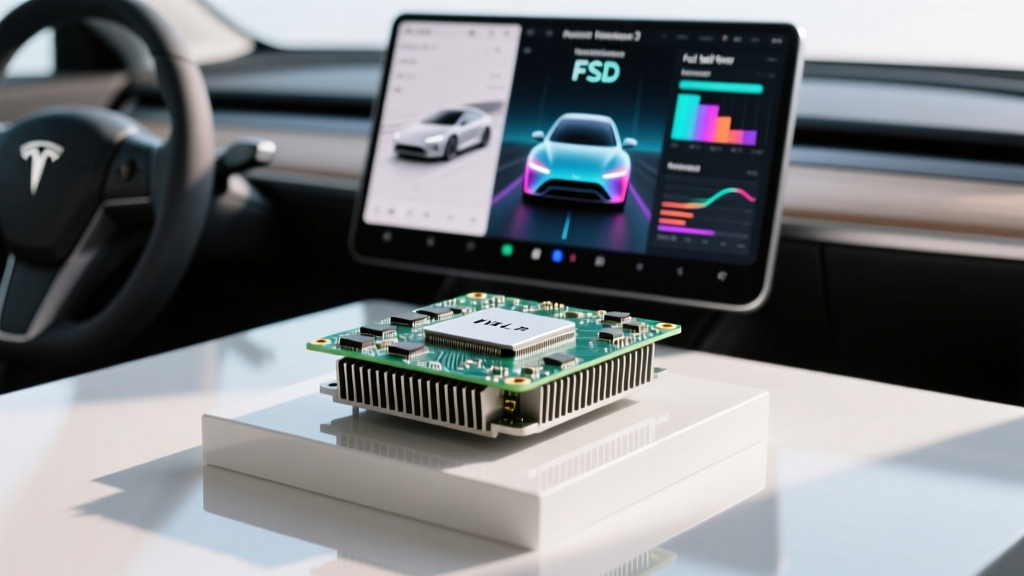
Tesla HW3—officially called the Full Self-Driving Computer by Tesla, and internally designated as AP3.0—is the third-generation Autopilot processing platform. It replaced HW2.5 in production starting April 2019. The system was designed from the ground up to run Tesla's neural networks for Autopilot, Enhanced Autopilot, and Full Self-Driving (Supervised).
HW3 Camera Suite and Sensors
Tesla HW3 vehicles use a vision-only approach (TeslaVision), relying entirely on cameras with no radar or ultrasonic sensors in newer builds. The camera configuration includes:
- 8 cameras total providing 360-degree coverage
- Front-facing main camera (narrow, wide, and telephoto lenses housed behind the windshield)
- Forward-looking side cameras on the front fenders (left and right repeaters)
- Rearward-looking side cameras mounted in the B-pillars (left and right)
- Single rear-view backup camera
Camera resolution on HW3 vehicles is 1.2 megapixels per sensor. While adequate for the neural network processing Tesla employs, this is a notable difference from HW4, which upgraded to 5-megapixel cameras for significantly improved object detection at distance.
Onboard Compute: The FSD Chip
The heart of Tesla HW3 is a pair of custom-designed Full Self-Driving chips built on a 14nm process by Samsung. Each chip delivers approximately 36 TOPS (trillions of operations per second) of neural network processing power, yielding a combined theoretical throughput of roughly 72 TOPS. The dual-chip design provides redundancy: if one chip fails, the other can maintain basic Autopilot functionality.
| Specification | HW3 (AP3.0) | HW4 (AP4.0) |
|---|---|---|
| Camera Resolution | 1.2 MP | 5.0 MP |
| Camera Count | 8 | 7–8 (varies by model) |
| Neural Net Processing | ~72 TOPS (dual chip) | ~300+ TOPS (estimated) |
| Process Node | 14nm | 7nm |
| Radar | Removed (TeslaVision only on later builds) | None (TeslaVision only) |
| Ultrasonic Sensors | Removed in 2022+ builds | None |
What Can Tesla HW3 Actually Do? FSD Supervised in the Real World
As of 2026, Tesla HW3 vehicles running the latest FSD (Supervised) software can perform the following with active driver monitoring:
- Navigate highway on-ramps, off-ramps, and interchanges autonomously
- Execute lane changes based on navigation route and traffic conditions
- Stop at red lights and stop signs, then proceed when clear
- Navigate city streets with turns, yielding to pedestrians and cross-traffic
- Maintain speed relative to posted limits and surrounding traffic
- Recognize and respond to traffic cones, construction zones, and temporary signals
- The driver must keep hands on or near the wheel and eyes on the road at all times
- The cabin camera monitors driver attention; repeated inattention triggers escalating warnings and temporary lockouts
- Performance degrades in heavy rain, fog, snow, or direct sun glare washing out cameras
- Construction zones with non-standard lane markings or temporary barriers remain challenging
- Low-resolution HW3 cameras may struggle with distant small objects (debris, cyclists at range) compared to HW4
- This is not a Level 4 autonomous system — you are legally and operationally the driver
Real-World FSD Performance on HW3
In our testing across highway and urban environments, FSD Supervised on HW3-equipped vehicles handles well-marked highways competently. Lane centering is stable, speed management is reasonable, and interchange navigation succeeds the majority of the time. However, city street driving reveals the compute and resolution limitations of HW3 more frequently:
- Phantom braking events (unexpected deceleration with no apparent obstacle) occur more often on HW3 than on HW4, particularly with shadows, overpasses, and roadside signage
- Unprotected left turns across traffic can be hesitant or overly conservative
- Detection of partially occluded pedestrians or cyclists at intersections is slower on the 1.2 MP camera array
- Complex multi-lane roundabouts may require driver intervention
Tesla has continued to push software improvements to HW3 vehicles through over-the-air updates, and the neural network improvements benefit both hardware generations. However, the physical camera resolution gap is a hardware constraint that software alone cannot fully overcome.
Tesla HW3 vs HW4: Should It Affect Your Purchase Decision?
If you're buying a Tesla in 2026, you'll encounter both HW3 and HW4 vehicles on the market. New-production Teslas (Model 3 Highland refresh from late 2023 onward, current Model Y Juniper, refreshed Model S/X) ship with HW4. Used and certified pre-owned vehicles from 2019–2023 will predominantly carry HW3.
Here's how the practical differences break down for buyers:
✅ HW3 Is Fine If You...
- Use Autopilot primarily for highway cruising and lane-keeping
- Don't plan to purchase FSD Supervised (basic Autopilot works identically well on both)
- Are buying a used Model 3/Y at a significant discount where HW4 isn't available
- Drive mostly in fair weather with well-marked roads
🔍 Prioritize HW4 If You...
- Plan to subscribe to or purchase FSD Supervised and use it daily
- Drive frequently in challenging conditions (rain, complex urban environments)
- Want the best available phantom braking mitigation
- Are buying new and want the latest hardware for resale value and future feature support
Can Tesla HW3 Be Upgraded to HW4?
This is one of the most common questions from current HW3 owners. As of 2026, Tesla does not offer a retail retrofit to upgrade HW3 vehicles to HW4. The two systems use different camera harnesses, mounting points, and computer form factors, making a swap complex and expensive enough that Tesla has not made it available as a service center procedure.
Tesla previously offered a free HW3 computer upgrade to owners who had purchased the Full Self-Driving capability package on HW2/HW2.5 vehicles. That program has concluded. If you own an HW3 vehicle today, you should plan to keep it as-is or trade in for an HW4-equipped model if the camera and compute differences matter to your use case.
Does FSD (Supervised) on HW3 Qualify for Any Tax Credits or Incentives?
No. The IRS §30D federal EV tax credit applies to the vehicle itself, not to software add-ons. FSD Supervised—whether purchased outright or via monthly subscription—does not factor into tax credit eligibility.
However, the underlying Tesla vehicle must meet §30D requirements to qualify for the credit:
- MSRP caps: Vans, SUVs, and pickups must be ≤ $80,000; sedans and other body styles ≤ $55,000
- Buyer income limits: Modified AGI ≤ $150,000 (single), $225,000 (head of household), $300,000 (joint)
- Battery sourcing: Critical minerals and battery component requirements phase in annually — check current-year IRS guidance for exact percentages
- Point-of-sale transfer: Eligible buyers can transfer the credit to the dealer at purchase for an immediate price reduction
For used Tesla HW3 vehicles (model years 2019–2023), the Used Clean Vehicle Credit (§25E) offers up to $4,000 or 30% of the sale price (whichever is lower), subject to a $25,000 maximum vehicle price, income caps, and dealer reporting requirements. Consult a tax professional for your specific situation.
Tesla HW3 Owner FAQ
Is Tesla HW3 still receiving software updates in 2026?
Yes. Tesla continues to push FSD Supervised and Autopilot improvements to HW3 vehicles via over-the-air updates. However, some advanced neural network features may be optimized primarily for HW4's higher-resolution cameras and faster compute, meaning HW3 vehicles may receive a slightly different software branch or experience diminishing feature parity over time.
Does HW3 affect my Tesla's range, charging, or performance?
No. Tesla HW3 is the Autopilot/FSD compute platform only. It has no impact on the traction battery, drivetrain, EPA range, DC fast-charge speed, or 0-60 performance. Those specs are determined by the vehicle's battery pack, motor configuration, and thermal management system.
Can I use FSD Supervised on HW3 without purchasing it outright?
Yes. Tesla offers FSD (Supervised) as a monthly subscription (currently $99/month as of 2026) in addition to the one-time purchase option. The subscription works identically on HW3 and HW4 vehicles.
Is Tesla HW3 safe compared to HW4?
Both HW3 and HW4 vehicles have earned top safety ratings from NHTSA and the IIHS. The active safety systems (automatic emergency braking, lane departure warning, blind-spot monitoring) function on both platforms. HW4's higher-resolution cameras may provide marginally earlier detection in edge cases, but both systems meet Tesla's safety validation standards before deployment.
Will Tesla eventually stop supporting HW3?
Tesla has not announced an end-of-support date for HW3. Given the millions of HW3-equipped vehicles on the road, it's reasonable to expect continued security and core Autopilot updates for several more years. However, as FSD development increasingly targets HW4's capabilities, HW3 may gradually receive fewer cutting-edge feature additions. This is a common lifecycle pattern for automotive compute platforms.
How do I check if a Tesla has HW3 or HW4?
On the vehicle's touchscreen, navigate to Controls → Software → Additional Vehicle Information. The Autopilot computer type will be listed. HW3 will read "Full Self-Driving Computer" (or "Autopilot computer 3.0"), while HW4 will be listed as the newer generation. You can also visually inspect the front fender repeater cameras: HW4 uses noticeably larger camera housings with a different lens shape.
Bottom Line: Who Should Buy a Tesla With HW3?
Tesla HW3 remains a capable and actively supported platform in 2026. For buyers prioritizing value—particularly in the used and certified pre-owned market—HW3-equipped Model 3 and Model Y vehicles offer the full Tesla ownership experience: Supercharger network access, over-the-air updates, competitive range and efficiency, and functional Autopilot for highway driving.
If FSD Supervised is central to your purchase decision and you drive frequently in complex urban environments or adverse weather, HW4's superior camera resolution and compute headroom make it the stronger choice. But for the majority of Tesla owners who use Autopilot as an advanced cruise control and lane-centering system on highways, HW3 performs this task reliably and will continue to receive updates for the foreseeable future.
The right decision comes down to your budget, your tolerance for the camera resolution gap, and how heavily you plan to rely on FSD Supervised versus basic Autopilot. Both platforms deliver a compelling EV experience—HW3 just does it at a lower entry price on the secondary market.