If you have been searching for a Tesla hover car, you are not alone — the term draws consistent curiosity online. But let's be direct: as of 2026, Tesla does not manufacture, sell, or have any announced plans for a hover car, flying vehicle, or eVTOL (electric vertical takeoff and landing) aircraft. No Tesla vehicle leaves the ground. What does exist is a lineup of four production EVs with industry-leading efficiency, an expanding Supercharger network, and Full Self-Driving (Supervised) software that, despite the name, still requires your hands on the wheel.
This article clears up the hover-car confusion, then gives you the hard data on the closest thing Tesla offers to a futuristic flagship: the 2026 Tesla Model S. We cover real-world range, charging curves, battery chemistry, tax-credit eligibility, and how it stacks up against the Lucid Air and Mercedes EQS — the rivals that actually compete in this space.
The "Tesla Hover Car" Myth: Where It Comes From
The hover-car searches trace back to a few overlapping sources. First, Elon Musk has occasionally joked about a flying Tesla on social media, most notably a 2019 tweet replying "yes" to a fan asking about a flying car. Second, Tesla's Cybertruck reveal in 2019 featured angular, sci-fi styling that looked more concept than production — and fan renders of a hovering Cybertruck went viral. Third, the rise of eVTOL companies like Joby Aviation and Archer Aviation (both publicly traded, both backed by major automakers) has blurred the line in consumers' minds between "electric vehicle company" and "flying car company."
None of this changes the reality: Tesla's 2026 product roadmap, as stated in investor presentations, focuses on the next-generation compact platform (the long-rumored sub-$30,000 model), continued FSD iteration, the Cybercab robotaxi, and Optimus humanoid robotics. Hover cars are not on the list. If you want a Tesla today, you choose from the Model 3, Model Y, Model S, Model X, or Cybertruck.
2026 Tesla Model S: The Flagship That Actually Exists
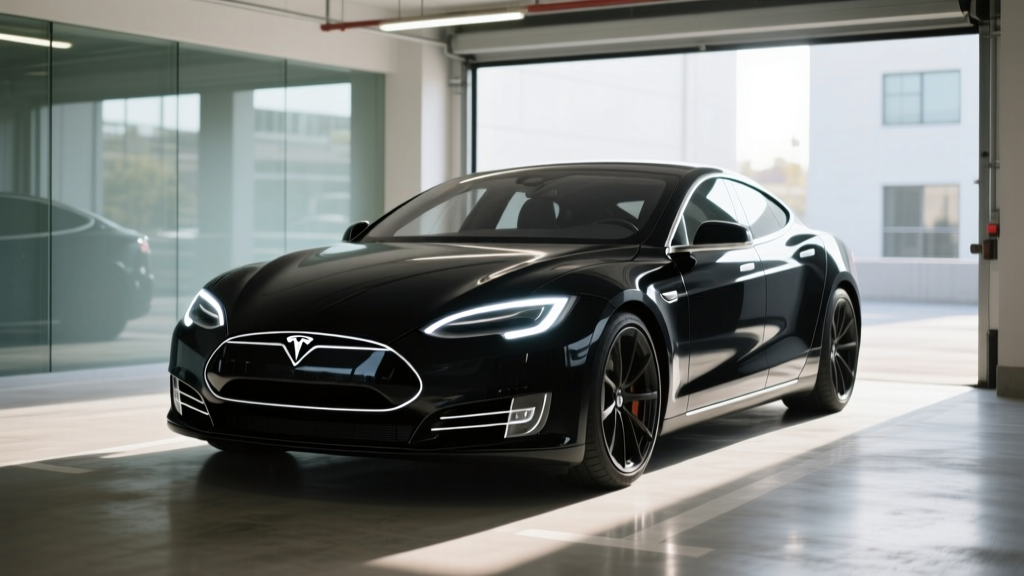
Since no hover car is coming, let's review the Tesla that most closely matches the futuristic promise: the 2026 Model S. Redesigned internally in 2021 with the Plaid powertrain and a refreshed cabin, the Model S continues into 2026 with minor software and battery-pack updates. It remains one of the quickest production sedans ever built and one of the most efficient large luxury EVs on the market.
| Spec | Model S Long Range | Model S Plaid |
|---|---|---|
| EPA Range | 402 mi | 359 mi |
| Battery (usable) | ~100 kWh, NMC | ~100 kWh, NMC |
| Drivetrain | Dual-Motor AWD | Tri-Motor AWD |
| Horsepower | 670 hp | 1,020 hp |
| 0–60 mph | 3.1 sec | 1.99 sec |
| Peak DC Fast Charge | 250 kW | 250 kW |
| 10–80% DCFC Time | ~27 min | ~27 min |
| Level 2 (11.5 kW) | ~41 mi/hr | ~41 mi/hr |
| MPGe (combined) | 120 MPGe | 116 MPGe |
| kWh/100 mi | 28 kWh | 29 kWh |
| Cargo (rear + frunk) | 28 + 3.1 cu ft | 28 + 3.1 cu ft |
| Rear Legroom | 35.4 in | 35.4 in |
| Base MSRP | $74,990 | $89,990 |
| Battery Warranty | 8 yr / 150,000 mi | 8 yr / 150,000 mi |
Source: fueleconomy.gov, Tesla.com. Figures reflect 2026 model-year data where published; carryover specs from the latest EPA filings.
Real-World Range: What the EPA Sticker Doesn't Tell You
EPA sticker: 402 miles. Real-world expectation: 310–340 mi at sustained 75 mph highway speeds; 250–280 mi in sub-freezing winter conditions with cabin heat. Plaid's higher-performance tires and tri-motor drag reduce real-world highway range to roughly 270–300 mi.
Tesla's efficiency engineering is genuinely class-leading. The Model S Long Range achieves 120 MPGe combined — better than the Lucid Air Grand Touring (131 MPGe combined but on a different test cycle weighting) and significantly better than the Mercedes EQS 580 (97 MPGe). The heat pump, standard since the 2021 refresh, recovers waste heat from the drivetrain to warm the cabin, cutting winter range loss roughly in half compared to resistive-heater EVs.
That said, physics is physics. At 80 mph on I-5 in January with the heater on, expect to see closer to 260 miles before the low-battery warning. Plan road trips around 200–220 mile legs to keep a comfortable buffer and stay in the fast part of the charge curve.
Charging Speed: Supercharger Reality vs. the Spec Sheet
| Charging Level | Power (kW) | Miles Added per Hour | Typical Use Case |
|---|---|---|---|
| Level 1 (120V) | ~1.4 kW | ~4 mi/hr | Emergency / overnight trickle |
| Level 2 (240V, 48A) | 11.5 kW | ~41 mi/hr | Home Wall Connector, full overnight |
| DC Fast (V3 Supercharger) | Peak 250 kW | ~200 mi in 15 min | Road trips, Supercharger network |
| DC Fast (CCS adapter, EA) | Up to 150 kW typical | Varies | Non-Tesla networks (adapter required) |
The Model S peaks at 250 kW on V3 Superchargers, but — and this is critical — that peak only holds between roughly 10% and 30% state of charge. By 50% SoC, you are closer to 150 kW, and above 80% the rate drops below 60 kW to protect the NMC cells. The 10–80% time of approximately 27 minutes assumes you arrive at a low state of charge and the pack is preconditioned (navigation routes to the Supercharger automatically trigger this).
For home charging, Tesla's Wall Connector at 48 amps delivers 11.5 kW — enough to add 300+ miles overnight. If your home has a 60-amp circuit available, installation typically runs $800–$2,000 depending on run length and panel location. Older homes with 100-amp main panels may need a $2,000–$4,000 panel upgrade before adding a 48A EV circuit. Always get a quote from a licensed electrician before committing.
Pricing, Trims, and Federal Tax Credit Eligibility
Here is where the Model S story gets complicated for budget-conscious buyers. The Long Range starts at $74,990 before destination, and the Plaid at $89,990. Both exceed the IRS §30D MSRP cap of $55,000 for sedans. This means neither the Model S Long Range nor the Plaid qualifies for the $7,500 federal EV tax credit when purchased new.
| Trim | Base MSRP | As Tested (typical) | §30D New EV Credit | Effective Price |
|---|---|---|---|---|
| Long Range | $74,990 | $79,490 (w/ FSD, red paint) | $0 (over $55K sedan cap) | $79,490 |
| Plaid | $89,990 | $95,490 | $0 (over $55K sedan cap) | $95,490 |
| Used Model S (dealer, 2+ yr old) | Varies (~$45–60K) | — | Up to $4,000 (used EV credit) | Varies |
There is one workaround: the used EV credit. If you buy a qualifying pre-owned Model S (at least two model years old, from a dealer, under $25,000 MSRP threshold for used — note: this threshold makes most used Model S units ineligible too, as resale values typically exceed $25,000). In practice, most Model S buyers in 2026 pay full sticker and absorb the cost. State-level incentives (California's CVRP, Colorado's innovative motor vehicle credit) may partially offset this; check your state's energy office for current programs.
For full §30D rules — including buyer income caps ($150K single / $300K joint for new EVs), critical-mineral sourcing requirements, and the point-of-sale transfer option — consult IRS.gov's clean vehicle credit page or a tax professional.
How the Model S Stacks Up: Lucid Air and Mercedes EQS
If you are shopping a six-figure luxury EV sedan, you have two serious alternatives that match or beat the Model S in key areas:
| Attribute | Tesla Model S LR | Lucid Air Grand Touring | Mercedes EQS 580 |
|---|---|---|---|
| EPA Range | 402 mi | 516 mi | 371 mi |
| Base MSRP | $74,990 | $125,600 | $127,350 |
| 0–60 mph | 3.1 sec | 3.0 sec | 4.1 sec |
| DC Fast Peak | 250 kW | 300+ kW | 200 kW |
| Rear Legroom | 35.4 in | 36.3 in | 40.0 in |
| ADAS | Autopilot / FSD (L2) | DreamDrive Pro (L2) | Drive Pilot (L3, limited) |
The Lucid Air wins on range (516 mi EPA is the highest of any production EV sold in the U.S.) and charging speed, but costs $50,000 more. The EQS offers a vastly quieter, more luxurious cabin and the only certified SAE Level 3 system available in the U.S. (Drive Pilot, approved in Nevada and California for highway traffic jams under 40 mph). The Model S wins on price-to-performance ratio, Supercharger network access, and over-the-air software updates that genuinely add features over time.
Tech, Driver Assists, and the FSD Caveat
The Model S runs Tesla's current infotainment stack: a 17-inch center touchscreen with a 60-degree tilt, a 12.3-inch driver cluster, and a rear-seat 8-inch screen. The yoke steering wheel remains optional; the round wheel is standard. Wireless Apple CarPlay is still not supported — Tesla's native interface handles navigation, media, and vehicle controls.
Standard Autopilot (included) handles adaptive cruise and lane-centering competently. FSD adds more capability but also more edge cases — construction zones, faded lane markings, and unprotected left turns still require quick driver takeover. NHTSA's AV safety portal tracks reported incidents involving Level 2+ systems; review the data before deciding whether FSD is worth the premium.
Pros, Cons, and Who Should Buy the Model S
- Class-leading efficiency (120 MPGe combined)
- 402-mi EPA range on Long Range — among the highest of any sedan
- Access to 50,000+ Superchargers globally, the most reliable DC network in the U.S.
- Sub-2-second 0–60 on Plaid is supercar territory
- OTA updates add real features (recent: adaptive suspension tuning, new UI)
- 8-year/150,000-mile battery warranty with 70% capacity retention guarantee
- No federal tax credit (over MSRP cap)
- Interior materials lag behind Lucid and Mercedes at this price point
- No Apple CarPlay / Android Auto
- FSD is expensive and still Level 2 — not autonomous
- Insurance costs 20–40% higher than comparable ICE sedans (IIHS data)
- Rear seat is tighter than the EQS and Lucid Air
Who the Model S suits best: Tech-forward commuters and road-trippers who prioritize range, Supercharger infrastructure, and acceleration over traditional luxury materials. If you drive 30,000+ miles per year and take regular 400-mile trips, the Model S Long Range's efficiency and charging network make it one of the lowest-hassle luxury EVs to own. If you want a chauffeur-grade rear seat or certified Level 3 autonomy, look at the EQS.
Frequently Asked Questions
Is Tesla building a hover car or flying vehicle?
No. As of 2026, Tesla has no announced hover car, flying car, or eVTOL program. Elon Musk has made offhand jokes about the idea, but Tesla's roadmap focuses on ground vehicles (including the Cybercab robotaxi), energy storage, and robotics. Companies like Joby Aviation and Archer are building eVTOL aircraft, but they are separate from Tesla.
What is the real-world range of the 2026 Tesla Model S?
The EPA rates the Long Range at 402 miles and the Plaid at 359 miles. In real-world highway driving at 75 mph, expect 310–340 miles (Long Range) and 270–300 miles (Plaid). In cold weather below 32°F with cabin heat, subtract another 15–25%.
How fast does the Model S charge?
On a V3 Supercharger, the Model S peaks at 250 kW and charges from 10–80% in approximately 27 minutes with preconditioning. At home on a 48A Level 2 Wall Connector (11.5 kW), you add roughly 41 miles per hour — a full charge takes about 10 hours.
Does the Tesla Model S qualify for the federal EV tax credit?
No. The §30D new clean vehicle credit has a $55,000 MSRP cap for sedans. The Model S starts at $74,990, making it ineligible. The used EV credit (up to $4,000) has a $25,000 sale-price cap that most used Model S units also exceed. Consult IRS.gov for current rules.
Is the Model S worth buying over the Lucid Air?
If budget matters, yes — the Model S Long Range is $50,000 less than the Air Grand Touring, offers Supercharger access, and delivers 90% of the real-world experience. If maximum range (516 mi EPA) and a more luxurious cabin are priorities, the Lucid Air is the better car, but at a steep premium.
Is Tesla's Full Self-Driving actually autonomous?
No. FSD (Supervised) is an SAE Level 2 system that requires continuous driver supervision. It handles many highway and some city scenarios but will hand off control in construction zones, poor weather, and ambiguous intersections. You remain legally and operationally responsible for the vehicle at all times.