Quick Verdict: The Model Y for Home-Charging Buyers
If you've been searching "Tesla house where to buy" you're likely a homeowner evaluating whether your property can support EV ownership — and whether the Tesla ecosystem (vehicle, home charger, solar, Powerwall) makes financial sense. The 2026 Tesla Model Y Long Range AWD remains the benchmark compact electric SUV for exactly this buyer: someone who wants a single-vendor approach to electrifying both their commute and their home energy footprint.
With an EPA-estimated 320 miles of range, a peak DC fast-charge rate of 250 kW, and access to the largest fast-charging network in North America, the Model Y solves the two biggest EV ownership hurdles — range and charging access — better than almost any competitor. But at a starting MSRP of $44,990 (before incentives), it demands careful financial evaluation, especially as federal tax credit rules continue to tighten under IRS §30D.
2026 Tesla Model Y: Full Specification Table
| Specification | Long Range AWD | Performance AWD |
|---|---|---|
| EPA Range | 320 miles | 295 miles |
| Battery (usable) | ~75 kWh, NMC | ~75 kWh, NMC |
| Drivetrain | Dual-Motor AWD | Dual-Motor AWD |
| Horsepower | 384 hp | 456 hp |
| 0-60 mph | 4.8 seconds | 3.5 seconds |
| Peak DC Fast Charge | 250 kW (CCS/NACS) | 250 kW (CCS/NACS) |
| 10-80% DC Fast Charge | ~25 minutes | ~25 minutes |
| Level 2 Home Charge Rate | 11.5 kW (~44 mi/hr) | 11.5 kW (~44 mi/hr) |
| MPGe (city/hwy/combined) | 123 / 105 / 114 | 110 / 94 / 102 |
| Efficiency (kWh/100 mi) | 29 | 33 |
| Cargo Volume (rear seats up) | 30.2 cu ft | 30.2 cu ft |
| Cargo Volume (rear seats down) | 72.1 cu ft | 72.1 cu ft |
| Rear Legroom | 41.6 in | 41.6 in |
| Base MSRP | $44,990 | $52,490 |
| Battery Warranty | 8 yr / 120,000 mi | 8 yr / 120,000 mi |
Sources: EPA / fueleconomy.gov, Tesla.com Model Y configurator.
Real-World Range: What the EPA Number Doesn't Tell You
Tesla's thermal management system is among the best in the industry, using a heat pump (standard on all 2026 trims) to reclaim waste heat from the drivetrain and ambient air. This reduces cold-weather range loss compared to older resistive-heater EVs, but physics still applies: expect roughly 15-25% range reduction in sub-freezing temperatures, depending on driving speed and cabin heat settings.
For homeowners considering a Tesla ecosystem, this range is more than sufficient for daily commuting — the average American drives 37 miles per day according to FHWA data. A nightly Level 2 top-up at home means you'll rarely touch the bottom 20% of the battery, which also helps preserve long-term battery health.
Charging Speed: DC Fast, Level 2, and the Home Setup
| Charging Level | Power (kW) | Speed (mi/hr added) | Typical Use Case |
|---|---|---|---|
| Level 1 (120V outlet) | ~1.4 kW | ~3-5 mi/hr | Emergency / overnight trickle |
| Level 2 (240V, Wall Connector) | 11.5 kW | ~44 mi/hr | Primary home charging |
| DC Fast (Tesla Supercharger V3) | 250 kW peak | ~1,000 mi/hr (peak) | Road trips, 10-80% in ~25 min |
Understanding the Charge Curve
The 250 kW peak rate applies only between roughly 10-30% State of Charge (SoC). Above 50%, the rate tapers significantly — expect ~100 kW at 60% SoC and ~40 kW above 80%. This is why Tesla (and every other manufacturer) quotes 10-80% times rather than 0-100%. Charging from 80-100% can add another 25-30 minutes, so plan road-trip stops around the 10-80% sweet spot.
At home, the Tesla Wall Connector ($475) delivers up to 11.5 kW on a 60-amp circuit (48 amps continuous). A full 10-100% charge takes approximately 7-8 hours — perfectly suited to overnight charging. Most homeowners will need a licensed electrician to install a NEMA 14-50 outlet or hardwire the Wall Connector; expect $500-$2,000 for installation depending on panel capacity and run length from your electrical panel to the garage.
The Tesla Home Ecosystem: Charger, Solar, and Powerwall
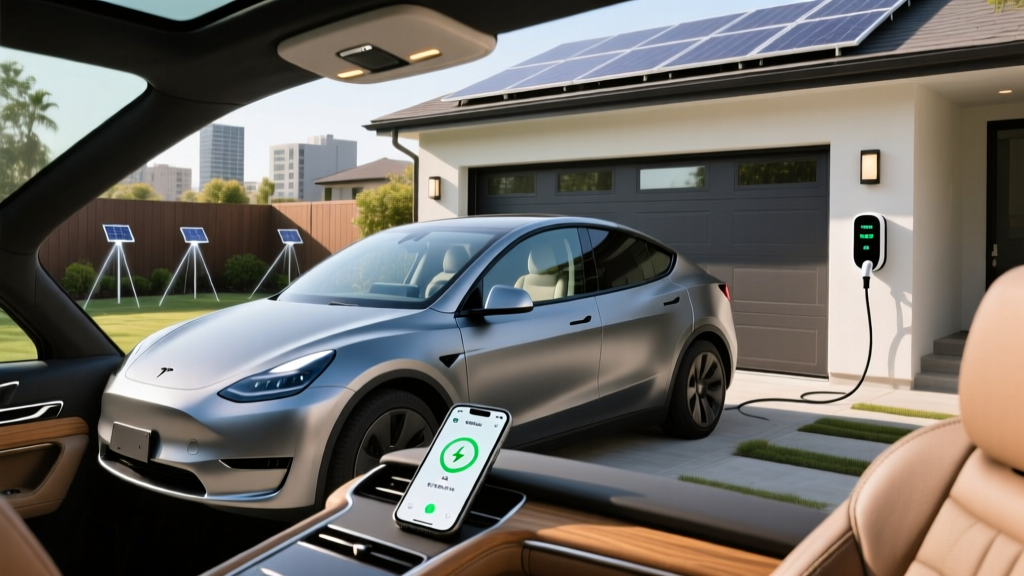
The search intent behind "Tesla house where to buy" often reflects interest in the full Tesla energy ecosystem, not just the car. Here's how the pieces connect:
- Tesla Wall Connector: Hardwired Level 2 charger, 11.5 kW max. Works with any EV that uses NACS (native on Tesla, adapter available for other brands).
- Tesla Solar Panels / Solar Roof: Can offset your EV charging electricity, effectively reducing your "fuel" cost to near-zero on sunny days.
- Powerwall 3: 13.5 kWh battery that stores solar energy for nighttime EV charging or backup power. At 11.5 kW charging rate, one Powerwall provides roughly 1 hour of full-speed Level 2 charging before depletion — enough for ~44 miles of range.
Purchasing the Tesla home ecosystem is done directly through Tesla.com or via certified Tesla installers. The vehicle itself is ordered online through Tesla's configurator with delivery to your home or nearest service center. Unlike traditional dealerships, Tesla sells direct — there are no franchised dealers to visit.
Pricing, Tax Credits, and Total Cost
| Item | Long Range AWD | Performance AWD |
|---|---|---|
| Base MSRP | $44,990 | $52,490 |
| Destination Fee | $1,390 | $1,390 |
| Federal Tax Credit (§30D max) | Up to $7,500* | Up to $7,500* |
| Est. Effective Price (after credit) | ~$38,880 | ~$46,380 |
*Federal EV tax credit eligibility under IRS §30D requires: buyer AGI below $150,000 (single) / $300,000 (joint); vehicle MSRP under $80,000 for SUVs; battery components and critical minerals meeting phased domestic-content thresholds. As of 2026, Tesla's battery sourcing partially qualifies — the exact credit amount ($3,750 or $7,500) depends on current-year critical-mineral and component rules. Consult IRS.gov §30D guidance and a tax professional before purchase. Point-of-sale transfer is available at checkout if eligible.
Homeowners benefit from an additional layer of economics: if you pair the Model Y with rooftop solar, your per-mile "fuel" cost can drop below $0.02/mile (versus $0.12-$0.15/mile for grid electricity and $0.15-$0.20/mile for gasoline at 25 MPG). Over a 5-year, 75,000-mile ownership period, solar-powered charging can save $6,000-$9,000 compared to gas.
Technology, Driver Assistance, and Interior
The 2026 Model Y retains Tesla's minimalist interior dominated by a 15.4-inch center touchscreen. Notable tech features include:
- Autopilot (standard): SAE Level 2 driver assistance with adaptive cruise control and lane-keeping. Driver must remain engaged with hands on the wheel at all times.
- Full Self-Driving Supervised ($8,000 option): Also SAE Level 2 — adds automatic lane changes, traffic-light recognition, and Navigate on Autopilot. Despite the name, this is not autonomous driving; constant supervision is required.
- Over-the-air updates: Tesla regularly pushes software improvements to range estimation, charging speed, and infotainment features.
- Sentry Mode / Dashcam: Built-in camera recording for security and incident documentation.
The interior trade-off is physical controls: there are no buttons for climate, mirrors, or glovebox — everything routes through the touchscreen. This is a dealbreaker for some buyers and a non-issue for others. Build quality has improved significantly since 2023, with tighter panel gaps and upgraded materials on the refreshed "Juniper" platform.
Pros and Cons at a Glance
Pros
- 320-mi EPA range; excellent real-world efficiency
- Supercharger network — 6,000+ stalls in North America
- Class-leading 250 kW DC fast charging
- Heat pump standard (cold-weather efficiency)
- Direct-to-consumer purchase; no dealer markup
- Strong OTA update pipeline
- Integrated home energy ecosystem (solar + Powerwall)
Cons
- No physical buttons — all controls via touchscreen
- FSD Supervised is expensive ($8,000) and still Level 2
- Insurance premiums 15-30% higher than comparable ICE SUVs
- Rear visibility limited; relies on cameras
- Tax credit amount uncertain — depends on battery sourcing
- No Apple CarPlay / Android Auto
- Service center wait times can be long in some regions
Who Should Buy the 2026 Model Y?
Choose the Model Y if: You're a homeowner who can install Level 2 charging, you want access to the most reliable DC fast-charging network for road trips, and you value the option of integrating your EV with Tesla solar and Powerwall for near-zero marginal fuel cost.
Consider a competitor (Hyundai Ioniq 5, Ford Mustang Mach-E, Chevrolet Equinox EV) if: You prefer physical buttons, need Apple CarPlay, want a lower starting price, or your daily driving is under 40 miles and public charging access is excellent in your area.
The Model Y is the strongest all-around EV for homeowners investing in a complete Tesla energy ecosystem. Its charging speed, range, and Supercharger access remain industry benchmarks. Just go in with realistic expectations about the touchscreen-only interface, the Level 2 (not self-driving) nature of Autopilot, and the variable federal tax credit.
Frequently Asked Questions
What is the real-world range of the 2026 Tesla Model Y?
The EPA estimates 320 miles for the Long Range AWD. Real-world highway driving at 70-75 mph yields approximately 270-290 miles in mild weather, dropping to 230-260 miles in freezing temperatures. City driving with regenerative braking can reach or slightly exceed 320 miles.
How fast does the Model Y charge at home and on the road?
At home on a Tesla Wall Connector (Level 2, 11.5 kW), the Model Y adds approximately 44 miles of range per hour, reaching a full charge overnight in 7-8 hours. On a V3 Supercharger (DC fast, 250 kW peak), it charges from 10-80% in approximately 25 minutes, though the rate tapers significantly above 50% SoC.
How much does the Model Y cost after the federal tax credit?
The Long Range AWD starts at $44,990 plus $1,390 destination. If you qualify for the full $7,500 §30D credit (subject to income, MSRP, and battery-sourcing rules), the effective price drops to approximately $38,880. Eligibility is not guaranteed — check IRS.gov and consult a tax professional.
Where do I buy a Tesla and Tesla home charging equipment?
Tesla vehicles are purchased directly through Tesla.com — there are no franchised dealerships. Home charging equipment (Wall Connector), solar panels, and Powerwall are also ordered through Tesla.com and installed by Tesla-certified technicians or licensed electricians.
Is the Model Y worth buying over competitors?
For homeowners wanting an integrated EV-plus-home-energy solution, the Model Y's combination of 320-mile range, 250 kW charging, and Supercharger network access is difficult to beat. Competitors like the Hyundai Ioniq 5 offer physical buttons and CarPlay at a lower price, but none match Tesla's charging infrastructure or home energy integration.
Does the 2026 Model Y qualify for the federal EV tax credit?
It may qualify for up to $7,500 under IRS §30D, but eligibility depends on your adjusted gross income (under $150K single / $300K joint), the vehicle's MSRP (under $80K for SUVs — the Model Y qualifies), and the battery's domestic critical-mineral and component content, which shifts annually. Always verify current-year rules on IRS.gov before purchasing.