Which Teslas Actually Offer a Factory Hitch?
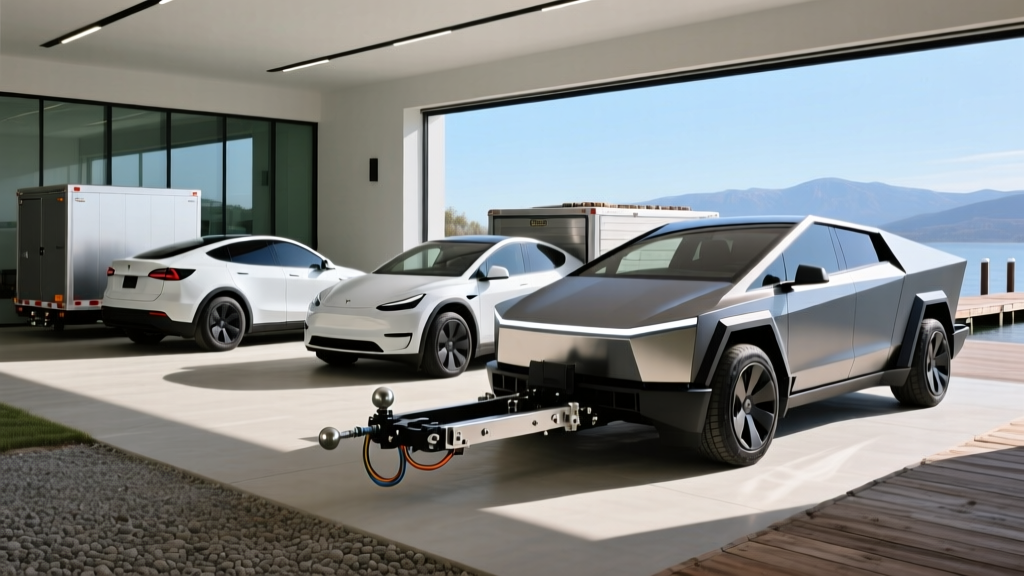
If you've been searching for Tesla hitch information, the first thing to know is that not every Tesla comes equipped for towing — and the differences between models are substantial. As of the 2026 model year, Tesla offers a factory-installed tow hitch on three vehicles: the Model Y, the Model X, and the Cybertruck. The Model 3 and the refreshed Roadster do not offer any factory tow package.
The hitch itself is a 2-inch receiver on all three models, but towing capacity, range impact, and price vary enormously. Below, we break down the real numbers — EPA range, battery specs, charging speeds, pricing after tax credits, and what you'll actually experience when hooking up a trailer.
Tesla Towing Specs at a Glance
| Spec | Model Y (2026) | Model X (2026) | Cybertruck AWD | Cybertruck Cyberbeast |
|---|---|---|---|---|
| Max Towing Capacity | 3,500 lbs | 5,000 lbs | 7,500 lbs | 7,500 lbs |
| Hitch Type | 2" receiver | 2" receiver | 2" receiver | 2" receiver |
| Hitch Included? | Optional ($1,000 add-on) | Standard on all trims | Standard | Standard |
| Trailer Mode | Yes (software) | Yes (software) | Yes (software) | Yes (software) |
| Integrated Brake Controller | No (aftermarket) | No (aftermarket) | Yes (built-in) | Yes (built-in) |
The Cybertruck stands apart with its integrated trailer brake controller — a feature that eliminates the need for an aftermarket module when towing heavier loads. For Model Y and Model X owners towing anything beyond a light utility trailer, a third-party brake controller (such as a Curt Echo or Tekonsha P3) is strongly recommended and, in many states, legally required for trailers over 3,000 lbs.
Range and Battery: What Happens When You Tow
Towing is the single biggest range killer in any EV. Expect to lose 30–50% of your rated range depending on trailer weight, aerodynamic profile, speed, and terrain. Here's what each model delivers before and after you hook up.
Model Y Long Range AWD: EPA 310 miles (unladen). Towing a 2,500 lb camper: expect 170–200 miles on a full charge at highway speeds (65 mph). Cold weather (below 32°F) can push that down to 140–160 miles.
Model X Long Range: EPA 320 miles (unladen). Towing 4,000 lbs: expect 175–210 miles. The larger 100 kWh battery helps offset the SUV's heavier curb weight.
Cybertruck AWD: EPA 340 miles (unladen). Towing 6,000 lbs: expect 170–200 miles. The truck's boxy shape and high curb weight (~6,800 lbs) compound aerodynamic drag at highway speeds.
Source: fueleconomy.gov EPA estimates; real-world figures from owner-reported data and independent testing.
| Model | EPA Range (unladen) | Battery (usable kWh) | Chemistry | Est. Range Towing Max Load |
|---|---|---|---|---|
| Model Y Long Range AWD | 310 mi | ~75 kWh | NMC | 160–200 mi |
| Model X Long Range | 320 mi | ~100 kWh | NMC | 175–210 mi |
| Cybertruck AWD | 340 mi | ~123 kWh | NMC | 170–200 mi |
| Cybertruck Cyberbeast | 320 mi | ~123 kWh | NMC | 155–185 mi |
All three current Tesla models use NMC (nickel manganese cobalt) battery chemistry, which prioritizes energy density over cycle life compared to LFP. This matters for towing because NMC packs more kWh into less weight — critical when you're already hauling thousands of pounds. Tesla recommends charging to 80% for daily driving but allows 100% charges for trips, which is essential when towing.
Charging Speed: DC Fast and Home Level 2
When towing, charging strategy becomes critical. You'll be stopping more often, so knowing exactly how fast each model charges determines whether your road trip is a minor inconvenience or a logistical nightmare.
| Charging Metric | Model Y LR AWD | Model X LR | Cybertruck AWD |
|---|---|---|---|
| Max DC Fast Charge (kW) | 250 kW | 250 kW | 250 kW (350 kW capable) |
| 10–80% DC Fast Charge | ~27 min | ~32 min | ~28 min |
| Level 2 Home Rate (kW) | 11.5 kW (48A) | 11.5 kW (48A) | 11.5 kW (48A) / 17 kW (80A capable) |
| Miles Added per Hour (L2) | ~44 mi/hr | ~40 mi/hr | ~44 mi/hr (up to ~54 mi/hr at 17 kW) |
| Full L2 Charge Time (0–100%) | ~7.5 hr | ~9.5 hr | ~11 hr (at 11.5 kW) |
A critical note on the Cybertruck: while it can accept up to 350 kW at compatible V4 Superchargers, most existing Supercharger stalls max out at 250 kW. The charge curve also tapers significantly above 80% State of Charge — a 10–80% charge may take 27 minutes, but pushing from 80–100% can add another 20+ minutes. When towing, plan your stops around the 10–80% sweet spot for efficiency.
For home charging, a Level 2 wall connector on a 60-amp circuit is strongly recommended if you tow regularly. The Tesla Wall Connector costs around $475, with professional installation typically running $500–$1,500 depending on panel proximity and local permit requirements. If you're towing multiple times per week, overnight charging from 20% back to 80% takes roughly 5–6 hours on a 48-amp circuit.
Performance and Drivetrain
| Metric | Model Y LR AWD | Model X LR | Cybertruck AWD | Cybertruck Cyberbeast |
|---|---|---|---|---|
| 0–60 mph | 4.8 sec | 3.8 sec | 4.1 sec | 2.6 sec |
| Horsepower | 384 hp | 670 hp | 600 hp | 845 hp |
| Drivetrain | Dual Motor AWD | Dual Motor AWD | Dual Motor AWD | Tri-Motor AWD |
| Curb Weight | 4,398 lbs | 5,185 lbs | ~6,800 lbs | ~6,850 lbs |
All three towing-capable Teslas come standard with dual-motor (or tri-motor) all-wheel drive, which is essential for maintaining traction on boat ramps, gravel campsites, and wet pavement. The Model X's air suspension is a significant towing advantage — it auto-levels under load, eliminating the rear sag that plagues many SUVs when hitched to a trailer. The Model Y uses conventional coil springs, so a weight-distribution hitch is recommended for loads approaching the 3,500-lb limit.
Pricing, Tax Credits, and Total Cost
| Model / Trim | Base MSRP | Hitch Cost | Federal §30D Credit | Effective Price (est.) |
|---|---|---|---|---|
| Model Y Long Range AWD | $48,990 | +$1,000 | $7,500 (if eligible) | ~$42,490 |
| Model X Long Range | $79,990 | Included | $7,500 (if eligible) | ~$72,490 |
| Cybertruck AWD | $79,990 | Included | $7,500 (if eligible) | ~$72,490 |
| Cybertruck Cyberbeast | $99,990 | Included | $7,500 (if eligible) | ~$92,490 |
- MSRP Cap: SUVs, pickups, and vans: $80,000 max. Sedans: $55,000 max. The Model X Long Range ($79,990) and Cybertruck AWD ($79,990) qualify; the Cyberbeast ($99,990) does NOT qualify due to MSRP cap.
- Income Cap: Modified AGI ≤ $150,000 (single), $225,000 (head of household), $300,000 (joint). Exceed this in either the purchase year or prior year, and the credit phases out entirely.
- Battery Sourcing: Increasing percentages of critical minerals and battery components must be sourced from the US or FTA partners. Check IRS.gov for the current-year qualifying VIN list — eligibility changes as supply chains shift.
- Point-of-Sale Transfer: You can transfer the credit to the dealer at purchase, reducing your out-of-pocket cost immediately rather than waiting until tax filing.
Efficiency, Cargo Space, and Daily Usability
When you're not towing, these vehicles need to function as daily drivers. Here's how they stack up on efficiency and practicality.
| Metric | Model Y LR AWD | Model X LR | Cybertruck AWD |
|---|---|---|---|
| MPGe (combined) | 111 MPGe | 102 MPGe | 79 MPGe |
| kWh / 100 miles | 30 kWh | 33 kWh | 43 kWh |
| Cargo (rear seats up) | 30.2 cu ft | 37.1 cu ft | 34.2 cu ft (bed) + 7.1 cu ft (frunk) |
| Cargo (seats folded) | 72.1 cu ft | 85.1 cu ft | Bed: 6.5 ft × 4 ft |
| Frunk | 4.1 cu ft | 7.1 cu ft | 7.1 cu ft |
| Rear Legroom | 37.3 in | 38.4 in | N/A (2-row pickup) |
The Model Y remains the efficiency champion of the group at 111 MPGe combined — a number that drops sharply when towing but still delivers reasonable per-mile energy costs for daily driving. The Cybertruck's 79 MPGe reflects its massive battery, heavy curb weight, and poor aerodynamics relative to the car-based models.
Standout Tech and Notable Drawbacks
- Supercharger network — 60,000+ stalls in North America; the only network with reliable uptime for towing routes
- Trailer Mode software automatically adjusts regen, acceleration, and stability control when hitched
- Cybertruck's integrated brake controller eliminates aftermarket complexity
- Over-the-air updates continuously improve towing algorithms and range estimation
- Model X air suspension auto-levels under trailer tongue weight
- Model Y and Model X lack integrated brake controllers — aftermarket required for heavier trailers
- Range loss of 30–50% when towing makes long-distance towing a multi-stop affair
- No Tesla offers a Class IV or V hitch — maximum capacity tops out at 7,500 lbs (Cybertruck)
- Cybertruck's stainless steel exoskeleton limits aftermarket hitch and accessory options
- Supercharger stalls are not designed for pull-through towing — you may need to unhitch at some stations
- Autopilot/FSD (Supervised) is SAE Level 2 and NOT approved for use while towing
Who Should Buy a Tesla With a Hitch?
Choose the Model Y with hitch if: You tow a light trailer (bike rack, small utility trailer, jet ski under 3,500 lbs) a few times per year and want an efficient daily driver that happens to tow. Best value in the lineup.
Choose the Model X if: You need 5,000-lb towing for a mid-size camper or boat, want three rows of seating for family trips, and value air suspension auto-leveling. Premium pricing but the most versatile SUV option.
Choose the Cybertruck if: Towing is a primary use case. The 7,500-lb capacity, integrated brake controller, and truck bed make it the only Tesla that functions as a serious tow vehicle. Best for boat owners, horse trailers, and construction equipment haulers.
Look elsewhere if: You need to tow over 7,500 lbs regularly (consider a Ford F-150 Lightning at 10,000 lbs or a Rivian R1T at 11,000 lbs), or you tow long distances through areas with sparse Supercharger coverage.
Warranty Coverage
| Coverage | Model Y | Model X | Cybertruck |
|---|---|---|---|
| Basic Vehicle | 4 yr / 50,000 mi | 4 yr / 50,000 mi | 4 yr / 50,000 mi |
| Battery & Drive Unit | 8 yr / 120,000 mi | 8 yr / 150,000 mi | 8 yr / 120,000 mi |
| Battery Capacity Threshold | 70% retention | 70% retention | 70% retention |
Tesla's battery warranty guarantees that the pack will retain at least 70% of its original capacity over the warranty period. For towing-heavy owners, this is worth monitoring via the car's State of Health (SoH) readout. Frequent 100% charges and heavy-load driving can accelerate degradation slightly, but NMC chemistry in Tesla's thermal-managed packs has shown strong longevity in real-world data — most packs retain 90%+ capacity at 100,000 miles.
Frequently Asked Questions
What is the real-world range of a Tesla when towing?
Expect a 30–50% reduction from the EPA-estimated range depending on trailer weight, shape, and speed. A Model Y Long Range rated at 310 miles EPA will realistically deliver 170–200 miles when towing a 2,500-lb camper at 65 mph. Cold weather, headwinds, and mountain grades push range toward the lower end of that estimate.
How fast does a Tesla charge while on a towing road trip?
At a 250 kW V3 Supercharger, the Model Y and Cybertruck achieve a 10–80% charge in roughly 27–28 minutes. The Model X takes about 32 minutes due to its larger 100 kWh battery. The Cybertruck can accept up to 350 kW at V4 stalls, slightly reducing charge times. Plan for 30-minute stops every 150–180 miles when towing at max capacity.
Does the Tesla Model Y hitch come standard?
No. The Model Y tow hitch is a $1,000 dealer-installed or factory-ordered option. It includes the 2-inch receiver, wiring harness, and Trailer Mode software activation. The Model X and Cybertruck include the hitch standard on all trims.
Is the Tesla Cybertruck better for towing than the Model X?
For pure towing capability, yes. The Cybertruck tows 7,500 lbs (vs. 5,000 for the Model X), includes a built-in trailer brake controller, and has a truck bed for gear. However, the Model X offers three rows of seating, a more refined ride, air suspension auto-leveling, and better Supercharger accessibility (the Cybertruck's width makes some stalls difficult to navigate).
Does a Tesla with a hitch qualify for the federal EV tax credit?
It depends on the model, your income, and current battery-sourcing rules. The Model Y ($48,990 + $1,000 hitch) and Model X ($79,990) fall under the $80,000 SUV MSRP cap. The Cybertruck AWD ($79,990) qualifies, but the Cyberbeast ($99,990) exceeds the cap. Buyer income must be under $150K/$225K/$300K (single/HOH/joint). Always verify current qualifying VINs at IRS.gov.
Can I use Autopilot or FSD while towing a trailer?
Tesla's Autopilot (basic adaptive cruise and lane-keeping) remains functional in Trailer Mode, but Full Self-Driving (Supervised) features are partially restricted. Regardless, both systems are SAE Level 2 — you must keep your hands on the wheel and full attention on the road. Towing adds stopping distance and alters vehicle dynamics, making attentive driving even more critical.
What about aftermarket hitches for Teslas?
Several companies (Curt, Draw-Tite, EcoHitch) offer aftermarket hitches for the Model Y and Model 3. However, aftermarket hitches do not activate Tesla's Trailer Mode software, meaning you lose the automatic regen adjustment, stability control tuning, and range estimation that the factory hitch enables. For safety and functionality, the OEM hitch is the recommended path.