Quick Verdict: The Fastest Tesla You Can Buy in 2026
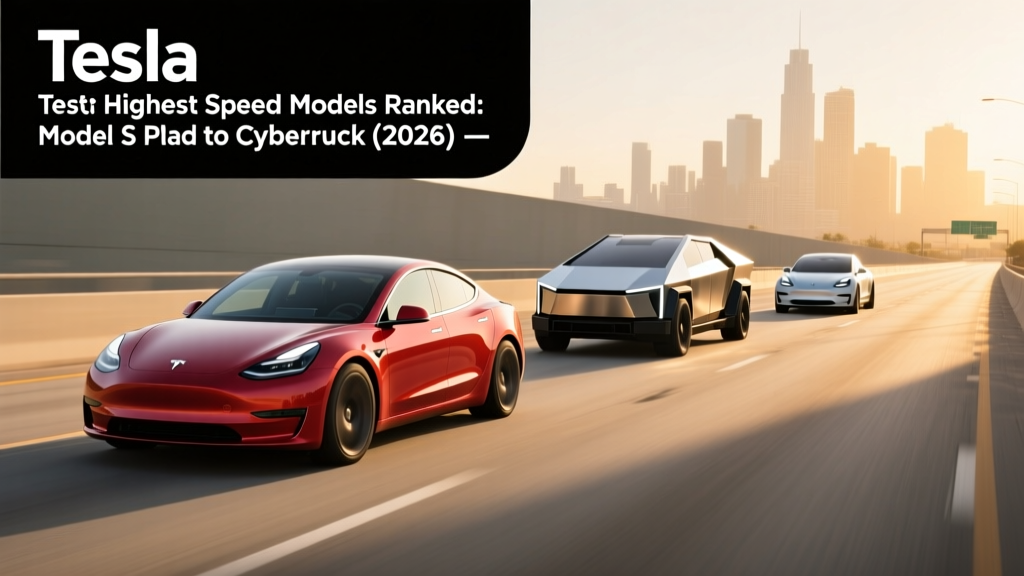
If you're searching for the Tesla highest speed champion, the answer is the Model S Plaid — a 1,020-horsepower sedan that hits 155 mph electronically limited, or 200 mph with the optional Track Package. No other production Tesla comes close to that top-end number, and few cars at any price match its 1.99-second 0-60 mph time.
But top speed is only one axis of performance. A Cybertruck owner towing a trailer cares about torque and range more than a 200-mph ceiling. A Model 3 commuter wants efficiency and charging speed. Below, we rank every current 2026 Tesla by peak velocity, then break down each model's real-world range, charging curve, pricing, and tax-credit eligibility so you can match speed to actual use case.
Tesla Highest Speed Rankings: Every 2026 Model
| Rank | Model / Trim | Top Speed | 0-60 mph | Horsepower | Drivetrain | EPA Range |
|---|---|---|---|---|---|---|
| 1 | Model S Plaid | 200 mph* | 1.99 s | 1,020 hp | Tri-Motor AWD | 396 mi |
| 2 | Model S (Dual Motor) | 155 mph | 3.1 s | 670 hp | Dual-Motor AWD | 402 mi |
| 3 | Model 3 Performance | 163 mph | 2.9 s | 510 hp | Dual-Motor AWD | 315 mi |
| 4 | Model X Plaid | 163 mph | 2.5 s | 1,020 hp | Tri-Motor AWD | 311 mi |
| 5 | Model Y Performance | 155 mph | 3.5 s | 510 hp | Dual-Motor AWD | 285 mi |
| 6 | Cybertruck (Cyberbeast) | 130 mph | 2.6 s | 845 hp | Tri-Motor AWD | 301 mi |
| 7 | Model 3 Long Range AWD | 125 mph | 4.2 s | 384 hp | Dual-Motor AWD | 346 mi |
| 8 | Model Y Long Range AWD | 125 mph | 4.8 s | 384 hp | Dual-Motor AWD | 310 mi |
*200 mph requires the optional Track Package ($5,000) and specific track-mode tire/wheel configuration. Standard Model S Plaid is limited to 155 mph.
Sources: Tesla Model S specs, fueleconomy.gov.
Model S Plaid Deep Dive: Range, Battery, and Real-World Efficiency
Real-world expectation: Expect 310–340 miles on mixed highway driving at 70+ mph. In freezing temperatures (below 32°F), plan for 250–280 miles usable range before needing a charge stop. Aggressive track use will drain the pack far faster — we've seen under 200 miles equivalent at sustained high-speed pulls.
The Model S Plaid uses a ~95 kWh usable NMC (nickel-manganese-cobalt) battery pack. Tesla does not publish exact kWh figures, but independent teardowns and EPA test data place usable capacity in the 95–100 kWh band. NMC chemistry delivers the high energy density and discharge rates required for 1,020 hp output, at the cost of slightly faster long-term degradation compared to LFP packs used in base Model 3 RWD trims.
Efficiency: EPA-rated at 124 MPGe combined (28 kWh/100 mi) for the 19-inch wheel configuration. That's impressive for a 4,766-lb sedan producing over 1,000 hp, though the lighter Model 3 Long Range AWD achieves 132 MPGe combined.
Charging Speed: DC Fast Charge and Home Level 2
Top speed means little if charging takes forever. Here's the Model S Plaid charging profile across all levels:
| Charge Level | Max Power | Speed (miles added/hr) | 10-80% Time | Connector |
|---|---|---|---|---|
| Level 1 (120V household) | 1.4 kW | ~4 mi/hr | Not practical | NACS (native) |
| Level 2 (240V home Wall Connector) | 11.5 kW | ~41 mi/hr | ~8 hours | NACS |
| DC Fast Charge (V4 Supercharger) | 250 kW peak | ~700+ mi/hr (peak) | ~25 minutes | NACS |
Charging curve reality: The Model S Plaid peaks near 250 kW only when the battery is preconditioned (navigating to a Supercharger triggers this automatically) and state of charge is below ~30%. Power tapers to roughly 150 kW by 50% SoC and drops sharply above 80%. If you arrive at a Supercharger with a cold battery and no preconditioning, expect peak rates closer to 100–120 kW until the pack warms — adding 5–10 minutes to your stop.
The native NACS (North American Charging Standard) connector gives Tesla owners seamless access to the Supercharger network — currently the most reliable DC fast-charging infrastructure in the US, with over 25,000 stalls nationwide.
Pricing, Trims, and Federal Tax Credit Eligibility
The Model S Plaid's performance comes at a premium that places it firmly outside federal incentive reach. Here's the 2026 pricing breakdown across the high-speed Tesla lineup:
| Model / Trim | Base MSRP | As-Tested (typical) | §30D Credit Eligible? | Effective Price |
|---|---|---|---|---|
| Model S Plaid | $89,990 | $96,000–$105,000 | No (exceeds $55K sedan cap) | $89,990+ |
| Model S Dual Motor | $74,990 | $80,000–$90,000 | No (exceeds $55K sedan cap) | $74,990+ |
| Model X Plaid | $94,990 | $100,000–$115,000 | No (exceeds $80K SUV cap) | $94,990+ |
| Model 3 Performance | $52,990 | $55,000–$60,000 | No (exceeds $55K sedan cap) | $52,990+ |
| Model 3 Long Range AWD | $45,240 | $47,000–$52,000 | Potentially (under $55K sedan cap) | ~$37,740–$45,240 |
| Model Y Long Range AWD | $44,990 | $47,000–$55,000 | Potentially (under $80K SUV cap) | ~$37,490–$44,990 |
| Cybertruck (Cyberbeast) | $99,990 | $105,000+ | No (exceeds $80K truck cap) | $99,990+ |
- MSRP caps: Sedans ≤ $55,000; SUVs/pickups/vans ≤ $80,000
- Buyer income caps: AGI ≤ $150K single / $225K head of household / $300K joint
- Battery sourcing: Critical minerals and battery components must meet escalating domestic-content thresholds — verify on fueleconomy.gov before purchasing
- Point-of-sale transfer: Eligible buyers can apply the credit as a down-payment reduction at purchase
Credit rules change frequently. Consult a tax professional and verify at irs.gov before committing to a purchase.
Performance and Driving Dynamics: Beyond Straight-Line Speed
The Model S Plaid's tri-motor setup (one front, two rear) delivers torque-vectoring AWD that makes its 1,020 hp usable on public roads — not just drag strips. The carbon-sleeved rotors in the rear motors spin to 20,000+ RPM, and the result is relentless acceleration that doesn't taper above 80 mph the way single- and dual-motor EVs do.
But the highest-speed Tesla isn't always the best-driving Tesla:
- Model S Plaid: Best for track days and highway passing. Yoke steering (standard) divides owners — some adapt in a week, others never do. Conventional round wheel is available as a no-cost option.
- Model 3 Performance: At 2.9 seconds to 60 mph and a 163-mph top speed, this is the best value in the high-speed Tesla lineup. Adaptive dampers (new for the refreshed model) sharpen handling, and at ~$53K it undercuts the Model S by $37K.
- Cybertruck Cyberbeast: 845 hp and a 2.6-second 0-60 time in a 6,800-lb stainless-steel truck. Top speed is limited to 130 mph due to aerodynamics and tire ratings. Best for those who need truck utility with supercar acceleration.
Driver assistance: All 2026 Teslas include Basic Autopilot (adaptive cruise + lane centering). Full Self-Driving (Supervised) is a $8,000 add-on or $99/month subscription. This is a SAE Level 2 system — the driver must remain fully engaged with hands on the wheel and eyes on the road. It is not autonomous driving.
Interior, Cargo, and Tech
The Model S Plaid cabin centers on a 17-inch OLED landscape touchscreen running Tesla's proprietary infotainment (no Apple CarPlay or Android Auto). A second 8-inch screen serves rear passengers. The 22-speaker audio system is among the best in any luxury sedan.
Cargo capacity:
- Model S: 28 cu ft (rear seats up) / 64.9 cu ft (folded) + 3.1 cu ft frunk
- Model 3: 23 cu ft trunk + 3.1 cu ft frunk
- Model X: 88.1 cu ft max (folded) + 6.6 cu ft frunk
- Model Y: 76.2 cu ft max (folded) + 4.1 cu ft frunk
- Cybertruck: 67 cu ft bed (6-ft vault) + ~7 cu ft frunk
Notable drawbacks: The Model S Plaid interior, while improved with the 2021+ refresh, still doesn't match Mercedes EQS or Lucid Air for material quality at this price point. Panel gap consistency has improved but remains a common owner complaint. The yoke steering, while standard, limits hand-over-hand maneuvering at low speeds.
Battery Warranty and Long-Term Ownership
Tesla covers the Model S and Model X battery and drive unit for 8 years or 150,000 miles, whichever comes first, with a minimum 70% capacity retention threshold over the warranty period. Model 3 and Model Y Long Range/Performance variants receive 8 years or 120,000 miles.
NMC packs in the Plaid models typically show 5–8% degradation in the first 20,000 miles, then plateau. Real-world data from high-mileage Model S owners suggests 10–15% total degradation at 100,000 miles — well within warranty coverage. The vehicle's limited warranty (bumper-to-bumper) is 4 years/50,000 miles, which is shorter than competitors like Lucid (4yr/50K similar, but Lucid offers 8yr/100K battery coverage on a lighter vehicle).
- Highest top speed of any production Tesla (200 mph w/ Track Package)
- 1.99-second 0-60 mph — among the fastest production cars ever made
- 396-mile EPA range is best-in-class for a performance sedan
- Supercharger network access (most reliable US DC fast-charging)
- Tri-motor torque vectoring for real-world usability
- $89,990+ MSRP — no federal tax credit eligibility
- Interior quality doesn't match price point vs. Lucid Air, Mercedes EQS
- Yoke steering is divisive; limits low-speed maneuverability
- 250 kW peak DC charging is slower than Hyundai Ioniq 5's 350 kW capability
- Real-world highway range drops significantly at sustained 80+ mph speeds
Who Should Buy the Tesla Highest Speed Models?
- Choose the Model S Plaid if: You want the absolute fastest Tesla available, track-day capability matters, and budget is not your primary constraint. Best for: performance enthusiasts, executive commuters who want supercar acceleration with sedan practicality.
- Choose the Model 3 Performance if: You want 90% of the thrill at 60% of the price. At $52,990 with a 163-mph top speed and 2.9-second 0-60, it's the best value in high-speed Teslas. Best for: driving enthusiasts, daily commuters who want passing power.
- Choose the Model Y Performance if: You need crossover practicality (family, cargo, child seats) but still want 155-mph capability and a 3.5-second sprint. Best for: families who refuse to compromise on acceleration.
- Choose the Cybertruck Cyberbeast if: You need truck-bed utility and towing (11,000-lb capacity) with absurd acceleration. Top speed is the lowest here (130 mph) but torque output is unmatched. Best for: truck owners who want EV performance.
- Look elsewhere if: Budget is under $45K or you need the federal tax credit. The Model 3 Long Range AWD at $45,240 is your best Tesla option for §30D eligibility, though its 125-mph top speed won't satisfy speed seekers.
What is the real-world range of the Model S Plaid?
EPA-rated at 396 miles on 19-inch wheels, but expect 310–340 miles in real-world highway driving at 70–75 mph. At sustained speeds above 85 mph (track or unrestricted highway), range drops to roughly 200–240 miles. Cold weather (below freezing) reduces usable range by 20–30%, bringing it to approximately 250–280 miles.
How fast does the Model S Plaid charge at DC fast chargers and at home?
At a V3/V4 Supercharger with a preconditioned battery, the Model S Plaid peaks at 250 kW and charges from 10–80% in approximately 25 minutes. At home on a Level 2 Tesla Wall Connector (48A/11.5 kW), a full charge takes about 8 hours, adding roughly 41 miles of range per hour of charging.
Does the Model S Plaid qualify for the federal EV tax credit?
No. The Model S Plaid's $89,990 MSRP exceeds the IRS §30D sedan cap of $55,000. No Model S, Model X, or Cybertruck trim qualifies for the federal credit in 2026 due to MSRP limits. The Model 3 Long Range AWD ($45,240) and Model Y Long Range AWD ($44,990) are the most likely Tesla candidates, subject to income and battery-sourcing requirements.
Is the Model S Plaid worth buying vs. the Lucid Air Sapphire?
The Lucid Air Sapphire (1,234 hp, 1.89-second 0-60, 427-mile EPA range, ~$249,000) exceeds the Model S Plaid on every performance and range metric, but at nearly three times the price. If budget allows, the Sapphire is the superior machine. The Plaid remains the value king in the hyper-EV sedan segment at $89,990. For buyers who prioritize charging infrastructure, Tesla's Supercharger network is a significant practical advantage over Lucid's more limited fast-charging access.
What are the biggest drawbacks of Tesla's highest-speed models?
The primary trade-offs are cost (no tax credit, high insurance premiums averaging 20–30% above comparable ICE sedans), interior material quality that lags the price point, DC fast-charging speeds that peak at 250 kW while competitors like the Ioniq 5 and Porsche Taycan reach 350+ kW, and real-world range that shrinks significantly when you actually use the performance the car was built for.
Does higher top speed affect tire wear and maintenance?
Yes. The Model S Plaid's Michelin Pilot Sport 4S tires (or Pirelli P Zero with the Track Package) are rated for sustained high-speed use but wear faster than standard touring tires — expect 15,000–20,000 miles before replacement at $350–$450 per tire. Track use accelerates wear dramatically. Brake rotor life is also reduced under repeated hard use, though the Plaid's regenerative braking handles most daily deceleration.