If you have seen the phrase Tesla Hey Grok feature trending on forums and social feeds, you are not alone. Grok is xAI's large-language-model assistant, and Tesla has been integrating it into the in-car voice interface on vehicles running newer versions of Tesla's infotainment software. Unlike the legacy "Hey Tesla" voice commands — which handled basic navigation, media, and climate requests — Grok aims to answer conversational questions, summarize messages, draft text, and surface contextual vehicle information through natural speech.
This guide breaks down exactly what the Hey Grok feature does in 2026, which Tesla models and trims support it, and pairs that with the hard numbers buyers actually need: EPA range, battery chemistry, DC fast-charge speeds, pricing, and federal tax-credit eligibility under IRS §30D.
What Is Tesla's Hey Grok Feature?
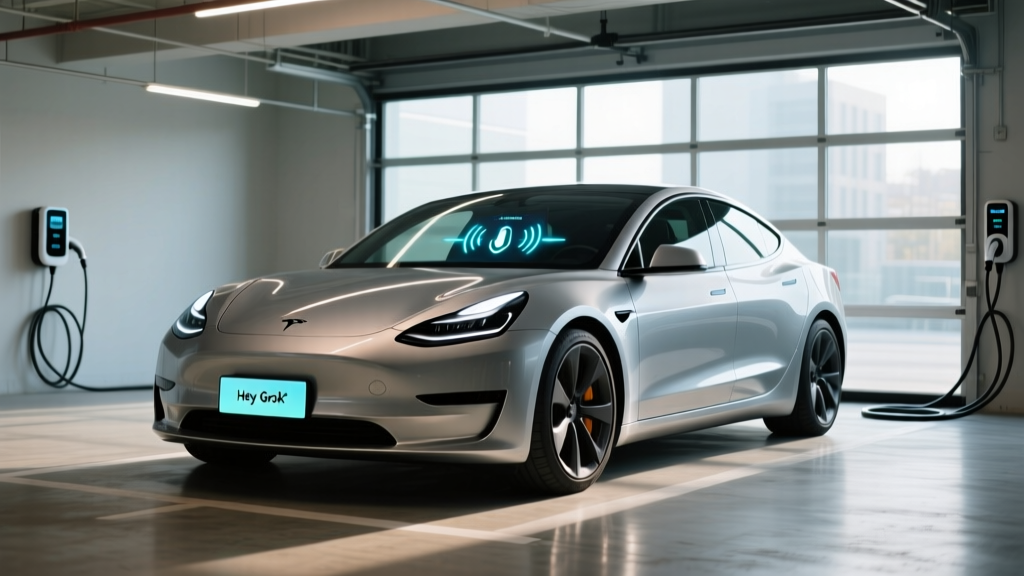
Grok is an AI model developed by xAI, a company founded by Elon Musk. In Tesla's 2026 software builds, Grok powers an upgraded voice assistant accessible by saying "Hey Grok" (or tapping the microphone icon on the touchscreen). Where the older voice system relied on fixed command grammar, Grok handles freeform queries — think "find me a Supercharger with a coffee shop nearby that has at least six open stalls" or "explain why my range estimate dropped 12 miles since this morning."
Key capabilities observed in current software builds include:
- Conversational navigation: Multi-step routing requests with points of interest context.
- Vehicle-state Q&A: Questions about tire pressure, energy consumption trends, and battery health in plain language.
- Media and communication: Message summarization, text drafting (while parked), and podcast/music discovery beyond rigid title/artist lookups.
- General knowledge: Factual questions, unit conversions, and trip-planning math — handy on road trips.
Which 2026 Tesla Models Support Hey Grok?
As of the current 2026 software rollout, Hey Grok requires Tesla's Hardware 4 (HW4) computer and a software version from the 2025.44 branch or newer. That effectively limits support to newer-build vehicles. Here is how availability breaks down across the current lineup:
| Model | Hey Grok Availability | Notes |
|---|---|---|
| Model 3 Highland (2024+) | Yes | All trims with HW4 |
| Model Y Juniper (2025+) | Yes | Standard on Long Range & Performance |
| Model S / Model X (2025+) | Yes | HW4 retrofit availability varies |
| Cybertruck | Yes | Native HW4 platform |
| Older Model 3/Y (HW3) | No | Legacy "Hey Tesla" only |
Owners of older HW3 vehicles should not expect a retrofit path — Tesla has not announced one, and the compute requirements for on-device LLM inference make a backport unlikely.
Tesla Model 3 Long Range: Reference Specs for Grok-Equipped Buyers
Because the Model 3 Long Range AWD is the most popular gateway to the Hey Grok feature, here are the full 2026 specs buyers cross-shop against rivals like the Hyundai Ioniq 6, BMW i4, and Polestar 2.
| Spec | 2026 Model 3 Long Range AWD |
|---|---|
| EPA Range | 363 miles |
| Battery (usable) | ~75 kWh, NMC (LG 2170 cells) |
| Drivetrain | Dual-motor AWD |
| Horsepower | ~384 hp combined |
| 0–60 mph | 4.2 seconds |
| Efficiency | 132 MPGe / 25 kWh/100 mi |
| Max DC Fast Charge | 250 kW (peak) |
| 10–80% DC Time | ~27 minutes |
| Level 2 Home Rate | 11.5 kW (~44 mi/hr) |
| Cargo Volume | 23 cu ft trunk + 3 cu ft frunk |
| Rear Legroom | 35.3 inches |
| Battery Warranty | 8 years / 120,000 miles (70% retention) |
| Base MSRP | $47,740 (before incentives) |
Charging Speed: What Grok Can Tell You (and What It Can't Change)
One practical use of Hey Grok is asking for real-time charging estimates — "how long to 80% at the next Supercharger?" — which the assistant pulls from navigation and battery preconditioning state. What Grok cannot change is the physics of the Model 3's charge curve.
| Charging Level | Power | Miles Added per Hour | Best Use |
|---|---|---|---|
| Level 1 (120V) | ~1.4 kW | ~4–5 mi/hr | Emergency / overnight trickle |
| Level 2 (240V, 48A) | 11.5 kW | ~44 mi/hr | Daily home charging |
| DC Fast (V3 Supercharger) | 250 kW peak | ~170 mi in 15 min | Road trips |
The 250 kW peak is not sustained — the Model 3 Long Range tapers significantly above 60% state of charge. That is why the 10–80% time is roughly 27 minutes even though peak power suggests faster. Always precondition the battery via navigation routing to a Supercharger for maximum charge speed.
Pricing, Trims, and Federal Tax Credit Eligibility
The Hey Grok feature itself is not a separately priced option — it ships with the vehicle's software at no additional cost (unlike FSD Supervised, which is an $8,000 add-on or $99/month subscription as of 2026). So your cost question really comes down to trim selection and §30D credit eligibility.
| Trim | MSRP | Est. After §30D |
|---|---|---|
| Model 3 RWD | $38,990 | ~$31,490* |
| Model 3 Long Range AWD | $47,740 | ~$40,240* |
| Model 3 Performance | $54,990 | ~$47,490* |
*Assumes full $7,500 §30D credit. Actual eligibility varies.
- MSRP cap: Sedans must be under $55,000 — the Model 3 Performance qualifies, but adding high-cost options can push it over.
- Income cap: Adjusted gross income must not exceed $150,000 (single), $225,000 (head of household), or $300,000 (joint). Source: IRS §30D.
- Battery sourcing: Critical-minerals and battery-component requirements phase in annually. Tesla's shift toward LFP in the RWD trim (sourced from CATL) has complicated credit eligibility in past years — confirm current-year status on fueleconomy.gov before purchasing.
- Point-of-sale transfer: Eligible buyers can apply the credit as a down-payment reduction at the dealer rather than waiting for tax filing.
Pros and Cons of a Grok-Equipped Tesla
- Class-leading Supercharger network reliability
- Best-in-class efficiency (kWh/100 mi)
- Hey Grok adds genuinely useful conversational UX
- Strong resale value relative to EV peers
- OTA updates continuously add features
- No Apple CarPlay / Android Auto
- Rear seat comfort trails Hyundai/BMW rivals
- Panel-gap and paint quality inconsistency
- FSD Supervised still requires full driver attention
- RWD trim's LFP battery may limit §30D credit
Is a Grok-Equipped Tesla Worth It vs. Competitors?
The Hey Grok feature is a differentiator in voice UX, but it should not drive a $40,000+ purchase decision alone. Against the Ioniq 6 (longer warranty, 800V architecture for faster peak charging), the BMW i4 (more traditional luxury interior), and the Polestar 2 (Google built-in), Tesla still wins on charging-network convenience and software iteration speed. It loses on interior material quality and service-center wait times in high-density markets.
If Grok's conversational AI genuinely fits your workflow — frequent road trips, heavy reliance on voice commands, interest in AI features — the Tesla ecosystem rewards you. If you prioritize build quality, back-seat comfort, or CarPlay integration, test-drive the Ioniq 6 and i4 before committing.
Frequently Asked Questions
Does Hey Grok require a subscription?
No. Unlike FSD Supervised, the Grok voice assistant is included with the vehicle at no recurring cost. An internet connection (Tesla's built-in LTE) is required for full functionality.
Can Grok control driving features like Autopilot?
No. Grok handles infotainment, navigation, climate, and information queries. Driving-assist features remain manually activated and require driver supervision per SAE Level 2 classification.
Will older Teslas get Hey Grok via software update?
Unlikely. Grok's inference requirements appear to need HW4 compute. Owners of 2021–2023 HW3 vehicles should expect to retain the legacy "Hey Tesla" command set.
Does using Grok drain range?
Negligibly. The compute load for voice queries is minor compared to drivetrain consumption — expect no measurable range impact.
What is the real-world range of a Grok-equipped Model 3?
EPA 363 miles (Long Range AWD). Plan for ~300–320 miles highway, ~240–270 miles in freezing weather, and use fueleconomy.gov for official figures.