Why the Tesla Heat Pump Matters for Real-World EV Range
Search for "Tesla pump" and you will find owners and shoppers trying to understand one of the most consequential efficiency upgrades Tesla has shipped in the last half-decade: the electric heat pump that replaced resistive cabin heating across the fleet. It is not a single model—it is a thermal-management architecture that now ships standard on every 2026 Tesla Model 3, Model Y, Model S, and Model X, and it changes the math on cold-weather driving more than any battery-size bump could.
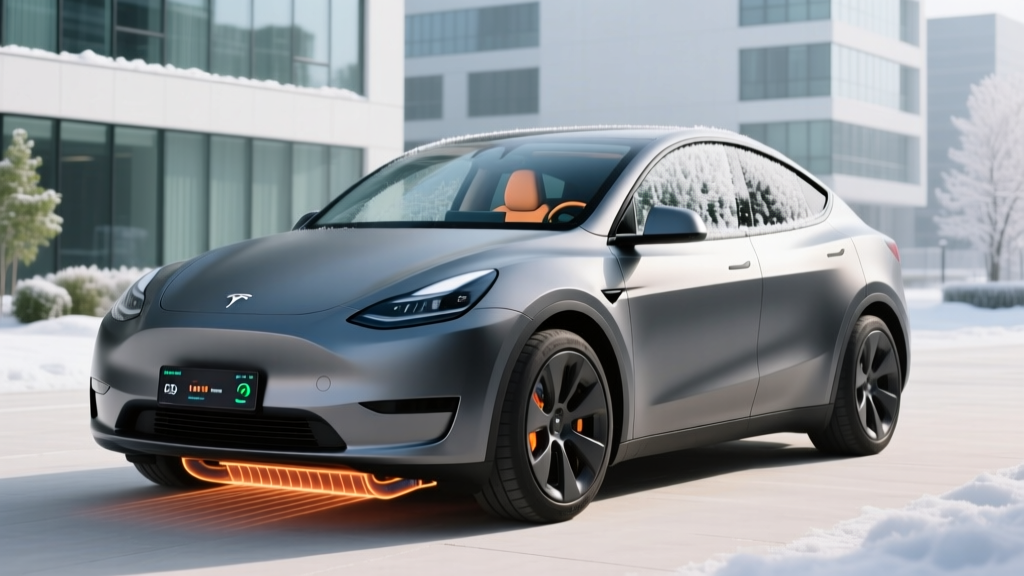
Resistive heaters (the old PTC units Tesla used through roughly 2020 on Model S/X and through 2021 on older Model 3 builds) convert electricity into heat at a 1:1 ratio. A heat pump moves thermal energy rather than creating it, achieving a coefficient of performance (COP) typically between 2.0 and 4.0 in moderate cold. That means 1 kW of electrical draw can deliver 2–4 kW of heating. On a 30°F morning, that difference can be the gap between arriving with a 20% buffer or sweating a mid-route charge stop.
How Tesla's Octovalve Heat Pump System Works
Tesla's current-generation heat pump (introduced with the Model Y in 2020 and later retrofitted in architecture to the refreshed Model 3, Model S, and Model X) is more than a compressor and a reversing valve. It is integrated into what Tesla calls the Octovalve manifold—an eight-port thermal router that manages heat flow between four loops: the battery pack, the drive units, the cabin HVAC, and the ambient-air heat exchanger.
The system scavenges waste heat from the motors and power electronics (which generate substantial thermal energy under load) and redirects it to either warm the battery pack or heat the cabin. In very cold ambient conditions where air-source heat extraction is inefficient, the system can fall back to a small resistive element to supplement, but the bulk of heating duty is handled by the compressor loop.
This integration is why a 2026 Model 3 or Model Y preconditioning cycle on a Supercharger route will warm the battery, cabin, and drive units in a coordinated sequence rather than fighting each other for thermal energy. The result is faster charge acceptance at the first DC stop and less energy wasted bringing the pack up to its optimal ~35°C operating window.
2026 Tesla Fleet: Range, Efficiency, and Heat Pump Specs
Below is the current 2026 lineup with EPA figures, battery details, and the efficiency metrics that the heat pump directly influences. All current-production Teslas use the heat pump as standard equipment.
| Model / Trim | EPA Range | Battery (usable kWh) | Chemistry | MPGe (combined) | kWh/100 mi | 0–60 mph | Drivetrain | HP |
|---|---|---|---|---|---|---|---|---|
| Model 3 RWD | 363 mi | ~62 kWh | LFP | 132 MPGe | 25 | 5.8 s | RWD | 283 |
| Model 3 Long Range AWD | 363 mi | ~75 kWh | NMC | 134 MPGe | 25 | 4.2 s | Dual-motor AWD | 384 |
| Model 3 Performance | 315 mi | ~75 kWh | NMC | 121 MPGe | 28 | 2.9 s | Dual-motor AWD | 510 |
| Model Y Long Range AWD | 320 mi | ~75 kWh | NMC | 122 MPGe | 28 | 4.8 s | Dual-motor AWD | 384 |
| Model Y Performance | 285 mi | ~75 kWh | NMC | 111 MPGe | 30 | 3.5 s | Dual-motor AWD | 510 |
| Model S Long Range | 402 mi | ~95 kWh | NMC | 124 MPGe | 27 | 3.1 s | Dual-motor AWD | 670 |
| Model X Long Range | 348 mi | ~95 kWh | NMC | 111 MPGe | 30 | 3.8 s | Dual-motor AWD | 670 |
Sources: fueleconomy.gov, Tesla.com 2026 configurator. EPA figures; real-world highway range at 70+ mph typically runs 10–15% below sticker even in mild weather.
Charging Speed: DC Fast, Level 2, and Cold-Weather Preconditioning
The heat pump's role in charging is often underappreciated. When you navigate to a Supercharger, the car begins preconditioning the pack 10–30 minutes out. The Octovalve routes compressor heat and drive-unit waste heat into the battery coolant loop, bringing cells to the ~35°C window where lithium-ion charge acceptance peaks. Skip preconditioning—or arrive with a cold-soaked pack—and peak kW is electronically limited to protect the cells, sometimes cutting charge rate in half.
| Charge Type | Model 3 / Y | Model S / X | Miles Added per Hour |
|---|---|---|---|
| DC Fast (peak kW) | 250 kW (V3 Supercharger) | 250 kW (V3 Supercharger) | ~750–1,000 mi/hr at peak |
| DC 10–80% time | ~25–30 min | ~30–35 min | — |
| Level 2 home (kW) | 11.5 kW (48A) | 11.5 kW (48A) | ~44 mi/hr (Model Y) |
| Level 1 (120V / 12A) | ~1.4 kW | ~1.4 kW | ~3–5 mi/hr |
A critical nuance: kW is power (charge rate); kWh is energy (battery capacity). A 75 kWh battery charging at a sustained 150 kW (not the 250 kW peak, which tapers quickly past ~50% SoC) will add roughly 50 kWh in 20 minutes—enough for about 170 miles in a Model Y. The 250 kW peak is only held for a narrow state-of-charge window, typically 10–30% SoC on a preconditioned NMC pack.
Cold-Weather Range: What the Heat Pump Actually Saves You
Independent testing from groups like Recurrent Auto and the Norwegian Automobile Federation (NAF) has consistently shown that Tesla's heat-pump-equipped models lose roughly 20–25% of range at 20°F compared to their EPA baseline, whereas older resistive-heated EVs from the same era lost 30–40% under similar conditions.
Here is how that translates for a 2026 Model Y Long Range AWD owner in a northern climate:
- 68°F, mixed driving: ~290–310 miles (close to the 320 EPA)
- 32°F, mixed driving: ~250–270 miles
- 10°F, highway 70 mph: ~210–230 miles
- 10°F, short city trips (no garage): ~180–200 miles (each cold-soak restart re-heats cabin and pack from scratch)
The heat pump's biggest advantage shows up in the city-trip scenario. Resistive heaters draw 3–5 kW continuously to maintain cabin temperature; the heat pump typically draws 1–2 kW once the cabin is up to temp, because it is maintaining rather than generating. Over a 30-mile commute in 25°F weather, that 2–3 kW difference can preserve 10–15 miles of range per trip.
- 20–30% better cold-weather efficiency vs resistive heating
- Integrated with battery thermal management (Octovalve)
- Faster DC charge acceptance after preconditioning
- Waste-heat scavenging from drive units reduces net energy draw
- Standard on every 2026 Tesla—no package upgrade needed
- COP drops sharply below ~0°F; supplemental resistive heat engages
- Added system complexity—compressor and valve failures are costly out of warranty
- Early 2020–2021 Model Y units had recall-level issues (largely resolved in current production)
- Does not eliminate cold-weather range loss; only reduces it
- Cabin heat-up time is slightly slower than resistive on initial start in deep cold
2026 Pricing, Trims, and Federal Tax Credit Eligibility
Tesla's pricing has stabilized after years of volatility. Below are 2026 base MSRPs and the federal tax credit landscape under IRS §30D rules. The credit is available as a point-of-sale reduction at the dealer (or Tesla's direct-sales equivalent), but eligibility depends on buyer income, vehicle MSRP caps, and battery-component/critical-mineral sourcing requirements that change annually.
| Model / Trim | 2026 Base MSRP | MSRP Cap Met? | Max §30D Credit | Effective Price (if eligible) |
|---|---|---|---|---|
| Model 3 RWD | $44,130 | Yes (sedan cap: $55,000) | Up to $7,500 | ~$36,630 |
| Model 3 Long Range AWD | $49,130 | Yes | Up to $7,500 | ~$41,630 |
| Model 3 Performance | $54,130 | Yes | Up to $7,500 | ~$46,630 |
| Model Y Long Range AWD | $46,630 | Yes (SUV/truck cap: $80,000) | Up to $7,500 | ~$39,130 |
| Model Y Performance | $51,630 | Yes | Up to $7,500 | ~$44,130 |
| Model S Long Range | $79,990 | Yes | Up to $7,500 | ~$72,490 |
| Model X Long Range | $84,990 | No (exceeds $80k SUV cap) | $0 | $84,990 |
Credit caveats: Buyer AGI must not exceed $150,000 (single) / $300,000 (joint). Battery sourcing and critical-mineral requirements tighten each year under the Inflation Reduction Act—check current-year eligibility on IRS.gov or confirm at point of sale. Model X currently exceeds the $80,000 SUV MSRP cap and does not qualify.
Who Should Buy a Heat-Pump-Equipped Tesla (and Who Should Look Elsewhere)
Best for: Cold-climate commuters and road-trippers who regularly drive in 10–45°F weather and want the most range-efficient cabin heating available in a mass-market EV. The Model Y Long Range AWD is the sweet spot—320 EPA miles, generous cargo volume (76 cu ft with rear seats folded, 30 cu ft behind the second row), and the heat pump's efficiency advantage compounds on 40–80 mile daily commutes in winter.
Less ideal for: Buyers in consistently warm climates (Phoenix, Miami, San Diego) where the heat pump's efficiency advantage rarely activates. If you never see temperatures below 50°F, the thermal-management sophistication is wasted on your use case—a simpler, cheaper EV with resistive heat may offer similar real-world value.
Also consider: The Hyundai Ioniq 5 (which also uses a heat pump in cold-climate trims) and the Rivian R1S/R1T (heat pump standard) if you need more ground clearance or off-pavement capability than the Tesla crossover lineup provides.
Warranty Coverage
Tesla's 2026 battery and drive-unit warranty remains competitive:
- Model 3 / Model Y: 8 years / 100,000 miles (Long Range and Performance); 8 years / 120,000 miles for the battery with a minimum 70% capacity retention threshold.
- Model S / Model X: 8 years / 150,000 miles, same 70% retention threshold.
- Heat pump / HVAC components: Covered under the 4-year / 50,000-mile basic vehicle warranty. Out-of-warranty compressor or Octovalve replacements have been quoted in the $1,500–$3,000 range at service centers.
Maximizing Your Heat Pump's Efficiency
Three owner-level habits make a measurable difference:
- Always precondition while plugged in. Schedule departure times in the Tesla app so the car warms the cabin and battery using grid power, not battery energy. This alone can recover 10–20 miles of range on a cold morning.
- Use seat heaters and steering-wheel heat as primary comfort. These draw ~100W combined vs 1,000–2,000W for full cabin air heating. Set the cabin temp to 65°F and let contact heating do the work.
- Navigate to every Supercharger. Even if you know the route, entering the destination triggers pack preconditioning. Arriving with a warm pack can shave 5–10 minutes off a 10–80% charge.
Frequently Asked Questions
Does every 2026 Tesla have a heat pump?
Yes. Every current-production Model 3, Model Y, Model S, and Model X ships with the Octovalve-integrated heat pump as standard equipment. It is not an optional package or trim-level upgrade.
Can I retrofit a heat pump to an older Tesla?
No. The heat pump requires extensive changes to the thermal-management plumbing, the Octovalve manifold, and the HVAC control architecture. It is not a service-center retrofit. If cold-weather efficiency is a priority, upgrading to a 2021-or-newer Model Y or a 2023-or-newer Model 3 (Highland refresh) is the practical path.
How much range does the Tesla heat pump save in winter?
Based on Recurrent Auto fleet data and NAF testing, expect a heat-pump-equipped Tesla to retain roughly 75–80% of its EPA range at 20°F, compared to 60–70% retention for equivalent EVs with resistive heating. On a Model Y Long Range, that translates to roughly 30–40 additional miles of usable range in deep cold.
Is the Tesla heat pump noisy?
The compressor is audible at low speeds and when stationary—typically a low hum or whir during preconditioning or initial cabin heat-up. It is not louder than a typical HVAC system and is well-insulated in current-production vehicles. Earlier 2020–2021 Model Y units had more noticeable compressor noise; subsequent revisions improved isolation.
Does the heat pump work below zero Fahrenheit?
Yes, but with diminishing returns. Below approximately 0°F, the coefficient of performance drops toward 1.0, and the system supplements with a resistive heating element. You still benefit from the integrated battery thermal management and waste-heat scavenging, but the efficiency advantage over pure resistive heating narrows significantly in extreme cold.
Does using the heat pump affect battery longevity?
No negative impact has been documented. In fact, the heat pump's integration with battery thermal management helps keep cells within their optimal temperature range, which is beneficial for long-term health. Tesla's 70% capacity retention warranty at 8 years / 100,000–150,000 miles reflects confidence in the overall thermal system.