Why Tesla's Hard Drive Matters More Than You Think
When EV shoppers research a new Tesla, they fixate on range, 0-60 times, and Supercharger access. But one of the most searched yet least understood components is the Tesla hard drive — the solid-state storage and computing hardware that powers the infotainment system, navigation, Sentry Mode dashcam footage, and over-the-air (OTA) updates. Unlike legacy automakers that still rely on spinning mechanical drives or small eMMC chips, Tesla has iterated through multiple generations of onboard computing (from MCU1 to the current AMD Ryzen-based MCU4 architecture) that fundamentally shapes the ownership experience.
This article reviews the Tesla infotainment and storage hardware ecosystem as it stands in the 2026 model year, while also delivering the full vehicle profile buyers expect: real-world range, charging speed, pricing, tax-credit eligibility, and a verdict on whether a Tesla still earns its premium against rivals like the Hyundai Ioniq 5, BMW i4, and Ford Mustang Mach-E.
Tesla's Onboard Computing: From Intel Atom to AMD Ryzen
The phrase "Tesla hard drive" is technically a misnomer. Tesla has never used a traditional spinning hard disk drive (HDD) in its vehicles. Every generation relies on solid-state storage (eMMC or NVMe SSD) soldered or slotted onto the media control unit (MCU). Here is the evolution:
| Generation | Processor | Storage Type | Vehicles / Years |
|---|---|---|---|
| MCU1 | NVIDIA Tegra 3 | 8 GB eMMC | Model S/X (2012–2018) |
| MCU2 | Intel Atom E3950 | 64 GB eMMC | Model 3 (2018–2021), Model S/X refresh |
| MCU3 / Ryzen | AMD Ryzen Embedded | 256 GB NVMe SSD | Model S/X (2021+), Model 3/Y (2022+) |
| MCU4 (2025+) | AMD Ryzen AI+ | 512 GB NVMe SSD | Refreshed Model Y (Juniper), Cybertruck, new platforms |
The jump from eMMC to NVMe SSD was transformational. Map rendering, game loading (yes, Tesla runs Cyberpunk 2077 and Stardew Valley natively), and Sentry Mode clip retrieval went from sluggish to near-instant. The 512 GB NVMe drive in current models stores months of dashcam and Sentry footage, full game libraries, and the increasingly large OTA update packages Tesla pushes every few weeks.
For prospective buyers, the practical takeaway: any 2022-or-newer Model 3, Model Y, Model S, or Model X ships with SSD-class storage and AMD silicon. Older MCU1 vehicles (pre-2018 S/X) are eligible for a paid infotainment upgrade from Tesla Service, typically around $1,500–$2,000 installed.
2026 Tesla Lineup: Range, Charging, and Performance Specs
The infotainment hardware is only half the story. Here is how the current Tesla lineup stacks up on the metrics that actually determine daily usability.
| Spec | Model 3 Long Range AWD | Model Y Long Range AWD | Model S Long Range | Model X Long Range |
|---|---|---|---|---|
| EPA Range | 363 mi | 320 mi | 402 mi | 348 mi |
| Battery (usable) | ~75 kWh (NMC) | ~75 kWh (NMC) | ~95 kWh (NMC) | ~95 kWh (NMC) |
| Peak DC Charge | 250 kW | 250 kW | 250 kW | 250 kW |
| 10–80% DC Time | ~25 min | ~25 min | ~30 min | ~31 min |
| Level 2 Rate | 11.5 kW (~44 mi/hr) | 11.5 kW (~44 mi/hr) | 11.5 kW (~34 mi/hr) | 11.5 kW (~34 mi/hr) |
| 0–60 mph | 4.2 sec | 4.8 sec | 3.1 sec | 3.8 sec |
| Horsepower | ~346 hp | ~384 hp | ~670 hp | ~670 hp |
| Drivetrain | Dual-motor AWD | Dual-motor AWD | Dual-motor AWD | Dual-motor AWD |
| MPGe (combined) | 132 MPGe | 122 MPGe | 120 MPGe | 109 MPGe |
Source: fueleconomy.gov and Tesla.com official specs, 2026 model year.
EPA estimates assume a mix of city and highway driving at moderate temperatures. In sustained 75-mph highway driving at 70°F, expect roughly 85–90% of the EPA sticker — so a Model 3 LR delivers ~310 miles before needing a charge. In freezing winter conditions (below 32°F), range drops 20–30% due to cabin heating and battery resistance, landing closer to 250–270 miles on the highway. Tesla's heat pump (standard since 2021) mitigates this better than most competitors, but physics still wins in deep cold. Preconditioning the battery while plugged in recovers 10–15 miles of range on cold mornings.
Charging: Supercharger Network Advantage and Home Setup
Tesla's DC fast-charging speed peaks at 250 kW on V3 Superchargers, which is competitive but no longer class-leading — the Hyundai Ioniq 5 and Kia EV6 push 350 kW on compatible chargers, and the Lucid Air exceeds 300 kW. Where Tesla still dominates is network reliability. Superchargers consistently deliver 99%+ uptime, plug-and-charge authentication (no apps or RFID cards), and accurate in-car routing that preconditions the battery for optimal charge-curve performance.
The charge curve matters. A Model 3 Long Range will sustain ~250 kW from roughly 10–30% state of charge (SoC), then taper to ~150 kW through 50%, and drop below 100 kW past 70%. That 10–80% session takes about 25 minutes in ideal conditions. Charging past 80% is painfully slow — plan your road-trip stops to leave at 75–80% and move on.
For home charging, Tesla's Wall Connector delivers up to 11.5 kW on a 60-amp circuit (48 amps continuous), adding roughly 44 miles of range per hour for the Model 3. A full overnight charge from 20% to 100% takes about 7 hours. Professional installation of a 60-amp circuit typically runs $800–$2,000 depending on panel proximity and local permitting; a panel upgrade to 200 amps can add $1,500–$3,000. Always get a quote from a licensed electrician before committing.
With the 2025 industry-wide adoption of the NACS (North American Charging Standard) connector, Tesla vehicles now access Electrify America, EVgo, and other CCS networks via native NACS stalls or included adapters — a significant expansion of public charging options beyond the Supercharger network.
Pricing, Trims, and Federal Tax Credit Eligibility
| Model / Trim | Base MSRP | §30D Federal Credit | Effective Price (est.) |
|---|---|---|---|
| Model 3 RWD | $38,990 | Up to $7,500 | ~$31,490 |
| Model 3 Long Range AWD | $45,490 | Up to $7,500 | ~$37,990 |
| Model 3 Performance | $52,990 | Up to $7,500 | ~$45,490 |
| Model Y Long Range AWD | $46,490 | Up to $7,500 | ~$38,990 |
| Model Y Performance | $51,490 | Up to $7,500 | ~$43,990 |
| Model S Long Range | $79,990 | $0 (over MSRP cap) | $79,990 |
| Model X Long Range | $84,990 | $0 (over MSRP cap) | $84,990 |
Prices reflect 2026 MSRP before destination fees. Tax credit subject to IRS §30D rules.
- MSRP Cap: Sedans (Model 3) must be ≤$55,000; SUVs/trucks/vans (Model Y) ≤$80,000. Model S and X exceed these limits.
- Buyer Income Cap: AGI ≤$150,000 (single), ≤$225,000 (head of household), ≤$300,000 (joint).
- Battery Sourcing: Critical minerals and battery components must meet escalating percentages from FTA countries — Tesla's North American supply chain generally qualifies, but always verify the specific VIN at IRS.gov.
- Point-of-Sale Transfer: Since 2024, buyers can transfer the credit to the dealer at purchase, reducing the out-of-pocket price immediately rather than waiting for a tax refund.
Consult a tax professional to confirm eligibility for your specific situation. State and utility incentives vary by jurisdiction and may stack on top.
Interior, Cargo, and Tech: Where the Hard Drive Earns Its Keep
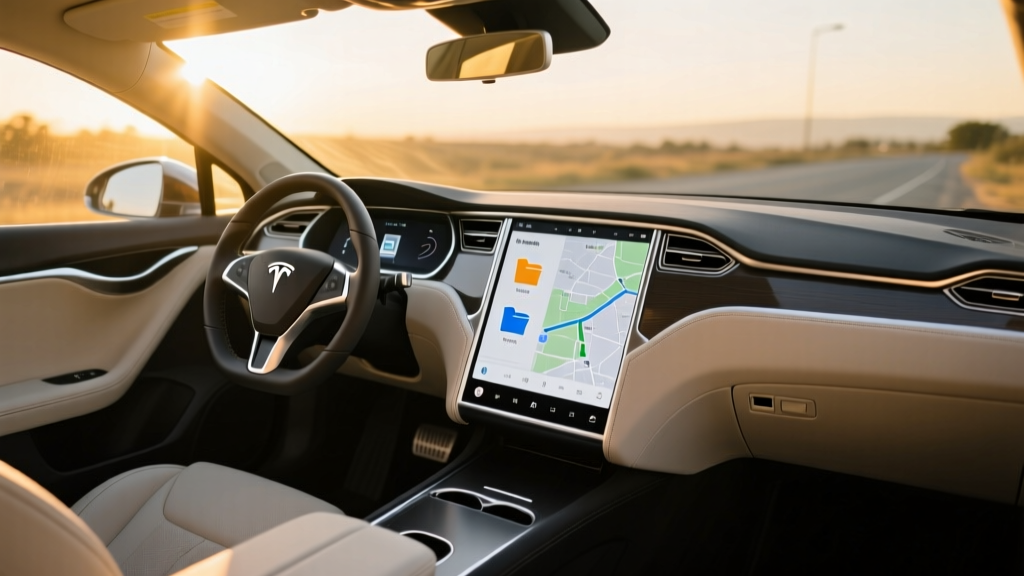
The Tesla cabin is defined by its 15.4-inch center touchscreen (17-inch in Model S/X) running Tesla's proprietary Linux-based OS. This is where the NVMe SSD and AMD Ryzen processor justify their existence:
- Navigation: Real-time traffic, Supercharger availability, and elevation-aware range prediction render instantly.
- Sentry Mode & Dashcam: All eight cameras record simultaneously to the SSD. Clips are saved in 1-minute segments and can be exported to a USB drive or viewed on-screen. Expect ~1 GB per hour of Sentry recording.
- Gaming: AAA titles like Cyberpunk 2077 load from the SSD in under 10 seconds — a genuine differentiator for parents waiting at soccer practice or drivers killing time at a Supercharger.
- OTA Updates: Tesla pushes major software updates (sometimes 5–10 GB) that add features, improve efficiency, and refine Autopilot. The fast SSD means updates install in 20–40 minutes versus over an hour on older MCU1 hardware.
Cargo and Passenger Space:
| Dimension | Model 3 | Model Y | Model S | Model X |
|---|---|---|---|---|
| Rear Legroom | 35.2 in | 41.6 in | 35.4 in | 37.1 in |
| Cargo (rear seats up) | 23 cu ft | 30 cu ft | 28 cu ft | 37 cu ft |
| Cargo (rear seats folded) | 65 cu ft | 72 cu ft | 79 cu ft | 88 cu ft |
| Frunk | 3.1 cu ft | 4.1 cu ft | 5.3 cu ft | 6.6 cu ft |
The Model Y remains the sweet spot for families: SUV cargo capacity, available 7-seat configuration (though the third row is tight for anyone over 5'4"), and a ride height that makes loading car seats manageable.
Driver Assistance: Autopilot and FSD (Supervised)
Tesla's Autopilot and Full Self-Driving (Supervised) are SAE Level 2 driver-assistance systems. The driver must remain fully engaged, hands on the wheel (or applying torque), and eyes on the road at all times. These are not self-driving systems. Only Level 4 services like Waymo operate without a human driver in geofenced areas.
Autopilot (included standard) handles adaptive cruise control and lane centering on highways competently. FSD (Supervised), a $8,000 one-time purchase or $99/month subscription as of 2026, adds city-street navigation, traffic-light recognition, and automatic turns. After years of iterative neural-network training, FSD Supervised is genuinely capable in many suburban and urban scenarios — but it still makes unpredictable errors at construction zones, unprotected left turns, and faded lane markings. Treat it as an advanced cruise control, not a chauffeur.
- Drive you home while you sleep or text
- Reliably handle work zones, emergency vehicles, or unmapped roads
- Replace driver attention — NHTSA has opened multiple investigations into Autopilot-related crashes involving stationary emergency vehicles
- Operate in all weather — heavy rain, snow, and direct sun glare degrade camera performance
Warranty, Ownership Costs, and Long-Term Battery Health
Tesla's warranty coverage is average for the EV segment:
- Basic Vehicle: 4 years / 50,000 miles
- Battery & Drive Unit (Model 3/Y): 8 years / 120,000 miles (Long Range AWD)
- Battery & Drive Unit (Model S/X): 8 years / 150,000 miles
- Capacity Retention Threshold: Tesla warrants a minimum of 70% retention over the warranty period. Below that, they replace or refurbish the pack at no cost.
Real-world degradation data from large owner surveys (including Teslanorthown and Recurrent Auto) shows Tesla NMC packs typically lose 5–8% capacity in the first 50,000 miles, then degrade linearly at roughly 1% per 20,000 miles thereafter. At 150,000 miles, most packs retain 88–92% of original capacity — well above the warranty threshold. LFP-equipped Model 3 RWD variants show even slower degradation and can be charged to 100% daily without harm.
Insurance remains a pain point. Tesla vehicles carry some of the highest insurance premiums in the EV segment due to expensive collision repairs (aluminum body panels, integrated battery structure, and sensor recalibration costs). Budget $2,500–$4,500 annually depending on your state, age, and driving record. Tesla's own insurance product, available in select states, uses real-time driving data and can undercut traditional carriers by 10–20% for clean-record drivers.
Pros, Cons, and the Competition
- Supercharger network remains the gold standard for road-trip reliability
- Class-leading software, OTA updates, and infotainment responsiveness (AMD + NVMe)
- Strong efficiency — Model 3 LR achieves 132 MPGe combined
- Over-the-air feature additions keep the car feeling current years after purchase
- Sentry Mode and dashcam integration are best-in-class
- Model 3 and Y qualify for the full $7,500 federal credit (income/MSRP permitting)
- Build quality inconsistency — panel gaps, paint defects still reported more than legacy OEMs
- No Apple CarPlay or Android Auto — Tesla's ecosystem is walled-garden
- Insurance premiums significantly above segment average
- FSD (Supervised) is expensive and still requires full driver attention
- DC fast-charging speed (250 kW) lags 800V rivals (Ioniq 5, EV6 at 350 kW)
- Rear-seat comfort in Model 3 is tight for adults on long trips
Versus key competitors: The Hyundai Ioniq 5 charges faster (10–80% in 18 minutes at 350 kW) and offers a more comfortable ride, but its public charging experience depends on third-party networks. The BMW i4 delivers superior build quality and handling, but starts $10,000+ higher and lacks the Supercharger ecosystem. The Ford Mustang Mach-E undercuts on price but trails on efficiency and software polish. Tesla's integrated hardware-software-charging stack remains its most defensible advantage.
Who Should Buy a Tesla in 2026?
- Choose the Model 3 if you want the most efficient, tech-forward sedan under $45,000 (after credit) and primarily commute solo or with one passenger.
- Choose the Model Y if you need family-friendly cargo space, car-seat accessibility, and the option of a third row for small children.
- Choose the Model S or X if budget is flexible and you want flagship performance (3.1-second 0–60 in the S) with premium cabin space — but know you forfeit the federal credit.
- Look elsewhere if you demand Apple CarPlay, prefer a dealer-service experience, or live in a region with sparse Supercharger coverage and unreliable third-party DC chargers.
Frequently Asked Questions
Can I upgrade the hard drive in my older Tesla?
Yes, but only through Tesla Service. Owners of MCU1-equipped Model S and X (2012–2018) can pay for an infotainment upgrade that replaces the entire MCU with the newer Intel or AMD-based unit, including faster SSD storage. Aftermarket SSD swaps are not supported and will void the warranty. For Model 3 and Y, the storage is soldered and not user-serviceable.
How much Sentry Mode footage can the Tesla hard drive store?
The 256 GB NVMe SSD in current MCU3 vehicles stores roughly 100–150 hours of Sentry Mode footage across all cameras before the oldest clips are overwritten. The 512 GB drive in MCU4 vehicles roughly doubles that. You can also export clips to a USB-C flash drive for long-term archival.
Does the Tesla Model 3 or Model Y qualify for the $7,500 federal tax credit?
Both the Model 3 and Model Y generally qualify for the full $7,500 under IRS §30D, provided the buyer's AGI is within limits ($150K single / $300K joint), the vehicle MSRP is under the cap ($55K sedans / $80K SUVs), and the battery meets critical-mineral and component sourcing thresholds. Since 2024, the credit can be transferred at point of sale, reducing your purchase price immediately. Verify your specific VIN's eligibility at IRS.gov.
Is Tesla's 250 kW charging speed fast enough for road trips?
It is adequate but no longer best-in-class. A 10–80% charge in ~25 minutes means 15–20 minute Supercharger stops every 200–250 miles on a road trip. The Hyundai Ioniq 5 and Kia EV6, on 350 kW chargers, can do 10–80% in ~18 minutes. For most drivers, the difference is marginal because Supercharger reliability and in-car routing offset the slightly slower peak speed.
What is the real-world range of the Tesla Model 3 Long Range?
The EPA rates it at 363 miles. In real-world highway driving at 70–75 mph in mild weather, expect 300–320 miles. In winter (below freezing), plan for 250–270 miles of usable range. Preconditioning while plugged in and using seat heaters instead of cabin heat can recover 15–20 miles.
Is Autopilot or FSD (Supervised) actually self-driving?
No. Both are SAE Level 2 driver-assistance systems that require continuous driver supervision. You must keep your hands on the wheel and eyes on the road. FSD (Supervised) can navigate city streets and make turns, but it makes errors and is not a substitute for an attentive driver. True self-driving (Level 4) is currently only available through robotaxi services like Waymo in limited geofenced cities.