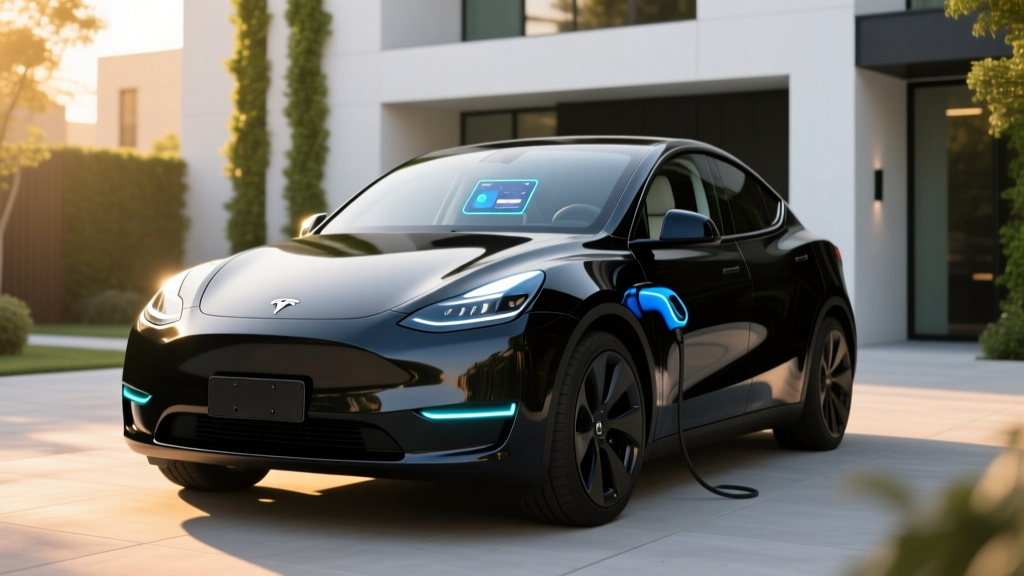
Tesla's integration of Grok — the large language model developed by Elon Musk's xAI — into its vehicle fleet has been one of the most anticipated software shifts in the EV space. The latest over-the-air Grok update, rolling out to Model Y and Model 3 vehicles throughout early 2026, moves beyond novelty voice commands into deeper vehicle-system awareness. But what does it actually change for the person behind the wheel, and does it alter the ownership calculus for Tesla's best-selling crossover?
This profile examines the 2026 Model Y (post-refresh) as the primary recipient of the Grok update, pairing a full spec review with a clear-eyed look at what the AI integration adds — and what it doesn't.
What the Tesla Grok Update Actually Does
Before diving into range and charging, it's worth clarifying what Grok brings to the in-car experience. The 2026 update integrates xAI's Grok model directly into the Tesla voice interface, replacing the previous, more limited natural-language processing with a full conversational AI. Key additions include:
- Contextual vehicle queries: Ask "Why is my range lower today?" and Grok cross-references recent driving data, ambient temperature, and tire pressure to give a specific answer rather than a generic tip.
- Natural-language navigation: "Find me a charger near a good sushi place in Sacramento" now parses compound intent without requiring sequential commands.
- Trip planning with reasoning: Grok can explain why it chose a particular Supercharger stop over another, factoring in real-time stall availability, terrain, and your historical charging preferences.
- Vehicle manual replacement: Instead of scrolling through the touchscreen manual, you can ask Grok how to adjust regen braking or activate Sentry Mode and receive a direct, step-by-step answer.
- Smart Home & calendar integration: Grok can interface with connected HomeKit/Matter devices and your calendar to precondition the car before a meeting or close your garage door as you pull away.
What Grok does not do is control driving dynamics, alter FSD behavior, or modify powertrain output. It's an infotainment and vehicle-information layer — a sophisticated one, but still bounded by the same Level 2 guardrails as before.
2026 Model Y: Range, Battery, and Real-World Efficiency
| Spec | Long Range AWD | Performance |
|---|---|---|
| EPA Range | 320 miles | 285 miles |
| Battery (usable) | ~75 kWh, NMC | ~75 kWh, NMC |
| MPGe (combined) | 111 MPGe | 103 MPGe |
| kWh/100 mi | 30 kWh | 33 kWh |
| 0-60 mph | 4.8 sec | 3.5 sec |
| Horsepower | 384 hp | 456 hp |
| Drivetrain | Dual-motor AWD | Dual-motor AWD |
| Top Speed | 125 mph | 155 mph |
Tesla continues to use nickel-manganese-cobalt (NMC) chemistry in the Long Range and Performance trims, prioritizing energy density over the cycle-life advantages of LFP. The standard-range RWD variant (not currently sold in the US as of early 2026) used LFP in prior years; US buyers get NMC across the board.
Charging: DC Fast, Level 2, and the Supercharger Advantage
| Charging Level | Power / Rate | Speed | Notes |
|---|---|---|---|
| Level 1 (120V) | ~1.4 kW | ~4 mi/hr | Emergency/trickle only |
| Level 2 (240V, 48A) | 11.5 kW | ~37 mi/hr | Home Wall Connector; ~8.5 hrs for full charge |
| DC Fast (V3 Supercharger) | Peak 250 kW | 10-80% in ~22 min | Sustains ~250 kW to ~40% SoC, tapers sharply above 60% |
| DC Fast (V4 Supercharger) | Peak 250 kW (vehicle-limited) | 10-80% in ~22 min | Model Y architecture caps at 250 kW; V4 stalls deliver more but car can't accept it |
Tesla's charging curve is a critical ownership detail often glossed over in marketing. The Model Y peaks near 250 kW only when the battery is preconditioned (navigation routed through a Supercharger) and state of charge is below 40%. Above 60% SoC, the rate drops to roughly 100-120 kW, and above 80% it falls below 50 kW. This means charging from 10-80% takes about 22 minutes, but 10-100% takes closer to 50 minutes. Plan road-trip stops around 80% to minimize time at the charger.
The Grok update enhances trip planning by explaining charge-curve taper in plain language when you ask, and by recommending shorter stops at higher stall-count stations to reduce wait risk.
Home charging with the Tesla Wall Connector on a 60A circuit (48A continuous) delivers 11.5 kW, adding roughly 37 miles of range per hour. A full overnight charge from 20% to 100% takes about 8-9 hours. Installation typically runs $800-$2,000 depending on panel proximity and local permitting — budget for a possible 200A panel upgrade ($1,500-$3,000) if your home has an older 100A service.
Interior, Cargo, and Daily Livability
The refreshed Model Y (sometimes called "Juniper" from the 2025 refresh, carried into 2026) improved interior materials, added ventilated front seats, a rear-seat touchscreen, and ambient lighting. Cargo space remains a class strength:
- Cargo (rear seats up): 30.2 cu ft
- Cargo (rear seats folded): 72.1 cu ft
- Front trunk (frunk): 4.1 cu ft
- Rear legroom: 41.6 inches
- Front headroom: 40.3 inches
The 15.4-inch central touchscreen remains the sole interface for nearly all vehicle controls — no physical buttons for climate, mirrors, or glovebox. The Grok update partially mitigates this by allowing voice control of most settings ("Set cabin to 70 degrees and turn on seat heaters"), which is genuinely faster than tapping through menus while driving. However, passengers unfamiliar with the system still face a learning curve.
Pricing, Trims, and Federal Tax Credit Eligibility
| Trim | Base MSRP | Est. §30D Credit | Effective Price |
|---|---|---|---|
| Long Range AWD | $48,990 | Up to $7,500* | ~$41,490* |
| Performance | $53,990 | Up to $7,500* | ~$46,490* |
*Federal tax credit eligibility under IRS §30D depends on multiple requirements that change periodically. As of 2026, key rules include:
- MSRP cap: SUVs/crossovers must be under $80,000 (Model Y qualifies).
- Buyer income cap: Adjusted gross income must not exceed $150,000 (single), $225,000 (head of household), or $300,000 (joint).
- Battery sourcing: Critical minerals and battery components must meet phased-in domestic/free-trade-partner thresholds. Tesla's shifting supply chain means eligibility can vary by production batch — confirm at point of sale.
- Point-of-sale transfer: Eligible buyers can apply the credit as an instant rebate at purchase rather than waiting for tax filing.
Always verify current eligibility on irs.gov or with a tax professional before relying on the credit in your purchase decision. Tesla's website also maintains a credit-eligibility indicator that updates as sourcing rules shift.
Tech, Driver Assistance, and the Grok Differentiator
Beyond Grok, the 2026 Model Y ships with Tesla's current Autopilot suite as standard, including Traffic-Aware Cruise Control and Autosteer. Full Self-Driving (Supervised) remains an $8,000 add-on (or $99/month subscription) and includes Navigate on Autopilot, Auto Lane Change, Autopark, and Smart Summon.
The Grok update's real value emerges in reducing touchscreen distraction. Asking Grok to "navigate to the nearest V4 Supercharger with at least four open stalls" is faster and safer than tapping through the map while driving. Similarly, querying "What's my average efficiency this week compared to last?" surfaces data that previously required digging through the energy app.
Entertainment features include Netflix, YouTube, and arcade games while parked, plus a 17-speaker premium audio system with immersive sound. The Grok update adds conversational trivia, news briefings, and the ability to summarize long emails or messages read aloud while driving.
Warranty, Ownership Costs, and Long-Term Outlook
- Basic vehicle warranty: 4 years / 50,000 miles
- Battery & drive unit: 8 years / 120,000 miles (Long Range AWD); 8 years / 120,000 miles (Performance)
- Battery degradation threshold: Tesla warrants retention of at least 70% capacity during the warranty period
Insurance costs for the Model Y remain above segment average — expect $1,800-$2,800/year depending on state, driving record, and coverage level. Tesla Insurance is available in select states and uses real-time driving data to price premiums, which can benefit low-mileage or cautious drivers.
Depreciation has been a pain point: the Model Y has seen steeper-than-average resale value drops in 2024-2025 due to price cuts and increased competition. If you plan to keep the vehicle 5+ years, this matters less; if you trade every 3 years, factor in higher ownership cost.
Model Y vs. Key Competitors: Is It Still Worth It?
The Model Y faces real competition in 2026 that didn't exist at this scale two years ago:
- Hyundai Ioniq 5: 800V architecture enables 10-80% in ~18 min (vs. Tesla's ~22 min). EPA range up to 305 mi. More physical controls. No Grok equivalent. Starting ~$44,000.
- Ford Mustang Mach-E: Improved range (EPA 320 mi on Extended Range). BlueCruise hands-free on mapped highways (still Level 2). Starting ~$43,000.
- Cadillac Lyriq: Luxury interior, 314 mi EPA range, Super Cruise availability. Starting ~$58,000 — different price bracket.
The Model Y's advantages remain the Supercharger network (now partially open to competitors via NACS adapters, but still most seamless for Tesla owners), the Grok-enhanced software experience, over-the-air update cadence, and cargo practicality. Its disadvantages are the buttonless interior, insurance cost, and a brand perception that has polarized some buyer segments.
Pros, Cons, and Who Should Buy
- Supercharger network access (most reliable DC fast-charging ecosystem)
- Grok integration reduces touchscreen distraction
- Class-leading cargo space (72.1 cu ft)
- Strong efficiency (111 MPGe combined)
- Continuous OTA improvements
- Point-of-sale tax credit available if eligible
- No physical buttons — everything through the screen or voice
- 250 kW DC peak cap (slower than 800V competitors)
- Above-average insurance premiums
- FSD is expensive and still Level 2
- Depreciation steeper than some rivals
- Brand perception may affect resale in some markets
Best for: Tech-forward commuters and small families who want a do-it-all electric crossover with strong road-trip charging infrastructure, value continuous software improvement, and are comfortable with a screen-centric interface. The Grok update makes the daily interaction meaningfully smoother for anyone who prefers voice over touch.
Look elsewhere if: You want physical climate controls, need the absolute fastest DC charging (Hyundai/Kia's 800V platform is quicker), prefer a traditional dealership experience, or are sensitive to Tesla brand association in your community.
Frequently Asked Questions
What is the real-world range of the 2026 Tesla Model Y?
The EPA rates the Long Range AWD at 320 miles. Real-world highway driving in moderate weather yields 270-290 miles. In winter cold (below 32°F), expect 210-250 miles on the highway. City driving with regenerative braking can match or slightly exceed the EPA figure.
How fast does the Model Y charge at home and on the road?
At home on a Level 2 Wall Connector (11.5 kW), you gain about 37 miles of range per hour, with a full charge taking roughly 8-9 hours. On a V3 or V4 Supercharger, 10-80% takes about 22 minutes, with the charge rate tapering significantly above 60% state of charge.
Does the 2026 Model Y qualify for the federal EV tax credit?
It can, but eligibility depends on your income (under $150K single / $300K joint), the vehicle's MSRP (under $80K for SUVs — Model Y qualifies), and battery-sourcing requirements that shift over time. Confirm eligibility at point of sale and on fueleconomy.gov.
What does the Tesla Grok update change about daily driving?
Grok replaces limited voice commands with a conversational AI that understands compound requests ("find a charger near a coffee shop"), answers vehicle-specific questions using your driving data, and reduces the need to interact with the touchscreen while driving. It does not change driving dynamics, range, or FSD capability.
Is the Model Y still worth buying vs. the Ioniq 5 or Mach-E?
It depends on your priorities. The Model Y wins on Supercharger access, cargo space, software sophistication (especially with Grok), and efficiency. The Ioniq 5 charges faster on DC (800V architecture), and the Mach-E offers BlueCruise hands-free driving on mapped highways. All three are strong — test-drive each before deciding.
Does Grok require a subscription or extra fee?
As of early 2026, Tesla has included Grok functionality at no additional charge for vehicles with the latest software. Tesla Premium Connectivity ($10.99/month) is required for satellite-based features and live traffic, which Grok's trip planning leverages. Tesla could change this pricing model in future updates.