Tesla Grok AI Meets the Best-Selling EV: The 2026 Model Y Profile
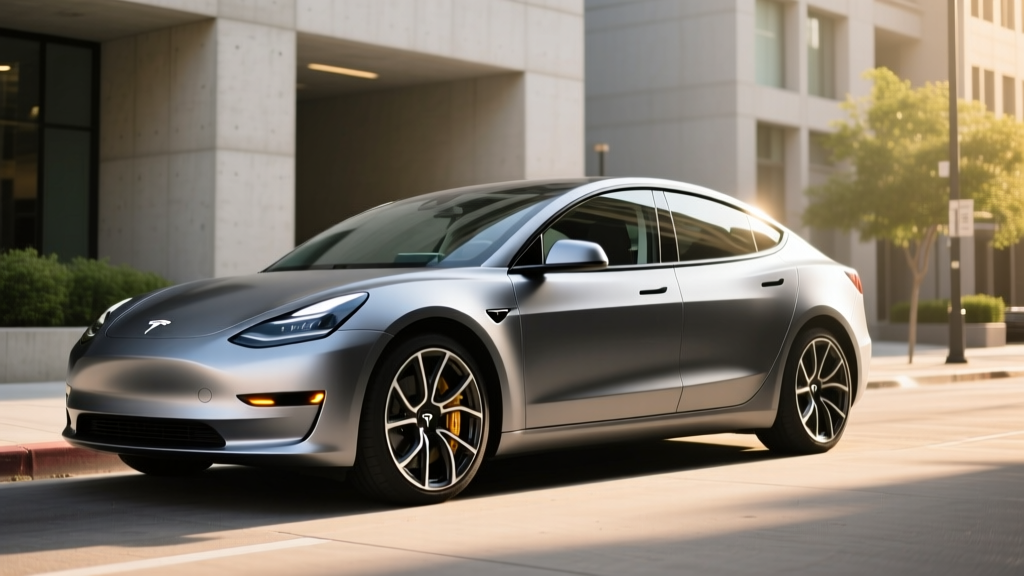
When Tesla announced it would integrate its Grok AI assistant across the vehicle fleet, most coverage focused on the chatbot's conversational abilities. But for EV buyers, the more important question is practical: does Tesla Grok AI meaningfully change what it's like to own and drive a 2026 Model Y? The short answer is that Grok reshapes the infotainment and trip-planning layer while the underlying EV hardware — battery, motors, charging architecture — remains the proven Juniper-refresh platform that made the Model Y the best-selling EV in the US.
This review covers the 2026 Tesla Model Y Long Range AWD and Performance trims with full attention to EPA range, real-world efficiency, DC fast-charging curves, pricing after the §30D federal tax credit, and exactly where Grok AI fits into daily ownership. If you're cross-shopping against the Hyundai Ioniq 5, Ford Mustang Mach-E, or Chevrolet Equinox EV, the data below will tell you what you're actually buying.
| Spec | Long Range AWD | Performance |
|---|---|---|
| EPA Range | 320 miles | 295 miles |
| Battery (usable) | ~75 kWh, NMC | ~75 kWh, NMC |
| Drivetrain | Dual-motor AWD | Dual-motor AWD |
| Horsepower | 384 hp | 456 hp |
| 0-60 mph | 4.8 sec | 3.5 sec |
| Peak DC Fast Charge | 250 kW | 250 kW |
| 10-80% DCFC Time | ~25 min | ~25 min |
| Level 2 Home Charge | 11.5 kW (~44 mi/hr) | 11.5 kW (~44 mi/hr) |
| MPGe (combined) | 111 MPGe | 102 MPGe |
| kWh / 100 mi | 30 kWh | 33 kWh |
| Cargo (rear seats up) | 30.2 cu ft | 30.2 cu ft |
| Cargo (seats folded) | 72.1 cu ft | 72.1 cu ft |
| Rear Legroom | 38.2 in | 38.2 in |
| Base MSRP | $44,990 | $48,990 |
| Battery Warranty | 8 yr / 120,000 mi | 8 yr / 120,000 mi |
Range and Efficiency: EPA Sticker vs. Real-World Miles
The 2026 Model Y Long Range AWD carries an EPA-estimated 320 miles of range. The Performance trim drops to 295 miles due to stickier tires, a lower ride height, and more aggressive powertrain mapping. These figures come from Tesla's Juniper battery pack, which uses approximately 75 kWh of usable NMC (nickel manganese cobalt) chemistry — a proven formulation that prioritizes energy density over the cycle-life advantages of LFP (lithium iron phosphate).
- EPA sticker: 320 miles
- Mixed driving (city + highway, 65-75°F): ~280-300 miles
- Sustained highway (75 mph, moderate temps): ~255-275 miles
- Cold weather (20-30°F, cabin heat): ~210-240 miles
- Worst case (highway + cold + headwind): ~195-215 miles
The Model Y's heat pump helps mitigate cold-weather losses compared to older resistive-heating EVs, but any EV loses roughly 20-30% of range in freezing temps. Plan road-trip charging stops using ~260 miles as a safe warm-weather highway buffer.
Efficiency lands at 111 MPGe combined (30 kWh per 100 miles) for the Long Range, per fueleconomy.gov. That's competitive with the Hyundai Ioniq 5 (114 MPGe) and slightly behind the BMW iX xDrive50 (113 MPGe combined with a much heavier vehicle). The Performance trim's 102 MPGe reflects its wider tires and sport tuning.
Charging Speed: DC Fast Charge and Home Level 2
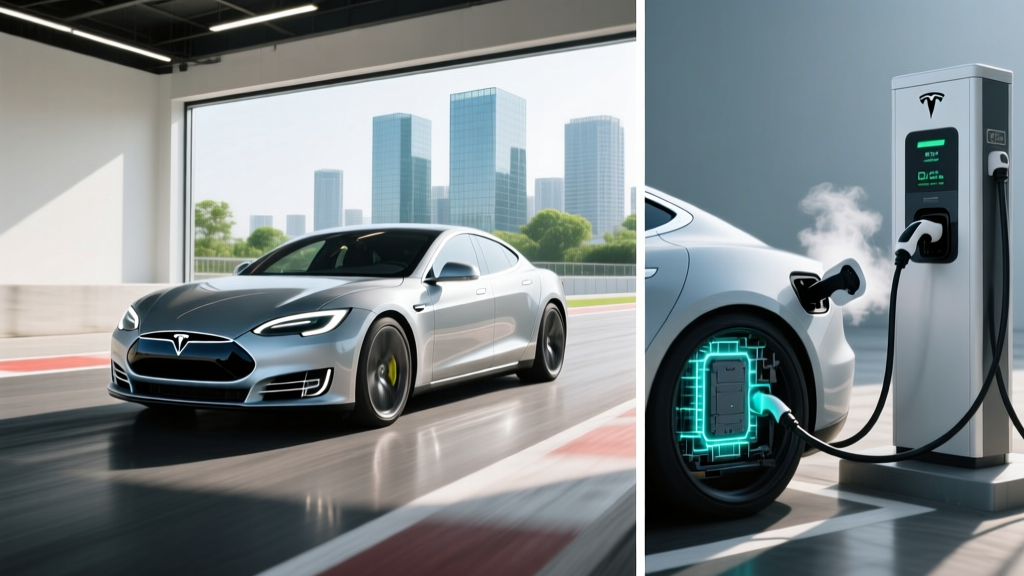
Tesla's Supercharger network remains the most reliable DC fast-charging ecosystem in North America, and the 2026 Model Y takes full advantage. The onboard charge architecture supports a peak 250 kW at V3 and V4 Supercharger stalls.
| Charge Level | Power | Speed (miles added) | Notes |
|---|---|---|---|
| Level 1 (120V outlet) | ~1.4 kW | ~4-5 mi/hr | Emergency/trickle only |
| Level 2 (240V, 48A) | 11.5 kW | ~44 mi/hr | Full charge in ~7 hours |
| Level 2 (240V, 32A Mobile) | 7.7 kW | ~30 mi/hr | Tesla Mobile Connector |
| DC Fast (Supercharger V3/V4) | Peak 250 kW | ~175 mi in 15 min | 10-80% in ~25 min |
| DC Fast (CCS adapter, non-Tesla) | Peak ~150-200 kW | Varies by station | Requires NACS-to-CCS adapter at some networks |
The important nuance is the charge curve. The Model Y hits 250 kW only between roughly 10-25% state of charge (SoC). From 25-50%, it sustains around 170-200 kW. Above 50%, it tapers to ~100 kW, and above 80% it drops sharply to ~40-50 kW to protect the NMC cells. This is why Tesla recommends charging to 80% at Superchargers — the last 20% takes nearly as long as the first 60%.
For home charging, a Wall Connector on a 60-amp circuit delivers the full 11.5 kW (48 amps continuous), adding about 44 miles of range per hour. That means a depleted battery reaches full overnight in roughly 7 hours. Most owners who plug in nightly at home never visit a Supercharger except on road trips. Home installation of a 60-amp circuit typically runs $800-$2,000 depending on panel proximity and local permitting — factor this into your purchase budget.
What Tesla Grok AI Actually Does in Your Car
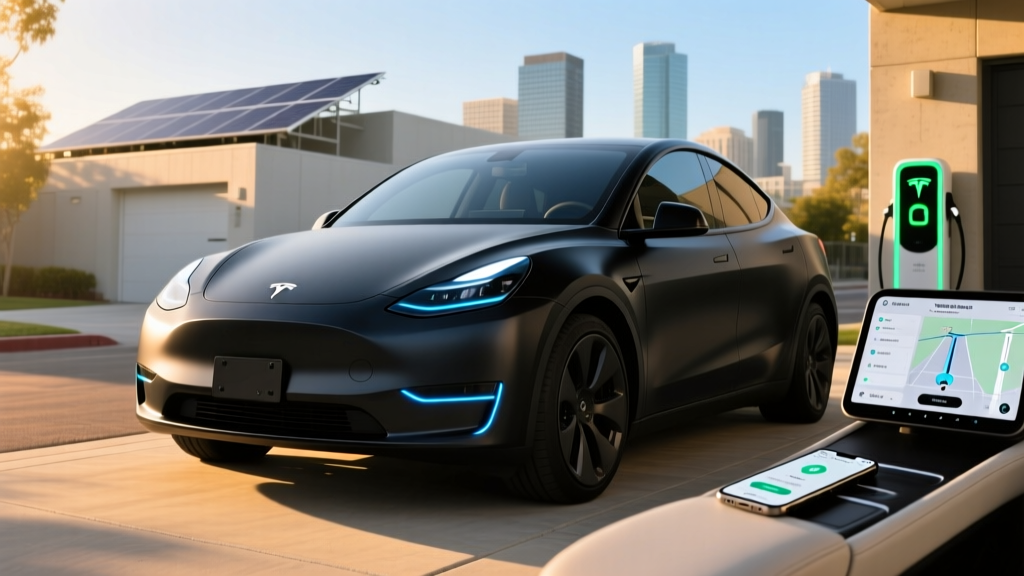
Grok AI is Tesla's large-language-model assistant, integrated directly into the vehicle's infotainment system via the car's built-in connectivity. Unlike voice assistants that simply parse commands, Grok can handle multi-turn natural-language queries about your trip, vehicle status, and surroundings. In practice, this means:
- Natural trip planning: Ask "Find me a Supercharger near a good sushi restaurant in Flagstaff" and Grok returns a route with both the charging stop and the restaurant, cross-referencing real-time stall availability.
- Vehicle diagnostics in plain language: "Why is my range lower today?" prompts Grok to analyze recent driving data, temperature, tire pressure, and cabin preconditioning to give a specific answer rather than a generic help article.
- Destination and POI reasoning: Grok can answer contextual questions about charging stops — "Is this Electrify America station reliable?" — pulling from aggregated user data.
- Entertainment and information: Conversational queries about news, sports, or trivia while parked, functioning similarly to the standalone Grok chatbot in the X (formerly Twitter) app.
What Grok does not do is drive the car. Tesla's Full Self-Driving (Supervised) remains a SAE Level 2 driver-assistance system, meaning the driver must remain fully attentive with hands on or near the wheel at all times. Grok is an interface layer for information and convenience, not an autonomy upgrade. This distinction matters because marketing around "AI in cars" often blurs the line between chatbot intelligence and driving automation.
Performance, Handling, and Daily Drivability
The 2026 Model Y Long Range AWD posts a 4.8-second 0-60 mph time with 384 combined horsepower from its dual permanent-magnet and induction motor setup. That's genuinely quick for a family crossover — quicker than a Toyota Camry V6 and on par with many sports sedans from a decade ago. The Performance trim drops that to 3.5 seconds with 456 hp, which is supercar-adjacent acceleration in a vehicle with 72 cubic feet of cargo space.
Handling benefits from the Juniper refresh's revised suspension tuning, which addressed the most common complaint about pre-2025 Model Ys: a firm, sometimes crashy ride over broken pavement. The 2026 version is noticeably more compliant while retaining the low center of gravity that makes all EVs feel planted in corners. Steering remains quick and direct, if a bit numb on center — a Tesla hallmark.
The regenerative braking system offers strong one-pedal driving capability. Tesla removed the user-adjustable regen setting several years ago, so the deceleration force when lifting off the accelerator is fixed. Most owners adapt within a week, but if you're coming from a vehicle with adjustable regen (like a Hyundai or Kia EV), expect a brief adjustment period.
Pricing, Trims, and Federal Tax Credit Eligibility
The 2026 Model Y lineup starts at $44,990 for the Long Range AWD and $48,990 for the Performance. Both fall under the IRS §30D MSRP cap of $80,000 for SUVs, which is the first hurdle for federal tax credit qualification. However, eligibility depends on several factors that change frequently and vary by buyer.
| Trim | Base MSRP | Typical Options | As-Tested | Est. After §30D* |
|---|---|---|---|---|
| Long Range AWD | $44,990 | $0-$3,000 | $44,990-$47,990 | $37,490-$40,490 |
| Performance | $48,990 | $0-$3,000 | $48,990-$51,990 | $41,490-$44,490 |
*Assumes full $7,500 credit. Actual eligibility depends on income, battery sourcing, and point-of-sale transfer rules. See IRS guidelines below.
- MSRP cap: Vehicle must be under $80,000 for SUVs (both Model Y trims qualify)
- Buyer income cap: Modified AGI ≤ $150,000 (single), $225,000 (head of household), $300,000 (joint)
- Battery sourcing: Critical minerals and battery components must meet escalating domestic/free-trade-agreement thresholds — Tesla's US-built battery packs have generally met these requirements, but verify at purchase
- Point-of-sale transfer: Eligible buyers can apply the credit as an instant discount at the dealership rather than waiting for a tax refund
- FEOC restriction: Vehicles with battery components from Foreign Entities of Concern are disqualified — check current IRS guidance at time of purchase
Tax credit rules are subject to legislative change. Consult a tax professional and verify eligibility on irs.gov before finalizing your purchase.
Interior, Cargo, and Technology
The Juniper-refreshed Model Y interior is a meaningful step up from the pre-2025 cabin. Materials are softer, the ambient lighting is more deliberate, and the ventilated front seats are standard on both trims. The minimalist dashboard remains — there is still no instrument cluster behind the wheel, and all information routes through the 15.4-inch center touchscreen.
Cargo space is a genuine strength: 30.2 cubic feet behind the second row and 72.1 cubic feet with the 60/40 split seats folded. That exceeds the Ford Mustang Mach-E (29.7 / 59.7 cu ft) and rivals midsize gas SUVs. The front trunk (frunk) adds roughly 4.1 cubic feet for charging cables, groceries, or a carry-on bag.
Rear legroom at 38.2 inches is adequate for adults on longer trips, though the sloping roofline cuts into headroom for passengers over 6 feet tall. The rear touchscreen added in the Juniper refresh lets back-seat passengers control climate and entertainment — a welcome addition for families.
On the technology front, Grok AI sits alongside Tesla's existing suite: over-the-air software updates, Sentry Mode dashcam recording, a mobile app with remote climate and charging control, and the optional FSD (Supervised) package at $8,000 (or $99/month subscription). The 17-speaker audio system with immersive sound is standard and genuinely excellent — one of the best factory audio setups in any vehicle under $60,000.
Warranty, Ownership Costs, and Longevity
Tesla covers the Model Y's battery and drive unit for 8 years or 120,000 miles (whichever comes first), with a capacity retention threshold of 70%. The basic vehicle limited warranty is 4 years / 50,000 miles. This battery warranty is competitive with the industry standard (Hyundai offers 10yr/100,000 mi on the Ioniq 5 battery; Ford offers 8yr/100,000 mi on the Mach-E).
Long-term battery degradation data on Tesla's NMC packs shows an average capacity loss of roughly 10-12% over the first 150,000 miles, based on aggregated fleet data from Tesla owners. Most packs retain above 85% state of health (SoH) at 100,000 miles. The 70% warranty threshold is conservative — very few packs have been reported to drop below it within the warranty period under normal use.
Insurance costs remain a consideration. The Model Y typically insures for 15-25% more than a comparably priced gas crossover, driven by higher repair costs after collisions (specialized body panels, sensor recalibration, battery inspection requirements). Get quotes from your insurer before committing to the purchase.
Maintenance costs are low relative to gas vehicles: no oil changes, no transmission fluid, no spark plugs. Expect to budget for tire rotations every 6,000-8,000 miles (EVs wear tires faster due to instant torque and heavier curb weight), cabin air filter replacement annually, and brake fluid checks every two years. The regenerative braking system means brake pads often last well past 100,000 miles.
How the Model Y Stacks Up Against Key Competitors
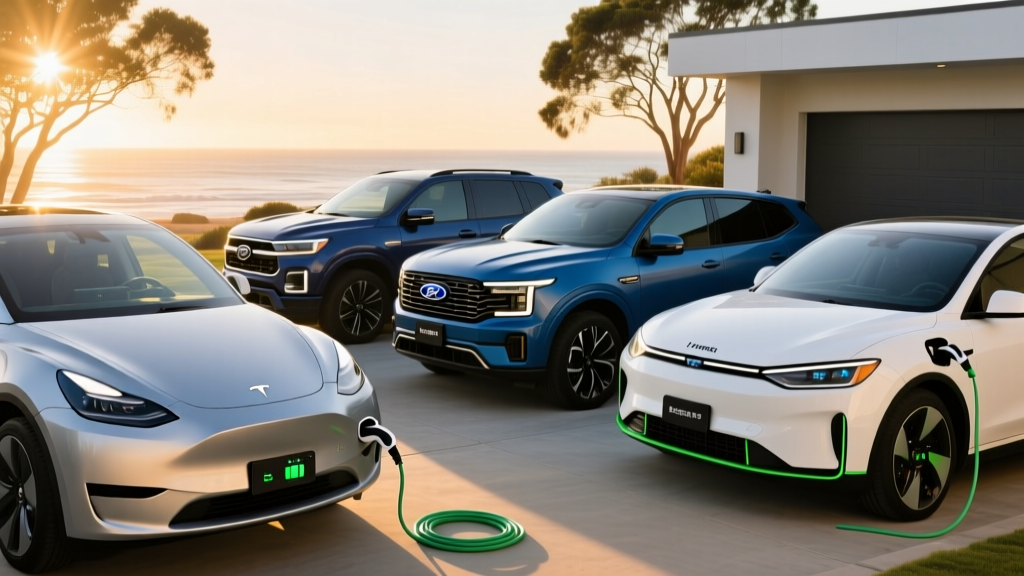
The 2026 Model Y's most direct competitors are the Hyundai Ioniq 5, Ford Mustang Mach-E, and Chevrolet Equinox EV. Here's how they compare on the metrics that matter most:
- Range: Model Y LR (320 mi) vs. Ioniq 5 Long Range (305 mi) vs. Mach-E Extended Range (320 mi) vs. Equinox EV (319 mi). Essentially a tie at the top end.
- Charging speed: Ioniq 5 wins with its 800V architecture (peak 350 kW, 10-80% in ~18 min). The Model Y and Mach-E peak at 250 kW. The Equinox EV peaks around 150 kW.
- Charging network: Tesla's Supercharger network remains the most reliable and widespread, though all competitors now have access via NACS adapters. The gap is narrowing but not closed.
- Cargo space: Model Y (72.1 cu ft max) beats the Mach-E (59.7) and Ioniq 5 (59.3) decisively.
- Software/AI: Grok AI gives Tesla a conversational interface edge, but Hyundai's Bluelink and Ford's SYNC 4A are mature, reliable platforms with strong app integration.
- Price after credit: All four vehicles potentially qualify for the §30D credit depending on trim and sourcing. The Equinox EV starts lowest (~$33,000), making it the budget pick.
- You prioritize cargo space and practicality alongside EV performance
- You want the most reliable DC fast-charging network for road trips
- You value over-the-air updates and a strong software ecosystem
- Grok AI's conversational trip planning appeals to your workflow
- You need the fastest possible DC charging (Hyundai Ioniq 5 at 350 kW)
- You want a lower entry price (Chevrolet Equinox EV)
- You prefer traditional automotive controls and a physical instrument cluster
- You want a longer battery warranty (Hyundai's 10yr/100,000 mi)
- Class-leading cargo volume (72.1 cu ft)
- Supercharger network reliability for road trips
- Strong real-world efficiency (30 kWh/100 mi)
- Grok AI adds genuine trip-planning utility
- Quick acceleration even on the Long Range trim
- Low maintenance costs vs. gas crossovers
- Charging speed trails 800V competitors (250 kW vs. 350 kW)
- No adjustable regenerative braking
- Insurance premiums 15-25% above gas equivalents
- Minimalist interior polarizes — no physical buttons
- Rear headroom tight for tall passengers
- FSD (Supervised) remains Level 2 despite the name
Frequently Asked Questions
What is the real-world range of the 2026 Tesla Model Y?
Expect roughly 280-300 miles in mixed driving, 255-275 miles on sustained highway trips at 70-75 mph, and 210-240 miles in freezing weather with cabin heat. The EPA rates it at 320 miles, but real-world conditions — especially highway speeds and cold temperatures — reduce that figure by 10-30%.
How fast does the Model Y charge at home and on the road?
At home on a Level 2 Wall Connector (11.5 kW / 48 amps), the Model Y adds about 44 miles of range per hour, fully charging from empty in roughly 7 hours. On a V3 or V4 Supercharger, it peaks at 250 kW and charges from 10-80% in approximately 25 minutes, though the charge curve tapers significantly above 50% SoC.
How much does the 2026 Model Y cost after the federal tax credit?
The Long Range AWD starts at $44,990 and the Performance at $48,990. If you qualify for the full $7,500 §30D credit (meeting income caps, MSRP caps, and battery sourcing requirements), effective pricing drops to approximately $37,490 and $41,490 respectively. The credit can be applied as a point-of-sale discount. Verify current eligibility at irs.gov and with a tax professional.
Does the Model Y qualify for the federal EV tax credit?
Both trims fall under the $80,000 MSRP cap for SUVs, and Tesla's US-built battery packs have generally met the critical-mineral and component sourcing thresholds. However, buyer income limits ($150K single / $300K joint) and FEOC sourcing rules apply. Eligibility is not guaranteed for every buyer — check current IRS guidance at the time of purchase.
Is Tesla Grok AI a self-driving feature?
No. Grok AI is a conversational assistant for infotainment, trip planning, and vehicle information queries. It does not control steering, braking, or acceleration. Tesla's Autopilot and FSD (Supervised) are SAE Level 2 driver-assistance systems that require full driver attention at all times.
Is the 2026 Model Y worth buying over the Hyundai Ioniq 5 or Ford Mach-E?
The Model Y wins on cargo space, Supercharger network access, and software ecosystem. The Ioniq 5 charges faster (350 kW peak on 800V architecture) and has a longer battery warranty. The Mach-E offers a more traditional driving feel and strong dealer support. If road-trip charging reliability and cargo volume are your top priorities, the Model Y remains the strongest all-around pick. If peak charging speed or a lower starting price matters more, the Ioniq 5 or Equinox EV deserve serious consideration.