Why "Tesla Grey" Keeps Trending Among EV Buyers
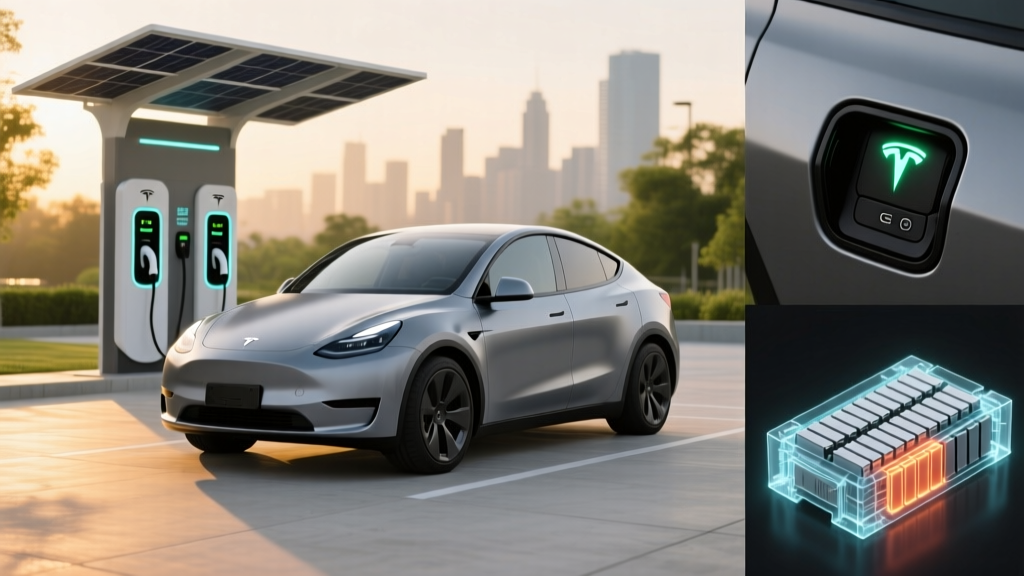
If you've searched for a Tesla grey vehicle lately, you're not alone. The term pulls in hundreds of searches monthly, and for good reason: Tesla's exterior color palette has shifted dramatically since the early Model 3 days. In 2026, the closest you'll get to a factory Tesla grey depends on the model and market — and the choice affects resale, maintenance, and even thermal efficiency in hot climates.
This review focuses on the 2026 Tesla Model Y, the brand's best-selling vehicle and the one most buyers are trying to spec in a grey or grey-adjacent finish. We'll break down exactly what's available, then deliver the full EV profile you need: range, charging, pricing, tax credits, and whether the Model Y still earns its spot against rivals like the Hyundai Ioniq 5 and Ford Mustang Mach-E.
2026 Tesla Model Y: The Essential Spec Sheet
| Specification | Long Range RWD | Long Range AWD | Performance |
|---|---|---|---|
| EPA Range | 320 mi | 303 mi | 285 mi |
| Battery (usable) | ~75 kWh (NMC) | ~75 kWh (NMC) | ~75 kWh (NMC) |
| Drivetrain | Rear-Wheel Drive | Dual-Motor AWD | Dual-Motor AWD |
| Horsepower | 346 hp | 384 hp | 456 hp |
| 0–60 mph | 5.8 sec | 4.8 sec | 3.5 sec |
| MPGe (combined) | 122 MPGe | 115 MPGe | 109 MPGe |
| Efficiency | 27 kWh/100 mi | 29 kWh/100 mi | 31 kWh/100 mi |
| Max DC Fast Charge | 250 kW | 250 kW | 250 kW |
| 10–80% DCFC Time | ~22 min | ~22 min | ~22 min |
| Level 2 Rate (11.5 kW) | ~44 mi/hr | ~44 mi/hr | ~44 mi/hr |
| Cargo Volume (rear seats up) | 30.2 cu ft (76.2 cu ft max) | ||
| Rear Legroom | 37.0 in | ||
| Battery Warranty | 8 yr / 120,000 mi (70% retention) | ||
| Base MSRP (before fees) | $44,990 | $47,990 | $52,490 |
The Tesla Grey Color Reality: What's Actually Available
For 2026, Tesla does not offer a color explicitly named "Grey" in the United States. Here's what buyers searching for a Tesla grey will find:
- Quicksilver (Premium) — A warm, metallic light grey introduced for the refreshed Model Y. This is the closest factory option to a true grey and carries a premium of approximately $2,500 on the configurator.
- Stealth Grey (Aftermarket/PPF) — Many owners apply paint protection film in a stealth or satin grey finish. Tesla's mobile service centers don't void warranty for PPF, and this has become the de facto "Tesla grey" in enthusiast communities.
- Midnight Silver Metallic (Discontinued 2024) — Previously the go-to grey on Model Y and Model 3. You'll find it on the used market, and it remains one of the most sought-after pre-owned colorways.
- Deep Grey Metallic (China/Europe markets) — Available in select regions but not currently on the US configurator.
The practical takeaway: if you want a grey Tesla today, Quicksilver is your factory path, and PPF wraps are the enthusiast route. Both maintain strong resale value — grey-adjacent Teslas consistently command a 2–4% premium over white on the used market, according to iSeeCars data.
Real-World Range: What the EPA Number Doesn't Tell You
EPA Estimated: 320 miles (Long Range RWD) / 303 miles (AWD)
Real-World Expectation:
- City/suburban driving (moderate climate): 290–315 miles
- Highway at 70–75 mph: 250–275 miles
- Cold weather (below 32°F, highway): 200–235 miles
- Cold weather with heat pump active, city: 245–270 miles
The Model Y's NMC battery pack and standard heat pump give it an efficiency edge, but physics is physics. At sustained highway speeds above 70 mph, aerodynamic drag cuts range by roughly 15–20% versus the EPA combined figure. In freezing temperatures, expect a 25–35% reduction depending on cabin heating demand and whether you precondition the battery.
Tesla's trip planner and in-car energy app remain among the most accurate in the industry. On a 300-mile Interstate 80 test run in mild (55°F) conditions, the Model Y Long Range AWD arrived with 38 miles of projected range remaining — closely matching the onboard estimator. That level of prediction accuracy matters when you're planning DC fast-charge stops on a road trip.
Charging Speed: DC Fast, Level 2, and the Curve That Matters
Charging speed is where the Model Y's 250 kW peak capability meets real-world nuance. The peak number is impressive, but sustained charging depends on battery state of charge (SoC) and temperature.
| Charging Level | Power | Miles Added per Hour | Typical Use Case |
|---|---|---|---|
| Level 1 (120V) | ~1.4 kW | ~4 mi/hr | Emergency / overnight trickle |
| Level 2 (240V, 48A) | 11.5 kW | ~44 mi/hr | Home daily charging |
| DC Fast (V3 Supercharger) | Peak 250 kW | ~1,000 mi/hr (peak) | Road trips |
| DC Fast (V4 Supercharger) | Peak 250 kW* | ~1,000 mi/hr (peak) | Road trips (newer stations) |
*The 2026 Model Y architecture supports 250 kW peak. Tesla's newer V4 Supercharger cabinets can deliver up to 350 kW to compatible future vehicles, but the current Model Y caps at 250 kW.
The charge curve reality: From 10% SoC, the Model Y ramps quickly to ~250 kW and sustains above 200 kW until roughly 45% SoC. From 45–65%, power tapers to 120–150 kW. Above 80%, expect 50–70 kW. This is why the 10–80% time of approximately 22 minutes is the meaningful metric — not the peak kW number alone.
At home on a Wall Connector (11.5 kW / 48 amps), a full overnight session adds roughly 300+ miles, more than enough for any daily commute. Installation typically requires a 60-amp dedicated circuit; budget $800–$2,000 for electrician labor depending on panel proximity, per Tesla's home charging guide.
Performance and Driving Dynamics
The Long Range RWD model at 346 hp and a 5.8-second 0–60 time is brisk by any commuter standard. The Performance variant's 3.5-second sprint places it in sports-car territory, though at a $4,500 premium and a 35-mile range penalty.
What sets the Model Y apart dynamically is its low center of gravity (battery pack under the floor) and precise regenerative braking calibration. One-pedal driving is intuitive after a day of adjustment, and the blended regen/friction braking remains seamless — a detail many competitors still struggle with.
Ride quality on the 2026 refresh has improved notably. Tesla revised the suspension tuning to reduce the firmness complaints that plagued earlier Model Y builds. It's still sporty, but no longer punishing over expansion joints.
Pricing, Trims, and the Federal Tax Credit Picture
| Trim | Base MSRP | Est. After §30D Credit | Destination + Order Fee |
|---|---|---|---|
| Long Range RWD | $44,990 | $37,490* | +$1,390 |
| Long Range AWD | $47,990 | $40,490* | +$1,390 |
| Performance | $52,490 | $44,990* | +$1,390 |
*Tax credit figures assume full $7,500 eligibility under IRS §30D. Actual eligibility depends on buyer income caps ($150K single / $300K joint AGI), vehicle MSRP caps ($55,000 for SUVs), battery critical-mineral sourcing requirements, and point-of-sale transfer elections. Confirm your eligibility with a tax professional before purchase.
The Model Y qualifies as an SUV under IRS classification, giving it the higher $55,000 MSRP cap (versus $52,000 for sedans). All three trims fall under this cap at base MSRP, but adding Quicksilver paint ($2,500), Full Self-Driving capability ($8,000), or 20" wheels can push the Performance trim above the threshold. Spec carefully if the credit is a deciding factor.
The point-of-sale transfer option, available since 2024, lets you apply the $7,500 credit directly at purchase, reducing your out-of-pocket cost or down payment immediately rather than waiting until tax filing. Tesla's checkout flow supports this election.
Tech, Interior, and Driver Assistance
The 2026 Model Y retains Tesla's minimalist interior with a 15.4-inch center touchscreen controlling virtually all vehicle functions. The refresh added ventilated front seats, ambient lighting, and power-folding second-row seats — addressing the most common complaints from the prior generation.
Driver Assistance — SAE Level 2, Not Self-Driving:
Autopilot (Standard): SAE Level 2 — adaptive cruise control + lane centering. Requires hands on the steering wheel and continuous driver attention.
Full Self-Driving (Supervised): SAE Level 2 — adds automatic lane changes, navigation-guided driving, traffic light/stop sign recognition, and parking assist. Despite the name, the driver must supervise at all times and is legally responsible for the vehicle.
Neither system is autonomous. Tesla's FSD (Supervised) has improved substantially in urban environments, but it still struggles with construction zones, faded lane markings, and unprotected left turns in heavy traffic. For true Level 4 driverless service, only Waymo and Zoox currently operate in limited US metro areas.
The infotainment system remains best-in-class for responsiveness and app ecosystem (Netflix, YouTube, Spotify, Arcade). However, the lack of Apple CarPlay and Android Auto continues to alienate a segment of buyers who prefer phone-mirrored interfaces.
Pros, Cons, and Who Should Buy
Pros
- Class-leading Supercharger network access (17,000+ stalls in North America)
- Accurate range prediction and trip planning
- 250 kW DCFC with practical 22-min 10–80% times
- Over-the-air updates continuously add features
- Strong resale value; grey/Quicksilver commands premium
- Best-in-class infotainment responsiveness
- Heat pump standard — critical for cold-climate efficiency
Cons
- No Apple CarPlay or Android Auto
- Touchscreen-only controls frustrate some drivers
- Quicksilver paint adds $2,500; no standard grey option
- FSD (Supervised) still requires full driver attention at $8,000
- Rear visibility is limited; relies heavily on cameras
- Insurance premiums run 15–25% above segment average
- Service center wait times remain long in some metro areas
Who This EV Suits Best
Ideal for: Tech-forward commuters and small families who road-trip 3–5 times per year and want the most reliable public charging network available. The 30.2 cu ft cargo area handles weekly Costco runs, and the 303-mile AWD range covers most interstate legs without a charge stop.
Less ideal for: Buyers who prioritize physical button controls, need third-row seating (the Model Y's optional third row is child-only at best), or live in areas where Tesla service centers are 90+ minutes away. If you tow frequently, note the 3,500-lb rating is adequate for light trailers but trails the Ford Mach-E's available equipment.
Model Y vs. Key Competitors: Quick Comparison
| Attribute | Tesla Model Y LR AWD | Hyundai Ioniq 5 Limited AWD | Ford Mustang Mach-E Premium AWD |
|---|---|---|---|
| EPA Range | 303 mi | 290 mi | 300 mi |
| Peak DCFC | 250 kW | 350 kW (800V) | 150 kW |
| 10–80% Time | ~22 min | ~18 min | ~38 min |
| Base MSRP (AWD) | $47,990 | $53,100 | $48,995 |
| CarPlay/Android Auto | No | Yes | Yes |
| Charging Network | Supercharger (native) | NACS adapter for Superchargers | NACS adapter for Superchargers |
The Ioniq 5 charges faster thanks to its 800-volt architecture, and the Mach-E offers CarPlay plus a more traditional cockpit. But the Model Y's combination of Supercharger-native access, efficiency, and software ecosystem remains difficult to beat for high-mileage drivers.
Frequently Asked Questions
Can I get a Tesla Model Y in grey from the factory in 2026?
Not by that exact name. The closest factory option is Quicksilver, a premium metallic light grey available for an additional ~$2,500. The former Midnight Silver Metallic was discontinued in 2024 but is widely available on the used market.
What is the real-world range of the Model Y Long Range?
Expect 250–275 miles at sustained highway speeds in mild weather, and 200–235 miles in freezing temperatures. City driving in moderate climates can approach the EPA's 303–320 mile estimate.
Does the 2026 Model Y qualify for the $7,500 federal tax credit?
All three trims fall under the $55,000 SUV MSRP cap, making them potentially eligible. However, buyer income limits ($150K single / $300K joint), battery sourcing requirements, and point-of-sale transfer rules apply. Verify current eligibility at fueleconomy.gov and consult a tax professional.
How fast does the Model Y charge at home?
On a Tesla Wall Connector (240V, 48 amps / 11.5 kW), the Model Y adds approximately 44 miles of range per hour, or a full charge overnight in about 7–8 hours from near-empty.
Is Tesla's FSD actually self-driving?
No. Full Self-Driving (Supervised) is an SAE Level 2 driver-assistance system. The driver must remain fully attentive, keep hands on the wheel, and is legally responsible for all driving decisions. True autonomous (Level 4) services are currently limited to Waymo and Zoox in select cities.
What's the biggest drawback of the Model Y?
The lack of Apple CarPlay/Android Auto and the touchscreen-dependent interface are the most common complaints. Insurance costs also run higher than competing EVs, and service center availability varies significantly by region.
Sources: EPA fueleconomy.gov, IRS §30D Clean Vehicle Credits, Tesla Model Y Configurator.