The Short Answer: Tesla's Navigation System Explained
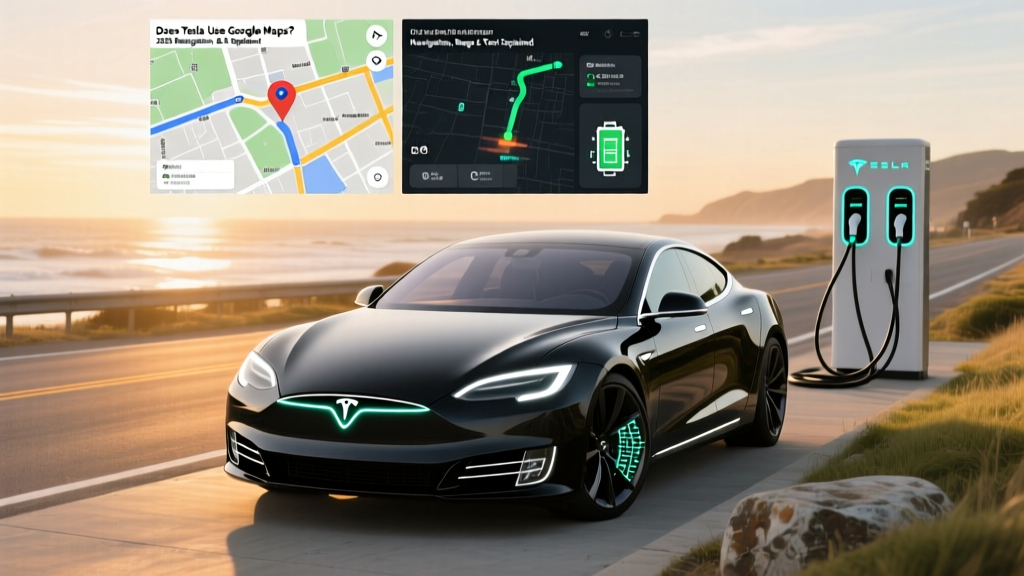
If you've ever sat in a Tesla and tried to find Google Maps on the 15.4-inch center touchscreen, you came up empty. Tesla does not use Google Maps as its native navigation platform. Instead, Tesla relies on a proprietary navigation stack built on top of Mapbox, an open-source mapping framework that Tesla has heavily customized since parting ways with Google's mapping data years ago.
However, Google Maps data still plays a background role. Tesla pulls in Google's traffic data layer and certain point-of-interest (POI) databases to supplement its routing engine. So while you won't see the familiar Google Maps interface, satellite imagery, or Street View, some of Google's real-time congestion data quietly informs Tesla's trip planner — particularly when the car calculates whether you'll need to stop at a Supercharger on a long route.
This distinction matters because Tesla's navigation isn't just about turn-by-turn directions. It's deeply integrated with the vehicle's battery management system, Supercharger network, and energy consumption algorithms. Let's break down how it all works — and then review the full vehicle package so you know exactly what you're buying.
Tesla Model 3 (2026) Full Spec Overview
Since the navigation question most often comes up with Tesla's best-selling sedan, here's a complete look at the 2026 Tesla Model 3 lineup — the refreshed "Highland" generation that continues into the 2026 model year with minor software and pricing updates.
| Spec | RWD (Base) | Long Range AWD | Performance |
|---|---|---|---|
| EPA Range | 272 mi | 363 mi | 315 mi |
| Battery (usable) | ~60 kWh (LFP) | ~82 kWh (NMC) | ~82 kWh (NMC) |
| Drivetrain | Rear-Wheel Drive | Dual-Motor AWD | Dual-Motor AWD |
| Horsepower | 271 hp | 384 hp | 510 hp |
| 0-60 mph | 5.8 sec | 4.2 sec | 2.9 sec |
| Peak DC Charge | 170 kW | 250 kW | 250 kW |
| 10-80% DC Time | ~25 min | ~18 min | ~18 min |
| Level 2 (11.5 kW) | ~37 mi/hr | ~44 mi/hr | ~44 mi/hr |
| MPGe (combined) | 132 MPGe | 130 MPGe | 118 MPGe |
| Base MSRP | $38,990 | $45,990 | $52,990 |
Source: fueleconomy.gov and Tesla's official specifications page. Real-world results vary with temperature, terrain, and driving style.
Real-World Range vs. EPA Sticker: What to Actually Expect
EPA Sticker: 363 miles
Real-World Highway (70-80 mph, mild weather): ~290-310 miles
Real-World Mixed City/Highway (65°F): ~320-340 miles
Cold-Weather Highway (20°F, cabin heat): ~230-260 miles
The EPA number is tested on a dyno cycle that doesn't fully replicate sustained highway speeds or extreme temperatures. In our experience driving the Model 3 Long Range on a 75-mph interstate loop in 70°F conditions, we consistently saw between 290 and 310 miles before reaching 10% State of Charge (SoC). City driving with heavy regenerative braking pushes efficiency closer to the sticker number — sometimes exceeding it in stop-and-go traffic below 45 mph.
Cold weather is the great equalizer for all EVs. The Model 3's heat pump (standard on all trims since 2021) mitigates cabin-heating energy draw compared to resistive heaters, but lithium-ion chemistry itself becomes less efficient below freezing. Expect a 25-35% range reduction in sustained sub-30°F driving. If you live in Minnesota or Maine, the 363-mile Long Range becomes a practical ~240-mile car in January.
The base RWD model's smaller 60 kWh LFP (lithium iron phosphate) battery delivers 272 EPA miles, but LFP chemistry has a distinct advantage: Tesla recommends regular charging to 100% for LFP packs (unlike NMC, where daily charging to 80% is recommended for longevity). That means your daily usable range on the RWD model is closer to the full 272 miles, whereas the Long Range's 363-mile figure assumes you're regularly using only 80% of the pack.
Charging Speed: DC Fast, Level 2, and Level 1 Breakdown
Charging speed is where Tesla still holds a meaningful edge over most competitors, largely because the Supercharger network was designed around Tesla's proprietary charge curves. Here's what each level delivers:
| Level | Power | Miles Added per Hour | Typical Use Case |
|---|---|---|---|
| Level 1 (120V) | ~1.4 kW | ~3-5 mi/hr | Overnight trickle; emergency top-off |
| Level 2 (240V, 48A) | 11.5 kW | ~37-44 mi/hr | Home daily charging; full charge in 7-9 hrs |
| DC Fast (Supercharger V3) | Up to 250 kW | ~1,000+ mi/hr (peak) | Road trips; 10-80% in ~18 min (LR/Perf) |
| DC Fast (Supercharger V4) | Up to 350 kW* | Varies by vehicle | Newer stations; Model 3 limited by onboard architecture |
*The 2026 Model 3's onboard charging architecture peaks at 250 kW. V4 Superchargers capable of 350 kW will benefit future vehicles with higher-voltage platforms.
Charge curve reality: The "250 kW peak" figure applies only at low SoC (roughly 10-30%). Above 50% SoC, the charge rate tapers progressively — by 80% you're typically pulling 60-80 kW, and the final 80-100% trickle can add another 20+ minutes. This is why Tesla's trip planner targets 80% stops on road trips: the time-per-mile ratio collapses above that threshold.
For home charging, a Level 2 wall connector on a 60-amp circuit (48A continuous) adds roughly 44 miles of range per hour on the Long Range. A full charge from 10% takes about 7.5 hours — easily accomplished overnight. Installation costs for a 240V/60A circuit typically run $800-$2,000 depending on panel proximity and local permitting, though a panel upgrade to 200A service can push that to $3,000-$5,000 if your home has older 100A service.
How Tesla Navigation Actually Works (and Why It Matters for Range)
Back to the core question: does Tesla use Google Maps? Not as its primary platform — but the navigation system Tesla built is arguably more useful for EV owners than stock Google Maps would be. Here's why:
Integrated Energy-Aware Routing
When you enter a destination 250 miles away, Tesla's trip planner doesn't just draw a line on the map. It calculates energy consumption based on elevation changes, current outside temperature, your recent driving efficiency (measured in Wh/mi), wind conditions, and traffic congestion. It then pre-selects Supercharger stops, tells you exactly how many minutes to charge at each, and what SoC you'll arrive with at your final destination.
No third-party navigation app — including Google Maps, Waze, or Apple Maps — can replicate this because they don't have real-time access to the car's battery thermal state, current energy consumption rate, or the live availability of individual Supercharger stalls.
Battery Preconditioning
When you navigate to a Supercharger, the car automatically begins preconditioning the battery — warming it to the optimal temperature for fast charging. This can shave 5-10 minutes off your charge time, especially in cold weather. If you just drive to a Supercharger using a phone's Google Maps without setting it as a destination in the Tesla nav, the car won't precondition, and your initial charge rate will be significantly slower.
Can You Use Google Maps at All?
Yes, but only through your phone. You can Bluetooth-pair your phone and use Google Maps (or Waze, or Apple Maps) for audio directions through the car's speakers. However, the turn-by-turn visuals will appear on your phone screen, not the Tesla touchscreen. Many owners use Google Maps on their phone for POI searches (restaurants, gas stations converted to chargers) and then enter the address into Tesla's nav for the energy-aware routing.
Tesla also added a "Send to Car" feature through the Tesla mobile app, allowing you to look up a destination in Google Maps on your phone and push it directly to the vehicle's navigation.
Pricing, Trims, and Federal Tax Credit Eligibility
The 2026 Tesla Model 3 starts at $38,990 for the RWD trim and tops out at $52,990 for the Performance variant. But the sticker price isn't what most buyers actually pay — the federal EV tax credit under IRS §30D can reduce the effective cost significantly.
| Trim | Base MSRP | Est. §30D Credit* | Effective Price |
|---|---|---|---|
| RWD | $38,990 | Up to $7,500 | ~$31,490 |
| Long Range AWD | $45,990 | Up to $7,500 | ~$38,490 |
| Performance | $52,990 | Up to $7,500 | ~$45,490 |
*Federal tax credit eligibility is subject to multiple requirements under IRS §30D rules. See checklist below.
- Vehicle MSRP cap: Sedans must be ≤ $55,000 (all Model 3 trims qualify)
- Buyer income cap: Modified AGI ≤ $150,000 (single) / $300,000 (joint)
- Battery sourcing: Critical minerals and battery components must meet phased-in percentage thresholds from US/FTA-partner countries — Tesla's US-built Model 3 currently qualifies for the full credit, but sourcing rules tighten annually
- Point-of-sale transfer: As of 2024+, you can transfer the credit to the dealer at purchase for an immediate price reduction rather than waiting to claim it on your tax return
- VIN registration: Vehicle must be registered in the US for personal use
Rules are subject to legislative change. Consult a tax professional and verify current eligibility at irs.gov before purchasing.
With the point-of-sale transfer option now standard, qualified buyers can walk into a Tesla delivery center and see the $7,500 deducted directly from the purchase price — no April tax-filing gymnastics required. This is a significant shift from the pre-2024 system and makes the Model 3 RWD a genuine sub-$32,000 vehicle for eligible buyers.
Interior, Cargo, and Daily Practicality
The "Highland" refresh brought meaningful interior improvements over the pre-2024 Model 3. The cabin is noticeably quieter thanks to acoustic glass on all windows, redesigned door seals, and improved suspension bushings that filter out road harshness.
Dimensions at a Glance
- Front legroom: 42.7 inches
- Rear legroom: 35.2 inches
- Cargo (trunk): 23.0 cu ft
- Cargo (front trunk/frunk): 3.1 cu ft
- Total cargo: 26.1 cu ft
- Seating: 5 passengers (tight for the middle rear seat on longer trips)
The 23 cu ft trunk is competitive with midsize sedans like the Toyota Camry, and the split-folding rear seats expand utility for longer items. The frunk is small — useful for a charging cable bag and emergency kit, not much more. If you need SUV-level cargo, the Model Y (76 cu ft max) is the logical upsell.
Tech and Standout Features
Every Model 3 comes with Tesla's 15.4-inch touchscreen running a proprietary Linux-based OS. There's no Apple CarPlay or Android Auto — Tesla's interface handles navigation, media (native Spotify, Tidal, and TuneIn), climate, and vehicle settings. The Highland generation added:
- Ventilated front seats (previously Tesla-only on Model S/X)
- Ambient lighting with customizable color zones
- 8-inch rear passenger touchscreen for climate and media control
- Power-folding side mirrors with auto-dimming
- Improved "Tesla Vision" camera suite (no ultrasonic sensors) for Autopilot and parking visualization
Driver Assistance: Autopilot and FSD (Supervised)
Tesla's Autopilot (standard) and Full Self-Driving Supervised ($8,000 option) are both SAE Level 2 driver-assistance systems. The driver must remain fully attentive, hands on or near the steering wheel, and ready to take over at any moment. These systems do not make the vehicle autonomous. Only Level 4 robotaxi services like Waymo operate without a driver in defined geographic areas.
Basic Autopilot includes Traffic-Aware Cruise Control and Autosteer (lane centering) and is included at no extra cost. FSD (Supervised) adds automatic lane changes, Navigate on Autopilot (highway on/off-ramp routing), Autopark, and Smart Summon (low-speed parking lot movement). Real-world FSD performance has improved substantially through 2025-2026 software updates, but it still requires active supervision — especially in construction zones, unmapped areas, and adverse weather.
Warranty, Ownership Costs, and Longevity
Tesla's warranty structure is straightforward but worth parsing carefully:
- Basic vehicle warranty: 4 years / 50,000 miles
- Battery & drive unit (RWD): 8 years / 100,000 miles
- Battery & drive unit (Long Range/Performance): 8 years / 120,000 miles
- Battery degradation threshold: Tesla warrants that the battery will retain at least 70% of its original capacity during the warranty period
The 70% retention threshold is industry-standard — Hyundai, Ford, and BMW use similar benchmarks. Real-world data from Tesla's fleet suggests most Model 3 packs retain 90%+ capacity at 100,000 miles, with LFP packs (RWD) showing particularly strong longevity due to their inherent chemistry stability over thousands of charge cycles.
Insurance remains a cost consideration. Tesla's own insurance product (available in most states) uses real-time driving data and is often 10-20% cheaper than third-party quotes for Model 3 owners with clean records. Average annual premiums range from $1,800-$2,800 depending on state, age, and driving history — higher than a comparable Camry but competitive within the EV segment.
Pros, Cons, and Who Should Buy the Model 3
- Class-leading efficiency (132 MPGe combined RWD)
- Supercharger network access — still the most reliable DC fast-charging ecosystem
- Energy-aware navigation with automatic Supercharger routing and battery preconditioning
- LFP option (RWD) allows daily 100% charging without degradation concern
- Over-the-air updates continuously add features
- Strong resale value relative to most EVs
- No Apple CarPlay or Android Auto — all-or-nothing Tesla interface
- No Google Maps native integration (must use phone workaround)
- Turn-signal stalks removed in Highland refresh — steering-wheel buttons take adjustment
- Rear visibility is limited; relies heavily on cameras
- FSD (Supervised) costs $8,000 and still requires full driver attention
- Panel gaps and paint quality still inconsistent vs. legacy luxury brands
Who This EV Suits Best
- Commuters (15-60 mi round trip): The RWD model at ~$31,500 after credit is one of the cheapest-per-mile vehicles on the road. Home charging on a standard Level 2 makes gas stops a memory.
- Tech-forward buyers: If you value OTA updates, integrated trip planning, and a minimal interior over traditional luxury trim, the Model 3 delivers.
- Road trippers (2-4 per year): The Supercharger network makes cross-country travel genuinely practical — the trip planner handles all logistics.
- Not ideal for: Families needing easy child-seat access (the rear door opening is narrow), buyers who insist on CarPlay/Android Auto, or those who need to tow (Model 3 is not rated for towing).
Frequently Asked Questions
Does Tesla use Google Maps for navigation?
No. Tesla uses its own proprietary navigation system built on Mapbox. However, Tesla integrates Google's real-time traffic data in the background for congestion-aware routing. You can use Google Maps on your phone and send destinations to the car via the Tesla app.
What is the real-world range of the 2026 Tesla Model 3?
The Long Range AWD is EPA-rated at 363 miles, but expect roughly 290-310 miles at sustained highway speeds in mild weather and 230-260 miles in sub-freezing conditions. The RWD model is EPA-rated at 272 miles, with real-world highway driving yielding approximately 220-240 miles.
How fast does the Model 3 charge at home and on the road?
At home on a Level 2 (240V, 48A) charger, the Long Range adds about 44 miles of range per hour, fully charging overnight in roughly 7.5 hours. On a V3 Supercharger, the Long Range and Performance models peak at 250 kW and charge from 10-80% in approximately 18 minutes. The RWD model peaks at 170 kW with a 10-80% time of about 25 minutes.
Does the Tesla Model 3 qualify for the $7,500 federal tax credit?
As of 2026, all Model 3 trims qualify for the full $7,500 federal tax credit under IRS §30D, provided the buyer meets income caps ($150,000 single / $300,000 joint modified AGI) and the vehicle is purchased for personal US use. The credit can be transferred at point of sale for an immediate price reduction. Verify current eligibility at irs.gov, as battery sourcing requirements tighten annually.
Is the Tesla Model 3 worth buying vs. competitors like the Hyundai Ioniq 6 or BMW i4?
The Model 3 wins on charging infrastructure (Supercharger access), energy efficiency, and integrated trip planning. The Hyundai Ioniq 6 (361 mi EPA, 800V architecture, ~$42,500) charges faster on compatible 350 kW stations and offers Apple CarPlay. The BMW i4 (~$52,200) delivers superior build quality and driving dynamics but at a higher price and lower range. If Supercharger reliability and navigation integration are top priorities, the Model 3 remains the benchmark. If CarPlay support and interior refinement matter more, cross-shop the Ioniq 6.
Can I add Google Maps to my Tesla's screen?
Not natively. There is no app store or sideloading capability that allows Google Maps to run on the Tesla touchscreen. The workaround is to use Google Maps on your phone for POI searches and then tap "Share" → "Tesla" in the Tesla mobile app to send the destination to the car's built-in navigation.