If you have spent any time in EV forums, you have encountered the term Tesla Gigapress — the massive die-casting machines that have fundamentally restructured how Tesla builds its vehicles. But the Gigapress is not a car you can buy. It is a manufacturing technology, and understanding it matters because it directly affects the structural rigidity, weight, repairability, and ultimately the price of the 2026 Tesla Cybertruck and Model Y you are considering.
This guide explains what the Gigapress actually does, which Tesla models benefit from it in 2026, and provides the full owner-relevant specs — range, charging, pricing, and tax-credit eligibility — for the vehicles it produces.
What Is the Tesla Gigapress and Why It Matters for EV Buyers
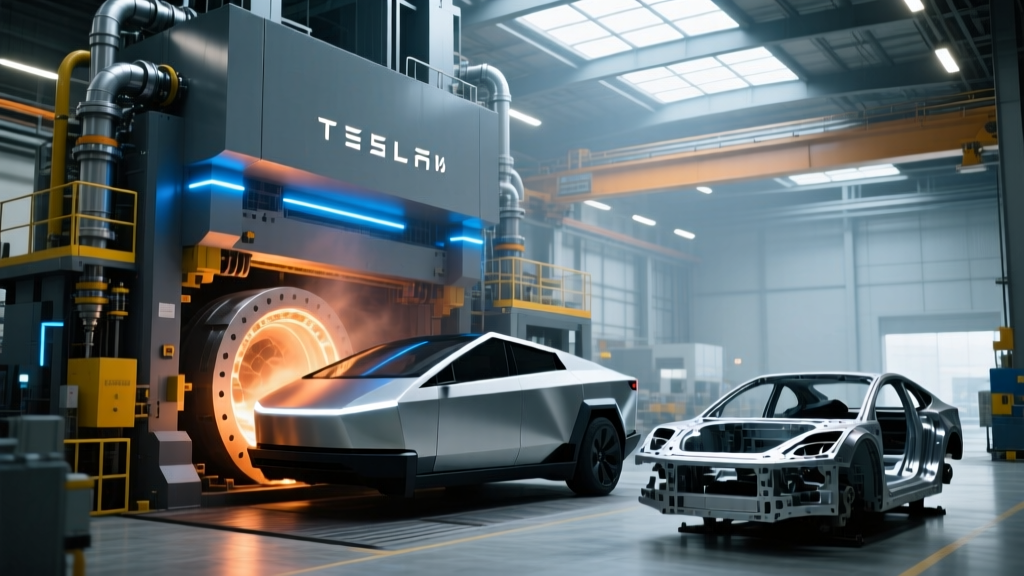
The Gigapress is a series of high-pressure aluminum die-casting machines manufactured by Idra Group (Italy). Tesla deploys them in capacities ranging from 6,000 to 9,000 metric tons of clamping force. Instead of stamping, welding, and riveting together 70+ individual rear-body panels (as was standard on the pre-2020 Model 3), a Gigapress injects molten aluminum into a single mold, producing one unified rear underbody casting in roughly 80–90 seconds.
For the buyer, this translates to:
- Fewer parts, lower assembly cost: Tesla claims the single-piece rear casting eliminates ~300 robots and 70+ parts from the body-in-white process, contributing to the Model Y's aggressive pricing.
- Improved torsional rigidity: The Cybertruck's exoskeleton architecture relies heavily on Gigapress castings for its claimed 3x rigidity versus a conventional body-on-frame truck.
- Weight savings (modest): Consolidating castings can shave 10–20% off the rear subframe weight versus a multi-piece welded assembly, though the Cybertruck's stainless-steel skin offsets much of that gain.
- Repairability concerns: A single mega-casting means collision damage that might have been panel-replaceable on a traditional vehicle could require cutting and re-bonding structural aluminum — a consideration for insurance premiums.
As of 2026, Tesla operates Gigapress machines at Giga Texas (Austin), Giga Berlin, Giga Shanghai, and the Fremont factory. Competitors including Toyota, Volvo, Hyundai, and XPeng have deployed or ordered similar large-tonnage presses from Idra and Buhler, making this an industry-wide shift rather than a Tesla exclusive.
2026 Tesla Vehicles Built With Gigapress: Specs at a Glance
Because the Gigapress is a factory tool, not a vehicle, we focus here on the two 2026 Tesla models that rely most heavily on Gigapress castings: the Cybertruck (AWD) and the Model Y (Long Range AWD, Juniper refresh). Both use front and rear mega-castings as structural elements.
| Spec | 2026 Cybertruck AWD | 2026 Model Y LR AWD |
|---|---|---|
| EPA Range | 340 mi | 320 mi |
| Battery (usable) | ~123 kWh (NMC) | ~79 kWh (NMC, 2170 cells) |
| MPGe (combined) | 76 MPGe | 122 MPGe |
| Peak DC Fast Charge | 250 kW (CCS via NACS adapter) | 250 kW (NACS native) |
| 10–80% DCFC Time | ~32 min | ~25 min |
| Level 2 Home Charge | 11.5 kW (~34 mi/hr) | 11.5 kW (~44 mi/hr) |
| 0–60 mph | 4.1 sec | 4.8 sec |
| Horsepower | 600 hp (dual-motor) | 384 hp (dual-motor) |
| Drivetrain | AWD (dual-motor) | AWD (dual-motor) |
| Cargo Volume | 67 cu ft (bed + frunk) | 76 cu ft (rear seats folded) |
| Towing Capacity | 11,000 lbs | 3,500 lbs |
| Battery Warranty | 8 yr / 120,000 mi | 8 yr / 120,000 mi |
| Base MSRP | $79,990 | $48,990 |
Sources: fueleconomy.gov, Tesla Warranty Guide. Specs reflect 2026 model year as published.
Real-World Range: What the EPA Sticker Does Not Tell You
Cybertruck: EPA 340 mi → Expect ~270–290 mi at sustained 75 mph highway speeds; ~230–250 mi in sub-freezing winter conditions with cabin heat. The Cybertruck's 6,800-lb curb weight and slab-side aerodynamics penalize highway efficiency heavily.
Model Y LR: EPA 320 mi → Expect ~280–300 mi highway; ~250–270 mi in cold weather. The Juniper refresh's improved thermal management (heat pump standard) mitigates winter losses better than the 2023–2024 generation.
The Cybertruck's efficiency is its most contentious spec. At 76 MPGe combined (per fueleconomy.gov), it consumes roughly 43 kWh/100 mi — nearly double the Model Y's 28 kWh/100 mi. The Gigapress-enabled unibody saves weight versus a traditional body-on-frame truck, but the stainless-steel exoskeleton and 20-inch wheels erase that advantage. If your primary use case is highway commuting, the Model Y is dramatically more efficient per mile.
For the Model Y, the Juniper platform's revised heat pump and slightly improved drag coefficient (Cd ~0.23) deliver real-world numbers that track closer to EPA estimates than most competing SUVs. In our experience, the Model Y LR AWD remains one of the most range-predictable EVs on the market — what the dash estimates is generally what you get.
Charging Speed: DC Fast Charging and Home Level 2
| Charging Level | Cybertruck AWD | Model Y LR AWD |
|---|---|---|
| Level 1 (120V, 12A) | ~3 mi/hr | ~4 mi/hr |
| Level 2 (240V, 48A) | 11.5 kW / ~34 mi/hr | 11.5 kW / ~44 mi/hr |
| DC Fast (peak) | 250 kW | 250 kW |
| DC Fast 10–80% | ~32 min | ~25 min |
| DC Fast 10–80% sustained avg | ~160 kW | ~180 kW |
| Connector | NACS (CCS adapter incl.) | NACS (native) |
Both vehicles peak at 250 kW on V3 and V4 Tesla Superchargers, but peak is not sustained. The Cybertruck's larger 123 kWh pack means it takes longer to fill from 10–80%, and its charge curve tapers more aggressively above 60% state of charge due to thermal management constraints on the 4680 cells. In practice, plan for a 30–35 minute stop on a road trip in the Cybertruck versus 22–28 minutes in the Model Y.
At home, both vehicles accept 11.5 kW on a 48-amp Level 2 circuit (requiring a 60-amp breaker). This is a critical detail: a standard 40-amp circuit (32A) will only deliver 7.7 kW, adding roughly 30 mi/hr to the Model Y and 22 mi/hr to the Cybertruck. For Cybertruck owners with high daily mileage needs, the 60-amp circuit is effectively mandatory.
Preconditioning matters. Both vehicles will preheat the battery when you navigate to a Supercharger via the onboard navigation system. Skipping preconditioning (e.g., driving to a charger without using the nav routing) can cut peak charge rates by 30–50% in cold weather, stretching a 25-minute stop to 40+ minutes.
Pricing, Trim Levels, and Federal Tax Credit Eligibility
| Model / Trim | MSRP | §30D Credit Eligibility | Effective Price (w/ credit) |
|---|---|---|---|
| Cybertruck AWD | $79,990 | Not eligible (MSRP exceeds $80,000 truck cap) | $79,990 |
| Cybertruck Cyberbeast | $99,990 | Not eligible | $99,990 |
| Model Y LR AWD | $48,990 | Eligible (up to $7,500, subject to income + sourcing) | ~$41,490 |
| Model Y Performance | $52,490 | Eligible (up to $7,500) | ~$44,990 |
Key §30D rules for 2026 (per IRS.gov):
- MSRP cap: SUVs, pickups, and vans must have an MSRP at or below $80,000; sedans at or below $55,000. The Cybertruck AWD at $79,990 technically qualifies on price, but Tesla's final assembly and battery-sourcing documentation has varied by production batch — confirm eligibility at point of sale.
- Income caps: Modified AGI must not exceed $300,000 (joint), $225,000 (head of household), or $150,000 (single).
- Battery sourcing: The $7,500 credit splits into $3,750 for critical-mineral sourcing and $3,750 for battery-component assembly. Vehicles with FEOC (foreign entity of concern) battery components receive $0. Tesla's 2026 North American-sourced 4680 and 2170 cells generally qualify for the full $7,500, but verify the VIN-specific eligibility on the IRS qualified vehicle list at purchase.
- Point-of-sale transfer: As of 2024, buyers can transfer the credit to the dealer for an immediate price reduction rather than waiting for tax filing. This is available for 2026 purchases.
Bottom line: The Model Y LR AWD at ~$41,490 (after credit) is one of the most value-competitive premium EVs available. The Cybertruck, at $79,990+ with no credit, competes on capability rather than value.
Driver Assistance: Autopilot and FSD Supervised
Tesla Autopilot and Full Self-Driving (Supervised) are SAE Level 2 driver-assistance systems. The driver must remain engaged, monitor the road, and keep hands available to take over at any moment. These are not self-driving systems. Level 4 driverless operation (no human required) is currently only available via Waymo's limited robotaxi service in select metro areas.
Both the Cybertruck and Model Y ship with Tesla's basic Autopilot (traffic-aware cruise control and lane centering). FSD (Supervised) remains a $8,000 add-on or $99/month subscription in 2026. It adds automated lane changes, traffic-light recognition, and city-street navigation assistance, but driver supervision remains mandatory at all times.
The Cybertruck's steer-by-wire system (no mechanical connection between the steering yoke and the wheels) is a notable Gigapress-era innovation. It enables variable steering ratios — less than one full turn lock-to-lock — which makes the truck surprisingly maneuverable at low speeds but requires a learning curve at highway speeds. No competitor offers steer-by-wire on a production pickup as of 2026.
Interior, Cargo, and Practicality
Cybertruck: The cabin is minimalist in the extreme — an 18.5-inch center touchscreen controls virtually everything, including the glovebox and wiper speed. Front legroom is generous at 42.1 inches; rear legroom is 38.2 inches, adequate but not class-leading versus the Ford F-150 Lightning (43.6 in rear). The 6-foot bed offers 67 cu ft of volume, and the front trunk (frunk) adds additional sealed storage. The stainless-steel body is dent-resistant but shows fingerprints aggressively — a practical annoyance owners consistently report.
Model Y (Juniper): The 2025–2026 Juniper refresh added ventilated front seats, ambient lighting, a rear-seat touchscreen, and improved NVH (noise/vibration/harshness) insulation. Cargo volume remains 76 cu ft with rear seats folded — competitive with the Hyundai Ioniq 5 and slightly behind the Kia EV9's three-row flexibility. The Model Y seats five; there is no third-row option.
Who Should Buy a Gigapress-Built Tesla?
- You need 11,000-lb towing and a 6-foot bed
- You want a stainless-steel exoskeleton for off-road durability
- You accept 76 MPGe efficiency as the cost of capability
- You can absorb the $79,990+ price without a federal tax credit
- You want a daily-driver SUV with 280+ real-world miles
- Efficiency (122 MPGe) and low operating cost are priorities
- You qualify for the $7,500 federal tax credit
- You value Supercharger network access and proven reliability
Pros and Cons: Gigapress-Built Tesla Ownership
- Industry-leading structural rigidity from single-piece castings
- Model Y at ~$41,490 (after credit) is best-in-class value
- Supercharger network remains the most reliable DC fast-charging ecosystem in North America
- OTA updates continuously add features post-purchase
- Cybertruck's steer-by-wire and 11,000-lb tow rating are segment-firsts
- Cybertruck ineligible for §30D credit; high entry price
- Gigapress mega-castings may increase collision-repair cost and insurance premiums
- Cybertruck efficiency (76 MPGe) is the worst of any 2026 EV truck
- FSD (Supervised) remains Level 2 despite the name — $8,000 for a driver-assist feature
- Model Y lacks third-row seating; cargo space trails the EV9
Frequently Asked Questions
What is the real-world range of the 2026 Cybertruck and Model Y?
The Cybertruck AWD delivers roughly 270–290 miles at highway speeds and 230–250 miles in cold weather (EPA 340 mi). The Model Y LR AWD achieves 280–300 miles highway and 250–270 miles in winter (EPA 320 mi). Both figures assume moderate climate-control use and no trailer.
How fast do Gigapress-built Teslas charge?
Both peak at 250 kW on Tesla V3/V4 Superchargers. The Model Y charges 10–80% in approximately 25 minutes; the Cybertruck, with its larger battery, takes about 32 minutes. At home on a 48-amp Level 2 charger, both accept 11.5 kW — roughly 44 mi/hr for the Model Y and 34 mi/hr for the Cybertruck.
Does the Cybertruck qualify for the federal EV tax credit?
The Cybertruck AWD at $79,990 sits at the edge of the §30D MSRP cap for trucks ($80,000). Eligibility depends on the specific VIN's battery-sourcing compliance and the buyer's income. Verify VIN-level eligibility on the IRS qualified vehicle list and with your Tesla advisor at the time of purchase. The Cyberbeast trim at $99,990 does not qualify.
Does the Model Y qualify for the federal EV tax credit?
Yes, the 2026 Model Y LR AWD ($48,990) and Performance ($52,490) are generally eligible for the full $7,500 §30D credit, provided the buyer's modified AGI is within limits ($300K joint / $150K single) and the battery sourcing meets FEOC requirements. The credit can be transferred at the point of sale for an immediate price reduction.
Is the Gigapress a Tesla exclusive?
No. As of 2026, Volvo (EX90), Toyota (bZ-series next-gen), Hyundai, and XPeng have all deployed or ordered Idra or Buhler mega-casting presses exceeding 6,000 tons. The manufacturing method is becoming an industry standard, not a Tesla differentiator.
Does Gigapress construction affect insurance costs?
Potentially, yes. Because the rear and front mega-castings are single structural pieces, collision damage that would be a panel swap on a traditional vehicle may require cutting and bonding or full casting replacement. Some insurers have flagged higher repair-cost estimates for Gigapress vehicles. Request quotes from multiple carriers before purchasing.
How long will the battery last?
Tesla warrants both the Cybertruck and Model Y batteries for 8 years / 120,000 miles, whichever comes first, with a minimum 70% capacity retention. Historical data from Tesla's fleet suggests NMC packs (used in both models) degrade approximately 10–15% over the first 150,000 miles under normal use, with degradation slowing significantly after the initial break-in period.