Why Tesla General Insurance Inc Matters for EV Buyers in 2026
For most electric-vehicle shoppers, the purchase price and the federal tax credit dominate the conversation. But a growing slice of total ownership cost comes from a line item many buyers overlook until after delivery: insurance. Tesla's in-house insurance operation, operating through Tesla General Insurance Inc and affiliated underwriters, has quietly become one of the most consequential factors in the real-world cost of owning a Model 3, Model Y, Model S, or Model X in 2026.
Unlike legacy carriers that price EVs based on historical claims data pooled across brands, Tesla's insurance arm leverages the vehicle's own telemetry — acceleration patterns, hard-braking events, Autopilot engagement frequency, and mileage — to calculate a monthly real-time insurance score. The result is a premium that can be meaningfully cheaper for safe, low-mileage drivers, and sometimes more expensive for aggressive or high-mileage ones. Understanding how this model works is essential before you sign a purchase agreement.
The 2026 Tesla Lineup: Range, Charging, and Pricing at a Glance
Before we map insurance costs onto ownership, here is the current 2026 Tesla lineup with the specs buyers actually cross-shop on. Figures below reflect the most recent EPA and manufacturer data available as of early 2026.
| Spec | Model 3 Long Range AWD | Model Y Long Range AWD | Model S Long Range | Model X Long Range |
|---|---|---|---|---|
| EPA Range | 341 mi | 320 mi | 402 mi | 348 mi |
| Battery (usable) | ~75 kWh (NMC) | ~75 kWh (NMC) | ~100 kWh (NMC) | ~100 kWh (NMC) |
| Peak DC Charge | 250 kW | 250 kW | 250 kW | 250 kW |
| 10–80% DCFC Time | ~25 min | ~27 min | ~32 min | ~34 min |
| Level 2 (11.5 kW) | ~44 mi/hr | ~44 mi/hr | ~44 mi/hr | ~44 mi/hr |
| 0–60 mph | 4.2 sec | 4.8 sec | 3.1 sec | 3.8 sec |
| Horsepower | ~384 hp | ~384 hp | ~670 hp | ~670 hp |
| MPGe (combined) | 132 MPGe | 122 MPGe | 120 MPGe | 102 MPGe |
| Base MSRP | $47,740 | $48,990 | $79,990 | $84,990 |
| Battery Warranty | 8 yr / 120,000 mi | 8 yr / 120,000 mi | 8 yr / 150,000 mi | 8 yr / 150,000 mi |
Tesla's Highland-refresh Model 3 and Juniper-refresh Model Y both use nickel-manganese-cobalt (NMC) lithium-ion packs for Long Range variants, favoring energy density over the cycle-life benefits of LFP chemistry found in the RWD Standard Range trims. That distinction matters for insurance too: NMC packs carry higher replacement cost estimates, a factor underwriters weigh when setting comprehensive coverage premiums.
Real-World Range vs. the EPA Sticker
EPA sticker: 320 miles
Real-world highway (70 mph, 68°F): ~270–285 miles
Real-world mixed city/highway (moderate climate): ~295–310 miles
Cold-weather highway (30°F, heater on): ~225–250 miles
Tesla's thermal management system is among the best in the industry, and the heat pump standard on all 2026 trims mitigates some cold-weather range loss. But physics still wins: highway driving at 75+ mph and winter temperatures consistently knock 15–30% off the EPA number. For insurance purposes, this matters indirectly — drivers who regularly exceed their planned range may charge more often at public DC fast chargers, slightly raising exposure to parking-lot incidents and increasing mileage logged, both of which can affect the Tesla insurance score.
Charging Speed: DC Fast, Level 2, and What You Actually See
| Charging Level | Power (kW) | Miles Added per Hour | Notes |
|---|---|---|---|
| Level 1 (120V) | ~1.4 kW | ~4–5 mi/hr | Emergency/trickle only |
| Level 2 (240V / 48A) | 11.5 kW | ~44 mi/hr | Home Wall Connector |
| Level 2 (240V / 32A) | 7.7 kW | ~30 mi/hr | Mobile Connector on dryer outlet |
| DC Fast (V3 Supercharger) | 250 kW peak | ~200 mi in 15 min | Tapers above 50% SoC |
| DC Fast (V4 Supercharger) | 250–350 kW peak | ~250 mi in 15 min | Model-dependent, CCS-native |
A critical nuance that marketing materials gloss over: the 250 kW peak rate is not sustained. On a Model Y Long Range, the charge curve peaks near 250 kW only between roughly 10–30% state of charge, then tapers progressively. The 10–80% time of ~27 minutes reflects this taper. Plan your road trips around 20–25-minute stops, not 15-minute ones, unless you arrive at very low SoC.
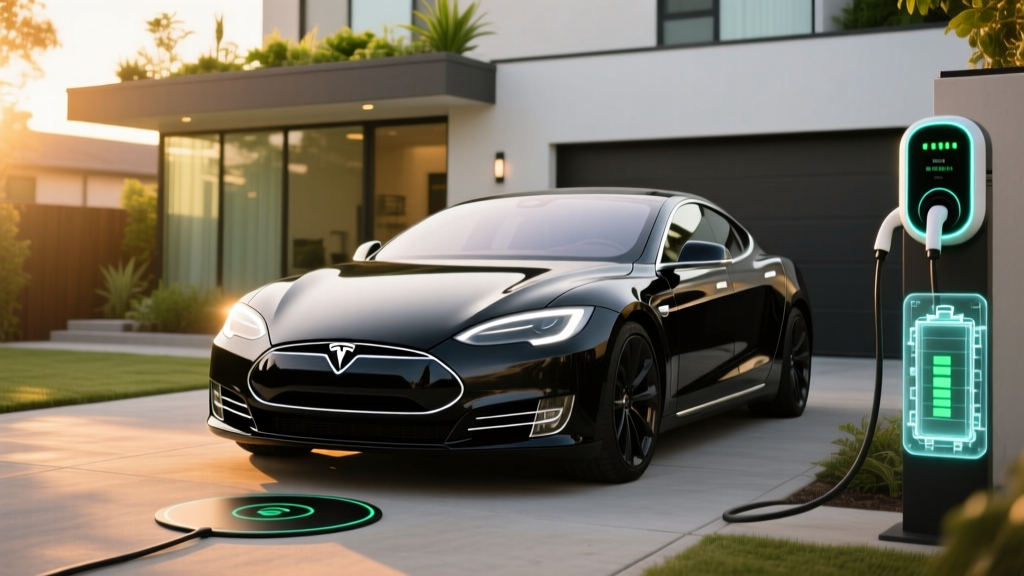
At home, a NEMA 14-50 outlet with Tesla's Wall Connector delivers up to 11.5 kW on a 60-amp circuit. Expect a full overnight charge from 20% to 80% in roughly 5 hours. Installation costs range from $800 to $2,500 depending on panel capacity and run length — a licensed electrician should confirm your panel can handle a 60-amp dedicated circuit before purchase.
Tesla General Insurance Inc: How the Safety Score Model Works
Tesla General Insurance Inc, alongside state-specific affiliates, offers policies in a growing number of U.S. states. The differentiator is the Safety Score — a monthly metric from 0 to 100 derived from five categories:
- Forward collision warning — frequency of hard-braking events per 1,000 miles
- Hard turning — lateral g-force events
- Unsafe following — tailgating duration relative to speed
- Forced Autopilot disengagement — how often the driver ignores hands-on-wheel warnings
- Miles driven — total exposure
Drivers who consistently score above 90 typically see premiums 20–40% below legacy carrier quotes, according to aggregated owner reports on forums like Tesla Motors Club and Reddit's r/teslamotors. Drivers scoring below 70 can see premiums rise above market. This is the core tradeoff: Tesla's insurance rewards predictable, attentive driving and penalizes the opposite, with far less tolerance than a conventional carrier's annual review cycle.
Insurance Cost by Model: What 2026 Owners Actually Pay
Based on aggregated owner-reported data and state filings, here are typical monthly premiums through Tesla General Insurance Inc for a 35-year-old driver with a clean record, 100/300/50 liability, and comprehensive coverage with a $1,000 deductible:
| Model | Base MSRP | Est. Monthly Premium (Safety Score 90+) | Est. Monthly Premium (Safety Score 70–85) | Est. Monthly Premium (Legacy Carrier Avg) |
|---|---|---|---|---|
| Model 3 LR AWD | $47,740 | $140–$175 | $195–$240 | $210–$260 |
| Model Y LR AWD | $48,990 | $150–$185 | $210–$255 | $225–$280 |
| Model S LR | $79,990 | $220–$275 | $310–$380 | $340–$420 |
| Model X LR | $84,990 | $240–$295 | $340–$410 | $370–$450 |
Model 3 and Model Y owners benefit most from the Safety Score discount because the base vehicle cost is lower and repair frequency is well-understood by Tesla's claims network. Model S and X premiums remain elevated due to higher parts costs, lower production volume, and more complex body structures — factors that affect all insurers, not just Tesla's captive operation.
Federal Tax Credit Eligibility and Total Cost of Ownership
The IRS §30D Clean Vehicle Credit remains available for qualifying 2026 Tesla purchases, but eligibility is not automatic. Here is the current checklist:
- MSRP cap: Sedans (Model 3) ≤ $55,000; SUVs/trucks/vans (Model Y, Model X) ≤ $80,000
- Buyer income cap: AGI ≤ $150,000 (single), ≤ $225,000 (head of household), ≤ $300,000 (joint)
- Battery sourcing: Critical minerals and battery components must meet phased-in domestic/free-trade-agreement thresholds — Tesla's U.S.-built packs generally qualify
- Assembly: Vehicle must undergo final assembly in North America (all U.S.-sold Teslas qualify)
- Point-of-sale transfer: Credit can be applied at purchase to reduce out-of-pocket cost, subject to dealer registration
As of early 2026, the Model 3 Long Range AWD and Model Y Long Range AWD both qualify for the full $7,500 credit for eligible buyers. The Model S exceeds the $55,000 sedan cap and is ineligible. The Model X Long Range at $84,990 exceeds the $80,000 SUV cap and is also ineligible. Always verify current eligibility on fueleconomy.gov before purchase — battery sourcing rules tighten annually.
| 5-Year Cost | Model Y LR AWD (with $7,500 credit) | Toyota RAV4 Hybrid (comparison) |
|---|---|---|
| Purchase (after credit) | ~$41,490 | ~$35,000 |
| Fuel / Electricity | ~$3,200 | ~$7,800 |
| Insurance (Tesla Ins., Score 90+) | ~$10,500 | ~$8,400 |
| Maintenance | ~$1,500 | ~$3,200 |
| Estimated Depreciation | ~$18,000 | ~$14,500 |
| 5-Year Total | ~$74,690 | ~$68,900 |
The Model Y narrows the gap with the RAV4 Hybrid primarily through fuel savings and lower maintenance, but Tesla Insurance premiums — even at favorable Safety Scores — partially offset those gains. This is the honest math that Tesla's marketing does not surface.
Pros and Cons of Tesla Ownership with Tesla Insurance
- Safety Score rewards safe drivers with 20–40% premium discounts
- Integrated claims: Tesla body shops and parts network streamline repairs
- Supercharger network (now open to NACS-equipped competitors) remains the most reliable DC fast-charging ecosystem in the U.S.
- Over-the-air updates continuously improve vehicle functionality
- Strong EPA efficiency (kWh/100mi) keeps charging costs low
- Excellent cargo space: Model Y offers 76 cu ft with seats folded
- Premiums can spike for aggressive drivers or those with low Safety Scores
- Repair costs remain high due to aluminum/cast body structures
- FSD (Supervised) is Level 2 — not self-driving — yet costs $8,000 or $99/month
- Model S/X ineligible for §30D credit due to MSRP caps
- Insurance availability still limited to select states
- No Apple CarPlay or Android Auto — Tesla's infotainment is proprietary
Who Should Buy a Tesla and Insure Through Tesla General Insurance Inc?
- You are a predictable, attentive driver who will score 90+ consistently
- You have home Level 2 charging and drive under 20,000 miles/year
- You want integrated claims handling and Tesla-certified repair
- You qualify for the §30D credit and want to maximize the Model 3/Y value proposition
- Your driving style includes frequent hard acceleration or aggressive lane changes
- You drive over 25,000 miles/year (high mileage increases the Safety Score penalty)
- You need Apple CarPlay/Android Auto or prefer traditional dealership service
- You live in a state where Tesla General Insurance Inc does not yet write policies
FAQ: Tesla General Insurance Inc and 2026 Tesla Ownership
What is the real-world range of a 2026 Tesla Model Y?
EPA-rated at 320 miles, expect ~270–285 miles on the highway at 70 mph in moderate temperatures, and ~225–250 miles in cold weather (30°F or below) with cabin heating. City driving with regenerative braking recovers more energy, often matching or slightly exceeding the EPA sticker.
How fast does a Tesla charge at home and on the road?
At home on a 240V/48A Wall Connector, you gain ~44 miles of range per hour (11.5 kW). On a V3 Supercharger, the Model Y peaks at 250 kW, reaching 10–80% in roughly 27 minutes. The charge curve tapers significantly above 50% SoC, so plan stops around the 10–60% window for maximum speed.
Does the 2026 Model Y qualify for the $7,500 federal tax credit?
Yes, for eligible buyers. The Model Y Long Range at $48,990 is under the $80,000 SUV MSRP cap. You must also meet AGI limits ($150K single / $300K joint) and the vehicle must meet battery-sourcing requirements, which U.S.-built Teslas generally satisfy. Verify at IRS.gov before purchasing.
Is Tesla Insurance cheaper than GEICO, Progressive, or State Farm?
For drivers with a Safety Score above 90, typically yes — savings of 20–40% are common. For drivers below 70, Tesla's premiums can exceed legacy carriers. Always get quotes from at least two carriers before committing.
What are the biggest drawbacks of Tesla ownership in 2026?
High repair costs after collisions, proprietary infotainment without phone projection, FSD (Supervised) remaining a Level 2 system despite the price, and insurance premiums that penalize aggressive driving more harshly than traditional carriers.
Is Tesla's Autopilot or FSD self-driving?
No. Both are SAE Level 2 driver-assistance systems. You must keep your hands on the wheel and eyes on the road at all times. Only Level 4 services like Waymo operate without a human driver, and those are geofenced robotaxis, not consumer vehicles.