Quick Verdict: Still the Gold Standard for Tesla Home Charging
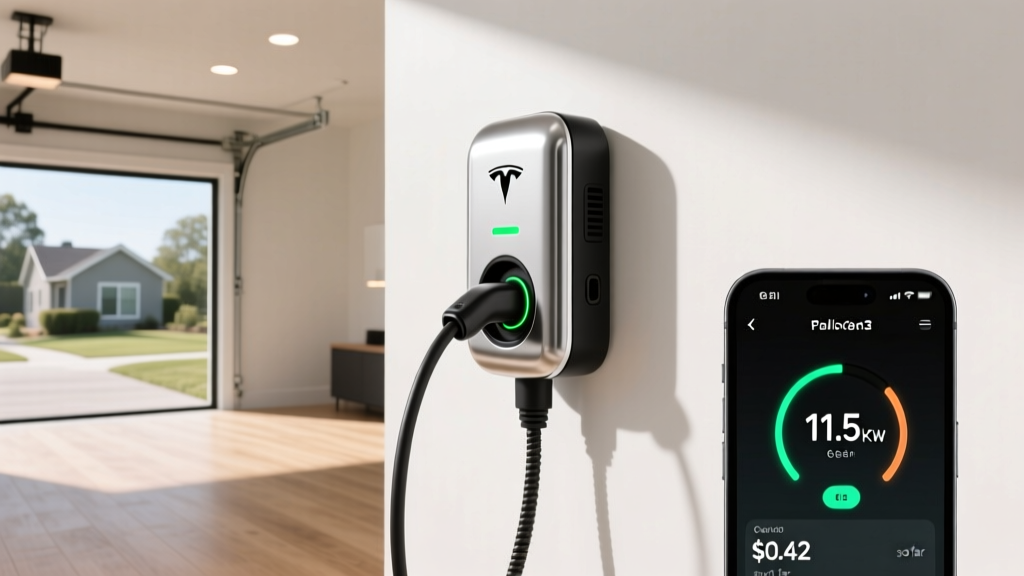
If you own a Tesla — or plan to — the Tesla Gen 3 Wall Connector remains the most seamless Level 2 home charging solution available in 2026. Priced at $475 directly from Tesla, this hardwired unit delivers up to 11.5 kW (48 amps) on a 60-amp circuit, adding roughly 44 miles of range per hour to a Model 3 or Model Y. Its integrated NACS (North American Charging Standard) plug means no adapter is needed for Tesla vehicles, and with a simple firmware toggle, it can now charge non-Tesla EVs using the J1772 adapter ecosystem that has expanded significantly since Ford, GM, and Rivian adopted NACS.
The Gen 3 Wall Connector isn't just about speed. Its Wi-Fi connectivity enables over-the-air firmware updates, scheduled charging, and integration with Tesla's app for energy monitoring. The 24-foot cable, tempered glass faceplate, and indoor/outdoor rating make it a durable, clean-looking installation. But it's not the cheapest option on the market, and non-Tesla EV owners may find better value in universal chargers like the ChargePoint Home Flex or Emporia Level 2. This review breaks down exact charge speeds, real-world installation costs, compatibility, and whether the Gen 3 is worth the investment for your garage.
| Specification | Value |
|---|---|
| Max Power Output | 11.5 kW (48A continuous on 60A circuit) |
| Voltage | 240V (split-phase, single-phase) |
| Connector Type | NACS (Tesla proprietary, now industry standard) |
| Cable Length | 24 feet |
| Wi-Fi Connectivity | Yes — 2.4 GHz, OTA firmware updates |
| Indoor/Outdoor Rated | Yes (NEMA 3R) |
| Weight | 15 lbs (unit + cable) |
| Warranty | 4 years |
| MSRP (Unit Only) | $475 |
| Non-Tesla EV Charging | Yes (via NACS-to-J1772 adapter, sold separately) |
Charging Speed: How Fast Does the Gen 3 Wall Connector Actually Charge?
The headline number is 11.5 kW, but what does that mean in practical terms? Charge speed depends on your vehicle's onboard charger capacity. Here's a real-world breakdown for popular 2026 EVs:
| Vehicle (2026 Model Year) | Onboard Charger | Actual Draw | Miles of Range Added / Hour |
|---|---|---|---|
| Tesla Model 3 Long Range | 11.5 kW (48A) | 11.5 kW | ~44 mi/hr |
| Tesla Model Y Long Range | 11.5 kW (48A) | 11.5 kW | ~41 mi/hr |
| Tesla Model S Plaid | 11.5 kW (48A) | 11.5 kW | ~38 mi/hr |
| Ford Mustang Mach-E (NACS) | 10.5 kW (44A) | 10.5 kW | ~33 mi/hr |
| Rivian R1S (NACS port) | 11.5 kW (48A) | 11.5 kW | ~30 mi/hr |
| Hyundai Ioniq 5 (via adapter) | 10.9 kW (45A) | 10.9 kW | ~36 mi/hr |
Key insight: The Gen 3 Wall Connector will only deliver its full 48 amps if your EV's onboard charger supports it. Many non-Tesla EVs cap at 32A (7.7 kW) or 44A (10.5 kW), so you won't extract the full 11.5 kW unless your vehicle is equipped for it. That said, even at 7.7 kW, an overnight charge (10 hours) adds roughly 250+ miles — more than enough for daily driving.
DC Fast Charging Context
It's important to distinguish the Wall Connector (Level 2, AC) from DC fast charging. Tesla's Supercharger V4 stations deliver up to 250 kW (V3) to 350 kW (V4) on compatible vehicles, charging a Model 3 Long Range from 10-80% in approximately 18-25 minutes depending on battery temperature and state of charge. The Wall Connector is designed for overnight and daily topping — not road-trip speed. Think of it as the difference between sipping water all day (Level 2) versus chugging a bottle in one gulp (DC fast).
Real-World Installation: What Does It Actually Cost?
The $475 unit price is just the beginning. Installation costs vary widely based on your electrical panel's capacity, the distance from panel to charger location, and local permit fees. Here's a realistic cost breakdown based on 2026 electrician rates and typical residential setups:
| Component | Low Estimate | High Estimate |
|---|---|---|
| Wall Connector Unit | $475 | $475 |
| Electrician Labor (60A circuit, hardwired) | $600 | $2,200 |
| Electrical Permit | $50 | $250 |
| Panel Upgrade (if 200A panel is full or you have a 100A service) | $0 | $3,500 |
| Conduit / Wiring Materials | $100 | $500 |
| Total Estimated Cost | $1,225 | $6,925 |
Where costs escalate: If your home has a 100-amp electrical panel or your panel has no available breaker slots, you'll likely need a service upgrade to 200 amps — a $2,000-$3,500 job on its own. Long wire runs (over 50 feet from panel to garage) also add material and labor costs. Always get a site assessment from a licensed electrician before purchasing. Tesla's website offers a certified installer finder that provides free quotes.
Federal and Utility Incentives for Home Charger Installation
The IRS Residential Clean Energy Credit (§25D) does not currently cover standalone EV charging equipment (that credit is reserved for solar, wind, geothermal, and battery storage). However, the Alternative Fuel Vehicle Refueling Property Credit (§30C) was revived and modified under the Inflation Reduction Act, offering up to $1,000 (30% of cost, capped) for home charger installation — but only if you live in a qualifying census tract (typically low-income or non-urban areas). Check your eligibility at the IRS §30C page. Many utilities also offer $250-$500 rebates for Level 2 charger installation — check with your local provider.
NACS, J1772, and the 2026 Charging Connector Landscape
One of the Gen 3 Wall Connector's biggest advantages in 2026 is its native NACS plug. Since Ford, GM, Rivian, Volvo, Polestar, Mercedes-Benz, and others have adopted NACS for their 2025-2026 EV models, the Wall Connector is no longer a Tesla-only device. If you own a 2026 Ford F-150 Lightning or a Rivian R1T with a NACS charge port, you can plug directly into the Gen 3 without an adapter.
| Vehicle Brand / Model | Charge Port | Adapter Needed? |
|---|---|---|
| Tesla (all models) | NACS (native) | No |
| Ford (2025+ EVs) | NACS (native) | No |
| GM / Chevrolet (2025+ EVs) | NACS (native) | No |
| Rivian (2025+ models) | NACS (native) | No |
| Hyundai / Kia (2026 EVs) | CCS1 (some NACS) | Yes — CCS-to-NACS adapter |
| Older J1772 EVs (Nissan Leaf, etc.) | J1772 | Yes — Tesla-to-J1772 adapter |
Important caveat: If you're charging a non-Tesla EV with a CCS port using an adapter, verify that the adapter supports the full 48A current. Some third-party adapters are rated for only 32A or 40A, which will bottleneck your charge speed regardless of the Wall Connector's capability.
Smart Features: Wi-Fi, Scheduling, and Power Sharing
The Gen 3 Wall Connector connects to your home Wi-Fi network (2.4 GHz only — a common complaint, as 5 GHz is not supported). This connection enables several features:
- Over-the-air firmware updates: Tesla regularly pushes updates that improve functionality. In 2025, a firmware update added "Power Sharing" support, allowing two Gen 3 units on a single circuit to dynamically split amperage.
- Scheduled charging: Set charging windows via the Tesla app to take advantage of off-peak electricity rates (e.g., charge only between 11 PM and 6 AM when rates are lowest).
- Access control: Restrict the charger to authorized vehicles only — useful if your charger is in a shared driveway or multi-unit building.
- Energy monitoring: Track kWh delivered per session and per month through the Tesla app, though it lacks the granular cost-per-kWh integration that ChargePoint's app provides.
Power Sharing is particularly useful for homes with limited electrical capacity. If you install two Gen 3 Wall Connectors on a single 60-amp circuit, the units communicate wirelessly and split the available 48 amps between them. If only one car is plugged in, it gets the full 48A. When both are charging, each gets ~24A (5.8 kW). This avoids the need for a costly panel upgrade in many two-EV households.
Tesla Gen 3 Wall Connector vs. Competitors
How does the Gen 3 stack up against the best universal Level 2 chargers in 2026?
| Feature | Tesla Gen 3 Wall Connector | ChargePoint Home Flex | Emporia Vue Level 2 |
|---|---|---|---|
| Max Power | 11.5 kW (48A) | 12 kW (50A) | 11.5 kW (48A) |
| Connector | NACS (native) | J1772 (NACS adapter included) | J1772 (NACS adapter sold separately) |
| Cable Length | 24 ft | 23 ft | 24 ft |
| Wi-Fi | Yes (2.4 GHz) | Yes (2.4 GHz) | Yes (2.4/5 GHz) |
| App Quality | Good (Tesla ecosystem) | Excellent (universal) | Good (energy-focused) |
| Hardwired / Plug-in | Hardwired only | Hardwired or NEMA 14-50 | Hardwired or NEMA 14-50 |
| Unit Price | $475 | $599 | $399 |
| Non-Tesla EV Support | Yes (adapter needed for CCS/J1772) | Yes (native J1772) | Yes (native J1772) |
| Warranty | 4 years | 3 years | 3 years |
Choose the Tesla Gen 3 if you own a Tesla or a 2025+ NACS-equipped EV and want the cleanest, most integrated experience. Choose the ChargePoint Home Flex if you have mixed EV brands in your household or prefer a plug-in NEMA 14-50 option for portability. Choose the Emporia if budget is the priority and you want detailed energy monitoring.
Pros and Cons
Pros
- Native NACS plug — no adapter needed for Tesla and 2025+ Ford, GM, Rivian EVs
- Up to 11.5 kW / 44 miles of range per hour (with compatible vehicles)
- 24-foot cable reaches most garage configurations
- Sleek tempered-glass design, indoor/outdoor rated
- Wi-Fi OTA updates add features over time (Power Sharing added in 2025)
- Access control prevents unauthorized use
- 4-year warranty — longest in the segment
- Power Sharing allows two units on one 60A circuit
Cons
- Hardwired only — no NEMA 14-50 plug option (portability is zero)
- 2.4 GHz Wi-Fi only — weaker signal in garages far from routers
- App features are Tesla-centric; limited utility for non-Tesla EV owners
- $475 unit price is mid-range; Emporia offers similar specs for $399
- No built-in cable management holster (sold separately, ~$30)
- Non-Tesla EVs with CCS ports require a third-party adapter (adds $100-$200)
Who Should Buy the Tesla Gen 3 Wall Connector?
The Gen 3 Wall Connector is ideal for:
- Tesla owners who want the fastest, most integrated Level 2 home charging experience with zero adapters.
- Households adding a 2025-2026 NACS-equipped EV (F-150 Lightning, Equinox EV, Rivian R1S) alongside a Tesla.
- Two-EV households that can benefit from Power Sharing on a single 60-amp circuit.
- Homeowners with adequate electrical capacity (200A panel with available slots) who want a hardwired, permanent installation.
It is not ideal for renters, homes with 100A panels that can't be upgraded, or households with exclusively CCS-port EVs (Hyundai Ioniq 5, Kia EV6) who would be better served by a universal J1772 charger.
Frequently Asked Questions
Does the Tesla Gen 3 Wall Connector work with non-Tesla EVs?
Yes. Any EV with a NACS charge port (2025+ Ford, GM, Rivian models) can plug in directly. EVs with CCS or J1772 ports require a NACS-to-CCS or NACS-to-J1772 adapter, available from Tesla and third-party manufacturers. Verify the adapter's amperage rating to ensure you're not bottlenecking charge speed.
How fast does the Tesla Gen 3 Wall Connector charge a Model 3 or Model Y?
At its full 11.5 kW output (48 amps on a 60-amp circuit), the Gen 3 adds approximately 44 miles of range per hour to a Model 3 Long Range and about 41 miles per hour to a Model Y Long Range. A full charge from 10% to 90% takes roughly 7-8 hours, making it ideal for overnight charging.
Do I need a 60-amp circuit for the Gen 3 Wall Connector?
For maximum 11.5 kW output, yes — a dedicated 60-amp breaker is required. However, the Gen 3 can be configured during setup to operate on lower-amperage circuits (e.g., 40A or 50A breakers), which will reduce max output proportionally. A 40-amp circuit delivers ~7.7 kW; a 50-amp circuit delivers ~9.6 kW. Your electrician will determine the appropriate circuit based on your panel capacity.
Is there a federal tax credit for installing the Tesla Wall Connector?
The IRS §30C Alternative Fuel Vehicle Refueling Property Credit offers up to $1,000 (30% of equipment + installation cost) for home EV charger installation, but only if your home is located in a qualifying census tract (generally low-income or non-urban areas designated by the IRS). The §25D Residential Clean Energy Credit does not cover EV chargers. Consult a tax professional and check the IRS §30C guidelines for your eligibility.
Can I install the Gen 3 Wall Connector outdoors?
Yes. The Gen 3 is rated NEMA 3R, meaning it is designed for both indoor and outdoor installation. It can withstand rain, snow, and dust. However, Tesla recommends installing it under a carport or overhang when possible to extend the lifespan of the cable and faceplate.
How does the Gen 3 compare to Tesla's older Gen 2 Wall Connector?
The Gen 3 is lighter, has a glass faceplate (vs. plastic), includes Wi-Fi for OTA updates, supports Power Sharing, and uses the NACS connector natively. The Gen 2 (discontinued) used a proprietary Tesla connector and had no Wi-Fi capability. If you have a Gen 2 installed, there is no urgent need to upgrade unless you want Power Sharing or the NACS standard.
Does the Wall Connector come with a warranty?
Yes. Tesla provides a 4-year warranty on the Gen 3 Wall Connector, covering defects in materials and workmanship. This is the longest warranty among major home charger manufacturers — ChargePoint and Emporia both offer 3 years.
Sources: Tesla official specifications (tesla.com), IRS §30C Alternative Fuel Vehicle Refueling Property Credit (irs.gov), U.S. Department of Energy EV charging infrastructure data (fueleconomy.gov).