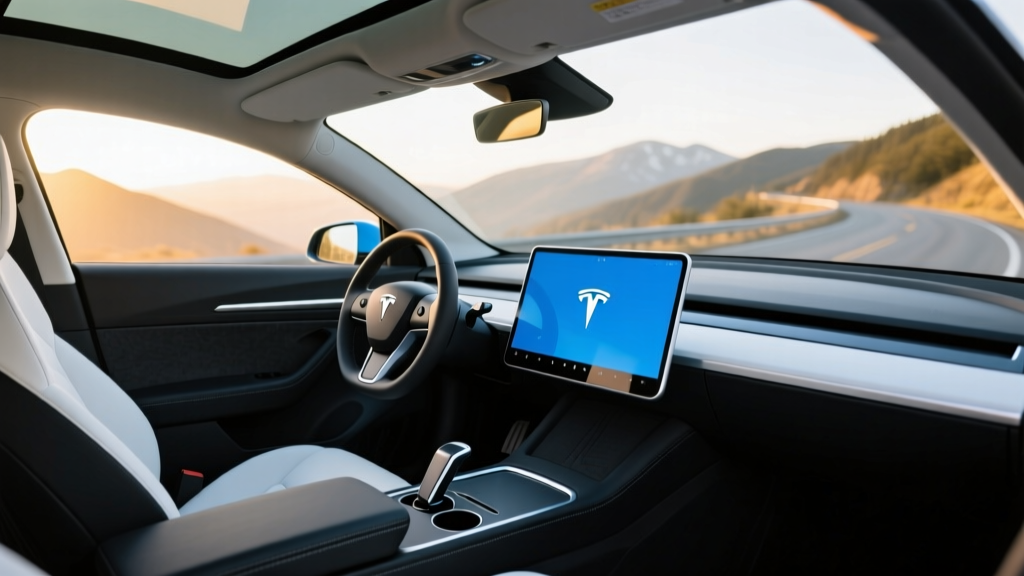
When Tesla refreshed the Model Y for 2025 and carried it into the 2026 model year, it made one of the most polarizing interior decisions in modern automotive history: it deleted the physical gear shifter stalk entirely. No column stalk, no center-console dial, no push-button gear selector. Instead, the 2026 Tesla Model Y asks you to swipe a thin glass touchscreen to choose Drive, Reverse, Neutral, or Park.
For a keyword like tesla gear shifter, the honest answer in 2026 is that there isn't one — at least not in the traditional sense. This review examines how the screen-based shifting system works in practice, whether it's safe, and whether the rest of the refreshed Model Y (now with 320 miles of EPA range, 250 kW DC fast charging, and a starting price around $44,990) justifies the learning curve.
How the Tesla Touchscreen Gear Selector Works
In the 2026 Model Y, gear selection lives on the left edge of the 15.4-inch center touchscreen. A slim vertical strip displays P, R, N, and D icons. To shift, you simply swipe up (for Drive) or swipe down (for Reverse) on that strip. Park is engaged by tapping the P icon or by opening the driver's door while stopped. Neutral requires a long-press.
Tesla also implemented what it calls Auto Shift out of Park. When you buckle your seatbelt and press the brake, the car infers your intended direction based on what's in front of and behind the vehicle using its surround cameras. If there's an obstacle behind you and clear space ahead, it selects Drive automatically. If the reverse is true, it selects Reverse. You can override the selection at any time via the touchscreen.
There is also a backup capacitive strip on the overhead console near the map lights. In the rare event the main screen becomes unresponsive, you can swipe this overhead touch panel to select a gear and drive the vehicle to safety. Tesla added this redundancy specifically to address NHTSA inquiries about screen-based shifting safety.
2026 Tesla Model Y Core Specifications
| Spec | Long Range AWD | Performance |
|---|---|---|
| EPA Range | 320 miles | 295 miles |
| Battery (Usable) | 78.1 kWh, NMC | 78.1 kWh, NMC |
| Drivetrain | Dual-Motor AWD | Dual-Motor AWD |
| Horsepower | 384 hp | 510 hp |
| 0–60 mph | 4.8 sec | 3.5 sec |
| MPGe (Combined) | 111 MPGe | 103 MPGe |
| Efficiency | 30 kWh/100 mi | 33 kWh/100 mi |
| Max DC Fast Charge | 250 kW | 250 kW |
| 10–80% DC Charge | ~25 min | ~25 min |
| Base MSRP | $44,990 | $51,490 |
Source: EPA Fueleconomy.gov, Tesla.com specifications (2026 model year).
Real-World Range: What 320 EPA Miles Actually Means
EPA Sticker: 320 miles (Long Range AWD)
Real-World Highway (70 mph, 72°F): ~270–290 miles
Real-World Cold Weather (30°F, mixed driving): ~230–260 miles
Real-World City (stop-and-go, moderate temps): ~300–320 miles
The 2026 Model Y Long Range achieves its 320-mile EPA rating thanks in part to improved aerodynamics from the refresh (drag coefficient reduced to 0.23 Cd) and a heat pump that comes standard on all trims. The heat pump is critical for cold-weather efficiency — it scavenges waste heat from the powertrain and cabin to warm the battery and interior without relying solely on resistive heating, which is far more energy-intensive.
In real-world highway testing at sustained 70–75 mph speeds, expect to use approximately 31–33 kWh/100 miles, which translates to roughly 270–290 miles before the battery buffer engages. Cold weather at or below freezing can reduce range by 20–30%, depending on whether you precondition the battery and cabin while plugged in. Preconditioning — warming the battery to optimal operating temperature before departure — is essential for both range preservation and fast-charge speed when you hit a Supercharger.
Charging Speed: DC Fast, Level 2, and the Supercharger Advantage
The 2026 Model Y charges at a peak rate of 250 kW on DC fast chargers, specifically at Tesla V3 and V4 Superchargers. That peak rate is not sustained across the entire charging session. Like all lithium-ion batteries, the Model Y's NMC pack follows a charging curve: it accepts maximum power between roughly 10–40% state of charge (SoC), then progressively tapers. By 60% SoC, charge rate drops to approximately 120–140 kW. By 80%, it falls below 60 kW. This is why the 10–80% time is ~25 minutes rather than the ~19 minutes you'd calculate from peak rate alone.
| Charging Level | Power (kW) | Miles Added per Hour | Full Charge Time |
|---|---|---|---|
| Level 1 (120V outlet) | 1.4 kW | ~4 mi/hr | ~55+ hours |
| Level 2 (240V, 32A Mobile Connector) | 7.7 kW | ~25 mi/hr | ~10 hours |
| Level 2 (240V, 48A Wall Connector) | 11.5 kW | ~37 mi/hr | ~7 hours |
| DC Fast (Tesla Supercharger V3/V4) | Up to 250 kW | ~1,000+ mi/hr (peak) | 10–80% in ~25 min |
| DC Fast (CCS adapter, non-Tesla) | Up to 150–170 kW* | ~500–600 mi/hr (peak) | 10–80% in ~35 min |
*CCS adapter charging speed depends on the host network's charger capability and the adapter's throughput limit. Tesla's NACS connector is now the industry standard, and most non-Tesla networks are adding NACS cables through 2026–2027.
For home charging, the Tesla Wall Connector at 48 amps on a 60-amp dedicated circuit delivers the best overnight experience — roughly 37 miles of range per hour of charging, easily replenishing a day's driving in 2–3 hours. Installation typically costs $500–$1,500 depending on your electrical panel's proximity to the garage and whether a panel upgrade (to 200A service) is needed.
Pricing, Trims, and Federal Tax Credit Eligibility
| Trim | Base MSRP | §30D Credit Eligibility | Effective Price (if eligible) |
|---|---|---|---|
| Long Range AWD | $44,990 | Up to $7,500 | ~$37,490 |
| Performance AWD | $51,490 | Up to $7,500 | ~$43,990 |
The 2026 Model Y qualifies for the IRS §30D federal EV tax credit — up to $7,500 — but eligibility is not automatic. Here's what determines whether you actually receive it:
- MSRP Cap: The Model Y is classified as an SUV, so it must be under $80,000 MSRP. Both trims qualify.
- Buyer Income Cap: Modified adjusted gross income (MAGI) must not exceed $150,000 (single), $225,000 (head of household), or $300,000 (married filing jointly).
- Battery Sourcing: At least 60% of critical minerals must be sourced from the U.S. or a free-trade-agreement country, and battery components must not be from a "foreign entity of concern" (FEOC). Tesla has been progressively re-shoring its supply chain; the 2026 Model Y currently meets both requirements for the full $7,500 ($3,750 for critical minerals + $3,750 for battery components).
- Point-of-Sale Transfer: As of 2024, you can transfer the credit to the dealer at purchase, reducing your out-of-pocket cost immediately rather than waiting for a tax refund.
Tax rules change. Verify current eligibility on IRS.gov and consult a tax professional before purchasing.
Interior, Cargo, and Technology
The 2026 Model Y's interior received meaningful upgrades in the refresh: acoustic glass on all four doors, ventilated front seats, ambient lighting, and a rear-seat entertainment screen mounted on the back of the center console. Build quality has improved noticeably — panel gaps are tighter, materials feel more premium, and road noise is substantially lower than in pre-2025 models.
Cargo space: 30.2 cubic feet behind the second row, expanding to 72.1 cubic feet with the rear seats folded. The front trunk (frunk) adds 4.1 cubic feet — useful for charging cables or a small bag. Total passenger volume is 106.1 cubic feet, with 41.8 inches of front legroom and 38.4 inches rear.
Infotainment: All vehicle controls — climate, mirrors, glovebox, and yes, gear selection — run through the 15.4-inch touchscreen. There are no physical buttons for climate control. The system is responsive, with a custom AMD Ryzen processor, and supports Netflix, YouTube, and gaming while parked. Apple CarPlay and Android Auto are still not supported natively, though Tesla's built-in navigation and media are robust.
Driver Assistance: Basic Autopilot (adaptive cruise control, lane centering, automatic emergency braking) is standard. Full Self-Driving (Supervised) remains a $8,000 add-on or $99/month subscription. FSD is an SAE Level 2 system — it does not make the car self-driving. The driver must remain attentive, keep hands on the wheel (or demonstrate engagement via the cabin camera), and be prepared to take over at any moment.
Warranty, Ownership Costs, and Long-Term Battery Outlook
Tesla covers the 2026 Model Y with a 4-year/50,000-mile basic vehicle warranty and an 8-year/120,000-mile battery and drive unit warranty. The battery warranty guarantees that the pack will retain at least 70% of its original capacity during the coverage period. If it falls below that threshold, Tesla will repair or replace it.
NMC battery chemistry (nickel manganese cobalt) offers higher energy density than LFP (lithium iron phosphate), which is why the Long Range achieves 320 miles from a 78.1 kWh pack. However, NMC packs are generally more sensitive to sustained high states of charge. Tesla recommends daily charging to 80% for NMC vehicles and 100% only when you need full range for a trip. This contrasts with Tesla's LFP-equipped Standard Range models, where 100% daily charging is recommended.
Insurance costs for the Model Y tend to run 15–25% higher than comparable non-electric SUVs, reflecting higher repair costs and parts pricing. Expect annual premiums in the $1,800–$2,600 range depending on your location, driving record, and coverage level. Tesla offers its own insurance product in many states, which uses real-time driving data to set premiums — safe drivers can sometimes save significantly.
How It Compares: Model Y vs. Key Rivals
The 2026 Model Y's closest competitors are the Hyundai Ioniq 5 (310 miles, ~$45,500), Ford Mustang Mach-E Extended Range (320 miles, ~$48,000), and Chevrolet Equinox EV (315 miles, ~$36,000). Here's how the Model Y stacks up on the factors that matter most:
- Charging network: Tesla's Supercharger network remains the most reliable and expansive DC fast-charging infrastructure in North America. Competitors now have NACS access agreements, but Tesla owners still get priority and seamless plug-and-charge integration.
- Efficiency: At 30 kWh/100 miles, the Model Y is among the most efficient electric SUVs sold. The Ioniq 5 is comparable at ~31 kWh/100 mi, while the Mach-E trails slightly at ~34 kWh/100 mi.
- Cargo practicality: The Model Y's 30.2 cu ft rear cargo area beats the Ioniq 5 (27.2 cu ft) and is close to the Mach-E (29.7 cu ft).
- Physical controls: Every competitor retains a physical gear selector. If the touchscreen shifter is a dealbreaker, the Mach-E (rotary dial) or Ioniq 5 (column stalk) offer conventional alternatives.
Choose the Model Y if: You prioritize Supercharger network access, best-in-class efficiency, over-the-air software updates, and don't mind adapting to touchscreen-based controls.
Choose a competitor if: You want physical buttons and a traditional gear selector, prefer Apple CarPlay/Android Auto, or want a lower entry price (Equinox EV starts ~$36K).
Pros, Cons, and Final Verdict
- 320-mile EPA range, best-in-class for the segment
- Supercharger network reliability
- 250 kW DC fast charging, 10–80% in ~25 min
- Excellent efficiency (30 kWh/100 mi)
- Strong acceleration (4.8s Long Range, 3.5s Performance)
- Continuous OTA software improvements
- Spacious cargo area (30.2 + 4.1 cu ft frunk)
- Full $7,500 tax credit eligibility (if income qualifies)
- No physical gear shifter — steep adaptation curve
- No Apple CarPlay or Android Auto
- Nearly all controls are touchscreen-only
- Higher insurance premiums than ICE equivalents
- NMC battery requires 80% daily charge limit
- FSD (Supervised) remains Level 2 despite the name
- Ride quality firm on rough roads
Frequently Asked Questions
Is the Tesla touchscreen gear shifter safe?
Tesla added an overhead capacitive backup shifter and automatic park engagement (activates when the driver's door opens while stopped). NHTSA has not issued any recalls related to the system. In practice, the auto-park feature and backup shifter provide adequate redundancy, though the adaptation period requires extra attention in parking situations.
Can I still get a physical gear stalk in a 2026 Tesla?
No. Tesla eliminated the physical gear stalk across the Model S, Model 3, Model X, and Model Y. The Cybertruck also uses screen-based shifting. There is no option to add a physical shifter.
What happens if the touchscreen goes black while driving?
The vehicle continues to operate normally — propulsion, braking, and steering are independent of the display. The car will remain in its current gear (Drive) and you can continue driving. To shift to Park, the overhead backup panel remains functional. Pull over safely and reboot the screen by holding both scroll wheels on the steering wheel for ~10 seconds.
Does the 2026 Model Y qualify for the full $7,500 federal tax credit?
Yes, the 2026 Model Y currently qualifies for the full $7,500 under IRS §30D, provided your income is below the applicable cap ($150K single / $300K joint). The credit can be applied as a point-of-sale reduction at delivery. Verify current battery-sourcing compliance on the IRS website before ordering, as these requirements are subject to periodic updates.
How does the Model Y's range hold up in winter?
Expect 20–30% range reduction in sustained sub-freezing temperatures, bringing the real-world winter range to roughly 230–260 miles. Preconditioning the battery while plugged in mitigates some of this loss and ensures faster DC charging speeds when you arrive at a Supercharger. The standard heat pump is significantly more efficient than resistive cabin heating.
Is the Model Y worth buying over the Hyundai Ioniq 5 or Ford Mach-E?
If Supercharger access and software ecosystem matter most to you, the Model Y remains the segment benchmark. If you prefer physical controls, CarPlay/Android Auto, or a slightly softer ride, the Ioniq 5 and Mach-E are strong alternatives at similar price points. All three are compelling — the decision comes down to interface preference and charging network priorities.