Why Tesla Frozen Door Handles Happen and How to Fix Them
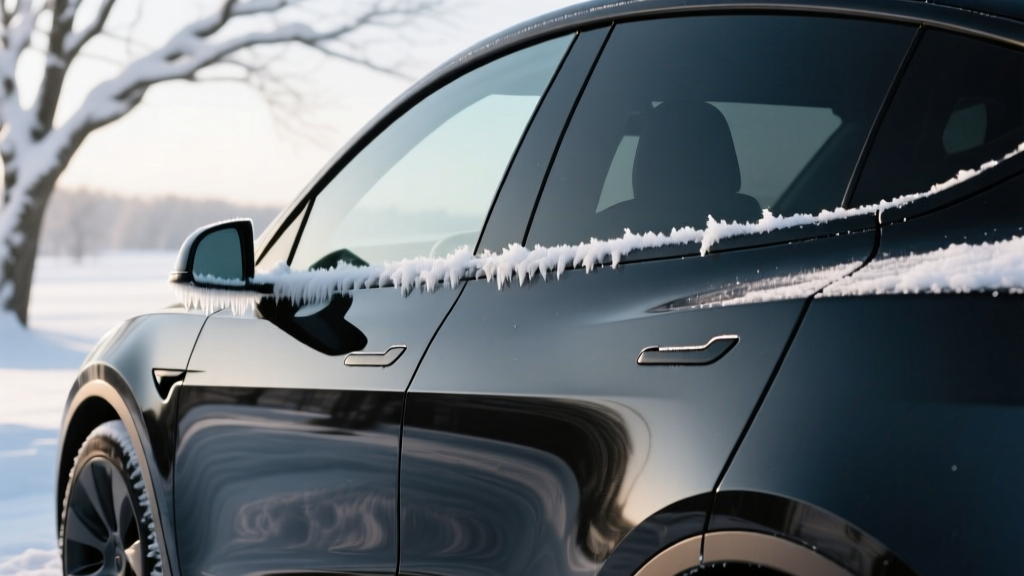
If you own a Tesla in a cold climate, you have likely experienced the frustration of frozen door handles. Unlike traditional vehicles with mechanical pull handles, Tesla's flush, electronic door handles are particularly vulnerable to ice buildup. The handles on the Model 3 and Model Y sit flush with the body for aerodynamic efficiency, but this design creates a pocket where moisture collects and freezes solid overnight. For 2026 Tesla owners across the northern United States, this isn't a theoretical issue — it's a recurring winter challenge that affects daily usability.
This guide covers the specific techniques Tesla owners use to prevent and resolve frozen handles, alongside a complete ownership profile of the 2026 Tesla Model Y Long Range — including real-world winter range expectations, charging speeds, pricing, and whether the vehicle makes sense if you live where temperatures regularly drop below freezing.
The Real-World Winter Range Reality
Before diving into the frozen-handle fix, let's set expectations for what happens to the Model Y's range when temperatures drop. The 2026 Tesla Model Y Long Range AWD carries an EPA-estimated range of 320 miles on a full charge, powered by a 75 kWh usable battery pack using NMC (nickel manganese cobalt) chemistry.
- EPA Estimated: 320 miles (combined city/highway, 72°F)
- Real-World Highway (65-70 mph, moderate temps): ~270-290 miles
- Real-World Winter (20°F, highway, cabin heat on): ~210-240 miles
- Extreme Cold (below 0°F, short trips): ~180-210 miles
Cold weather reduces range through multiple mechanisms: battery internal resistance increases, cabin heating demands energy (the heat pump helps but doesn't eliminate this), and rolling resistance increases. Expect roughly a 25-35% range reduction in sustained freezing conditions, per fueleconomy.gov EV efficiency data.
2026 Tesla Model Y: Full Spec Breakdown
| Specification | 2026 Model Y Long Range AWD |
|---|---|
| EPA Range | 320 miles |
| Battery Capacity (usable) | 75 kWh, NMC chemistry |
| Drivetrain | Dual Motor AWD |
| Horsepower | 384 hp (combined) |
| 0-60 mph | 4.8 seconds |
| Top Speed | 125 mph |
| Efficiency (EPA) | 122 MPGe combined / 27 kWh/100 mi |
| Max DC Fast Charge | 250 kW peak (V3 Supercharger) |
| 10-80% DC Fast Charge | ~27 minutes |
| Level 2 Home Charging | 11.5 kW (44 mi/hr at 48A) |
| Cargo Volume (rear seats up) | 30.2 cu ft |
| Cargo Volume (rear seats folded) | 72.1 cu ft |
| Rear Legroom | 37.7 inches |
| Curb Weight | 4,363 lbs |
| Towing Capacity | 3,500 lbs (with tow package) |
Charging Speeds: Home and DC Fast Charging
The 2026 Model Y uses the NACS (North American Charging Standard) connector natively — Tesla's proprietary plug that has now been adopted by most major automakers. This gives Tesla owners access to the Supercharger network, widely regarded as the most reliable DC fast-charging network in the US.
| Charging Level | Power / Rate | Miles Added per Hour | Best Use Case |
|---|---|---|---|
| Level 1 (120V outlet) | ~1.4 kW | ~5 mi/hr | Emergency/overnight trickle |
| Level 2 (240V, 48A Wall Connector) | 11.5 kW | ~44 mi/hr | Daily home charging |
| Level 2 (240V, 32A Mobile Connector) | 7.7 kW | ~30 mi/hr | Rental/travel charging |
| DC Fast (250 kW V3 Supercharger) | 250 kW peak | ~1,000+ mi/hr (peak) | Road trips, 10-80% in ~27 min |
| DC Fast (V4 Supercharger) | Up to 350 kW (future-capable) | Varies by session | Newer Supercharger stations |
Charging curve reality: The Model Y Long Range peaks at 250 kW only at low state-of-charge (roughly 5-15% SoC) and with a preconditioned battery. Charge speed tapers progressively — from ~250 kW down to ~100 kW by 50% SoC, and below 40 kW past 80%. This is why Tesla quotes 10-80% time rather than a full 0-100% figure. Charging past 80% on DC fast charging is slow and inefficient; plan to charge to 80% and go.
For home Level 2 charging, a full overnight session on the Tesla Wall Connector (48 amps) replenishes the entire 75 kWh battery in roughly 7-8 hours — more than enough for any daily driving need.
Frozen Door Handles: Prevention and Fixes That Work
Here are the proven methods Tesla owners in cold climates use to deal with frozen flush handles, ranked by effectiveness:
Prevention (Do This Before the Freeze)
- Silicone-based lubricant spray: Apply to the handle seams and pivot points before winter. This creates a hydrophobic barrier that prevents water from entering the mechanism. Reapply every 4-6 weeks.
- WD-40 Specialist Water-Resistant Silicone: Specifically the silicone variant (not standard WD-40, which can degrade rubber). Spray into the handle gap.
- Car cover or magnetic windshield cover: Reduces overall ice accumulation on the vehicle, including handle areas.
- Park in a garage when possible: Even an unheated garage prevents direct precipitation from entering handle mechanisms.
- Enable "Cabin Overheat Protection" off and use Scheduled Departure: Preconditioning the cabin via the Tesla app 10-15 minutes before departure warms the door panels enough to thaw minor ice.
Fixes (When Handles Are Already Frozen)
- Firm push-then-pull technique: Press the handle firmly inward with your fist, then pull. The push breaks the ice seal in the recess. This is Tesla's official recommendation.
- De-icer spray (isopropyl-based): Keep a can of automotive lock de-icer in your bag. Spray directly into the handle seam. Works in under 60 seconds.
- Warm water in a ziplock bag: Press a bag of warm (not hot) water against the handle to melt ice without risking water intrusion into electronics.
- Remote preconditioning: Open the Tesla app, turn on climate control to 72°F with seat heaters. Wait 10-15 minutes. The thermal bleed to door panels often frees mildly frozen handles.
- Avoid: hot water poured directly on the handle, excessive force (the electronic mechanism can break), or using a lighter/hair dryer at close range (risk of paint or sensor damage).
Pricing, Trims, and Federal Tax Credit Eligibility
The 2026 Tesla Model Y lineup includes three primary trims. Here's the current pricing and tax-credit picture:
| Trim | Base MSRP | Est. After §30D Credit | Key Specs |
|---|---|---|---|
| Long Range AWD | $44,990 | ~$37,490* | 320 mi range, 384 hp, dual motor |
| Performance | $48,990 | ~$41,490* | 295 mi range, 510 hp, 3.5s 0-60 |
| Long Range RWD (if available) | $42,990 | ~$35,490* | 330 mi range, single motor |
*Tax credit estimates assume full eligibility. Actual credit varies based on IRS §30D requirements.
- MSRP Cap: Vehicle must have an MSRP under $55,000 (sedans) or $80,000 (SUVs/trucks). All Model Y trims qualify as an SUV.
- Buyer Income Cap: AGI must not exceed $150,000 (single), $225,000 (head of household), or $300,000 (married filing jointly).
- Battery Sourcing: Critical minerals and battery components must meet phased-in domestic/free-trade sourcing thresholds. Tesla's US-built battery supply chain has generally met requirements, but check the IRS eligible vehicle list before purchasing, as sourcing rules tighten annually.
- Point-of-Sale Transfer: The credit can now be transferred to the dealer at purchase, reducing your out-of-pocket cost immediately rather than waiting for tax filing.
- One vehicle per VIN, one credit per taxpayer per year.
Consult a tax professional to confirm eligibility for your specific situation.
Technology, Safety, and Driver Assistance
The 2026 Model Y continues with Tesla's minimalist interior architecture centered on a 15.4-inch touchscreen. Key technology highlights:
- Autopilot (standard): SAE Level 2 driver-assist including adaptive cruise control, lane centering, and automatic emergency braking. Requires active driver supervision — hands on wheel, eyes on road.
- Full Self-Driving Supervised ($8,000 option or $99/mo): Adds automatic lane changes, Navigate on Autopilot, traffic light/stop sign recognition, and parking assist. Still SAE Level 2 — the driver must monitor at all times. This is not autonomous driving.
- Infotainment: Netflix, YouTube, Spotify, Arcade built in. No Apple CarPlay or Android Auto (Tesla's walled garden approach).
- Over-the-air updates: Tesla regularly pushes software updates adding features, efficiency improvements, and UI refinements.
- Sentry Mode and Dashcam: Uses the vehicle's cameras for 360-degree security recording.
The 2026 Model Y earned a TOP SAFETY PICK+ rating from IIHS and a 5-star overall rating from NHTSA, with strong crash-test performance across all categories.
Pros and Cons: The Honest Assessment
- Best-in-class DC fast charging network (Supercharger access is a genuine competitive advantage)
- Strong real-world efficiency — 27 kWh/100 mi is excellent for a dual-motor AWD crossover
- Spacious cargo area (72.1 cu ft) with practical hatchback form factor
- Heat pump standard — significantly reduces winter range loss vs. resistive heating
- Continuous OTA updates add value post-purchase
- Strong resale value relative to most EV competitors
- Excellent safety ratings across NHTSA and IIHS
- Frozen flush door handles are a recurring cold-climate nuisance
- No Apple CarPlay or Android Auto — a dealbreaker for some buyers
- Build quality inconsistencies still reported (panel gaps, trim alignment)
- Minimalist interior not for everyone — no physical buttons, no instrument cluster
- FSD is expensive ($8,000) and remains Level 2 despite the name
- Insurance costs tend to be higher than comparable ICE crossovers
- Ride quality is firm — sporty tuning trades comfort for handling
Who Should Buy the 2026 Model Y (And Who Shouldn't)
The Model Y Long Range AWD is best suited for:
- Daily commuters who can charge at home and want a practical, efficient crossover with hatchback utility
- Tech-forward families who value the Supercharger network for road trips and need cargo space for gear and strollers
- Cold-climate drivers who understand the winter range trade-offs and have access to a garage or covered parking (mitigating the frozen handle issue)
- Buyers who want strong resale value — Tesla's brand recognition and Supercharger ecosystem support long-term value retention
Consider alternatives if:
- You need Apple CarPlay/Android Auto integration (look at the Hyundai Ioniq 5 or Ford Mustang Mach-E)
- You frequently tow heavy loads beyond 3,500 lbs (the Rivian R1S or Ford F-150 Lightning serve better)
- You have no home charging access and live in an area with sparse public charging infrastructure
- You prefer a traditional interior with physical controls and a dedicated instrument display
Warranty Coverage
Tesla's warranty for the 2026 Model Y:
- Basic Vehicle: 4 years / 50,000 miles
- Battery & Drive Unit: 8 years / 120,000 miles (whichever comes first), with a minimum 70% capacity retention guarantee
- Corrosion: 12 years, unlimited miles (perforation only)
The 70% retention threshold is industry-standard for NMC packs. Real-world data from high-mileage Teslas suggests NMC batteries in the Model Y typically lose 8-12% capacity over the first 100,000 miles, with degradation slowing significantly after the initial break-in period.
Frequently Asked Questions
What is the real-world range of the 2026 Tesla Model Y in winter?
Expect 210-240 miles in sustained freezing temperatures (20°F) with highway driving and cabin heat. The EPA rates it at 320 miles, but cold weather reduces usable range by 25-35%. The heat pump helps mitigate this compared to older resistive-heating EVs, but physics dictates some loss. Preconditioning while plugged in recovers some efficiency.
How fast does the Model Y charge at home and on road trips?
At home on a Level 2 Tesla Wall Connector (48A/240V), the Model Y adds about 44 miles of range per hour — a full charge takes roughly 7-8 hours overnight. On a V3 Supercharger (250 kW peak), a 10-80% session takes approximately 27 minutes with a preconditioned battery. Remember that charge speed tapers significantly above 80%.
How much does the 2026 Model Y cost after the federal tax credit?
The Long Range AWD starts at $44,990 MSRP. If you qualify for the full $7,500 §30D federal tax credit (meeting income, sourcing, and MSRP requirements), the effective price drops to approximately $37,490. Point-of-sale transfer allows you to apply this credit at purchase rather than waiting until tax filing. Always verify current eligibility on the IRS eligible vehicle list.
Is the Tesla Model Y worth buying vs. the Hyundai Ioniq 5 or Ford Mach-E?
The Model Y wins on Supercharger network access, efficiency, and cargo space. The Ioniq 5 offers faster 10-80% charging (~18 minutes on 350 kW chargers), a more comfortable ride, and Apple CarPlay. The Mach-E provides a more traditional interior with physical controls and BlueCruise hands-free driving. Your priority — charging network, interior preference, or driving feel — determines the winner.
How do I prevent Tesla frozen door handles in winter?
Apply a silicone-based lubricant to the handle seams before winter, park in a garage when possible, and use the Tesla app to precondition the cabin 10-15 minutes before departure. If handles are already frozen, press firmly inward to break the ice seal, or use isopropyl-based de-icer spray. Avoid forcing the handle — the electronic actuator is expensive to replace.
Does the 2026 Model Y qualify for the full $7,500 federal EV tax credit?
The Model Y qualifies on MSRP (under the $80,000 SUV cap) and is assembled in the US. However, the full credit depends on battery sourcing requirements (critical minerals and component thresholds that tighten annually), plus buyer income caps ($150K single / $300K married filing jointly). Check the IRS list before purchase and consult a tax professional for your specific situation.