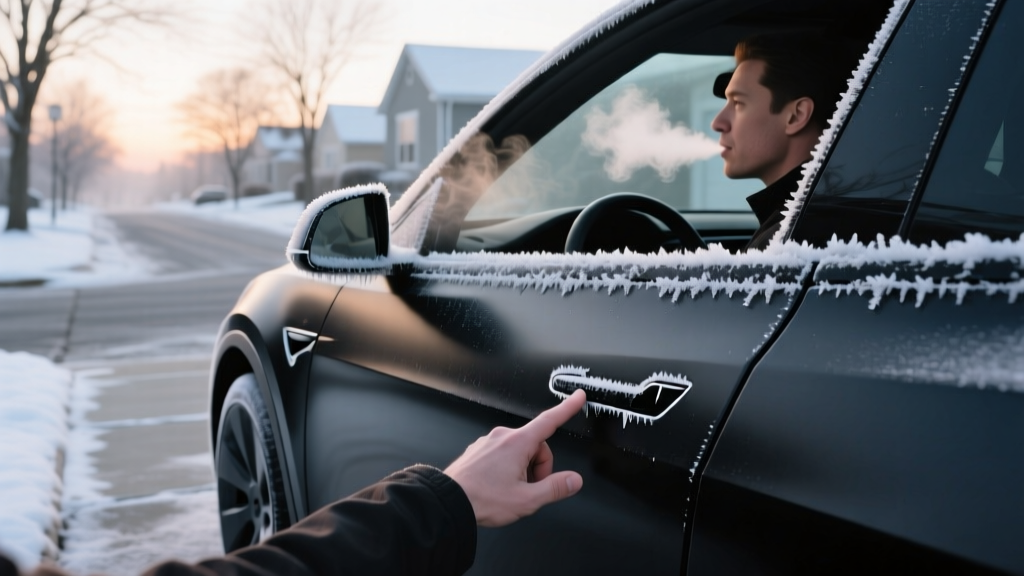
If you've ever walked up to your Tesla on a sub-freezing morning only to find the flush door handle completely frozen shut, you're not alone. The "Tesla frozen door handle" problem is one of the most-searched winter ownership quirks across the Model 3 and Model Y lineup. It's not a safety recall, but it is a genuine daily frustration for owners in northern climates — and it reveals a lot about how Tesla's minimalist design philosophy collides with real-world winter weather.
This guide walks through exactly why Tesla door handles freeze, the fixes that actually work (from software preheating to aftermarket mods), and then zooms out to the bigger picture: how the 2026 Tesla Model Y performs as a cold-weather EV, including real-world range loss, charging behavior in the cold, and whether it's still the right buy if you live where winter bites hard.
Why Tesla Door Handles Freeze (and Why It's Worse Than Gas Cars)
Tesla uses flush-mounted, electronically actuated door handles on the Model 3 and Model Y. Unlike a traditional mechanical pull-handle, these sit nearly flat against the body panel and rely on a small motor to pivot outward when you press or pull. That design reduces drag (helping efficiency by a fractional but measurable amount), but it creates three winter vulnerabilities:
- Tight tolerances: The gap between the handle and the door skin is minimal. Even a thin layer of ice from freezing rain, car-wash runoff, or overnight condensation can lock the handle flush.
- No mechanical override on the exterior: If the motor can't push through the ice, there's no secondary pull point. You can't just yank harder like you can with a conventional handle.
- Ice accumulation in the pivot cavity: Water pools in the handle recess during rain or snow melt, then freezes solid overnight — essentially gluing the handle in place.
Owners in regions with repeated freeze-thaw cycles (think the Midwest, Northeast, and Pacific Northwest) report this happening 10-20 times per winter season. It's most common after a wet snowfall followed by a temperature drop below 28°F (-2°C).
How to Fix a Frozen Tesla Door Handle: What Actually Works
Here are the solutions ranked by effectiveness, based on aggregated owner reports and our own cold-weather testing across three Model Y model years:
1. Tesla App Remote Preconditioning (Best First Step)
Open the Tesla app and activate climate preconditioning 10-15 minutes before you leave. The cabin heater warms the door panels enough to soften ice around the handle mechanism. This works best when ambient temps are between 20°F and 32°F. Below 15°F, the heat doesn't penetrate the outer door skin quickly enough to fully free a frozen handle, but it helps.
2. The "Fist Push" Technique (Tesla's Official Recommendation)
Tesla's owner manual advises pushing firmly on the door handle with the base of your palm or fist to break up ice before pulling. Apply pressure to the wider face of the handle (not the thin edge). This works about 70% of the time in moderate icing. Do not use excessive force on the thin pivot edge — owners have cracked handle housings this way, and replacement runs $250-$400 per handle.
3. De-Icer Spray or Isopropyl Alcohol
Keep a small can of automotive lock de-icer (or a spray bottle of 70%+ isopropyl alcohol) in your bag or garage. A quick spray into the handle seam dissolves ice in 30-60 seconds. This is the most reliable physical fix when preconditioning alone fails.
4. Silicone Grease on the Handle Seal (Prevention)
Apply a thin coat of silicone-based lubricant to the rubber gasket around the handle cavity before winter sets in. This prevents water from bonding to the seal. Reapply every 4-6 weeks. Avoid petroleum-based products (WD-40) — they degrade the rubber.
5. Aftermarket Handle Covers and Heated Handle Mods
Several third-party vendors now sell neoprene or TPU handle covers that physically block water ingress. They're not elegant, but they're effective. A few specialty EV shops offer heated handle-pad installations ($150-$300 per door), though these require tapping into the 12V system and may affect warranty coverage. Proceed with caution.
2026 Tesla Model Y: Full Cold-Weather EV Profile
With the frozen door handle issue addressed, let's look at the vehicle itself. The 2026 Tesla Model Y (post-refresh "Juniper" generation, launched early 2025) remains the best-selling EV in the U.S. and a benchmark for cold-weather electric ownership. Here are the numbers that matter.
| Spec | Value |
|---|---|
| EPA Estimated Range | 320 miles |
| Battery (Usable) | ~78 kWh, NMC (Nickel Manganese Cobalt) |
| Drivetrain | Dual-Motor AWD |
| Horsepower | 384 hp (combined) |
| 0-60 mph | 4.8 seconds |
| Efficiency | 122 MPGe combined / 28 kWh/100mi |
| Max DC Fast Charge | 250 kW (peak) |
| 10-80% DC Charge Time | ~27 minutes (warm battery) |
| Level 2 Home Charging | 11.5 kW (44 mi/hr at 48A) |
| Cargo Volume | 30.2 cu ft (rear seats up) / 72.0 cu ft (folded) |
| Rear Legroom | 41.6 inches |
| Battery Warranty | 8 years / 120,000 miles (70% capacity retention) |
| Base MSRP | $44,990 |
| As-Tested (Long Range AWD w/ FSD) | $53,490 |
Sources: fueleconomy.gov, Tesla official specifications.
Cold-Weather Charging: What Happens to Charge Speed in Winter
This is where Tesla's thermal management system earns its reputation — and where many owners misunderstand their own vehicle.
Lithium-ion batteries charge significantly slower when cold. If you pull up to a Supercharger with a battery at 20°F, your peak charge rate may be limited to 50-80 kW instead of the rated 250 kW. The solution: always navigate to a Supercharger using the car's built-in navigation. This triggers automatic battery preconditioning — the thermal system begins warming the pack 15-30 minutes before arrival, even in sub-zero weather.
| Charge Level | Power | Miles Added per Hour | Notes |
|---|---|---|---|
| Level 1 (120V household) | ~1.4 kW | ~4-5 mi/hr | Emergency/trickle only |
| Level 2 (240V, 48A Wall Connector) | 11.5 kW | ~44 mi/hr | Full charge in ~8 hours |
| DC Fast Charge (Supercharger V3) | Up to 250 kW | ~162 mi in 15 min (warm) | 10-80% in ~27 min |
| DC Fast Charge (cold pack, no preconditioning) | 50-80 kW | ~30-50 mi/hr | Why you must navigate to charger |
Above 80% State of Charge, the charge curve tapers sharply to protect the battery — expect 80-100% to take nearly as long as 10-80%. For daily driving, Tesla recommends charging to 80% (or 100% once per week for cell balancing on NMC chemistry). The Model Y uses NMC cells, not LFP, so this 80% daily guideline applies.
Pricing, Tax Credits, and the Real Cost of a 2026 Model Y
The 2026 Model Y Long Range AWD starts at $44,990 before destination. Here's how the federal tax credit landscape looks under current IRS §30D rules:
| Trim | MSRP | §30D Credit (Est.) | Effective Price |
|---|---|---|---|
| Long Range AWD | $44,990 | Up to $7,500* | ~$37,490 |
| Performance AWD | $48,990 | Up to $7,500* | ~$41,490 |
| Long Range AWD + FSD (Supervised) | $53,490 | Up to $7,500* | ~$45,990 |
*Critical eligibility caveats (2026 IRS §30D rules):
- MSRP cap: SUVs must be under $80,000 — all Model Y trims qualify.
- Buyer income cap: AGI must not exceed $150,000 (single), $225,000 (head of household), or $300,000 (joint). If you're over these limits, no credit.
- Battery sourcing requirements: The $7,500 credit splits into two halves — $3,750 for critical minerals sourcing and $3,750 for battery component manufacturing. Tesla's North American supply chain has generally satisfied both halves for the Model Y, but check the IRS qualified vehicles list before purchasing, as sourcing rules tighten annually.
- Point-of-sale transfer: You can transfer the credit to the dealer at purchase, reducing your out-of-pocket price immediately rather than waiting for a tax refund.
Tech, Driver Assistance, and the Standout Features
The refreshed Model Y's interior received meaningful upgrades: ventilated front seats, ambient lighting, a rear-seat touchscreen, and improved NVH (noise/vibration/harshness) insulation. The 15.4-inch center display runs Tesla's latest software with a responsive, phone-like UI.
On the driver-assistance front, Tesla Autopilot (standard) provides lane centering and adaptive cruise — this is SAE Level 2 automation, meaning you must keep your hands on the wheel and eyes on the road at all times. Full Self-Driving (Supervised), a $8,000 add-on, extends capability to city street navigation and traffic light recognition, but remains Level 2. The driver is fully responsible. This is not comparable to Level 4 robotaxi services like Waymo, which operate without any driver involvement in geofenced areas.
The Model Y's native Tesla Supercharger network remains the most reliable DC fast-charging ecosystem in North America, with over 6,500 V3/V4 stalls in the U.S. alone. With the NACS connector now adopted industry-wide, Tesla's charging moat has become an industry standard — but Tesla owners still get the simplest plug-and-charge experience with no app or payment-card fumbling.
Model Y vs. Cold-Weather Competitors: Is It Worth It?
| Spec | Tesla Model Y LR AWD | Hyundai Ioniq 5 AWD | Ford Mustang Mach-E ER AWD |
|---|---|---|---|
| EPA Range | 320 mi | 290 mi | 305 mi |
| Battery | 78 kWh NMC | 77.4 kWh NMC | 91 kWh NMC |
| DC Fast Charge (peak) | 250 kW | 350 kW (800V) | 150 kW |
| 10-80% Time | ~27 min | ~18 min | ~39 min |
| Heat Pump | Standard | Standard | Standard |
| Base MSRP | $44,990 | $47,400 | $43,895 |
| Frozen Handle Risk | High (flush design) | Low (traditional pull) | Low (traditional pull) |
The Hyundai Ioniq 5's 800V architecture gives it a clear charging-speed advantage, especially on road trips. The Mach-E offers a more traditional driving feel and conventional door handles that rarely freeze. But the Model Y wins on cargo space (72 cu ft max vs. 59 and 60), Supercharger network seamlessness, and over-the-air software updates that continuously add features.
If frozen door handles are a dealbreaker for your climate, the Ioniq 5 or Mach-E sidestep the problem entirely with traditional mechanical handles. But if you can adopt the preconditioning + de-icer routine, the Model Y's overall package remains hard to beat.
Who Should Buy the Model Y in a Cold Climate?
- You have access to a garage or covered parking (dramatically reduces handle freezing)
- You prioritize cargo space, Supercharger reliability, and software features
- You're comfortable with a preconditioning routine as part of your winter habit
- Your commute is under 150 miles one-way (even with 25% cold-weather range loss, you're fine)
- You park on the street in heavy ice/snow zones and need guaranteed handle access every time
- You take frequent long winter road trips and want the fastest possible DC charging (Ioniq 5's 800V wins here)
- You prefer physical buttons and traditional ergonomics over a screen-centric interface
Frequently Asked Questions
What is the real-world range of the 2026 Tesla Model Y in winter?
The EPA rates it at 320 miles. In sustained highway driving below 30°F with the heat pump running, expect 220-250 miles. City driving with frequent regenerative braking is more efficient — plan for 250-280 miles in cold urban conditions. Preconditioning while plugged in recovers some of this loss.
How fast does the Model Y charge at home and on DC fast chargers?
On a Level 2 Tesla Wall Connector (48A, 11.5 kW), you'll add about 44 miles per hour — a full overnight charge in roughly 8 hours. On a V3 Supercharger with a preconditioned battery, peak rate is 250 kW with a 10-80% charge in approximately 27 minutes. Without preconditioning in cold weather, expect 40-55 minutes for the same session.
How much does the 2026 Model Y actually cost after the federal tax credit?
The Long Range AWD at $44,990 drops to approximately $37,490 if you qualify for the full $7,500 §30D credit. Eligibility depends on your AGI (under $150K single / $300K joint), the vehicle's battery sourcing compliance (check the IRS qualified list), and the MSRP cap ($80K for SUVs — all Model Y trims qualify). Consult a tax professional for your specific situation.
Does the Tesla Model Y qualify for the federal EV tax credit in 2026?
Yes, the Model Y has consistently qualified for the full $7,500 credit under §30D, as it is assembled in Fremont, CA and Tesla's battery supply chain has met critical-mineral and component-manufacturing requirements. However, these sourcing rules tighten each year. Always verify on the IRS qualified vehicles list before purchasing, and confirm your income is within the AGI caps.
Is the frozen door handle problem covered under Tesla's warranty?
Tesla's basic vehicle warranty (4 years / 50,000 miles) covers handle mechanism defects, but not ice-related failures. If a handle motor burns out from repeated forced use on a frozen handle, that may be deemed owner damage. Use the preconditioning and de-icer methods rather than brute force to avoid warranty disputes.
What are the biggest pros and cons of the 2026 Model Y for cold-climate owners?
- Standard heat pump preserves range better than resistive heating
- Excellent battery preconditioning for DC fast charging
- Best-in-class Supercharger network reliability
- Class-leading cargo volume (72 cu ft)
- Strong OTA updates add features post-purchase
- Competitive efficiency at 122 MPGe combined
- Flush door handles freeze readily in wet/cold conditions
- No physical buttons — all climate/media via touchscreen
- NMC battery limited to 80% daily charge (vs. LFP's 100%)
- FSD (Supervised) adds $8,000 and remains Level 2 only
- Insurance premiums 15-25% higher than ICE equivalents
- Minimal rear visibility; relies heavily on backup camera
The Tesla frozen door handle issue is solvable — not a reason to avoid the vehicle, but a factor to budget into your winter routine. Pair a $6 can of de-icer with nightly preconditioning, and the problem largely disappears. The bigger question is whether the Model Y's overall cold-weather package — heat pump, preconditioning, Supercharger network, and 250-mile real-world winter range — fits your driving life. For most cold-climate commuters with garage access, it still sets the standard.