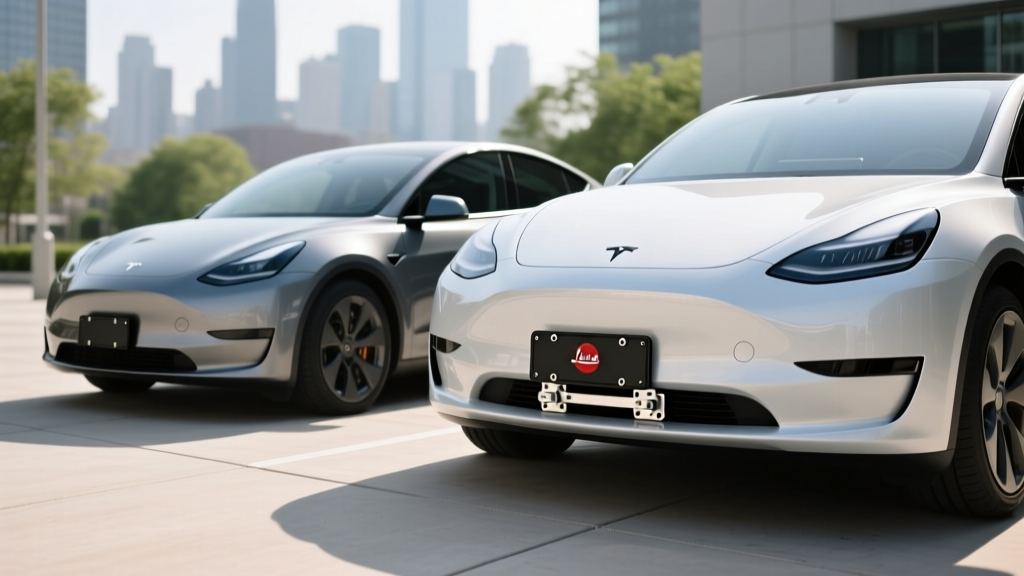
If you have just taken delivery of a Tesla Model 3 or Model Y, you may have noticed something missing from the front bumper: a license plate bracket. Tesla ships many vehicles without a front plate mount installed, leaving new owners to navigate a patchwork of state laws, aftermarket brackets, and potential warranty questions. This guide covers everything you need to know about the Tesla front license plate requirement — including which states mandate it, which mounting solutions actually work without drilling, and a full 2026 ownership profile of the two models most affected.
Why Tesla Omits the Front License Plate Bracket
Tesla designs the Model 3 and Model Y front fascia for aerodynamic efficiency. A recessed plate well or pre-drilled bracket adds drag and complicates the bumper mold. In markets where front plates are not legally required — including most of Canada, the UK, and roughly half of U.S. states — Tesla ships vehicles without the bracket to preserve the clean front-end styling and reduce manufacturing steps.
However, 29 U.S. states plus Washington D.C. require a front license plate on passenger vehicles. Driving without one in those jurisdictions can result in a fix-it ticket or a fine typically ranging from $25 to $200. The problem is most acute for Tesla owners because:
- There is no factory-installed bracket on many U.S.-spec vehicles.
- Drilling into the bumper may void portions of the exterior warranty.
- Aftermarket adhesive or tow-hook mounts vary widely in quality and fitment.
State-by-State Front Plate Requirements
Before choosing a mounting solution, confirm whether your state actually requires a front plate. The following states mandate both front and rear plates as of 2026 (always verify with your local DMV, as laws can change):
| Require Front + Rear Plate | Front Plate NOT Required |
|---|---|
| California, Colorado, Connecticut, Hawaii, Idaho, Illinois, Iowa, Maine, Maryland, Minnesota, Missouri, Nebraska, New Hampshire, New Jersey, New York, North Dakota, Ohio, Oregon, Pennsylvania, Rhode Island, South Dakota, Texas, Utah, Vermont, Virginia, Washington, Washington D.C., West Virginia, Wisconsin | Alabama, Arizona, Arkansas, Delaware, Florida, Georgia, Indiana, Kansas, Kentucky, Louisiana, Massachusetts, Michigan, Mississippi, Montana, Nevada, New Mexico, North Carolina, Oklahoma, South Carolina, Tennessee, Wyoming |
Key nuance: Massachusetts is interesting — it does not require a front plate on most passenger vehicles, but some commercial registrations do. If you move between states or frequently travel across state lines, mounting a front plate preemptively avoids citations.
Mounting Options: No-Drill vs. OEM Bracket
Tesla owners generally have three paths to front plate compliance:
1. Tesla OEM Front License Plate Bracket
Tesla sells an official front plate bracket (part varies by model year) through its service centers and online store. On the 2024+ Highland Model 3 and Juniper Model Y, this bracket uses pre-existing mounting points behind the bumper fascia — no drilling required. Installation takes roughly 15 minutes with basic hand tools. Cost: typically $35–$55 depending on the model.
2. Aftermarket No-Drill Adhesive Mounts
Brands like Sto N Sho and EVANNEX offer adhesive-backed or tow-hook-mounted brackets. These attach using 3M VHB tape or the front tow-hook receiver (a threaded port behind a small bumper cap). Advantages include zero modification to the bumper. Drawbacks: adhesive mounts can loosen in extreme heat, and tow-hook mounts limit access to the tow point.
3. Dealer-Installed Bracket at Delivery
Some Tesla delivery centers will install the OEM bracket at no charge if you request it during delivery, particularly in states with front-plate mandates. Ask your delivery advisor before signing paperwork. This is the cleanest option since it avoids any post-delivery modification questions.
2026 Tesla Model 3: Full Ownership Profile
The refreshed Model 3 (internally called "Highland," launched for the 2024 model year and continuing into 2026) received updated styling, improved cabin insulation, ventilated front seats, and a rear touchscreen. Here is the complete spec breakdown buyers need.
| Spec | Model 3 RWD | Model 3 Long Range AWD | Model 3 Performance |
|---|---|---|---|
| EPA Range | 363 mi | 346 mi | 315 mi |
| Battery (usable) | ~60 kWh (LFP) | ~75 kWh (NMC) | ~75 kWh (NMC) |
| Peak DC Charge Rate | 170 kW | 250 kW | 250 kW |
| 10–80% DC Fast Charge | ~30 min | ~25 min | ~25 min |
| Level 2 Home Charge | 11.5 kW (~44 mi/hr) | 11.5 kW (~44 mi/hr) | 11.5 kW (~44 mi/hr) |
| 0–60 mph | 5.8 sec | 4.2 sec | 2.9 sec |
| Horsepower | ~271 hp | ~346 hp | ~510 hp |
| Drivetrain | RWD | Dual-Motor AWD | Dual-Motor AWD |
| Efficiency | 132 MPGe / 25 kWh/100mi | 130 MPGe / 26 kWh/100mi | 119 MPGe / 28 kWh/100mi |
| Cargo Volume | 23 cu ft (trunk + frunk) | 23 cu ft | 23 cu ft |
| Rear Legroom | 35.3 in | 35.3 in | 35.3 in |
| Base MSRP | $38,990 | $45,990 | $52,990 |
| Battery Warranty | 8 yr / 100,000 mi | 8 yr / 120,000 mi | 8 yr / 120,000 mi |
2026 Tesla Model Y: Full Ownership Profile
The refreshed Model Y ("Juniper" refresh, arriving for the 2025 model year and continuing into 2026) brings a redesigned front and rear fascia, ambient interior lighting, a rear-row touchscreen, and improved ride quality. It remains Tesla's best-selling vehicle globally and the most common model affected by front-plate compliance issues due to its crossover-SUV popularity in states like California, New York, and Texas.
| Spec | Model Y RWD | Model Y Long Range AWD | Model Y Performance |
|---|---|---|---|
| EPA Range | 320 mi | 330 mi | 295 mi |
| Battery (usable) | ~60 kWh (LFP) | ~75 kWh (NMC) | ~75 kWh (NMC) |
| Peak DC Charge Rate | 170 kW | 250 kW | 250 kW |
| 10–80% DC Fast Charge | ~30 min | ~25 min | ~25 min |
| Level 2 Home Charge | 11.5 kW (~37 mi/hr) | 11.5 kW (~37 mi/hr) | 11.5 kW (~37 mi/hr) |
| 0–60 mph | 6.5 sec | 4.8 sec | 3.5 sec |
| Horsepower | ~295 hp | ~384 hp | ~456 hp |
| Drivetrain | RWD | Dual-Motor AWD | Dual-Motor AWD |
| Efficiency | 125 MPGe / 27 kWh/100mi | 122 MPGe / 28 kWh/100mi | 111 MPGe / 30 kWh/100mi |
| Cargo Volume | 76 cu ft (rear seats folded) | 76 cu ft | 76 cu ft |
| Rear Legroom | 39.0 in | 39.0 in | 39.0 in |
| Base MSRP | $44,990 | $49,990 | $54,990 |
| Battery Warranty | 8 yr / 100,000 mi | 8 yr / 120,000 mi | 8 yr / 120,000 mi |
Federal Tax Credit Eligibility (IRS §30D)
As of 2026, the federal EV tax credit under IRS §30D provides up to $7,500 for qualifying new EVs, but eligibility depends on several conditions that change frequently:
- MSRP Cap: Sedans (Model 3) must be under $55,000; SUVs/trucks (Model Y) must be under $80,000. All current Model 3 and Model Y trims fall within these caps.
- Buyer Income Cap: Modified adjusted gross income must not exceed $150,000 (single), $225,000 (head of household), or $300,000 (married filing jointly).
- Battery Sourcing: The $7,500 credit splits into two halves — $3,750 for critical minerals sourcing and $3,750 for battery component manufacturing. As of 2026, Tesla sources an increasing share of materials domestically and from FTA-partner countries, but the exact credit amount varies by production batch. Verify the specific VIN's eligibility on the IRS clean vehicle portal before purchase.
- Point-of-Sale Transfer: Buyers can transfer the credit to the dealer at purchase, reducing the out-of-pocket price immediately rather than waiting for a tax refund.
- FEOC Restriction: Vehicles with battery components from a "foreign entity of concern" (FEOC) may be disqualified from part or all of the credit. Tesla's vertically integrated supply chain generally avoids this, but rules tighten annually.
| Model / Trim | Base MSRP | Est. Max Credit | Effective Price |
|---|---|---|---|
| Model 3 RWD | $38,990 | Up to $7,500* | ~$31,490 |
| Model 3 Long Range AWD | $45,990 | Up to $7,500* | ~$38,490 |
| Model 3 Performance | $52,990 | Up to $7,500* | ~$45,490 |
| Model Y RWD | $44,990 | Up to $7,500* | ~$37,490 |
| Model Y Long Range AWD | $49,990 | Up to $7,500* | ~$42,490 |
| Model Y Performance | $54,990 | Up to $7,500* | ~$47,490 |
*Credit amount depends on battery sourcing compliance and buyer income. Verify your specific VIN at fueleconomy.gov and consult a tax professional. Credit rules are subject to change.
Charging, Tech, and Standout Features
Tesla's Supercharger network remains a key ownership advantage. Both the Model 3 and Model Y use the NACS (North American Charging Standard) connector natively — no adapter needed at Tesla Superchargers. With the 2025+ opening of Superchargers to non-Tesla EVs, the network has expanded further, and Tesla vehicles still receive priority routing and pricing in many markets.
| Charging Level | Power (kW) | Speed | Use Case |
|---|---|---|---|
| Level 1 (120V) | ~1.4 kW | ~4–5 mi/hr | Overnight trickle, emergencies |
| Level 2 (240V, 48A) | 11.5 kW | ~37–44 mi/hr | Daily home charging |
| DC Fast (Supercharger V3/V4) | Up to 250 kW | ~170 mi in 15 min (peak) | Road trips, rapid top-ups |
Charge curve reality: The 250 kW peak rate applies only between roughly 10–30% State of Charge on NMC trims. Above 50%, the rate tapers progressively — expect 80–100 kW in the 50–80% range. LFP trims (RWD) can be charged to 100% regularly without degradation concerns, which partially offsets their lower peak rate.
Standout Tech Features
- 15.4" front touchscreen with redesigned UI and faster processor (Highland/Juniper)
- 8" rear touchscreen for climate, media, and entertainment
- Autopilot (SAE Level 2) standard — includes adaptive cruise, lane centering, and automatic emergency braking
- FSD (Supervised) available as a $8,000 add-on or $99/mo subscription — still requires active driver supervision at all times
- Ventilated front seats (new for Highland/Juniper)
- Ambient lighting across dash and door panels
- Improved NVH — cabin noise reduced significantly over pre-2024 models
Notable Drawbacks
- No physical stalks: Turn signals and gear selection are now via steering wheel buttons and touchscreen, which many drivers find unintuitive during the adjustment period.
- No Apple CarPlay / Android Auto: Tesla's proprietary infotainment is the only option. If you rely on phone-based navigation or media, this is a real limitation.
- Rear visibility: The Model 3's rear window is relatively narrow; the Model Y improves this but still benefits from the standard backup camera.
- Insurance costs: Tesla insurance premiums tend to run 15–30% higher than comparable non-Tesla EVs due to repair costs and claim frequency. Get a quote before committing.
Pros and Cons at a Glance
Pros
- Class-leading efficiency (25–30 kWh/100mi)
- Supercharger network access (NACS native)
- Over-the-air updates continuously add features
- Strong resale value relative to non-Tesla EVs
- Spacious Model Y cargo area (76 cu ft)
- Lowest effective price in segment after §30D credit
Cons
- Front license plate bracket not pre-installed
- Turn signal / gear selector learning curve
- No Apple CarPlay or Android Auto
- Higher-than-average insurance premiums
- FSD subscription cost adds up over time
- LFP RWD trims lose more range in cold weather
Who Should Buy the Model 3 vs. Model Y?
Decision Framework
Choose the Model 3 if: You prioritize maximum range and efficiency, commute solo or with one passenger, don't need SUV cargo height, and want the lowest possible effective price after tax credits. The RWD trim at ~$31,490 (after credit) is the value play.
Choose the Model Y if: You need family-friendly rear seat space (39" legroom), hatchback-style cargo loading (76 cu ft), or plan to install a child seat. The Long Range AWD is the sweet spot for road-trippers needing AWD traction and 330 miles of EPA range.
Choose the Performance trim if: Track capability and sub-3.5-second 0–60 times matter to you, and you accept the 35–40 mile range penalty versus Long Range.
Frequently Asked Questions
Can I get a ticket for not having a Tesla front license plate?
Yes. In the 29 states plus D.C. that require front plates, driving without one is a traffic infraction. Fines typically range from $25 to $200. Some officers issue fix-it tickets (dismissed once you install the plate), while others issue straight fines. Tesla's lack of a pre-installed bracket is not a legal defense.
Does installing an aftermarket front plate bracket void my Tesla warranty?
Using a no-drill adhesive or tow-hook mount generally does not affect your warranty. However, drilling into the front bumper fascia could void coverage on the bumper itself and potentially affect front parking sensor calibration. The OEM Tesla bracket uses factory mounting points and is the safest option.
How much does the Tesla OEM front license plate bracket cost?
The OEM bracket typically costs $35–$55 through Tesla's online store or service center. Some delivery centers install it for free at delivery if you request it in advance, particularly in front-plate-mandate states.
Does the front plate bracket affect range or aerodynamics?
Minimally. Independent testing by EV owners has shown a range reduction of approximately 1–3 miles at highway speeds — well within normal variance. The effect is negligible for daily driving.
What is the real-world range of the 2026 Tesla Model 3 and Model Y?
The Model 3 Long Range AWD delivers approximately 280–310 miles in mixed highway driving (EPA: 346 mi). The Model Y Long Range AWD yields roughly 265–290 miles (EPA: 330 mi). In sub-30°F winter conditions, subtract 20–25% from these figures.
How fast do the Model 3 and Model Y charge at home?
On a 48-amp Level 2 home charger (240V), both vehicles accept up to 11.5 kW, adding approximately 37–44 miles of range per hour. A full overnight charge from 20% to 80% takes about 5–6 hours.
Do the Model 3 and Model Y qualify for the $7,500 federal tax credit?
All current trims fall under the §30D MSRP caps ($55,000 for sedans, $80,000 for SUVs). However, the actual credit amount depends on battery sourcing compliance, buyer income limits, and FEOC restrictions. Check your specific VIN's eligibility on fueleconomy.gov and consult a tax professional.
Is the Tesla Model Y worth buying over competitors like the Hyundai Ioniq 5 or Ford Mustang Mach-E?
The Model Y wins on Supercharger network access, cargo space (76 cu ft vs. ~55–60 cu ft for rivals), and software integration. The Ioniq 5 charges faster on non-Tesla DC chargers (up to 350 kW on 800V architecture) and offers Apple CarPlay. The Mach-E provides a more traditional driving feel. If you road-trip frequently and value the Supercharger ecosystem, the Model Y remains the default choice in 2026.
Sources: EPA range and efficiency data from fueleconomy.gov. Federal tax credit rules from IRS.gov. Vehicle specifications from Tesla's official product pages. Safety ratings from NHTSA. Always verify current pricing, credit eligibility, and state laws before purchasing.