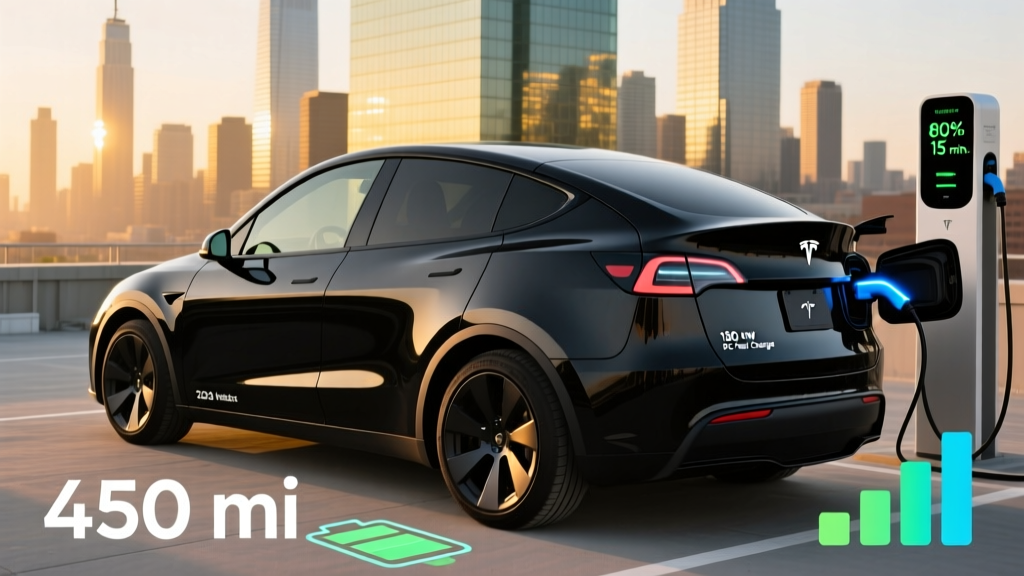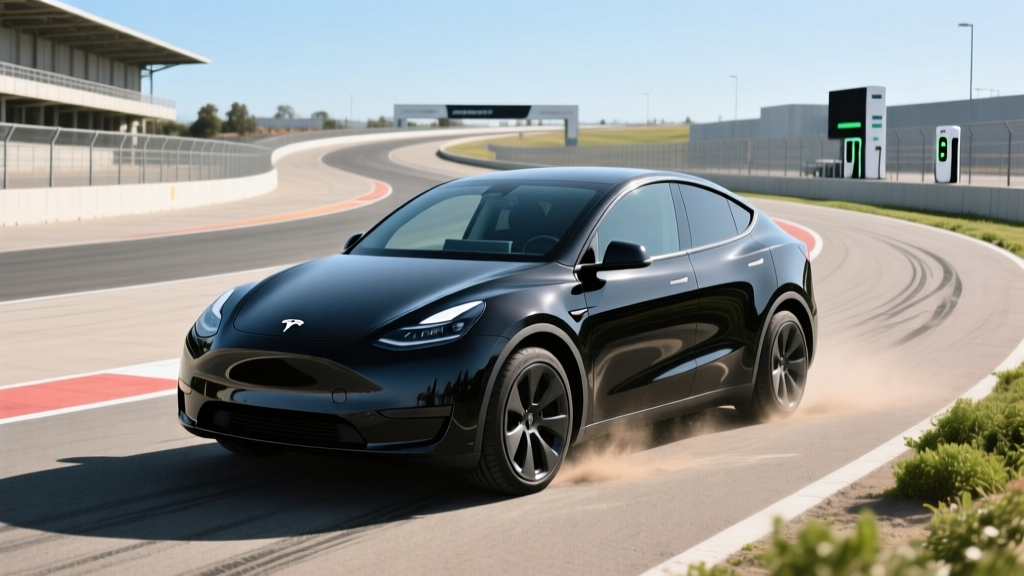
The Tesla Model Y remains the best-selling electric vehicle in the United States for good reason: crossover practicality, access to the Supercharger network, and continuous manufacturing refinements out of Gigafactory Texas and the original Fremont plant. While enthusiasts sometimes search for "tesla fremont test track model y" footage to see how early engineering mules handled validation loops, what matters to buyers in 2026 is how the production Long Range, Performance, and Standard Range variants perform on real roads — in cold weather, on highway loops, and at 250 kW DC fast chargers.
This review covers the current Model Y lineup with the exact numbers you need: EPA range, usable battery kWh, charge-curve behavior, 0-60 times, cargo dimensions, and the IRS §30D tax-credit math that determines your out-of-pocket cost.
Quick Verdict: Who the Model Y Actually Suits
The Model Y Long Range AWD is the sweet spot for two-row families and commuters who want 300+ miles of EPA range, 250 kW peak DC charging, and genuine cargo versatility. The Performance trim trades roughly 20 miles of range for a 3.5-second 0-60 time and track-tuned suspension. The Standard Range RWD lowers the entry price for urban drivers who charge at home nightly and rarely exceed 220 miles between plugs. All three share Tesla's minimalist interior, 15.4-inch touchscreen, and over-the-air update cadence that keeps decade-old hardware feeling current.
Look elsewhere if: You need third-row seating (Kia EV9), luxury materials (Genesis GV70 Electrified), or a physical instrument cluster.
Range, Efficiency, and the Real-World Caveat
EPA range stickers are a starting point, not a promise. The Model Y's efficiency advantage comes from its heat pump (standard across trims), low drag coefficient (~0.23 Cd), and aggressive regenerative braking that enables one-pedal driving in most conditions.
Performance AWD: EPA 295 miles. Expect ~250-265 miles highway; ~220-235 miles in cold weather.
Standard Range RWD: EPA 260 miles. Expect ~225-240 miles highway; ~195-210 miles in cold weather.
| Spec | Long Range AWD | Performance AWD | Standard Range RWD |
|---|---|---|---|
| EPA Range | 320 mi | 295 mi | 260 mi |
| Battery (usable) | ~75 kWh (NMC) | ~75 kWh (NMC) | ~60 kWh (LFP) |
| MPGe (combined) | 122 MPGe | 111 MPGe | 128 MPGe |
| kWh/100 mi | 28 | 30 | 26 |
| 0-60 mph | 4.8 sec | 3.5 sec | 6.5 sec |
| Horsepower | 384 hp | 456 hp | 295 hp |
| Drivetrain | Dual-motor AWD | Dual-motor AWD | Single-motor RWD |
| Tow Rating | 3,500 lb | 3,500 lb | Not rated |
The Long Range and Performance trims use nickel-manganese-cobalt (NMC) cells optimized for energy density and sustained high-speed discharge. The Standard Range RWD uses lithium iron phosphate (LFP) chemistry — heavier but more cycle-durable, and Tesla recommends charging LFP packs to 100% regularly to maintain cell-balancing accuracy. If you commute short distances and charge nightly at home, LFP's longevity advantage is meaningful.
Charging Speed: DC Fast, Level 2, and the Charge Curve
Peak kW is not sustained kW — this is the single most misunderstood EV spec. The Model Y Long Range and Performance can peak at 250 kW on a V3 Supercharger, but the charge curve tapers significantly above 60% state of charge (SoC). LFP packs in the Standard Range accept lower peak rates (~170 kW) due to chemistry and thermal limits.
| Method | Long Range / Perf | Standard Range (LFP) | Miles Added per Hour |
|---|---|---|---|
| DC Fast (V3 Supercharger) | Peak 250 kW; 10-80% ~25 min | Peak ~170 kW; 10-80% ~30 min | ~200 mi/hr at peak |
| DC Fast (V4 Supercharger) | Up to 250 kW (current Y architecture) | ~170 kW | Similar to V3 |
| Level 2 (48A / 11.5 kW) | 11.5 kW onboard | 11.5 kW onboard | ~37 mi/hr |
| Level 2 (32A / 7.7 kW) | 7.7 kW | 7.7 kW | ~25 mi/hr |
| Level 1 (120V / 12A) | ~1.4 kW | ~1.4 kW | ~4-5 mi/hr |
For home charging, a 60-amp circuit with a Tesla Wall Connector (or any J1772/NACS-compatible unit at 48A continuous) delivers roughly 37 miles of range per hour — enough to replenish a full day's driving overnight. If your electrical panel can't support a 60-amp circuit, a 40-amp circuit at 32A still adds ~25 miles per hour, sufficient for most commuters under 80 miles round-trip. Always consult a licensed electrician for final load calculations and permitting.
Preconditioning matters: navigate to a Supercharger in the Tesla nav and the car warms the pack en route, enabling peak charge rates on arrival. Skipping preconditioning in cold weather can cut your peak kW by 30-50%.
Performance and Driving Dynamics
The dual-motor AWD layout provides precise torque vectoring without a mechanical differential. The Performance trim adds a lowered suspension, larger brakes, and 21-inch Überturbine wheels (which reduce range by ~10 miles vs the 19-inch Gemini wheels on Long Range).
Ride quality improved markedly after the 2024 "Juniper" refresh with revised dampers, acoustic glass, and ventilated front seats. The steering remains quick-ratio and heavy at speed, confidence-inspiring on highway sweeps but occasionally twitchy on broken urban pavement. Regenerative braking is strong enough for near-one-pedal driving, though Tesla removed the user-adjustable regen setting — it's always on, always strong.
Interior, Cargo, and Practicality
The cabin is defined by the 15.4-inch center touchscreen that consolidates climate, media, navigation, and vehicle controls. No physical instrument cluster exists; speed and range live in the upper-left corner of the display. Build quality from Fremont and Austin plants now matches mainstream competitors, though panel-gap variance still appears occasionally.
- Front legroom: 41.8 inches
- Rear legroom: 41.6 inches
- Cargo (rear seats up): 30.2 cu ft
- Cargo (rear seats folded): 72.1 cu ft
- Frunk (front trunk): 4.1 cu ft
- Towing: 3,500 lb (AWD trims with tow package)
The rear seat comfortably fits two adults on long trips; a third middle passenger is feasible but cramped. The cargo area swallows a full Costco run or two large suitcases with the parcel shelf removed. The frunk handles charging cables and a small soft bag.
Pricing, Trims, and Federal Tax Credit Eligibility
Model Y pricing has fluctuated repeatedly. As of early 2026, base MSRPs before destination are approximately:
| Trim | Base MSRP | §30D Credit (if eligible) | Effective Price |
|---|---|---|---|
| Standard Range RWD | $44,990 | Up to $7,500 | ~$37,490 |
| Long Range AWD | $48,990 | Up to $7,500 | ~$41,490 |
| Performance AWD | $52,490 | Up to $7,500 | ~$44,990 |
Eligibility for the IRS §30D clean vehicle credit is not automatic. Key 2026 rules include:
- MSRP cap: SUVs/crossovers must be ≤ $80,000 (all Model Y trims qualify).
- Buyer income cap: Modified AGI ≤ $150,000 single / $300,000 joint.
- Battery sourcing: Critical minerals and battery components must meet escalating North American / FTA-partner thresholds — Tesla's U.S. cell production generally satisfies this, but verify at fueleconomy.gov before purchase.
- Point-of-sale transfer: You can transfer the credit to the dealer at purchase, reducing your drive-off price immediately rather than waiting for tax-season refund.
- VIN verification: The dealer must submit the VIN to IRS Energy Credits Online before the sale finalizes.
Because sourcing rules tighten annually, confirm eligibility with your tax professional and the IRS portal before signing. State incentives (California CVRP, Colorado tax credit, etc.) stack on top but vary by jurisdiction — check your state energy office.
Warranty, Safety, and Ownership Costs
Tesla's warranty package is competitive but not class-leading:
- Basic vehicle: 4 years / 50,000 miles
- Battery & drive unit: 8 years / 120,000 miles (Long Range/Performance); 8 years / 100,000 miles (Standard Range)
- Capacity retention threshold: 70% SoH during warranty period
The Model Y holds a 5-star NHTSA overall rating and consistently earns top marks from IIHS. Standard active safety includes automatic emergency braking, lane-keeping assist, and blind-spot monitoring. Autopilot (basic lane-centering + adaptive cruise) is included; Full Self-Driving (Supervised) is a costly add-on that remains SAE Level 2 — you must keep hands on the wheel and eyes on the road at all times.
Insurance premiums for the Model Y run 15-30% higher than comparable gas crossovers due to repair costs and aluminum/cast-body construction. Get a quote before purchasing; Tesla Insurance is available in some states and can be competitive for clean-record drivers.
Pros, Cons, and How It Stacks Up
- Best-in-class Supercharger network reliability (now opening to other brands, but native integration remains superior)
- Class-leading efficiency (kWh/100 mi) translates to lower charging costs
- Over-the-air updates add features years after purchase
- Strong resale value relative to other EVs
- Spacious rear seat and cargo area for the footprint
- No physical controls for climate or volume — everything is on-screen
- FSD (Supervised) is expensive and still requires full driver attention
- Ride quality on 21-inch wheels can be harsh on broken pavement
- No third-row option; growing families may outgrow it
- Panel-gap variance and occasional build-quality quirks persist
Against the Hyundai Ioniq 5, the Model Y offers more range and Supercharger access but a less distinctive interior and no 800V architecture. Against the Ford Mustang Mach-E, the Tesla wins on efficiency and charging infrastructure but loses on steering feel and physical controls. The BMW iX is more luxurious but costs $20,000+ more.
Frequently Asked Questions
What is the real-world range of the Tesla Model Y?
The Long Range AWD EPA-estimates 320 miles; plan for 275-290 miles on a 70 mph highway trip and 240-255 miles in freezing weather. The Standard Range RWD delivers roughly 225-240 miles highway in mild conditions.
How fast does the Model Y charge at home and on the road?
At a V3 Supercharger, Long Range and Performance trims peak at 250 kW, adding 10-80% in roughly 25 minutes. At home on a 48A Level 2 charger, expect ~37 miles of range per hour — a full overnight replenishment for most daily driving.
Does the Model Y qualify for the $7,500 federal EV tax credit?
Most trims do, provided you meet the income cap ($150K single / $300K joint), the MSRP cap ($80K for SUVs — all Model Y trims qualify), and the battery-sourcing requirements. Verify at fueleconomy.gov and consult a tax professional, as rules tighten annually.
Is the Model Y worth buying vs the Ioniq 5 or Mach-E?
If Supercharger reliability, efficiency, and resale value are your priorities, yes. If you prefer physical controls, 800V ultra-fast charging (Ioniq 5), or a more engaging steering feel (Mach-E), test-drive all three before deciding.
What's the biggest drawback of owning a Model Y?
The all-touchscreen interface divides owners — some love the minimalism, others miss physical knobs for climate and volume. Insurance costs also run higher than average, and FSD remains a Level 2 driver-assist despite its name and price.
Is the Fremont-built Model Y different from the Austin-built one?
Functionally, no. Both plants produce to the same spec post-Juniper refresh. Some early Fremont cars had more panel-gap variance, but 2025-2026 build quality has converged. VIN decoding reveals the plant of origin but not a meaningful spec difference for buyers.