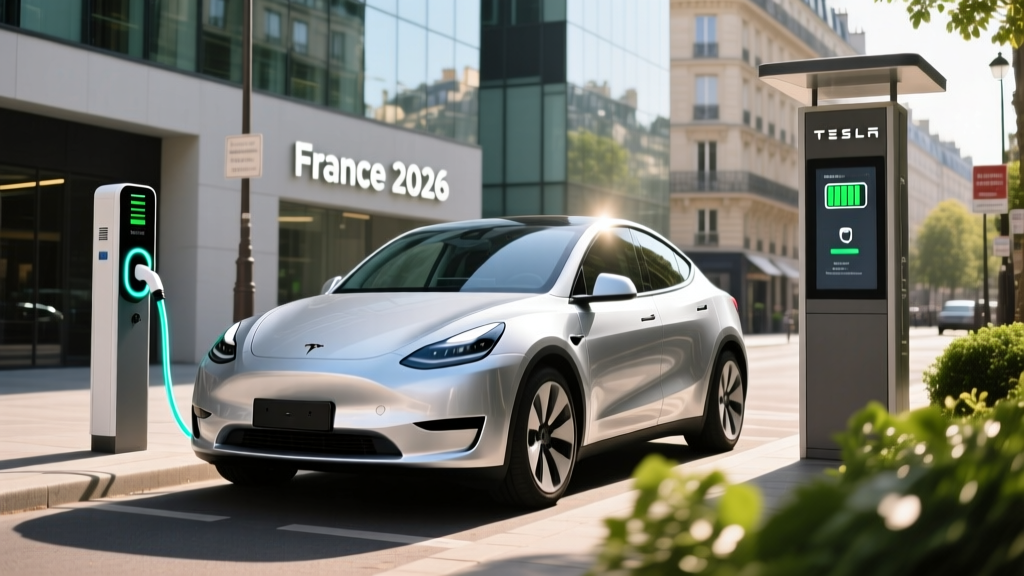
Tesla's dominance in European EV markets has faced headwinds in 2025 and into 2026, with the widely reported Tesla France sales drop reflecting a broader shift in buyer sentiment and competitive pressure from Chinese and legacy European automakers. But market-share statistics don't tell you whether a specific car is right for your driveway. The refreshed 2026 Tesla Model Y (codenamed "Juniper") remains one of the most capable electric SUVs on the market, with improved efficiency, a quieter cabin, and faster charging. This review breaks down exactly what you get for the money, what the real-world range looks like beyond the EPA sticker, and whether the Model Y still deserves your consideration amid the headlines.
2026 Tesla Model Y: Core Specifications at a Glance
| Spec | Long Range AWD | Performance AWD | RWD (Base) |
|---|---|---|---|
| EPA Range | 320 mi | 295 mi | 305 mi |
| Battery (usable) | 75 kWh (NMC) | 75 kWh (NMC) | 60 kWh (LFP) |
| Drivetrain | Dual-Motor AWD | Dual-Motor AWD | Single-Motor RWD |
| Horsepower | 384 hp | 456 hp | 295 hp |
| 0–60 mph | 4.8 sec | 3.5 sec | 6.2 sec |
| Peak DC Charge Rate | 250 kW | 250 kW | 170 kW |
| 10–80% DC Fast Charge | ~22 min | ~22 min | ~28 min |
| Level 2 Home Charge | 11.5 kW (~44 mi/hr) | 11.5 kW (~44 mi/hr) | 11.5 kW (~44 mi/hr) |
| MPGe (combined) | 122 MPGe | 111 MPGe | 125 MPGe |
| Efficiency | 28 kWh/100 mi | 30 kWh/100 mi | 27 kWh/100 mi |
| Cargo (rear seats up) | 30.2 cu ft | 30.2 cu ft | 30.2 cu ft |
| Cargo (rear seats folded) | 72.1 cu ft | 72.1 cu ft | 72.1 cu ft |
| Rear Legroom | 38.4 in | 38.4 in | 38.4 in |
| Base MSRP | $48,990 | $53,990 | $44,990 |
| Battery/Drive Warranty | 8 yr / 120,000 mi | 8 yr / 120,000 mi | 8 yr / 100,000 mi |
Real-World Range: What the EPA Number Doesn't Tell You
Real-World Expectation: ~260–280 mi highway at 70 mph; ~220–240 mi in sub-30°F winter conditions; ~300+ mi city/regen-heavy driving
The 2026 Model Y Long Range AWD carries an EPA-estimated 320 miles of range, a modest bump over the pre-refresh model thanks to improved aerodynamics, a revised heat pump, and slightly higher energy-density NMC cells. On paper, that's competitive with the Hyundai Ioniq 5 (305 mi) and the Ford Mustang Mach-E Extended Range (320 mi).
But EPA testing favors mixed city/highway driving with moderate climate use. In real-world highway testing at sustained 70–75 mph speeds, expect roughly 260–280 miles before needing to stop. Cold weather (below 30°F) compounds this: battery chemistry becomes less efficient and cabin heating draws significant power. Without preconditioning, winter range can drop to 220–240 miles. Tesla's heat pump is among the best in the industry at mitigating this, but physics still applies.
City drivers who lean on regenerative braking can push past the EPA number, sometimes exceeding 300 miles in mild weather. The LFP-equipped RWD model, while rated at 305 miles, is more tolerant of daily 100% charging, which partially offsets its smaller 60 kWh pack.
Charging Speed: DC Fast Charging and Home Setup
| Charging Level | Power | Miles Added per Hour | Notes |
|---|---|---|---|
| Level 1 (120V household) | ~1.4 kW | ~4–5 mi/hr | Emergency/trickle only |
| Level 2 (240V home, 48A) | 11.5 kW | ~44 mi/hr | Full charge in ~7–8 hours |
| DC Fast Charge (Long Range) | Peak 250 kW | ~1,000 mi/hr (peak) | 10–80% in ~22 min; tapers above 80% |
| DC Fast Charge (RWD LFP) | Peak 170 kW | ~700 mi/hr (peak) | 10–80% in ~28 min |
The Long Range and Performance trims peak at 250 kW on V3 Superchargers or equivalent CCS/NACS DC fast chargers. However, peak rate is not sustained rate. The charge curve is aggressive in the 10–40% state-of-charge window, then tapers progressively. By 70%, you're typically pulling 80–100 kW; by 90%, it drops below 40 kW. This is why the 10–80% metric (~22 minutes) is more useful than peak kW alone.
The RWD model's LFP battery charges at a lower 170 kW peak. LFP cells are less charge-rate-tolerant than NMC, but they offer a significant ownership advantage: Tesla recommends you can charge LFP to 100% daily without accelerated degradation. That means a 60 kWh pack at 100% gives you all 305 miles every morning — versus the NMC models where daily charging to 80% nets you roughly 256 usable miles.
For home Level 2 charging, the onboard charger accepts up to 11.5 kW (48 amps on a 60-amp circuit). A Wall Connector or equivalent third-party Level 2 unit on a NACS plug will add roughly 44 miles of range per hour, meaning a full overnight charge is trivial for most commutes. Installation typically runs $800–$2,000 depending on panel capacity and run length — factor in a potential $500–$1,500 panel upgrade if your home has a 100-amp service.
Performance and Driving Dynamics
The 2026 Model Y lineup offers three distinct performance tiers. The base RWD model (295 hp, 0–60 in 6.2 seconds) is more than adequate for commuting and highway merging. The Long Range AWD (384 hp, 4.8 seconds) adds dual-motor traction and confident all-weather capability. The Performance variant (456 hp, 3.5 seconds) is genuinely quick by any standard, rivaling sports sedans at a fraction of the price.
The Juniper refresh brought meaningful improvements to ride quality. Tesla retuned the suspension, added acoustic glass, and improved sound deadening — addressing the most common complaint about the prior generation. The result is a noticeably quieter cabin at highway speeds and less harshness over expansion joints. It still rides firmer than a Toyota bZ4X or a Hyundai Ioniq 5, but the gap has narrowed significantly.
Steering remains precise and well-weighted, and the low center of gravity (battery pack under the floor) keeps body roll minimal. The Model Y is not a luxury SUV in the ride-comfort sense, but it handles better than most compact crossovers.
Pricing, Trim Levels, and Federal Tax Credit Eligibility
| Trim | Base MSRP | Destination | Est. §30D Credit | Effective Price (if eligible) |
|---|---|---|---|---|
| RWD (Base) | $44,990 | $1,390 | Up to $7,500 | ~$38,880 |
| Long Range AWD | $48,990 | $1,390 | Up to $7,500 | ~$42,880 |
| Performance AWD | $53,990 | $1,390 | Up to $7,500 | ~$47,880 |
Under current IRS §30D rules, the Model Y qualifies for up to $7,500 in federal tax credit, which can now be transferred at the point of sale as an immediate price reduction (effective 2024 onward). However, eligibility is not universal. Key requirements per IRS guidelines:
- MSRP Cap: SUVs must have an MSRP at or below $80,000. All Model Y trims clear this.
- Buyer Income Cap: Modified adjusted gross income must not exceed $150,000 (single), $225,000 (head of household), or $300,000 (joint). If you exceed these, you lose the credit entirely.
- Battery Sourcing: The $7,500 is split into two halves — $3,750 for critical-minerals sourcing and $3,750 for battery-component manufacturing. Tesla's U.S.-built battery packs and evolving supply chain have generally allowed the Model Y to qualify for the full amount, but sourcing rules tighten annually. Confirm current-year eligibility on the IRS site or with your tax professional before purchase.
As-tested pricing climbs quickly with options. The common additions — FSD (Supervised) at $8,000, premium paint colors at $1,500–$2,500, and 20-inch wheels at $2,000 — can push a Long Range into the mid-$50,000s before credit. Full Self-Driving (Supervised) remains a Level 2 driver-assist system requiring continuous driver attention; it is not autonomous driving. Evaluate whether the feature justifies its cost for your use case.
Interior, Cargo, and Technology
The 2026 Juniper interior is a significant step up from the pre-2025 Model Y. Tesla added ventilated front seats, ambient lighting, a rear-seat touchscreen for climate and entertainment, and power-folding second-row seats. Material quality still leans minimalist — there's no traditional instrument cluster, and all controls route through the 15.4-inch center touchscreen — but fit and finish have improved.
Cargo space remains a strong suit: 30.2 cubic feet behind the second row and 72.1 cubic feet with seats folded. The front trunk (frunk) adds roughly 4.1 cubic feet for charging cables or a small bag. Rear legroom at 38.4 inches is adequate for adults on longer trips, though the sloping roofline cuts into headroom for passengers over 6 feet.
On the tech front, Tesla's infotainment remains the industry benchmark for responsiveness and over-the-air update frequency. Navigation integrates Supercharger routing with battery preconditioning — the car warms the battery en route to a fast charger, optimizing charge speed on arrival. The Tesla app is reliable for remote climate control, charge monitoring, and location. Drawbacks include the lack of Apple CarPlay/Android Auto (Tesla uses its own ecosystem exclusively) and the reliance on touchscreen-only controls for features like windshield wiper speed and mirror adjustment, which some drivers find distracting.
Pros and Cons
Pros
- Class-leading Supercharger network access (17,000+ U.S. stations)
- Excellent efficiency: 27–30 kWh/100 mi depending on trim
- 250 kW peak DC fast charging (Long Range/Performance)
- Strong cargo capacity (72.1 cu ft max) with practical frunk
- Frequent OTA updates add features post-purchase
- LFP RWD model allows daily 100% charging without degradation concern
- Improved Juniper ride comfort and cabin quietness
Cons
- No Apple CarPlay or Android Auto
- Touchscreen-only controls frustrate some drivers
- Rear headroom limited by coupe-like roofline
- FSD (Supervised) is expensive ($8,000) and still Level 2 — not autonomous
- Insurance costs run 15–25% higher than comparable ICE SUVs
- Service center wait times can be long in some metro areas
- Brand controversy has affected resale values in some markets
Who Should Buy the 2026 Tesla Model Y?
Commuters (30–80 miles/day round trip): Any trim works well. The RWD LFP model is the value pick — charge to 100% nightly, never worry about degradation, and enjoy the lowest entry price.
Families needing cargo space: The Long Range AWD is the sweet spot. Dual-motor traction for all-weather school runs, 320 miles of EPA range for weekend trips, and 72.1 cu ft of cargo for strollers, groceries, and luggage.
Road trippers: The Supercharger network remains the most reliable and extensive DC fast-charging ecosystem in North America. 250 kW peak charging and battery preconditioning make 300-mile legs manageable with 20–25 minute stops.
Buyers in cold climates: AWD trims with the heat pump are strongly recommended. Expect 220–240 miles of real winter range on the Long Range; preconditioning while plugged in is essential to preserve range and charge speed.
Buyers considering competitors: The Hyundai Ioniq 5 offers comparable range, 800V charging architecture (10–80% in ~18 min), and CarPlay. The Ford Mustang Mach-E is slightly larger and offers a more traditional interior layout. The Model Y's advantages remain the Supercharger network, software ecosystem, and efficiency. If those matter to you, the sales-drop headlines shouldn't deter a purchase — if they don't, the competition has closed the gap.
Frequently Asked Questions
What is the real-world range of the 2026 Tesla Model Y?
The EPA rates the Long Range AWD at 320 miles. Real-world highway driving at 70 mph yields approximately 260–280 miles. In cold weather (below 30°F), expect 220–240 miles. City driving with regenerative braking can exceed 300 miles in mild conditions.
How fast does the Model Y charge at home and on DC fast chargers?
At home on a 240V Level 2 charger (48A/11.5 kW), the Model Y adds roughly 44 miles of range per hour, completing a full charge in 7–8 hours. On a V3 Supercharger or equivalent 250 kW DC fast charger, the Long Range model charges from 10–80% in approximately 22 minutes, though the rate tapers significantly above 80%.
How much does the 2026 Model Y cost after the federal tax credit?
The base RWD starts at $44,990 + $1,390 destination. With the full $7,500 §30D credit (if you meet income and sourcing requirements), the effective price drops to roughly $38,880. The Long Range AWD comes to approximately $42,880 after credit. Always confirm current-year eligibility on irs.gov before purchasing.
Does the Model Y qualify for the federal EV tax credit?
Yes, the Model Y currently qualifies for up to $7,500 under IRS §30D, transferable at point of sale. Eligibility requires the buyer's MAGI to fall under $150K (single) / $300K (joint), and the vehicle must meet battery-sourcing requirements that tighten each year. All Model Y trims fall under the $80,000 SUV MSRP cap. Confirm eligibility with a tax professional.
Is the 2026 Model Y worth buying vs. competitors like the Ioniq 5 or Mach-E?
The Model Y remains the efficiency and charging-network leader. Its 27–30 kWh/100 mi consumption and Supercharger access are hard to match. However, the Hyundai Ioniq 5 charges faster (800V architecture, ~18 min 10–80%), includes CarPlay, and offers a more comfortable ride. The Mach-E provides more interior space and a traditional cockpit. If charging infrastructure and software integration are top priorities, the Model Y wins. If ride comfort, CarPlay, or interior layout matter more, test-drive the alternatives.
What are the biggest drawbacks of the 2026 Model Y?
The most common complaints: no Apple CarPlay/Android Auto, touchscreen-only controls (no physical buttons for climate or mirrors), higher insurance premiums (15–25% above comparable ICE SUVs), limited rear headroom due to the roofline, and FSD (Supervised) at $8,000 for a Level 2 system that still requires full driver attention. Service center availability can also be a concern depending on your metro area.
Sources: fueleconomy.gov (EPA range and efficiency data), IRS §30D Clean Vehicle Credit guidelines, Tesla official specifications. Real-world range estimates based on independent testing and owner-reported data. All pricing reflects 2026 model-year MSRP and is subject to change. Tax credit eligibility depends on individual circumstances and current-year sourcing rules — consult a tax professional.