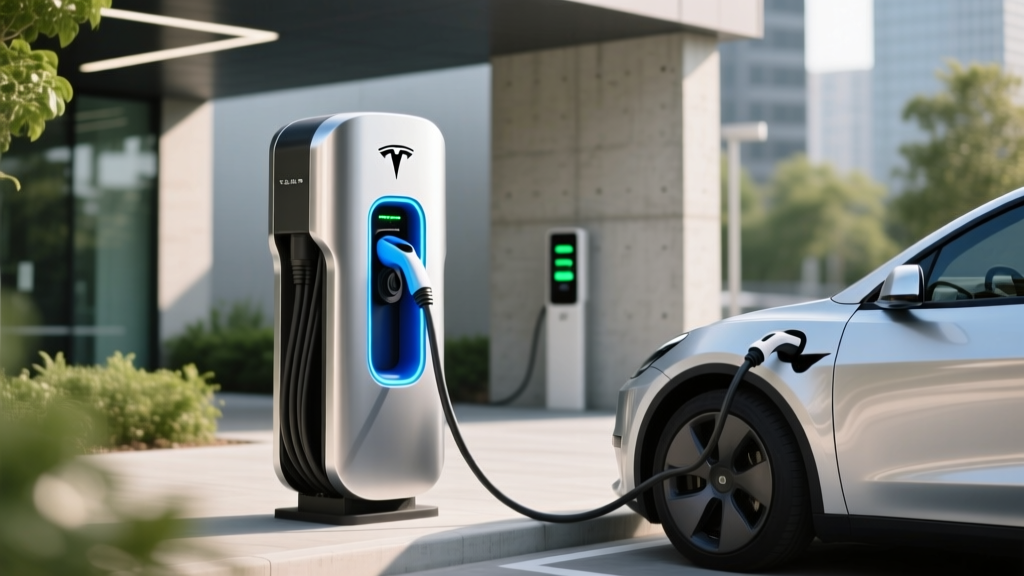
The Tesla folding V4 Supercharger represents the company's most modular public charging architecture to date — a cabinet-and-dispenser design that separates power electronics from the charge post, enabling flexible deployment in tight urban lots and remote highway corridors alike. For EV owners, the V4 matters less for its internal engineering and more for what it delivers at the plug: up to 350 kW peak DC fast charging via NACS, CCS1 compatibility through the Magic Dock adapter, and a redesigned cable management system that folds away when not in use.
But public fast-charging is only half the equation. Most EV owners do 80% or more of their charging at home. Understanding how the V4's public speeds compare to what you can install in your garage — and what that installation actually costs — is essential for building a complete charging strategy. This guide covers the V4's specs, the full spectrum of EV charging levels, home installation economics, and the equipment that gets you closest to public-charger convenience at a fraction of the per-session cost.
What the Tesla Folding V4 Supercharger Actually Is
The V4 Supercharger is not a single monolithic unit. It's a system composed of a centralized power cabinet (housing the AC-to-DC rectifiers and power conversion electronics) connected to one or more slender charge posts — the "folding" dispenser units that drivers interact with. By offloading the heavy power electronics to a ground-level cabinet, Tesla reduces the footprint of each charge post, simplifies maintenance (swap a cabinet module without touching the post), and allows sites to scale from two to eight-plus stalls without trenching new high-voltage runs for each one.
Key V4 specifications as deployed through early 2026:
- Peak DC output: Up to 350 kW per stall (vehicle-dependent; most current Teslas peak around 250–325 kW on V4 hardware)
- Voltage architecture support: Up to 1,000V DC — future-proofed for 800V+ battery platforms like the Cybertruck and next-gen vehicles
- Connector: Native NACS (North American Charging Standard) with CCS1 support via integrated Magic Dock adapter at select locations
- Cable length: Approximately 9.8 feet (3.0 m), with a folding retraction mechanism that keeps the cable off the ground
- Payment: Plug-and-charge for Teslas; non-Tesla EVs use the Tesla app for authentication and billing
The "folding" designation refers to the cable management system, not the post itself. A spring-loaded retraction mechanism pulls the cable upward into a compact loop when disconnected, reducing trip hazards and keeping the connector clean — a practical improvement over the drooping cables of V3 stalls.
The Three Charging Levels: Speed, Power, and Real-World Range Added
Every EV owner needs to understand the three charging tiers. The distinction between kW (kilowatts) — the rate of power flow, like water pressure from a hose — and kWh (kilowatt-hours) — the total energy delivered, like gallons in a bucket — is the single most important piece of EV literacy. A charger's kW rating tells you how fast it can push energy; your battery's kWh capacity tells you how much it holds.
| Level | Power Source | Typical kW Output | Miles of Range Added Per Hour | Best Use Case |
|---|---|---|---|---|
| Level 1 | 120V AC household outlet | 1.0–1.9 kW | 3–5 miles | Overnight top-ups for PHEVs or low-mileage commuters |
| Level 2 | 240V AC (dryer-style circuit) | 3.3–19.2 kW | 12–75 miles | Daily home charging; the practical standard for BEVs |
| DC Fast Charging | 480V+ DC (public stations) | 50–350 kW | 150–1,000+ miles/hr (peak) | Road trips and rapid top-ups; not for daily use |
A critical nuance: DC fast chargers deliver their peak kW only within a specific state-of-charge window, typically 10–50% SoC. As the battery fills, the charge rate tapers to protect cell health. A 350 kW V4 Supercharger might push 325 kW at 15% SoC but drop to 80 kW by 75% SoC. This is why manufacturers and testers quote 10–80% charge times rather than peak kW alone.
- 75 kWh battery (e.g., Tesla Model Y Long Range): ~18–22 minutes on a 250 kW V3 Supercharger; ~15–18 minutes on a V4 at full output
- 84 kWh battery (e.g., Hyundai Ioniq 5, 800V architecture): ~18 minutes on a 350 kW Electrify America or V4 station
- 100 kWh battery (e.g., Ford F-150 Lightning Extended Range): ~30–35 minutes on 150 kW DC; ~25 minutes on 250+ kW
- 40 kWh battery (e.g., PHEV like Toyota RAV4 Prime): ~15–20 minutes on DC fast (if equipped), but most PHEVs lack DC fast capability
Connector Compatibility: NACS, CCS1, and CHAdeMO in 2026
The connector landscape has consolidated dramatically since 2023. Tesla's NACS (North American Charging Standard) has been adopted by Ford, GM, Rivian, Hyundai, Kia, BMW, and most other major automakers for their North American vehicles starting with the 2025 model year. CCS1 (Combined Charging System) remains on many 2023–2024 vehicles still on the road, and CHAdeMO is effectively legacy — found on the Nissan Leaf and Mitsubishi Outlander PHEV but not adopted for new models.
| Connector | Brands Using It (2026 MY) | Adapter Needed for V4 Supercharger? |
|---|---|---|
| NACS (native) | Tesla (all), Ford, GM, Rivian, Hyundai, Kia, BMW, Mercedes, Volvo, Polestar | No — plug directly into V4 |
| CCS1 | Legacy 2023–2024 models (VW ID.4 early builds, some Ford/GM pre-switch) | Yes — CCS-to-NACS adapter (provided by automaker or aftermarket, ~$150–$250) |
| CHAdeMO | Nissan Leaf (legacy), Mitsubishi Outlander PHEV | Not compatible with Supercharger network; use CHAdeMO public stations |
The Tesla V4 Supercharger's integrated Magic Dock — a built-in CCS1 adapter housed within the connector holster — allows CCS1-equipped non-Tesla EVs to charge without carrying a separate adapter. However, Magic Dock availability varies by station. If you drive a CCS1 vehicle and plan to rely on Superchargers, carry a certified CCS-to-NACS adapter (such as the Tesla CCS Adapter or a Lectron/Freewire equivalent) as a backup.
Home EV Charger Installation: Costs, Electrical Requirements, and Gotchas
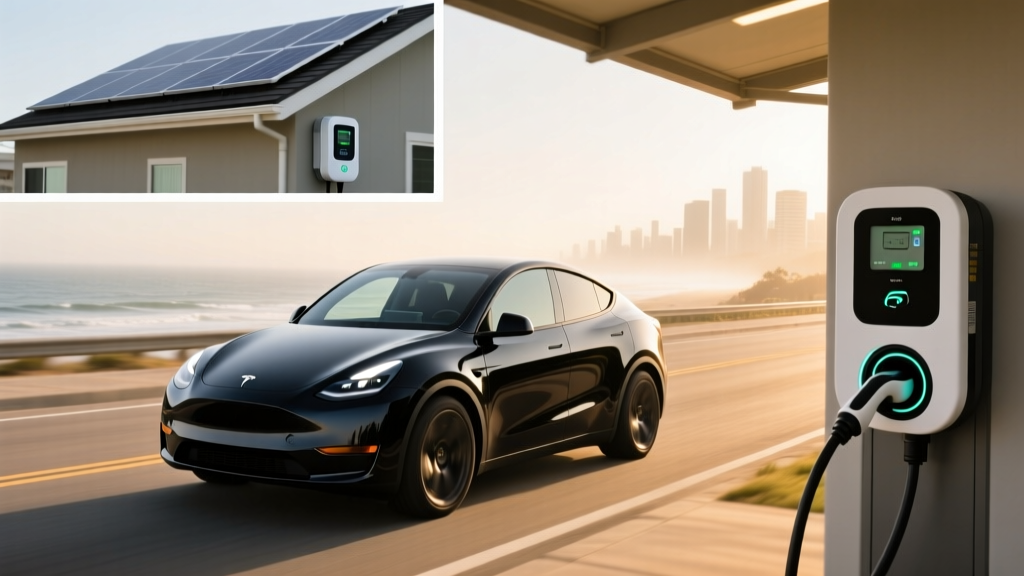
Installing a Level 2 home charger is the single highest-impact upgrade an EV owner can make. A properly installed Level 2 station replenishes 200–300 miles of range overnight — more than enough for any daily driving pattern — and costs roughly $0.04–$0.06 per mile in electricity, versus $0.12–$0.16 per mile for gasoline at current prices.
Electrical Requirements for Level 2 Home Charging
Level 2 charging requires a 240-volt AC circuit — the same type that powers an electric dryer or oven. The most common residential configurations:
- 240V / 40A circuit → delivers up to 9.6 kW (most common, sufficient for overnight charging of any BEV)
- 240V / 48A circuit → delivers up to 11.5 kW (ideal for larger batteries like the F-150 Lightning or Rivian R1T)
- 240V / 60A circuit → delivers up to 14.4 kW (requires hardwired charger; maximum residential single-circuit Level 2)
National Electrical Code (NEC) requires that continuous loads (including EV charging) not exceed 80% of a circuit's rated amperage. A 40A circuit therefore supports a maximum continuous draw of 32A (7.7 kW). This is why a "40-amp charger" actually needs a 50-amp breaker.
Installation Cost Breakdown
| Component | Budget Install | Typical Install | Complex Install |
|---|---|---|---|
| Level 2 charger equipment | $250–$400 | $400–$700 | $500–$800 |
| Electrician labor (2–6 hrs) | $300–$600 | $600–$1,500 | $1,500–$3,000 |
| Electrical permit | $50–$150 | $100–$250 | $100–$300 |
| Panel upgrade (if needed) | $0 (not needed) | $0–$500 (minor) | $2,000–$5,000 (full 200A service upgrade) |
| Total | $600–$1,150 | $1,100–$2,950 | $4,100–$9,100 |
The panel upgrade is the wildcard. Homes built before 2000 often have 100-amp or 150-amp electrical service. Adding a 40A or 48A EV circuit to an already-loaded 100A panel can exceed the panel's capacity, triggering a mandatory upgrade to 200A service — a $2,000–$5,000 job on its own. A licensed electrician will perform a load calculation during the site assessment to determine whether an upgrade is necessary. Do not skip this step: overloading a panel is a fire hazard and will fail inspection.
Some homeowners can offset installation costs through utility rebates (many utilities offer $250–$1,000 for EV charger installs) or the federal Residential Clean Energy Credit, which covers 30% of qualified equipment and installation costs up to $1,000 annually through 2032. Check IRS.gov and your local utility for current eligibility.
Cost to Charge: Home vs. Public DC Fast vs. Gasoline
Charging economics vary enormously depending on where and when you plug in. The following table models real-world cost-per-mile for a typical mid-size EV (3.5 miles per kWh efficiency, like a Tesla Model Y or Hyundai Ioniq 6) compared to a 28-MPG gasoline crossover.
| Charging Scenario | Rate ($/kWh) | Cost Per Mile | Annual Cost (12,000 mi) |
|---|---|---|---|
| Home, off-peak utility rate | $0.08–$0.12 | $0.025–$0.034 | $300–$410 |
| Home, standard utility rate | $0.14–$0.18 | $0.040–$0.051 | $480–$620 |
| Public Level 2 (ChargePoint, EVgo L2) | $0.20–$0.35 | $0.057–$0.100 | $685–$1,200 |
| DC Fast Charging (Tesla Supercharger V3/V4) | $0.28–$0.48 | $0.080–$0.137 | $960–$1,645 |
| DC Fast Charging (Electrify America, EVgo DC) | $0.35–$0.58 | $0.100–$0.166 | $1,200–$1,990 |
| Gasoline (28 MPG, $3.50/gal) | — | $0.125 | $1,500 |
The takeaway: home charging on off-peak rates is 3–5× cheaper per mile than gasoline. Even the most expensive public DC fast charging is roughly comparable to gasoline on a per-mile basis — and most EV owners fast-charge only on road trips, keeping their blended average well below gas costs. A driver who charges 85% at home (off-peak) and 15% on Superchargers would pay roughly $450–$550 annually for 12,000 miles of driving.
Level 2 Home Charger Equipment: What to Buy in 2026
The home charger market has matured significantly. The best units in 2026 offer Wi-Fi-connected smart features (scheduling, energy monitoring, utility demand-response integration), robust build quality rated for outdoor use, and adjustable amperage to match your circuit. Here are the top picks based on power output, connector options, cable length, and real-world reliability:
Tesla Wall Connector (Gen 4)
- Power: Up to 11.5 kW (48A on a 60A circuit)
- Connector: Native NACS; includes J1772 adapter for non-Tesla EVs
- Cable: 24 feet
- Smart features: Wi-Fi, OTA updates, load sharing between multiple units, Tesla app integration
- Price: ~$475
- Best for: Tesla owners or households with NACS-equipped vehicles
ChargePoint Home Flex
- Power: Up to 12 kW (50A on a 60A circuit, adjustable down to 16A)
- Connector: J1772 (NACS adapter included with most 2025+ EVs) or optional NACS pigtail
- Cable: 23 feet
- Smart features: Wi-Fi, Alexa/Google Home, ChargePoint app scheduling, utility integration
- Price: ~$550–$650
- Best for: Multi-EV households with mixed connector needs
Emporia Vue Level 2 Charger
- Power: Up to 11.5 kW (48A on a 60A circuit)
- Connector: J1772 or NACS (select at purchase)
- Cable: 24 feet
- Smart features: Wi-Fi, energy monitoring via Emporia Vue panel integration, solar-aware charging
- Price: ~$350–$400
- Best for: Budget-conscious buyers; solar-panel households
Grizzl-E Smart
- Power: Up to 10 kW (40A on a 50A circuit)
- Connector: J1772 or NACS
- Cable: 24 feet
- Smart features: OCPP-compatible, works with multiple apps, adjustable amperage via DIP switch
- Price: ~$450–$550
- Best for: Cold-climate durability (rated to -40°F); commercial/multi-unit dwellings
All of the above chargers are NEMA 4 or NEMA 4X rated for outdoor installation and carry at minimum a 3-year warranty. For most BEV owners with a 75–100 kWh battery, a 40A or 48A unit on a dedicated 50A or 60A circuit provides a full overnight recharge from 20% to 100% in 6–9 hours — well within a typical overnight window.
Safety, Electrical Code, and Installation Best Practices
EV charging is a high-draw, long-duration electrical load. Cutting corners on installation creates fire risk and insurance liability. Key safety requirements:
- Dedicated circuit: Your Level 2 charger must be on its own dedicated breaker — not shared with other appliances. A 40A or 50A circuit is standard.
- GFCI protection: NEC 2020 and later require ground-fault circuit interrupter protection for outdoor receptacles used for EV charging. Hardwired chargers have built-in GFCI; plug-in units require a GFCI breaker.
- Outdoor rating: If the charger is installed outdoors (garage exterior, carport, driveway), the unit must carry a NEMA 4 (weatherproof) rating. All recommended units above meet this standard.
- Permit and inspection: Virtually all jurisdictions require an electrical permit for a new 240V circuit. The installation must pass inspection before use. Your electrician will pull the permit — do not accept an unpermitted "cash deal" install, as it voids home insurance coverage for related incidents.
- Wire gauge: A 50A circuit requires minimum 6 AWG copper wire; a 60A circuit requires 4 AWG. Undersized wire is a fire hazard and will fail inspection.
Frequently Asked Questions
How much does it cost to install a home EV charger?
A straightforward Level 2 installation — where your electrical panel has sufficient capacity and the charger is within 20–30 feet of the panel — typically costs $1,100–$2,500 including equipment, electrician labor, and permit. If your home needs a panel upgrade from 100A to 200A service, add $2,000–$5,000. Utility rebates and the federal Residential Clean Energy Credit (30% of install cost, up to $1,000) can reduce out-of-pocket expense significantly.
How fast will each charging level add range?
Level 1 (120V) adds 3–5 miles of range per hour — adequate for PHEVs with small batteries but impractical for full BEVs. Level 2 (240V) adds 12–75 miles per hour depending on amperage and vehicle acceptance rate; a 48A/11.5 kW setup adds roughly 40–45 miles per hour for a typical mid-size EV. DC fast charging (50–350 kW) can add 150–1,000+ miles per hour at peak output, but tapering above 50–60% SoC means real-world sessions deliver 150–250 miles in a 20–30 minute stop.
Which connector and charger is compatible with my EV?
If you own a 2025 or 2026 model-year EV from Tesla, Ford, GM, Rivian, Hyundai, Kia, or most other major brands, your vehicle uses NACS. For home charging, a NACS-equipped Level 2 charger (like the Tesla Wall Connector) plugs in directly. If your EV is a 2023–2024 model with CCS1, you'll need a CCS-to-NACS adapter for Supercharger access, and a J1772 or CCS1 home charger (or use the adapter your automaker provided). CHAdeMO vehicles (Nissan Leaf) cannot use Superchargers and should rely on Electrify America or EVgo CHAdeMO stalls for public DC charging.
How much does charging cost per mile vs. gas?
Home charging on off-peak utility rates costs roughly $0.03–$0.05 per mile for a typical EV — about one-quarter to one-third the cost of gasoline at $3.50/gallon in a 28-MPG vehicle ($0.125/mile). Even public DC fast charging at $0.35–$0.48/kWh costs $0.08–$0.14 per mile, roughly on par with or cheaper than gasoline. Over 12,000 miles annually, a home-charging EV owner saves $900–$1,200 versus gas.
What electrical upgrades might I need?
The most common upgrade is a panel capacity increase. If your home has a 100A or 150A electrical panel that's already heavily loaded (central AC, electric range, dryer, water heater), adding a 40–60A EV circuit may exceed your panel's capacity. A licensed electrician will perform a NEC Article 220 load calculation. If an upgrade is needed, expect a 200A service upgrade to cost $2,000–$5,000. In some cases, a smart panel or load-management device (like the Emporia VUE with smart breaker) can avoid a full upgrade by dynamically limiting EV charge rate when other appliances draw heavy current.