Do Tesla Flying Cars Actually Exist in 2026?
If you've been searching for Tesla flying cars, you're not alone — the phrase pulls thousands of searches a month, fueled by Elon Musk's occasional teases about hover-mode Roadsters and SpaceX thruster packages. But let's cut through the noise with real engineering data.
As of the 2026 model year, Tesla does not sell a flying car. No production Tesla vehicle — not the Model S, Model X, Model 3, Model Y, Cybertruck, nor the long-delayed next-generation Roadster — has any vertical-lift, VTOL, or flight capability. Tesla's entire lineup consists of ground-based battery electric vehicles (BEVs) with wheels, tires, and conventional suspension.
What does exist is a lineup of high-performance EVs that feel futuristic in acceleration, software, and driver-assistance tech. Below, we break down the real specs, range, charging, pricing, and ownership economics of the Teslas that most closely match the "sci-fi supercar" expectation — the 2026 Model S, 2026 Model X, and the announced next-gen Roadster — so you know exactly what's buyable today and what remains vaporware.
2026 Tesla Model S: The Closest Thing to a Ground-Level Supercar
The Model S remains Tesla's flagship sedan and one of the quickest production cars on the planet. Here's what the numbers look like for the current model year.
| Spec | Long Range (AWD) | Plaid (Tri-Motor AWD) |
|---|---|---|
| EPA Range | 402 miles | 396 miles |
| Battery (usable) | ~100 kWh (NMC) | ~100 kWh (NMC) |
| Horsepower | 670 hp | 1,020 hp |
| 0–60 mph | 3.1 sec | 1.99 sec |
| Drivetrain | Dual-Motor AWD | Tri-Motor AWD |
| Max DC Fast Charge | 250 kW | 250 kW |
| 10–80% DC Time | ~30 min | ~30 min |
| Level 2 Home Charge | 11.5 kW (~44 mi/hr) | 11.5 kW (~44 mi/hr) |
| MPGe (combined) | 120 MPGe | 116 MPGe |
| Efficiency | 28 kWh/100 mi | 29 kWh/100 mi |
| Cargo Volume | 28 cu ft (rear + frunk) | 28 cu ft (rear + frunk) |
| Base MSRP | $74,990 | $89,990 |
Charging Speed: What the Curve Actually Looks Like
The Model S peaks at 250 kW on a V3 Tesla Supercharger, but that peak only sustains roughly from 10–30% State of Charge (SoC). After that, the charge curve tapers progressively: expect ~150 kW through the mid-50s, then a steep drop-off above 80%. A full 10–80% session takes approximately 30 minutes under ideal battery-preconditioned conditions.
At home on a Level 2 wall connector (11.5 kW / 48A), the Model S adds about 44 miles of range per hour, meaning an overnight 10-hour session replenishes roughly 440 miles — more than enough for most daily driving and commuter needs.
2026 Tesla Model X: The Sci-Fi SUV With Falcon Wing Doors
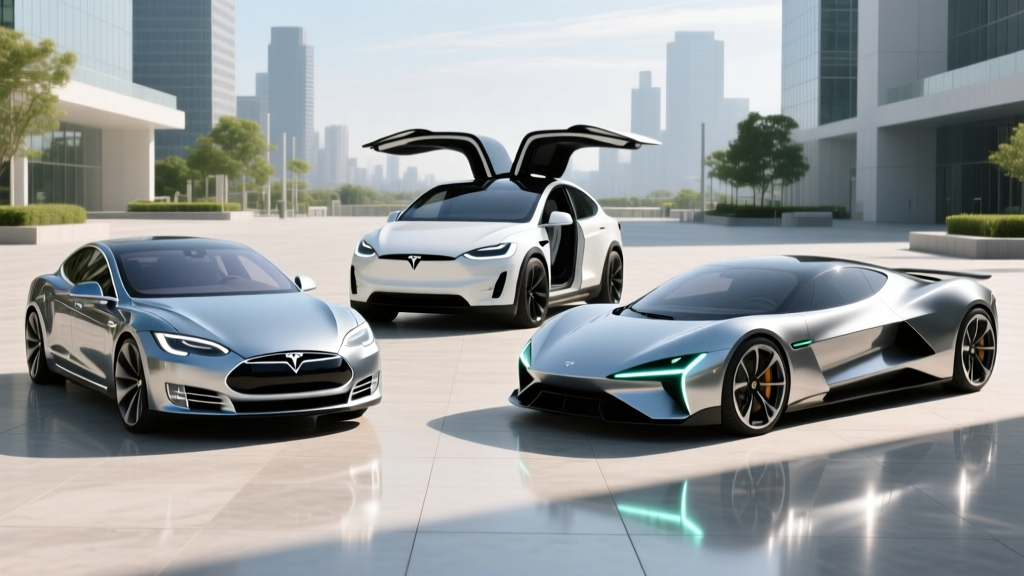
If any Tesla looks like it should fly, it's the Model X — its rear Falcon Wing doors open upward like wings. But make no mistake: this is a ground-bound, three-row electric SUV.
| Spec | Long Range (AWD) | Plaid (Tri-Motor AWD) |
|---|---|---|
| EPA Range | 335 miles | 320 miles |
| Battery (usable) | ~100 kWh (NMC) | ~100 kWh (NMC) |
| Horsepower | 670 hp | 1,020 hp |
| 0–60 mph | 3.8 sec | 2.5 sec |
| Drivetrain | Dual-Motor AWD | Tri-Motor AWD |
| Max DC Fast Charge | 250 kW | 250 kW |
| 10–80% DC Time | ~32 min | ~32 min |
| Level 2 Home Charge | 11.5 kW (~38 mi/hr) | 11.5 kW (~38 mi/hr) |
| MPGe (combined) | 102 MPGe | 98 MPGe |
| Cargo Volume | 88 cu ft (max, seats folded) | 88 cu ft (max, seats folded) |
| Seating | 5, 6, or 7 passengers | 5, 6, or 7 passengers |
| Towing Capacity | 5,000 lbs | 5,000 lbs |
| Base MSRP | $79,990 | $94,990 |
The Tesla Roadster: Announced, Not Available
The next-generation Tesla Roadster was first announced in November 2017 with jaw-dropping claims: a 0–60 mph time of 1.9 seconds, 620 miles of range, and an optional SpaceX cold-gas thruster package that Musk suggested could enable brief "hover" moments above the ground.
As of 2026, the Roadster is not in production and is not available for purchase. Tesla has repeatedly delayed the vehicle, and no firm delivery date has been confirmed. All published specifications remain preliminary and subject to change.
| Spec | Claimed (Unverified) |
|---|---|
| EPA Range | ~620 miles (claimed) |
| Battery | ~200 kWh (claimed, NMC) |
| 0–60 mph | 1.9 sec (claimed) |
| Top Speed | 250+ mph (claimed) |
| Drivetrain | Tri-Motor AWD |
| Base MSRP | $200,000 (announced) |
| Availability | TBD — not in production |
Even if the Roadster ships with the SpaceX thruster option, this would not constitute a "flying car" in any aviation sense. Cold-gas thrusters could theoretically provide brief lift for dramatic launches or cornering assist, but sustained flight is not part of the engineering plan. The Roadster, if it arrives, will be a ground-based hypercar.
Federal Tax Credit: Do These Teslas Qualify?
Under IRS §30D rules for the 2026 tax year, the federal EV tax credit offers up to $7,500 for qualifying new EVs — but eligibility depends on several strict requirements:
- MSRP Cap: Sedans (Model S) must have an MSRP ≤ $55,000. SUVs/pickups/vans (Model X) must be ≤ $80,000. Neither the Model S nor Model X Long Range currently qualifies at their base MSRPs under these caps.
- Buyer Income Cap: Modified AGI must not exceed $300,000 (joint), $225,000 (head of household), or $150,000 (single).
- Battery Sourcing: A percentage of critical minerals and battery components must be sourced from the U.S. or FTA-partner countries. Tesla's supply chain compliance varies by build date — verify the VIN-specific eligibility at fueleconomy.gov.
- Point-of-Sale Transfer: Eligible buyers can transfer the credit to the dealer for an instant price reduction at purchase.
Bottom line: At MSRPs of $74,990–$94,990, the Model S and Model X exceed the §30D MSRP caps for their respective vehicle classes. As of 2026, neither model qualifies for the federal purchase credit. Always confirm current eligibility at IRS.gov, as rules can shift with new Treasury guidance.
Tesla's Driver-Assistance Tech: Not Self-Driving
Tesla equips all current vehicles with Autopilot (standard) and offers Full Self-Driving (Supervised) as a $8,000 add-on or $99/month subscription. Despite the branding, both systems are classified as SAE Level 2 driver-assistance — meaning the driver must remain fully attentive, with hands on or near the wheel, at all times.
- Drive without an attentive, licensed driver in the seat
- Reliably handle construction zones, unmapped roads, or severe weather
- Replace human judgment in complex traffic scenarios
- Operate as a robotaxi — you cannot summon the car driverless to your location (Tesla's "Robotaxi" service remains announced, not launched as of 2026)
Who Should Buy a Tesla Model S or Model X?
Choose the Model S if:
- You want the quickest sedan available (Plaid: 1.99 sec 0–60)
- You need 350+ real-world miles for road trips with Supercharger access
- You value over-the-air software updates and a minimalist tech-forward interior
- Budget allows $75K–$95K without expecting a federal tax credit
Choose the Model X if:
- You need three-row seating (up to 7 passengers) with EV powertrain
- Falcon Wing doors appeal to you and you have garage/parking clearance for them
- You tow occasionally (5,000-lb capacity)
- You accept 260–285 real-world highway miles between charges
Look elsewhere if:
- You need a sub-$50K EV that qualifies for the $7,500 federal credit (consider the Model 3 or Model Y, or competitors like the Hyundai Ioniq 5 or Chevrolet Equinox EV)
- You want Level 4 autonomous driving — no consumer Tesla offers this
- You're waiting for a literal flying car — that technology does not exist from any automaker in 2026
Model S and Model X: Pros and Cons
Pros
- Class-leading acceleration (Plaid variants especially)
- Access to Tesla's Supercharger network — 60,000+ stalls globally, high uptime
- Over-the-air updates continuously add features
- Strong resale value relative to luxury EV competitors
- Model X offers unique Falcon Wing doors and 7-seat EV option
- Low running costs vs. gas equivalents (~$0.04–$0.06/mi on home charging)
Cons
- Neither model qualifies for the $7,500 federal EV tax credit at current MSRPs
- Model S/X interior build quality inconsistent at this price point
- Model X Falcon Wing doors can be problematic in tight garages or rain
- No Apple CarPlay or Android Auto — Tesla's proprietary infotainment only
- FSD (Supervised) costs $8,000 and remains Level 2 — not autonomous
- Insurance premiums run 20–40% higher than comparable gas sedans/SUVs
- 250 kW max DC charge rate trails newer 800V competitors (Hyundai Ioniq 5 at 350 kW peak)
Battery Warranty and Long-Term Ownership
Tesla covers the Model S and Model X battery and drive unit with an 8-year / 150,000-mile warranty (whichever comes first), with a guaranteed minimum 70% capacity retention over that period. The NMC (nickel manganese cobalt) chemistry used in both models offers high energy density but is somewhat more prone to calendar degradation than LFP (lithium iron phosphate) cells found in the base Model 3.
Real-world data from Tesla's impact reports and third-party fleet analyses suggest Model S/X batteries lose approximately 10–12% capacity over the first 100,000 miles, with degradation slowing significantly after the initial break-in period. Owners who primarily charge to 80–90% daily and avoid frequent DC fast charging tend to see better long-term State of Health (SoH).
Out-of-warranty battery replacement for the Model S/X currently runs $13,000–$22,000 depending on the pack and labor, based on service-center estimates. This is a real long-term cost to factor if you plan to keep the vehicle beyond the warranty period.
Frequently Asked Questions
Does Tesla make a flying car?
No. As of 2026, Tesla manufactures only ground-based electric vehicles. No Tesla model has flight, VTOL, or hover capability. The phrase "Tesla flying car" likely stems from Elon Musk's comments about the upcoming Roadster's optional SpaceX thruster package, which may enable brief ground-effect lift but not sustained flight.
What is the real-world range of the 2026 Tesla Model S?
The Model S Long Range has an EPA-estimated 402 miles. Real-world highway driving at 70–75 mph typically yields 320–350 miles. In cold weather below freezing, expect 260–290 miles. The Plaid variant returns slightly less due to higher power draw.
How fast does the Tesla Model S charge?
The Model S peaks at 250 kW on a V3 Supercharger, achieving a 10–80% charge in approximately 30 minutes when the battery is preconditioned. At home on a Level 2 Tesla Wall Connector (11.5 kW), it adds about 44 miles of range per hour.
Does the Tesla Model S or Model X qualify for the federal EV tax credit?
No, not as of 2026. Under IRS §30D rules, sedans must have an MSRP of $55,000 or less, and SUVs must be $80,000 or less. The Model S starts at $74,990 and the Model X at $79,990 (Long Range) — both exceeding their respective caps. Always verify current eligibility at IRS.gov.
Is Tesla FSD actually self-driving?
No. Tesla Full Self-Driving (Supervised) is an SAE Level 2 driver-assistance system. It requires the driver to remain fully attentive and ready to take over at any moment. It is not a Level 4 autonomous system like Waymo's robotaxis.
When will the Tesla Roadster be available?
Tesla has not confirmed a production date for the next-generation Roadster as of 2026. It was originally announced in 2017. All published specs (620-mile range, 1.9-sec 0–60, $200,000 price) remain preliminary and unverified.
Is the Model S worth buying vs. competitors like the Lucid Air or Porsche Taycan?
The Model S Plaid is the quickest sedan under $100K and benefits from the Supercharger network. However, the Lucid Air Grand Touring offers more EPA range (516 mi), and the Porsche Taycan Turbo GT offers superior build quality and 800V charging. Your decision should weigh range needs, charging infrastructure access, interior quality expectations, and budget.
What's the biggest drawback of the Model X?
Beyond its high price and lack of federal tax-credit eligibility, the Model X's Falcon Wing doors can be problematic — they require overhead clearance, can be slow to operate, and have historically been a source of water-leak and sensor issues. Its real-world highway range (~260–285 mi) also trails competitors like the Rivian R1S.