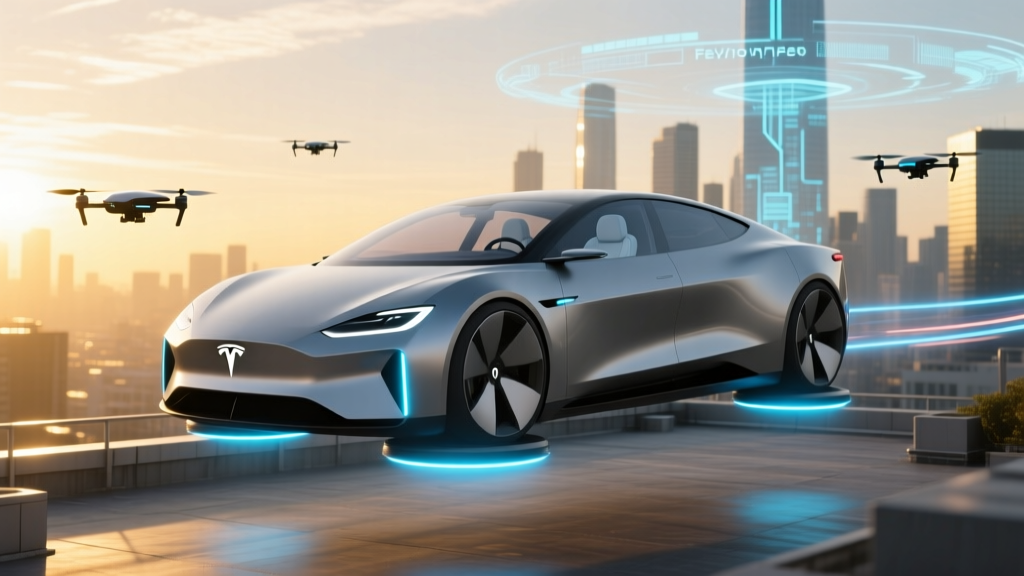
If you have spent any time on social media or YouTube in the past few years, you have almost certainly seen a render of a sleek, winged Tesla hovering above a highway. The concept is thrilling: a battery-electric aircraft or eVTOL (electric vertical takeoff and landing) vehicle wearing the Tesla badge. But as 2026 unfolds and Tesla's actual product lineup continues to expand across cars, trucks, and robots, the question remains urgent for curious shoppers: is the Tesla flying car real or fake?
The short answer, backed by every official statement Tesla has ever made, is fake. Tesla has never announced, patented in a production-ready form, or begun manufacturing any flying vehicle. What does exist is a robust lineup of ground-based electric vehicles that push the boundaries of range, charging speed, and autonomous-assist technology. Below, we separate the internet mythology from the engineering reality — and give you the exact specs, pricing, and ownership data on the Tesla vehicles you can actually buy today.
Where the Tesla Flying Car Rumor Started
The flying-car myth has three main origins. First, Tesla CEO Elon Musk has occasionally joked about the idea in interviews and on X (formerly Twitter), sometimes floating concepts like a "Tesla Roadster that hovers" using cold-gas thrusters — a feature that was announced for the next-generation Roadster but has nothing to do with sustained flight. Second, independent designers and AI tools have generated photorealistic renders of a "Tesla eVTOL" or "Tesla Model V," and these images routinely go viral without disclaimers. Third, the broader eVTOL industry — led by companies like Joby Aviation, Archer Aviation, and Waymo's parent Alphabet's Wing — has generated legitimate excitement about electric flight, and people naturally associate the EV leader with that movement.
None of these amount to a Tesla flying car in production or development. Tesla's official website, investor presentations, and SEC filings list ground vehicles (Model S, 3, X, Y, Cybertruck), energy products (Powerwall, Megapack), and robotics (Optimus). No aircraft division exists.
What Tesla Actually Builds: The 2026 Lineup at a Glance
Rather than chase a phantom, let's look at what Tesla actually offers buyers in 2026. The table below summarizes the core lineup with EPA data sourced from fueleconomy.gov and Tesla's official specifications.
| Model | Body Style | EPA Range | Battery (kWh) | 0–60 mph | Drivetrain | Base MSRP |
|---|---|---|---|---|---|---|
| Model 3 Long Range AWD | Sedan | 341 mi | ~79 kWh (NMC) | 4.2 sec | Dual-Motor AWD | $47,740 |
| Model Y Long Range AWD | Crossover SUV | 320 mi | ~78 kWh (NMC) | 4.8 sec | Dual-Motor AWD | $48,990 |
| Model S Long Range | Luxury Sedan | 402 mi | ~100 kWh (NMC) | 3.1 sec | Dual-Motor AWD | $79,990 |
| Model X Long Range | Luxury SUV | 335 mi | ~100 kWh (NMC) | 3.8 sec | Dual-Motor AWD | $84,990 |
| Cybertruck AWD | Pickup | 340 mi | ~123 kWh (NMC) | 4.1 sec | Tri-Motor AWD | $79,990 |
All models use Tesla's proprietary NACS (North American Charging Standard) connector, which has become the dominant EV charging standard in North America as of 2025–2026.
Deep Dive: 2026 Tesla Model Y Long Range AWD
Since the Model Y is Tesla's best-selling vehicle globally and the one most buyers research, let's use it as a concrete case study. If a flying Tesla existed, this is the ground vehicle you'd be giving up — and the specs show why most buyers are perfectly happy staying on the road.
Range, Battery, and Efficiency
EPA Estimated: 320 miles
Real-World Highway (70 mph, moderate temps): ~265–285 miles
Real-World Highway (cold weather, below 32°F): ~220–250 miles
City/Mixed Commuting (with regen): ~295–315 miles
Why the gap? EPA testing includes low-speed city cycles that favor regenerative braking. Sustained highway speeds above 70 mph and cold-weather battery resistance reduce usable range by 15–30%. Tesla's heat pump (standard since 2021) mitigates but does not eliminate cold-weather loss.
The Model Y Long Range AWD carries approximately 78 kWh of usable battery capacity using NMC (nickel manganese cobalt) chemistry. NMC offers higher energy density than LFP (lithium iron phosphate), which is why it appears in Long Range and Performance trims, while LFP is reserved for the lower-cost RWD Model 3. Tesla publishes an efficiency rating of 122 MPGe combined (28 kWh/100 mi) for the Model Y LR AWD — among the most efficient vehicles in its class.
Charging Speed: DC Fast and Home Level 2
| Charging Level | Power (kW) | Speed / Time | Notes |
|---|---|---|---|
| Level 1 (120V household) | ~1.4 kW | ~3–4 mi/hr | Emergency/trickle only |
| Level 2 (240V home, 48A) | 11.5 kW | ~37 mi/hr; full charge in ~8 hr | Wall Connector or NEMA 14-50 |
| DC Fast (Supercharger V3) | Peak 250 kW | 10–80% in ~25 min | Peak sustained to ~50% SoC, then tapers |
| DC Fast (Supercharger V4) | Peak 250 kW (vehicle-limited) | 10–80% in ~23 min | V4 stations support higher kW; Model Y onboard limits to ~250 kW |
A critical ownership note: the Model Y's charging curve peaks near 250 kW at low states of charge (around 10–20%) and tapers significantly above 80%. On a road trip, plan your stops around 10–80% increments for the fastest overall travel time. Charging from 80–100% can take as long as the 10–80% session due to cell-balancing protocols.
Performance and Drivetrain
The Model Y Long Range AWD produces approximately 384 horsepower from its dual-motor setup (induction front motor, permanent-magnet rear motor). The 0–60 mph time of 4.8 seconds puts it ahead of most gas-powered crossovers in its price range. All-wheel drive is standard, providing confident traction in rain and snow. The Performance trim drops 0–60 to 3.5 seconds at a $5,000 premium.
Interior, Cargo, and Tech
The refreshed Model Y ("Juniper" update, introduced in 2025) features a ventilated front seat row, ambient lighting, a rear-seat touchscreen, and a power-folding second row. Cargo volume stands at 30.2 cu ft behind the second row and 72.1 cu ft with the rear seats folded. Front legroom is 41.8 inches; rear legroom is 38.4 inches — competitive with the Hyundai Ioniq 5 and Ford Mustang Mach-E.
On the tech side, the 15.4-inch center touchscreen runs Tesla's proprietary infotainment system (no Apple CarPlay or Android Auto — a common complaint). Driver assistance comes via Basic Autopilot (standard, SAE Level 2) and optional FSD Supervised ($8,000 one-time or $99/month). FSD Supervised remains a Level 2 system: the driver must remain fully engaged, eyes on the road, hands available to take over at any moment. It is not self-driving.
Pricing, Tax Credits, and Total Cost
| Trim | MSRP | Federal §30D Credit | Effective Price (if eligible) |
|---|---|---|---|
| Long Range AWD | $48,990 | Up to $7,500 (point-of-sale) | ~$41,490 |
| Performance AWD | $53,990 | Up to $7,500 (point-of-sale) | ~$46,490 |
Federal tax credit caveats (IRS §30D, current for 2026): The $7,500 credit is available as a point-of-sale reduction (transferred to the dealer) or as a tax credit at filing. Eligibility depends on three factors:
- Buyer income caps: Modified AGI ≤ $150,000 (single), ≤ $300,000 (married filing jointly), ≤ $225,000 (head of household).
- MSRP cap: The vehicle's MSRP must not exceed $55,000 for sedans or $80,000 for SUVs/pickups. Both Model Y trims qualify.
- Battery sourcing: Critical minerals and battery components must meet phased-in domestic/free-trade-agreement sourcing percentages. Tesla's US-built batteries have largely met these thresholds, but always verify current-year compliance on IRS.gov before purchasing.
The credit is not guaranteed for every buyer in every year — rule changes and supply-chain shifts can alter eligibility. Consult a tax professional and check the IRS's qualified vehicle list before relying on the credit in your budget.
Warranty and Long-Term Ownership
Tesla provides a 4-year/50,000-mile limited vehicle warranty and an 8-year/120,000-mile battery and drive unit warranty. The battery warranty guarantees retention of at least 70% of original capacity during the warranty period. Real-world data from Tesla's Impact Reports and third-party fleet analyses show that Model Y batteries typically retain approximately 88–92% capacity at 100,000 miles — well above the warranty floor.
Maintenance costs are low compared to ICE vehicles (no oil changes, fewer brake replacements due to regenerative braking), but insurance premiums tend to run 15–25% higher than comparable gas crossovers, and tire replacement costs are elevated due to the vehicle's weight and instant torque. Budget approximately $0.04–$0.06 per mile for electricity at home (varies by utility rate) versus $0.12–$0.16 per mile for gasoline in a comparable ICE crossover.
Pros and Cons: The Honest Assessment
- Best-in-class Supercharger network reliability (17,000+ US stalls)
- 320 mi EPA range; real-world efficiency among top in segment
- Over-the-air updates continuously add features
- Strong resale value relative to EV segment average
- Point-of-sale tax credit reduces effective price to ~$41,490
- Spacious cargo area (72 cu ft max) with flat load floor
- No Apple CarPlay or Android Auto support
- FSD Supervised ($8,000) remains Level 2 — not autonomous
- Ride quality firm on larger wheel options (20" Induction)
- Insurance premiums above segment average
- Minimal physical controls; all functions routed through touchscreen
- Build quality improved but still inconsistent panel gaps reported
Could Tesla Ever Build a Flying Car?
From a pure engineering standpoint, an electric aircraft is possible — companies like Joby Aviation (backed by Toyota) and Archer Aviation are already conducting crewed test flights of eVTOL air taxis as of 2026. However, these vehicles carry 2–6 passengers over 20–100 mile routes at altitudes below 10,000 feet. They are air-taxi services, not personal flying cars, and they require pilot certification, vertiport infrastructure, and FAA type certification.
For Tesla specifically, several factors argue against a flying car program:
- Energy density gap: Current lithium-ion batteries achieve ~250–300 Wh/kg. Jet fuel delivers ~12,000 Wh/kg. Even with a 2x improvement (solid-state, ~500 Wh/kg), batteries remain 20x less energy-dense than jet fuel by weight. This makes long-range electric flight fundamentally challenging.
- Regulatory complexity: FAA certification for a new aircraft type takes 5–10 years and billions of dollars. Tesla's core competency is automotive manufacturing, not aerospace certification.
- Market focus: Tesla's stated priorities in 2026 are scaling the next-gen compact vehicle platform, expanding Optimus robotics production, deploying FSD at scale, and growing Megapack energy storage. A flying car diverts resources from all of these.
- Musk's own statements: In a 2020 interview, Musk explicitly said Tesla would not make a flying car, citing safety concerns (a falling vehicle is far more dangerous than a falling car) and regulatory impracticality.
Should You Wait or Buy Now?
If you were hoping to buy a Tesla flying car, the wait will be indefinite — it simply is not a real product in any stage of development. If you are evaluating a Tesla ground vehicle, the 2026 Model Y Long Range AWD represents a mature, well-rounded option with strong range, fast charging, and broad Supercharger access.
Choose the Model Y if: You want a family crossover with 300+ miles of real-world range, reliable DC fast charging, and access to the Supercharger network for road trips.
Look at competitors (Hyundai Ioniq 5, Ford Mustang Mach-E, Kia EV6) if: You need Apple CarPlay/Android Auto, prefer a more traditional ride quality, or want a more competitive lease deal.
Wait for a flying car if: You're prepared to wait at least 10–15 years for any personal eVTOL to reach consumer markets — and it almost certainly won't wear a Tesla badge.
Frequently Asked Questions
Has Tesla ever patented a flying car?
Tesla has filed patents related to vehicle-mounted drones and a conceptual "roadster with thrusters" for brief hover capability, but nothing resembling a production flying car. The Roadster thruster concept, announced in 2018, was described as a cold-gas propulsion add-on for short bursts of acceleration and ground-effect hover — not sustained flight. As of 2026, it has not shipped.
What is the closest thing to a Tesla flying car?
The closest real-world equivalent is the eVTOL air taxi sector (Joby Aviation, Archer Aviation, Lilium), none of which are Tesla products. These services are expected to begin limited commercial operations in select US cities by late 2026 or 2027, operating as ride-hail-style flights between vertiports, not personal ownership vehicles.
Does the 2026 Tesla Model Y qualify for the $7,500 federal tax credit?
Yes, the Model Y qualifies under current IRS §30D rules, provided the buyer meets income caps (≤$150K single / ≤$300K joint) and the vehicle's battery sourcing meets the critical-mineral and component requirements for the purchase year. The credit can be applied at point of sale, reducing the effective price to approximately $41,490 for the Long Range AWD trim. Always verify on fueleconomy.gov and IRS.gov at the time of purchase.
How much does it cost to charge a Tesla Model Y at home vs. Supercharging?
At the US average residential electricity rate of ~$0.16/kWh, a full 78 kWh charge costs approximately $12.50, yielding about $0.04 per mile. Supercharger pricing varies by location and time of day but typically ranges from $0.25–$0.45/kWh, or roughly $0.08–$0.14 per mile. Both remain significantly cheaper than gasoline at $0.12–$0.16 per mile for a comparable ICE crossover.
Is Tesla's FSD actually self-driving?
No. Full Self-Driving (Supervised) is an SAE Level 2 driver-assistance system. The driver must remain fully attentive, keep hands available, and be prepared to take over at any moment. True self-driving (SAE Level 4, no driver needed) is currently available only in geofenced robotaxi services like Waymo in select cities. Tesla's FSD has not received any Level 3 or Level 4 certification from NHTSA.
What's the real-world range of a Tesla Model Y on a road trip?
On a highway road trip at 70–75 mph in moderate temperatures (60–80°F), expect approximately 265–285 miles from a full charge. In cold weather (below 32°F), reduce that to 220–250 miles. Plan Supercharger stops at roughly 200-mile intervals for a comfortable buffer. Preconditioning the battery (automatic when a Supercharger is set as your navigation destination) optimizes charge speed upon arrival.