The "Tesla New Flying Car" Search: Separating Internet Hype from Reality
If you've typed "tesla new flying car" into a search engine recently, you're not alone — the phrase trends periodically across forums, YouTube thumbnails, and social media. But here's the unvarnished truth as of early 2026: Tesla has not announced, prototyped, or filed any regulatory paperwork for a flying car or eVTOL (electric vertical takeoff and landing) aircraft. There is no Tesla Model V, no Roadster-with-thrusters production timeline, and no FAA type certificate application bearing Tesla's name.
What does exist is a thriving ecosystem of real eVTOL startups, a Tesla vehicle lineup that continues to evolve on the ground, and a lot of speculative clickbait. This article breaks down where the rumor came from, what actual flying-car companies are delivering, and — because you're probably still shopping for a real EV — a data-driven look at the Tesla models you can actually buy today.
Where Did the Tesla Flying Car Rumor Come From?
The rumor is a composite of several real but misinterpreted data points:
- Elon Musk's offhand comments: In various interviews, Musk has mused about the concept of a flying car, usually to dismiss it as impractical due to noise, safety, and energy-density constraints. These quotes get clipped and re-shared without the skeptical context.
- The Tesla Roadster's "SpaceX Package": When the next-gen Roadster was announced (still not delivered as of 2026), Musk mentioned cold-gas thrusters for extreme performance. This was a ground-effect feature, not flight capability, but the headline wrote itself.
- SpaceX and Tesla brand conflation: SpaceX's Starship program and Tesla's EV platform share an aesthetic in the public imagination. SpaceX has no eVTOL program either, but the association fuels speculation.
- Competitor eVTOL hype cycles: Companies like Joby Aviation, Archer, and Wisk regularly generate headlines about "electric air taxis." When a headline says "electric flying car arrives," some readers assume Tesla is involved.
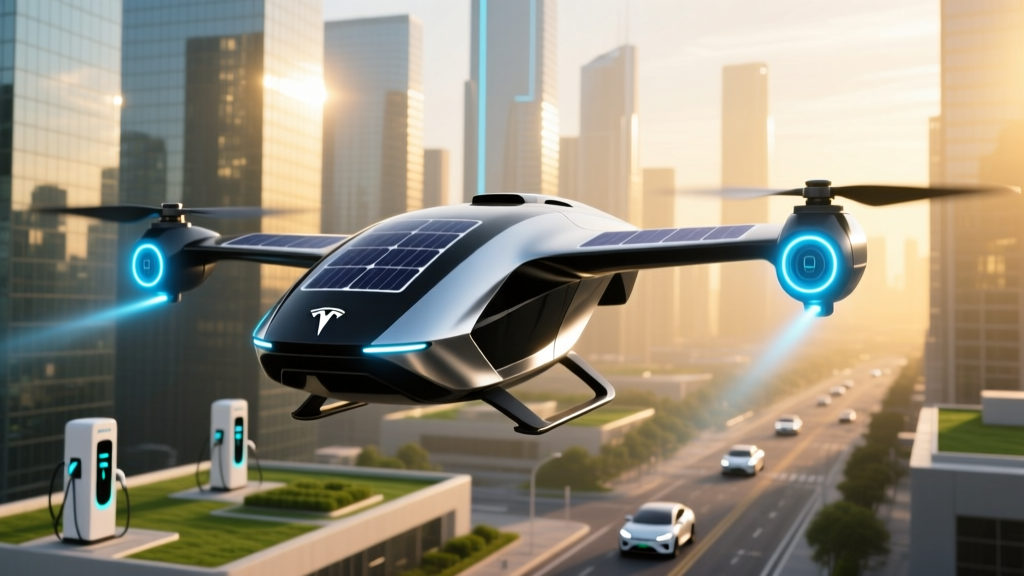
- AI-generated concept renders: Midjourney and DALL-E images of sleek Tesla-branded eVTOLs circulate on Reddit and X, often without "concept art" disclaimers.
Real eVTOL Companies: Who's Actually Building Electric Aircraft
If you're genuinely interested in electric flight, the action is elsewhere. Here's where the actual eVTOL industry stands in 2026:
| Company | Aircraft | Status (2026) | Range (est.) | Target Market |
|---|---|---|---|---|
| Joby Aviation | S4 | FAA type certification in progress; limited commercial ops with Delta/Toyota backing | ~100 mi | Air taxi (urban) |
| Archer Aviation | Midnight | FAA certification underway; partnership with United Airlines | ~100 mi | Air taxi (urban) |
| Wisk Aero (Boeing) | 6th-gen | Autonomous eVTOL in testing; FAA certification pending | ~25 mi | Autonomous air taxi |
| Beta Technologies | Alia | Cargo/medical delivery flights operational; passenger cert in progress | ~250 mi | Cargo/medical/logistics |
| EHang (China) | EH216-S | Certified in China; limited passenger ops | ~18 mi | Urban tourism/taxi |
None of these vehicles are consumer products you can buy for personal use. They're all aimed at commercial air-taxi or cargo operations, regulated under FAA Part 135 (air carrier) rules — not Part 91 (private pilot). You won't be parking one in your driveway.
What Tesla Actually Sells in 2026: The Real Lineup
Since there's no Tesla flying car to review, here's a spec-driven look at the ground-based Tesla vehicles you can actually order today. We'll focus on the highest-volume model — the refreshed Model Y — as the practical benchmark.
| Spec | Value |
|---|---|
| EPA Range | 320 miles |
| Battery Capacity | ~78 kWh usable (NMC chemistry) |
| Drivetrain | Dual-motor AWD |
| Horsepower | 384 hp combined |
| 0-60 mph | 4.8 seconds |
| Peak DC Fast Charge | 250 kW (Supercharger V3/V4) |
| 10-80% DC Charge Time | ~25 minutes |
| Level 2 Home Charge Rate | 11.5 kW (~44 mi/hr) |
| MPGe (combined) | 117 MPGe (28 kWh/100mi) |
| Cargo Volume | 30.2 cu ft (rear seats up) / 72.0 cu ft (folded) |
| Rear Legroom | 41.6 inches |
| Base MSRP | $47,990 |
| Federal Tax Credit (§30D) | $7,500 (if eligible — see rules below) |
| Battery/Drive Unit Warranty | 8 years / 120,000 miles |
Charging Speed: DC Fast, Level 2, and the Supercharger Network
Charging remains Tesla's strongest competitive moat. The Supercharger network now exceeds 70,000 stalls globally, and since 2024, non-Tesla EVs have gained access via the NACS (North American Charging Standard) connector — but Tesla owners still enjoy the most seamless plug-and-charge experience.
| Charging Level | Power | Miles Added per Hour | Typical Use Case |
|---|---|---|---|
| Level 1 (120V outlet) | ~1.4 kW | ~5 mi/hr | Emergency / overnight trickle |
| Level 2 (240V, 48A Wall Connector) | 11.5 kW | ~44 mi/hr | Home daily charging |
| DC Fast (V3 Supercharger) | 250 kW peak | ~1,000 mi/hr (peak) | Road trips; 10-80% in ~25 min |
| DC Fast (V4 Supercharger) | Up to 350 kW (cable-dependent) | Varies | Newer stations; Model Y may not sustain peak |
Charging curve reality: The 250 kW peak only applies at low states of charge (roughly 10-30%). Above 50% SoC, the rate tapers significantly. By 80%, you're typically at 60-80 kW. This is why the 10-80% metric matters more than peak kW — and why Tesla's 25-minute 10-80% time is competitive but not class-leading. Hyundai/Kia's E-GMP platform (Ioniq 5, EV6) can do 10-80% in ~18 minutes on a 350 kW charger thanks to 800V architecture.
Federal Tax Credit: Does the 2026 Model Y Qualify?
The short answer: possibly, but eligibility depends on your income, the vehicle's MSRP, and battery-sourcing requirements that shift annually under IRS §30D rules.
- MSRP Cap: SUVs (including Model Y) must have an MSRP at or below $80,000. The Model Y Long Range at $47,990 clears this easily.
- Buyer Income Cap: Modified adjusted gross income must not exceed $150,000 (single), $225,000 (head of household), or $300,000 (married filing jointly).
- Battery Sourcing (§30D(e)): Critical minerals and battery components must meet escalating domestic/free-trade-partner thresholds. As of 2026, the sourcing rules are stringent — and Tesla's battery supply chain (partly from CATL in China for LFP, partly domestic NMC) creates a complex eligibility picture that can change month to month.
- Point-of-Sale Transfer: If eligible, you can transfer the credit to the dealer at purchase, reducing your out-of-pocket cost immediately rather than waiting for tax filing.
Always verify current eligibility on the IRS §30D page and the fueleconomy.gov tax credit tool before purchasing. Do not rely on a salesperson's verbal assurance.
| Scenario | Price |
|---|---|
| Base MSRP (Long Range AWD) | $47,990 |
| After $7,500 §30D credit (if fully eligible) | ~$40,490 |
| After $3,750 partial credit (if only minerals requirement met) | ~$44,240 |
| Performance trim MSRP | $52,990 |
| Performance after full credit | ~$45,490 |
Tech, Driver Assistance, and What Tesla Still Doesn't Offer
Tesla's infotainment remains best-in-class for responsiveness and over-the-air updates. The 15.4-inch center screen handles navigation, media, and vehicle controls with minimal lag. However, Apple CarPlay and Android Auto remain absent — a dealbreaker for some buyers.
Standout tech:
- Tesla Vision (camera-only ADAS, no lidar or radar)
- Over-the-air updates that add features post-purchase
- Sentry Mode (360° parking surveillance)
- Dog Mode, Camp Mode, and built-in streaming
- Tesla app integration (remote preconditioning, location, charging status)
Notable drawbacks:
- No Apple CarPlay / Android Auto
- Phantom braking incidents reported with Tesla Vision
- No traditional instrument cluster (all info on center screen)
- Build quality inconsistency (panel gaps, paint) — improved but still a buyer complaint
- Service center wait times can stretch weeks in some metro areas
Competitor Comparison: Model Y vs. the Field
| Spec | Tesla Model Y LR | Hyundai Ioniq 5 Limited | Ford Mustang Mach-E ER AWD | Kia EV6 GT-Line AWD |
|---|---|---|---|---|
| EPA Range | 320 mi | 305 mi | 290 mi | 282 mi |
| Battery (kWh) | ~78 (NMC) | 84 (NMC) | 91 (NMC) | 77.4 (NMC) |
| Peak DC Charge | 250 kW | 350 kW | 150 kW | 350 kW |
| 10-80% Time | ~25 min | ~18 min | ~36 min | ~18 min |
| 0-60 mph | 4.8 sec | 5.1 sec | 5.1 sec | 4.5 sec |
| Base MSRP | $47,990 | $52,600 | $48,995 | $52,900 |
| NACS Native | Yes | Yes (2025+) | Yes (2025+) | Yes (2025+) |
Who Should Buy a Tesla Model Y (and Who Shouldn't)
Choose the Model Y if:
- You want the longest EPA range per dollar in the electric SUV segment
- Supercharger network access matters for frequent road trips
- You value OTA updates and a minimalist, screen-centric interior
- You qualify for the §30D credit and want to maximize effective savings
Look elsewhere if:
- You need Apple CarPlay/Android Auto
- Fastest possible DC charging is a priority (look at Ioniq 5/EV6)
- You prefer traditional controls, physical buttons, or an instrument cluster
- Tesla service center proximity is poor in your area
- Class-leading EPA range (320 mi)
- Best-in-class Supercharger network
- Spacious cargo area (72 cu ft max)
- Strong OTA update pipeline
- Competitive pricing after tax credit
- No Apple CarPlay/Android Auto
- DC charge speed trails 800V competitors
- Vision-only ADAS has phantom-braking reports
- Service access can be slow
- Build quality still inconsistent vs. legacy OEMs
Frequently Asked Questions
Is Tesla actually building a flying car?
No. As of 2026, Tesla has made no announcement, filed no FAA paperwork, and shown no prototype of any eVTOL or flying vehicle. All "Tesla flying car" content online is speculative, AI-generated, or clickbait.
What is the real-world range of the 2026 Tesla Model Y?
The EPA rates it at 320 miles. Real-world highway driving in mild weather yields approximately 270-290 miles. In freezing conditions, expect 230-260 miles due to battery chemistry limitations and heating demand.
How fast does the Model Y charge at home and on the road?
At home on a Level 2 Tesla Wall Connector (240V, 48A), it charges at 11.5 kW, adding about 44 miles per hour — enough to fully replenish overnight. On DC fast charging, it peaks at 250 kW on V3 Superchargers, achieving 10-80% in approximately 25 minutes.
How much does the 2026 Model Y cost after tax credits?
The Long Range AWD starts at $47,990. If you meet all IRS §30D requirements (income cap, MSRP cap, battery sourcing), the effective price drops to approximately $40,490 via the point-of-sale transfer option. Partial credit ($3,750) may apply if only one of the two battery-sourcing requirements is met.
Does the Model Y qualify for the federal EV tax credit?
It can, but eligibility is not guaranteed. The MSRP is well under the $80,000 SUV cap. Your personal income must fall under IRS thresholds ($150K single / $300K joint). Battery-sourcing rules under §30D(e) are complex and change periodically — verify on irs.gov at time of purchase.
Is the Model Y worth buying vs. competitors in 2026?
For range-per-dollar and charging-network convenience, yes — it remains the segment benchmark. If faster DC charging, Apple CarPlay, or physical controls matter more to you, the Hyundai Ioniq 5 or Kia EV6 are strong alternatives. Test-drive both before deciding.
What's the best Tesla to buy if I want something new?
The refreshed Model Y (2025-2026) is the volume pick. The Cybertruck serves niche truck buyers. The next-generation Tesla platform vehicle (sometimes called "Model 2" or "Redwood") has been announced for future production but is not yet available for order as of early 2026.
Sources: fueleconomy.gov (EPA range and efficiency data), IRS §30D Clean Vehicle Credit, Tesla.com official specifications. All specs reflect 2026 model year data available at time of publication. Tax credit eligibility is subject to change — consult a tax professional.