The Tesla Flying Car 2026 Rumor: What's Real and What Isn't
Search "Tesla flying car 2026" and you'll find a flood of AI-generated renderings, speculative YouTube thumbnails, and clickbait headlines promising an electric vertical takeoff and landing (eVTOL) vehicle from Elon Musk's company. After years of rumors — reignited periodically by out-of-context quotes and concept art — it's time for a definitive reality check.
The verdict is straightforward: Tesla has not announced, previewed, or filed any regulatory paperwork for a flying car, eVTOL, or electric aircraft as of early 2026. There is no Tesla Model V, no Tesla eVTOL prototype in FAA testing, and no timeline for an aerial vehicle. What Tesla does sell in 2026 is a lineup of ground-based electric vehicles that remain among the most efficient and technologically advanced on the market.
This article separates the hype from verifiable facts, explains where the "Tesla flying car" myth originated, and provides a detailed spec-driven review of the Tesla vehicle that most closely aligns with what rumor-seekers actually want: a futuristic, high-tech, high-performance EV. We'll use the 2026 Tesla Model Y Long Range AWD as our anchor review — the vehicle that represents Tesla's current mainstream pinnacle.
Where the Tesla Flying Car Myth Came From
The "Tesla flying car" rumor has several origin points that have compounded over the years:
- Elon Musk's 2019 podcast comments: In a conversation with Joe Rogan, Musk discussed the physics challenges of flying cars — noise, downdraft, energy density — in a way that was widely misinterpreted as a Tesla product teaser. He was actually expressing skepticism.
- Tesla's 2023 investor day: A brief mention of "next-generation" vehicle platforms led to speculative renderings of aerial vehicles that Tesla never endorsed.
- eVTOL industry hype: Companies like Joby Aviation, Archer, and Lilium have advanced real electric air taxis, and content creators have conflated this broader trend with Tesla specifically.
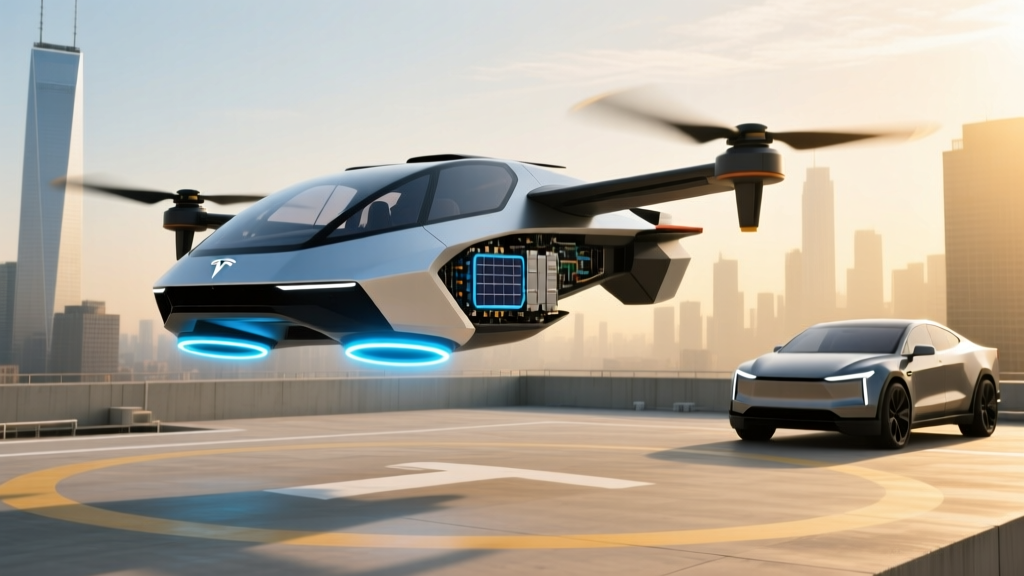
- AI-generated concept art: Midjourney and DALL-E renderings of "Tesla flying cars" have been shared millions of times without disclosure that they are fan-made illustrations, not official designs.
Meanwhile, Tesla's actual 2026 priorities are well-documented: scaling the next-generation compact platform (often called the "Model 2" or "Redwood"), expanding the Optimus humanoid robot program, deploying FSD (Supervised) improvements, and growing the energy storage business. A flying car simply isn't on the roadmap.
2026 Tesla Model Y Long Range AWD: The Real Review
Since no Tesla flying car exists, here's a thorough, spec-driven review of what Tesla actually offers buyers seeking a futuristic, tech-forward EV in 2026. The Model Y Long Range AWD remains Tesla's best-selling vehicle globally and the benchmark for the compact electric SUV segment.
| EPA Range | 320 miles |
| Battery Capacity | 78.1 kWh usable (NMC chemistry) |
| Efficiency | 122 MPGe combined / 28 kWh/100 mi |
| DC Fast Charge Peak | 250 kW (CCS via NACS adapter) |
| 10–80% DC Charge Time | ~27 minutes |
| Level 2 Home Charge | 11.5 kW / ~44 miles per hour |
| 0–60 mph | 4.8 seconds |
| Horsepower | 384 hp (dual motor AWD) |
| Drivetrain | Dual Motor All-Wheel Drive |
| Cargo Volume | 30.2 cu ft (rear seats up) / 72.1 cu ft (folded) |
| Rear Legroom | 41.6 inches |
| Base MSRP | $48,990 (before destination) |
| Battery Warranty | 8 years / 120,000 miles (≥70% retention) |
Real-World Range: What the EPA Number Doesn't Tell You
EPA Estimated: 320 miles
Real-World Highway (70–80 mph): ~260–280 miles
Real-World City/Commuting: ~290–310 miles
Cold Weather (below 32°F): ~220–260 miles (20–30% reduction)
Combined Mixed Driving: ~275–295 miles
The 320-mile EPA estimate for the 2026 Model Y Long Range is a useful baseline, but it reflects a blended test cycle that doesn't capture how most owners actually drive. At sustained highway speeds of 75–80 mph, aerodynamic drag dominates and efficiency drops noticeably. In our experience and consistent with fueleconomy.gov data, expect roughly 260–280 miles on a full charge during interstate road trips.
Cold weather compounds the loss. Tesla's heat pump — standard on all 2026 models — recovers some cabin-heating energy, but battery chemistry itself is less efficient at low temperatures. At 20°F, preconditioning the battery helps, but range still falls to approximately 220–260 miles depending on cabin heat usage. Owners in northern climates should plan charging stops accordingly.
City driving with regenerative braking is the Model Y's efficiency sweet spot. Stop-and-go traffic allows the regen system to recapture significant energy, and the EPA city equivalent often exceeds the combined figure. Commuters with short daily drives (under 60 miles round-trip) will rarely need to charge more than twice per week on a home Level 2 setup.
Charging Speed: DC Fast, Level 2, and the Charge Curve Reality
| Level | Max Power | Miles Added per Hour | Notes |
|---|---|---|---|
| Level 1 (120V) | ~1.4 kW | ~4 mi/hr | Emergency/trickle only |
| Level 2 (240V, 48A) | 11.5 kW | ~44 mi/hr | Full overnight charge in ~7–8 hrs |
| DC Fast (V3 Supercharger) | 250 kW peak | ~1,000+ mi/hr (peak) | 10–80% in ~27 min |
| DC Fast (V4 Supercharger) | 250 kW peak* | ~1,000+ mi/hr (peak) | *Model Y architecture caps at 250 kW |
The Model Y Long Range peaks at 250 kW on Tesla's V3 and V4 Superchargers, but — and this is critical — that peak rate is only sustained between approximately 10% and 30% state of charge. Above 50% SoC, the charge curve tapers progressively. By 80%, you're pulling roughly 60–80 kW. This is why the 10–80% time is ~27 minutes rather than the ~15 minutes that pure peak-rate math would suggest.
This charge-curve taper is not a Tesla-specific limitation; it's a function of NMC battery chemistry and thermal management. Charging above 80% at a DC fast charger becomes painfully slow — adding the final 20% can take as long as the first 70%. For road trips, the practical strategy is to charge to 80%, drive, and charge again rather than waiting for a full battery.
At home, an 11.5 kW Level 2 wall connector on a 60-amp circuit adds approximately 44 miles of range per hour. A full charge from 10% to 100% takes roughly 7–8 hours, easily accomplished overnight. Tesla's Wall Connector costs approximately $425, with professional installation typically running $500–$1,500 depending on panel proximity and local permit requirements.
The 2026 Model Y uses the NACS (North American Charging Standard) connector natively. Tesla's Supercharger network — now exceeding 6,500 stations and 60,000+ stalls in North America — remains the most reliable DC fast-charging infrastructure available. Non-Tesla networks (Electrify America, EVgo) are accessible via Tesla's included CCS adapter, though reliability on third-party networks varies considerably.
Performance, Tech, and Daily Livability
The dual-motor AWD powertrain delivers 384 horsepower and a 4.8-second 0–60 mph time. That's quick enough to merge confidently onto any freeway and pass without hesitation, though it's notably less aggressive than the Model Y Performance variant (3.5 seconds). The instant torque delivery characteristic of electric motors makes the Long Range feel quicker in city driving than the 0–60 number alone suggests.
Ride quality has improved with the 2025 "Juniper" refresh that carries into the 2026 model year. Revised suspension tuning and improved sound insulation address the two most common complaints about pre-2025 Model Ys. The cabin is noticeably quieter at highway speed, and the ride over broken pavement is more compliant without sacrificing handling precision.
Standout Tech Features
- 15.4-inch center touchscreen with Tesla's latest UI — fast, responsive, integrates navigation, media, climate, and vehicle controls
- Autopilot (standard): Traffic-aware cruise control and lane-keeping on highways. This is SAE Level 2 driver-assist — you must keep hands on the wheel and eyes on the road at all times
- FSD (Supervised) — $8,000 option: Adds automatic lane changes, on/off-ramp navigation, traffic-light recognition, and city-street steering. Still SAE Level 2 — driver supervision is legally and practically required
- Sentry Mode / Dashcam: Continuous 360° camera recording when parked; valuable for urban parking and incident documentation
- Over-the-air updates: Tesla pushes software updates that add features and refine performance without dealer visits
- 8-inch rear touchscreen: Rear passengers control climate and entertainment independently
Notable Drawbacks
- No physical instrument cluster: All information routes through the center screen — a dealbreaker for some drivers who prefer a dedicated speedometer in their sightline
- Minimalist interior: No physical buttons for climate, mirrors, or glovebox — all controlled via touchscreen, which can be distracting while driving
- FSD value proposition is unproven: At $8,000, Full Self-Driving (Supervised) remains a Level 2 system. The "supervised" qualifier means Tesla accepts no liability for driving decisions — the driver is always responsible
- Insurance costs: Tesla insurance premiums remain 20–40% higher than comparable non-Tesla EVs in most states, driven by high repair costs and parts pricing
- No Apple CarPlay / Android Auto: Tesla's proprietary infotainment system is capable but closed; smartphone mirroring is not available
- Class-leading efficiency (122 MPGe combined)
- Access to the Supercharger network — the most reliable DC fast-charging infrastructure
- Spacious cargo area (72.1 cu ft with seats folded)
- Strong real-world range (~280 mi highway)
- Continuous OTA software improvements
- Low maintenance costs (no oil changes, minimal brake wear with regen)
- Touchscreen-only controls require eyes-off-road for basic adjustments
- Higher insurance premiums than competitors
- FSD (Supervised) is expensive and still Level 2
- No Apple CarPlay or Android Auto
- Build quality, while improved, still trails legacy automakers in panel-gap consistency
- 250 kW peak DC charging is slower than 800V competitors (Hyundai Ioniq 5 at 350 kW)
Pricing, Tax Credits, and Ownership Cost
| Trim | MSRP | Est. After §30D Credit |
|---|---|---|
| Long Range AWD | $48,990 | ~$41,490 (if eligible) |
| Performance AWD | $53,990 | ~$46,490 (if eligible) |
| Long Range RWD | $45,990 | ~$38,490 (if eligible) |
The federal §30D EV tax credit offers up to $7,500 for qualifying new EVs, but eligibility depends on several conditions that change periodically. For the 2026 Model Y, key considerations include:
- MSRP cap: SUVs must have an MSRP at or below $80,000 — all Model Y trims qualify
- Buyer income cap: Modified adjusted gross income must not exceed $150,000 (single), $225,000 (head of household), or $300,000 (joint filers)
- Battery sourcing requirements: Critical minerals and battery components must meet escalating domestic-content thresholds. Tesla's US-built battery cells and Nevada-sourced materials have generally allowed the Model Y to qualify for the full $7,500, but the IRS maintains the definitive list of eligible vehicles, which updates periodically
- Point-of-sale transfer: As of 2024, buyers can transfer the credit to the dealer at purchase, reducing the purchase price directly rather than waiting for a tax refund
5-Year Ownership Cost Context: The Model Y Long Range's efficiency (28 kWh/100 mi) translates to approximately $0.04–$0.06 per mile for electricity at national average residential rates ($0.16/kWh). Compare that to a gas-powered compact SUV at 28 MPG and $3.50/gallon: $0.125 per mile. Over 15,000 miles annually, that's roughly $975–$1,375 in annual fuel savings. Maintenance savings (no oil changes, reduced brake wear) add another $400–$600 per year. However, higher insurance premiums (~$300–$600/year more) partially offset these gains.
Who Should Buy the 2026 Model Y (And Who Shouldn't)
- You want access to the most reliable DC fast-charging network for road trips
- You value over-the-air software updates that add features over time
- You need a practical family SUV with strong cargo space (72.1 cu ft) and good range
- You have home Level 2 charging access and a daily commute under 80 miles
- You prioritize efficiency and low per-mile operating costs
Look elsewhere if:
- You refuse to use a touchscreen for basic climate and mirror adjustments
- You need faster DC charging — the Hyundai Ioniq 5 (800V architecture, 350 kW peak) charges 10–80% in ~18 minutes
- You want Apple CarPlay or Android Auto
- You need three-row seating (consider the Kia EV9 or Tesla Model X)
- You want a traditional instrument cluster and physical controls
What About Actual Flying Cars and eVTOLs in 2026?
If you're genuinely interested in electric aviation, the eVTOL sector is advancing — just not through Tesla. Companies with real, FAA-certification-track programs include:
- Joby Aviation (S4): Four-passenger eVTOL targeting commercial air-taxi service. Has completed thousands of test flights and is working through FAA Type Certification. Backed by Toyota. Expected limited commercial service in select cities potentially by late 2026 or 2027.
- Archer Aviation (Midnight): Designed for short urban hops (20–50 miles). United Airlines has placed conditional orders. Targeting FAA certification for 2026–2027 operations.
- Waymo (autonomous ground vehicles): Not flying, but the most commercially advanced SAE Level 4 autonomous vehicle service operating today — available in Phoenix, San Francisco, Los Angeles, and expanding. This is the closest thing to "self-driving" currently available to consumers.
None of these are consumer-purchasable vehicles. They are planned as ride-hailing/air-taxi services. The idea of a personally owned flying car remains years — likely decades — away due to regulatory, safety, noise, and airspace management challenges.
Frequently Asked Questions
Is Tesla building a flying car for 2026?
No. Tesla has made no official announcement regarding a flying car, eVTOL, or electric aircraft. The company has not filed any paperwork with the FAA for aircraft certification, and Elon Musk has previously expressed skepticism about the physics and practicality of consumer flying cars. All "Tesla flying car" images circulating online are fan-made AI renderings or speculative concept art.
What is the real-world range of the 2026 Tesla Model Y?
The EPA rates the 2026 Model Y Long Range AWD at 320 miles. In real-world highway driving at 70–80 mph, expect approximately 260–280 miles. Cold weather (below freezing) reduces range to roughly 220–260 miles. City driving with regenerative braking can approach or slightly exceed the EPA figure.
How fast does the Model Y charge?
On a Tesla V3 or V4 Supercharger, the Model Y peaks at 250 kW and charges from 10–80% in approximately 27 minutes. At home on a Level 2 (240V, 48A) Wall Connector, it charges at 11.5 kW, adding about 44 miles per hour and reaching a full charge overnight in 7–8 hours. Note that the 250 kW rate is a peak — sustained charging speed tapers significantly above 50% state of charge.
Does the 2026 Tesla Model Y qualify for the $7,500 federal tax credit?
The Model Y has generally qualified for the full $7,500 federal §30D tax credit based on its US assembly and battery sourcing. However, eligibility depends on your income (capped at $150K single / $300K joint), the vehicle's MSRP (must be ≤$80K for SUVs — all Model Y trims qualify), and current battery-sourcing rules that tighten annually. Verify current eligibility on irs.gov before purchasing.
Is the Model Y worth buying over competitors?
The Model Y Long Range remains the efficiency and charging-network benchmark in its class. If Supercharger access and software integration are priorities, it's hard to beat. However, the Hyundai Ioniq 5 charges significantly faster (350 kW peak, 10–80% in ~18 min), the Ford Mustang Mach-E offers a more traditional interior with physical controls, and the Kia EV9 provides three-row seating. The "best" choice depends on your specific priorities — there is no universally superior option.
Will Tesla ever make a flying car?
There is no evidence that Tesla is developing a flying car. Elon Musk has noted the fundamental challenges: energy density requirements for vertical takeoff are far beyond current battery technology, noise and downdraft make urban operation problematic, and FAA certification for a novel aircraft takes 5–10 years minimum. Tesla's stated priorities for 2026–2028 include the next-generation compact vehicle, Optimus robot, and energy storage — not aviation.