The Tesla Flying Car Question: What Buyers Actually Need to Know
If you've searched for "Tesla flying car 2025" and landed here, you're not alone. The idea of a Tesla-branded electric vertical takeoff and landing (eVTOL) vehicle has circulated across social media, YouTube thumbnails, and speculative forums for years. Elon Musk himself has occasionally floated the concept of electric air taxis, and Tesla's engineering prowess in batteries and electric drivetrains makes the notion feel plausible to many enthusiasts.
Here's the unvarnished truth as of early 2026: Tesla does not manufacture, sell, or accept orders for a flying car. There is no Tesla eVTOL, no Tesla air taxi, and no Tesla Model V or Model X-Air in any announced product pipeline. What does exist are ground-bound Tesla vehicles with increasing performance, plus a handful of third-party eVTOL startups that sometimes get conflated with Tesla in viral content.
This article breaks down where the rumors come from, what Tesla's actual lineup offers for buyers who want futuristic performance, and which real eVTOL companies are closest to commercial launch. If you're shopping for an EV with cutting-edge tech in 2026, we'll also profile the Tesla vehicle that comes closest to the "flying car" fantasy: the 2026 Tesla Roadster (announced) and the currently available 2026 Tesla Model S Plaid.
Where the Tesla Flying Car Rumors Come From
The "Tesla flying car" concept stems from several overlapping sources:
- Elon Musk's public comments: In various interviews, Musk has mentioned the theoretical possibility of electric VTOL aircraft, though he has consistently noted that regulatory certification for autonomous flying vehicles is extraordinarily difficult. He has never announced a Tesla flying car project.
- Tesla Roadster "SpaceX Package": The announced next-gen Roadster was teased with a cold-gas thruster option developed with SpaceX, intended for extreme acceleration and handling — not flight. This fueled "flying Tesla" speculation.
- Third-party eVTOL confusion: Companies like Joby Aviation, Archer Aviation, and Lilium are developing electric air taxis. Viral social media posts sometimes mislabel these as Tesla products.
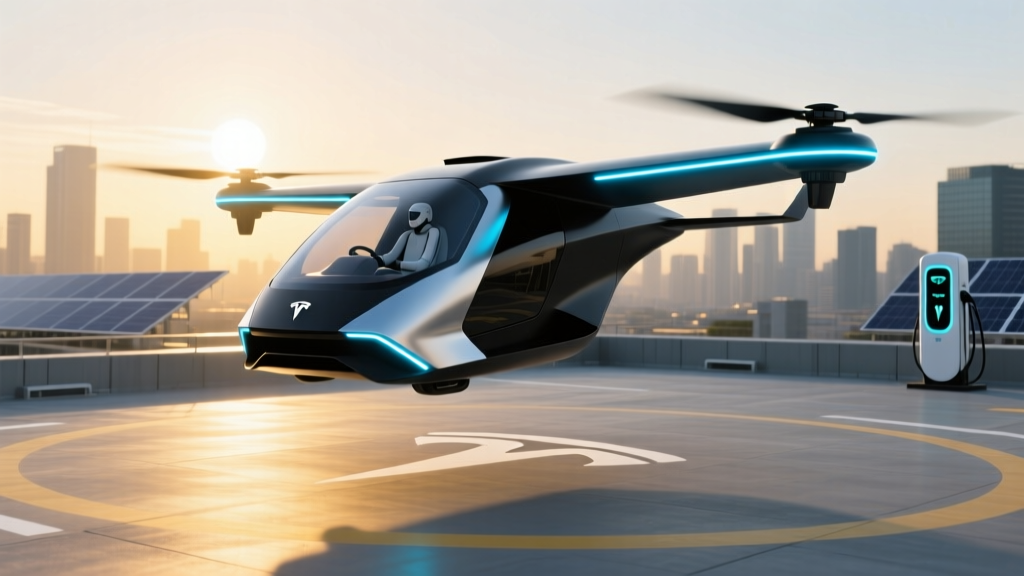
- AI-generated concept renders: Numerous fan-made and AI-generated images of a "Tesla Model V" or "Tesla eVTOL" circulate online, none of which represent actual Tesla products.
Tesla's official product page and investor materials contain no mention of an eVTOL or flying vehicle. The company's focus remains on ground vehicles, energy storage, solar, and the Optimus humanoid robot.
What Tesla Actually Offers in 2026: The Model S Plaid
If you're chasing Tesla's most extreme performance technology — the kind that makes a flying car feel conceptually adjacent — the 2026 Tesla Model S Plaid is the closest production reality. Here are the exact specs.
| Specification | 2026 Tesla Model S Plaid |
|---|---|
| EPA Range | 396 miles (Long Range AWD: 402 mi) |
| Battery Capacity | ~100 kWh usable (NMC chemistry) |
| Drivetrain | Tri-motor AWD (1 front, 2 rear) |
| Horsepower | 1,020 hp |
| 0-60 mph | 1.99 seconds (with rollout subtracted) |
| Top Speed | 200 mph (with Track Package) |
| Peak DC Fast Charge | 250 kW (V3 Supercharger) |
| 10-80% DC Charge Time | ~27 minutes |
| Level 2 Home Charge Rate | 11.5 kW (~41 miles/hr) |
| MPGe (Combined) | 116 MPGe |
| Efficiency | 29 kWh/100 mi |
| Cargo Volume | 28 cu ft (rear) + frunk |
| Base MSRP | $89,990 (Plaid); $74,990 (Long Range AWD) |
| Battery Warranty | 8 years / 150,000 miles |
Source: fueleconomy.gov and Tesla official specifications.
Real-World Range: What the EPA Number Doesn't Tell You
The Model S Plaid's EPA-estimated 396 miles is among the highest of any production EV sold in the US. But EPA testing uses a blended city/highway cycle at moderate temperatures, which doesn't reflect every driver's reality.
- Highway (70-80 mph, moderate weather): ~310-340 miles
- City/mixed driving (moderate weather): ~360-390 miles
- Cold weather (below 32°F, highway): ~250-290 miles (30-35% reduction)
- Cold weather + cabin heat (no heat pump in older builds): expect the lower end of that range
The Plaid's tri-motor drivetrain and wider rear tires create more rolling resistance and drag than the Long Range AWD variant, which achieves slightly better real-world efficiency despite a similar battery.
For context, the 2026 Model S Long Range AWD at 402 miles EPA tends to hold up slightly better on long highway runs, thanks to its dual-motor setup drawing less energy under steady-state cruising.
Charging Speed: Supercharger Network and Home Setup
Charging speed is where Tesla retains a significant practical advantage. The Supercharger network remains the most reliable and widespread DC fast-charging infrastructure in North America, with over 6,000 stations and 60,000+ individual stalls as of early 2026.
| Charging Level | Power (kW) | Miles Added per Hour | Typical Use Case |
|---|---|---|---|
| Level 1 (120V outlet) | ~1.4 kW | ~5 mi/hr | Emergency/trickle |
| Level 2 (240V, Wall Connector) | 11.5 kW | ~41 mi/hr | Daily home charging |
| DC Fast (V3 Supercharger) | Up to 250 kW | ~200 mi in 15 min | Road trips |
| DC Fast (V4 Supercharger) | Up to 350 kW* | Varies by vehicle | Newer stations; Model S caps at 250 kW |
*V4 Superchargers can deliver higher power, but the current Model S architecture limits intake to 250 kW. Future Tesla platforms (next-gen Roadster, potential Cybertruck updates) may support higher peak rates.
The Model S Plaid's 10-80% charge takes approximately 27 minutes on a V3 Supercharger. Like all lithium-ion batteries, the charge curve tapers significantly above 80% — going from 80% to 100% can add another 20-25 minutes. For road trips, the practical strategy is to charge to 80% and move on, which Tesla's navigation system automatically recommends when routing through Superchargers.
For home charging, the Tesla Wall Connector ($475) on a 60-amp circuit delivers the full 11.5 kW, adding roughly 41 miles of range per hour. Most owners who plug in overnight start each morning with a full battery — the single biggest quality-of-life advantage of EV ownership over gas cars.
Pricing, Trims, and Federal Tax Credit Eligibility
The Model S starts at $74,990 for the Long Range AWD and $89,990 for the Plaid. Options like the Track Package, premium interior colors, and 21-inch Arachnid wheels can push the as-tested price above $100,000.
| Trim | Base MSRP | Federal Tax Credit (§30D) | Effective Price |
|---|---|---|---|
| Model S Long Range AWD | $74,990 | Not eligible (MSRP exceeds $55,000 sedan cap) | $74,990 |
| Model S Plaid | $89,990 | Not eligible (MSRP exceeds $55,000 sedan cap) | $89,990 |
If federal incentives are a priority, Tesla's more affordable models — the Model 3 (starting ~$38,990) and Model Y (starting ~$44,990, classified as an SUV) — are more likely to qualify for partial or full credits, depending on battery sourcing and buyer income.
Is It Worth Buying vs. Key Competitors?
At nearly $90,000 for the Plaid, the Model S competes with a small set of ultra-high-performance EVs and luxury sedans. Here's how it stacks up:
| Metric | Tesla Model S Plaid | Lucid Air Sapphire | Porsche Taycan Turbo GT |
|---|---|---|---|
| EPA Range | 396 mi | 427 mi | 305 mi |
| 0-60 mph | 1.99 sec | 1.89 sec | 2.1 sec |
| Horsepower | 1,020 hp | 1,234 hp | 1,019 hp |
| Base MSRP | $89,990 | $249,000 | $230,000 |
| Peak DC Charge | 250 kW | 300+ kW | 320 kW |
| Charging Network | Supercharger (best coverage) | Electrify America + NACS adapter | Electrify America + Porsche network |
The Lucid Air Sapphire is faster and has more range, but costs nearly three times as much. The Porsche Taycan Turbo GT charges faster and handles better on a track, but sacrifices 90+ miles of range and starts at more than double the Plaid's price. The Model S Plaid's value proposition is clear: supercar acceleration at a fraction of the cost, paired with the most mature charging network in the country.
- You want sub-2-second 0-60 performance without spending $200K+
- You rely on the Supercharger network for frequent road trips
- You value Tesla's software ecosystem and OTA updates
- You need maximum range (Lucid Air Grand Touring: 516 mi EPA)
- You prioritize handling dynamics and build quality (Porsche Taycan)
- You want the fastest DC charging in the segment (Taycan or Air)
Standout Tech, Driver Assists, and Notable Drawbacks
Standout features:
- Yoke or round steering wheel option: The yoke remains polarizing but offers unobstructed screen visibility; the round wheel returned as a no-cost option.
- 17-inch center touchscreen: One of the largest in any production car, with gaming-grade processing for in-car entertainment while charging.
- Autopilot (included) and FSD Supervised ($8,000 option): Tesla's Full Self-Driving (Supervised) remains a Level 2 driver-assist system — the driver must remain attentive and hands-on or eyes-on at all times. It is not autonomous driving.
- Over-the-air updates: Tesla continues to push feature additions, UI improvements, and efficiency tweaks wirelessly.
Notable drawbacks:
- No physical instrument cluster: All information routes through the center screen, which requires glancing right rather than looking straight ahead.
- Build quality variability: While improved, panel-gap inconsistency and interior rattle reports persist more than in legacy luxury brands.
- 250 kW charge ceiling: Competitors like the Taycan and Lucid Air accept 300+ kW, meaning shorter charging stops for those vehicles on compatible chargers.
- Rear seat space: At 35.5 inches of rear legroom, the Model S is tighter than luxury sedans like the BMW i7 or Mercedes EQS.
- Insurance costs: Model S insurance premiums average 30-50% higher than comparable gas sedans due to repair costs and performance classification.
- Sub-2-second 0-60 at under $90K
- 396-mile EPA range — best-in-class for performance sedans
- Supercharger network reliability
- Continuous OTA feature updates
- Spacious frunk + rear cargo (28 cu ft)
- Strong battery warranty (8 yr / 150K mi)
- No federal tax credit (exceeds $55K sedan MSRP cap)
- 250 kW DC charge cap — outpaced by rivals
- Yoke steering divisive; no stalks for turn signals
- Build quality still inconsistent vs. Porsche/Mercedes
- High insurance premiums
- FSD Supervised requires constant driver attention
What About the Next-Gen Tesla Roadster?
The announced next-generation Tesla Roadster — sometimes associated with "flying car" speculation due to its teased SpaceX cold-gas thruster package — remains in announced/pre-production status as of early 2026. Tesla has not begun deliveries, and no firm production date has been confirmed.
Preliminary (unconfirmed) specifications from Tesla's announcements include:
- 0-60 mph in under 1 second (with SpaceX thruster package)
- Tri-motor AWD
- 620+ mile EPA range target
- Base price: ~$200,000 (estimated)
- The "SpaceX Package" uses cold-gas thrusters for cornering and braking enhancement — not for flight
Even if the Roadster enters production, the thruster system is designed for ground-based performance augmentation. It does not enable the vehicle to fly, hover, or leave the ground. The "flying car" label is a persistent misconception.
Real eVTOL Companies (Not Tesla) Closest to Launch
If you're genuinely interested in electric air taxis, these are the companies actually building them — none are affiliated with Tesla:
- Joby Aviation (NYSE: JOBY): Backed by Toyota, targeting 2026 commercial air-taxi service in select cities. 4-seat eVTOL, ~100-mile range, 200 mph cruise.
- Archer Aviation (NYSE: ACHR): Midnight aircraft, targeting 2026 launch. 4 passengers, ~100-mile range. Partnerships with United Airlines and Stellantis.
- Lilium (Germany): Jet-powered eVTOL, targeting European service. Has faced financial restructuring.
- Waymo (Alphabet): Ground-based autonomous robotaxis (Level 4), not flying — but the closest thing to "self-driving" currently available to the public in Phoenix, San Francisco, and Los Angeles.
These services will initially operate as air-taxi rides (think Uber for the sky), not personal vehicles you can buy and park in your garage. The regulatory pathway for personal eVTOL ownership is years, if not decades, away.
Frequently Asked Questions
Does Tesla make a flying car in 2025 or 2026?
No. Tesla does not manufacture or sell any flying vehicle. All current Tesla products — Model S, Model 3, Model X, Model Y, Cybertruck — are ground-based electric vehicles. Rumors of a Tesla flying car stem from Elon Musk's occasional comments about eVTOL concepts, AI-generated concept images, and confusion with third-party eVTOL companies.
What is the real-world range of the Tesla Model S Plaid?
The EPA estimates 396 miles for the Model S Plaid. In real-world highway driving at 70-80 mph, expect approximately 310-340 miles. In cold weather (below freezing), that drops to roughly 250-290 miles due to battery chemistry limitations and cabin heating demand.
How fast does the Model S Plaid charge?
On a V3 Supercharger, the Model S Plaid peaks at 250 kW, achieving a 10-80% charge in approximately 27 minutes. On a home Level 2 Wall Connector (11.5 kW), it adds about 41 miles of range per hour, fully recharging overnight.
Does the Tesla Model S qualify for the federal EV tax credit?
No. Under current IRS §30D rules, the federal EV tax credit has an MSRP cap of $55,000 for sedans. The Model S starts at $74,990 and does not qualify at any trim level, regardless of buyer income. The Model Y (SUV classification, $80,000 cap) and Model 3 are more likely to qualify, subject to battery-sourcing and income requirements.
Is the Tesla Roadster a flying car?
No. The announced next-gen Roadster's optional SpaceX cold-gas thruster package is designed to improve ground-based acceleration, cornering, and braking. It cannot enable flight. The Roadster remains in announced/pre-production status as of early 2026.
Who should buy the Tesla Model S Plaid?
The Model S Plaid suits performance enthusiasts who want supercar-level acceleration (1.99-second 0-60) at a sub-$100K price, combined with daily usability, 396-mile range, and access to the Supercharger network. It's not ideal for buyers who prioritize luxury build quality (consider Porsche Taycan), maximum range (Lucid Air), or federal tax credit eligibility (Tesla Model 3 or Model Y).
Will Tesla ever build a flying car?
There is no announced Tesla eVTOL or flying car program. Elon Musk has expressed personal interest in electric aviation concepts but has stated that regulatory certification for autonomous flying vehicles remains a major barrier. Any future Tesla involvement in aviation is purely speculative at this time.