What Is the Tesla Flamethrower Gun (And Can You Still Get One)?
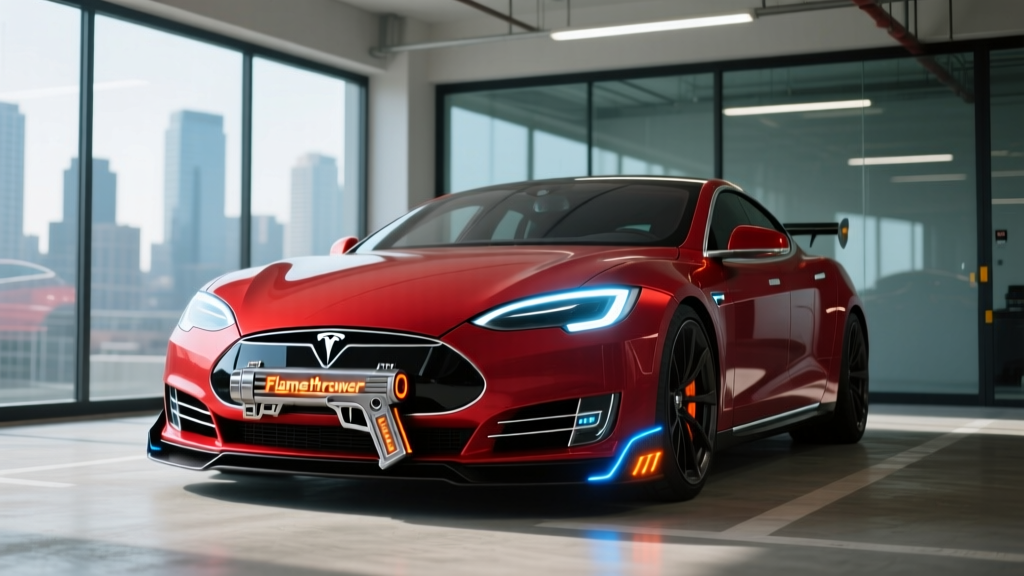
If you've landed here searching for the Tesla flamethrower gun, you're not alone — the term still pulls hundreds of searches a month. Here's the straight answer: the "Not-A-Flamethrower" was a $500 novelty product sold by The Boring Company (Elon Musk's tunneling side venture) in 2018. It was a rebranded roofing torch in a futuristic-looking housing, limited to 20,000 units, and it sold out in days. It was never a Tesla vehicle accessory, it was never street-legal to brandish in most jurisdictions, and it has been discontinued for years.
As of 2026, The Boring Company's merch store no longer lists it. Secondary-market units occasionally surface on eBay for $1,500–$3,000 as collector curiosities. If you own a Tesla and want to spend money on something that actually improves your ownership experience, this article redirects you to what matters: real 2026 Tesla EV specs, charging performance, tax-credit eligibility, and which model actually earns your dollars.
2026 Tesla Lineup at a Glance: What You Can Actually Buy
Instead of a novelty torch, here's the current U.S. Tesla lineup with the numbers buyers actually need. All figures are from Tesla's 2026 spec sheets and fueleconomy.gov where published.
| Model | EPA Range (mi) | Battery (kWh / chemistry) | 0-60 mph | HP | Base MSRP |
|---|---|---|---|---|---|
| Model 3 RWD | 341 | ~60 / LFP | 5.8 s | 271 | $38,990 |
| Model 3 Long Range AWD | 363 | ~82 / NMC | 4.2 s | 346 | $42,990 |
| Model Y Long Range AWD | 320 | ~82 / NMC | 4.8 s | 384 | $44,990 |
| Cybertruck AWD | 340 | ~123 / NMC (4680 cells) | 4.1 s | 600 | $79,990 |
| Model S LR AWD | 402 | ~100 / NMC | 3.1 s | 670 | $79,990 |
| Model X LR AWD | 348 | ~100 / NMC | 3.8 s | 670 | $84,990 |
Specs reflect base trims as of early 2026. Plaid and Performance variants have shorter range and higher outputs.
Real-World Range: What the EPA Sticker Doesn't Tell You
EPA sticker vs. reality: A Model 3 Long Range rated at 363 miles EPA typically delivers 290–310 miles on a sustained 75-mph highway run in mild weather, and 240–270 miles in sub-freezing temperatures. City/regenerative driving can exceed the EPA number, approaching 370+ miles at modest speeds.
Tesla's efficiency is among the best in the segment — the Model 3 RWD posts roughly 132 MPGe combined (about 25 kWh/100 mi) per EPA data — but physics still governs. Cold weather thickens electrolyte viscosity and increases cabin-heating load, even with Tesla's standard heat pump. Expect a 15–25% range reduction in sustained sub-30°F highway driving, and up to 35% if you're running the cabin at 72°F on a 10°F morning without preconditioning.
For road-trippers, the practical planning number is 270 usable miles between DC fast-charge stops on a Model 3 LR, keeping a 10% buffer for detours and elevation.
Charging Speeds: Supercharger Network vs. Home Level 2
Tesla's charging advantage remains its vertically integrated Supercharger network — over 6,500 U.S. V3 and V4 stalls as of 2026 — plus the proprietary NACS connector now adopted by most of the industry.
| Level | Power | Miles per Hour Added | Typical 10–80% Time |
|---|---|---|---|
| Level 1 (120V household) | ~1.4 kW | ~5 mi/hr | ~50+ hours |
| Level 2 (240V / 48A Wall Connector) | ~11.5 kW | ~44 mi/hr | ~7 hours |
| DC Fast (V3 Supercharger) | Peak 250 kW | ~170 mi/15 min | ~25 minutes |
| DC Fast (V4 Supercharger) | Peak 350 kW (capable) | Model-dependent | ~20 minutes (supported models) |
Charge-curve reality check: The "peak 250 kW" figure on V3 stalls only holds between roughly 10–30% state of charge. Above 50%, the rate tapers to ~100 kW; above 80%, it drops further to protect the pack. That's why Tesla (and every other OEM) quotes 10–80% times rather than 0–100%. Preconditioning the battery via the car's navigation-routed Supercharger prep is essential — arriving cold can double your session time.
For home charging, the Tesla Wall Connector ($420 hardware) on a 60A circuit delivers the full 48A/11.5 kW. Budget $800–$2,000 for a licensed electrician to install a dedicated 60A line if your panel supports it; older 100A service panels may need a $2,000–$4,000 upgrade. Per the IRS, the separate Alternative Fuel Vehicle Refueling Property Credit (30C) can cover up to $1,000 of home charger installation if you live in an eligible census tract.
Federal Tax Credit: Does a 2026 Tesla Qualify Under §30D?
The short answer: it depends on the trim, your income, and battery-sourcing rules that tighten each year. Under the Inflation Reduction Act's §30D credit, the maximum is $7,500, split between a $3,750 critical-minerals component and a $3,750 battery-components component. As of 2026, both components have stringent North American sourcing requirements that have disqualified several previously eligible vehicles.
| Model | MSRP | Under MSRP Cap? | Income Cap (AGI) | Typical Credit |
|---|---|---|---|---|
| Model 3 RWD | $38,990 | Yes ($55k sedan cap) | $150k single / $300k joint | $0–$7,500* |
| Model 3 Long Range | $42,990 | Yes | $150k single / $300k joint | $0–$7,500* |
| Model Y LR AWD | $44,990 | Yes ($80k SUV cap) | $150k single / $300k joint | $3,750–$7,500* |
| Cybertruck AWD | $79,990 | Yes ($80k truck cap) | $150k single / $300k joint | Varies* |
| Model S / X | $79,990+ | Exceeds sedan cap | N/A | $0 (over cap) |
*Battery-sourcing and critical-minerals rules evolve annually. Tesla's U.S.-built LFP packs (Model 3 RWD) have faced partial disqualification in past years due to CATL cell sourcing. Always verify current eligibility on fueleconomy.gov and consult a tax professional before relying on the credit. Point-of-sale transfer is available at participating dealers.
Tech, Driver Assists, and What's Genuinely Standout
Tesla's infotainment remains a differentiator: a 15.4-inch central touchscreen (17-inch tilt screen on Model S/X) handles navigation, media, climate, and vehicle settings with no physical buttons. The 2026 software stack includes a refined voice assistant, native streaming apps, and Sentry Mode dashcam recording. Over-the-air updates still deliver meaningful feature additions post-purchase — something legacy OEMs are only now matching.
SAE automation reality: Tesla's Autopilot (standard) and Full Self-Driving Supervised ($8,000 option or $99/mo subscription) are SAE Level 2 driver-assist systems. They require continuous driver attention, hands-on or eyes-on monitoring, and do not make the car self-driving. The driver is legally and physically responsible at all times. Level 4 driverless operation in the U.S. currently exists only in geofenced robotaxi services like Waymo, not in any consumer Tesla.
Notable tech drawbacks: Tesla's reliance on touchscreen-only controls for wipers, mirrors, and glovebox remains polarizing. The removal of ultrasonic sensors in favor of Tesla Vision (camera-only) has produced inconsistent parking-assist performance reported by owners. Build quality has improved markedly on 2024+ "Highland" Model 3 and 2025+ "Juniper" Model Y, but panel gaps still trail German and Korean competitors on some units.
Cargo, Passenger Space, and Daily Practicality
For buyers cross-shopping against the Hyundai Ioniq 5 or Ford Mustang Mach-E, interior dimensions matter:
- Model 3: 23 cu ft trunk + 3.1 cu ft frunk; rear legroom 35.2 in. Tight for tall rear passengers on long trips.
- Model Y: 30 cu ft behind second row (76 cu ft with seats folded) + 4.1 cu ft frunk; rear legroom 41.6 in. Genuine family hauler.
- Cybertruck: 6.5-ft bed with lockable tonneau, ~3,500-lb payload, 11,000-lb tow rating. Frunk adds 7 cu ft.
- Model X: Up to 91 cu ft cargo with seats folded; falcon-wing doors aid car-seat loading in tight garages.
The Model Y remains the highest-volume Tesla for good reason: it threads the needle between crossover practicality and sedan-like efficiency (roughly 28 kWh/100 mi on the LR AWD).
Warranty, Longevity, and Battery Degradation
Tesla's warranty structure is competitive but not class-leading:
- Basic vehicle: 4 years / 50,000 miles
- Battery & drive unit: 8 years / 100,000 miles (Model 3 RWD with LFP) or 8 years / 120,000 miles (Long Range / Performance / Model S / X)
- Capacity retention threshold: 70% of original capacity during the warranty period
Real-world data from Tesla's annual impact reports and third-party fleet aggregators suggest average degradation of roughly 10–12% at 150,000 miles for NMC packs, and somewhat less for LFP chemistry — though LFP packs require periodic 100% charges for BMS calibration and have lower energy density. Out-of-warranty pack replacement runs $12,000–$18,000 depending on model, a figure worth budgeting for if you plan to keep the car past 150k miles.
Pros, Cons, and Who Should Buy
Pros
- Best-in-class Supercharger network reliability and coverage
- Segment-leading efficiency (kWh/mi) across the lineup
- Continuous OTA improvements post-purchase
- Strong resale value relative to most EVs
- LFP option on Model 3 RWD offers longer cycle life
Cons
- Touchscreen-only controls frustrate some drivers
- Tesla Vision (no ultrasonics) parking assist is inconsistent
- FSD Supervised remains Level 2 despite the name and $8,000 price
- Tax-credit eligibility varies year to year based on sourcing rules
- Insurance premiums run 15–30% above segment average in most states
Choose a Tesla if: You value Supercharger access for road trips, want the most efficient kWh/mi in the segment, and can charge at home most nights.
Look at Hyundai/Kia (Ioniq 5, EV6) if: You want faster 800V-class DC charging (~18-min 10–80%), physical buttons, and IIHS Top Safety Pick+ ratings with more consistent ADAS.
Look at a Rivian R1S or Ford Mach-E if: You need more cargo flexibility, off-road capability, or a BlueCruise hands-off highway experience that's less attention-demanding than Autopilot.
Frequently Asked Questions
Is the Tesla flamethrower gun still available?
No. The Boring Company's "Not-A-Flamethrower" was a limited 2018 run of 20,000 units at $500 and has been discontinued. It was never a Tesla vehicle accessory. Secondary-market units sell for $1,500–$3,000 as collectibles.
What is the real-world range of a 2026 Tesla Model 3 Long Range?
EPA-rated at 363 miles, expect roughly 290–310 miles on a 75-mph highway trip in mild weather and 240–270 miles in sustained sub-freezing temperatures. City driving with regen can exceed the EPA figure.
How fast does a 2026 Tesla charge at a Supercharger?
On a V3 Supercharger, a Model 3 Long Range peaks at 250 kW and reaches 10–80% in approximately 25 minutes, with the rate tapering significantly above 50% SoC. Preconditioning via navigation is essential for peak rates.
Does a 2026 Tesla qualify for the $7,500 federal tax credit?
Eligibility under IRS §30D depends on the specific model's battery-sourcing compliance, your adjusted gross income (≤$150k single / $300k joint), and MSRP caps ($55k sedans, $80k SUVs/trucks). Model S and X exceed the sedan cap and do not qualify. Model 3 and Y eligibility varies by year — verify on fueleconomy.gov and consult a tax professional.
Is Tesla's Full Self-Driving actually self-driving?
No. FSD Supervised is an SAE Level 2 driver-assist system requiring continuous driver supervision. The driver is legally responsible for the vehicle at all times. True Level 4 driverless consumer vehicles are not sold in the U.S. as of 2026.
Is a Tesla worth buying versus a Hyundai Ioniq 5 or Kia EV6?
If Supercharger access and software polish are priorities, Tesla still leads. If you want faster 800V DC charging (~18-min 10–80% on 350-kW chargers), physical controls, and stronger IIHS safety ratings, the Korean platforms are compelling alternatives — especially with the Hyundai/Kia's current stronger §30D credit eligibility.