Quick Verdict: Is Tesla Ready for First-Responder Duty?
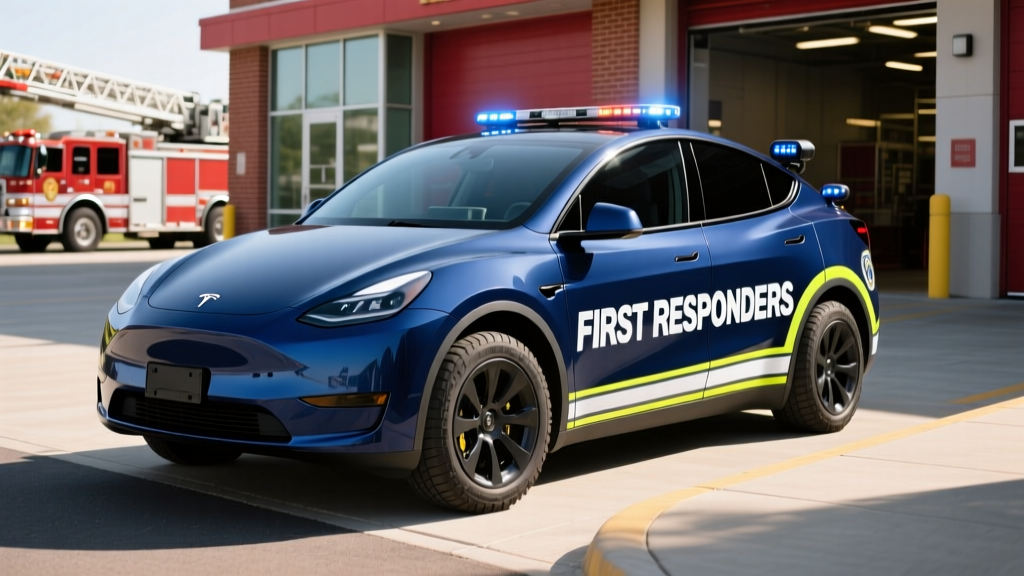
Tesla has quietly become one of the most talked-about platforms in municipal fleet electrification. From the Tesla Fleet program to grassroots police department pilots in cities like Fremont, California, and South Pasadena, the Model Y Long Range AWD is the de facto Tesla first responders vehicle — not because Tesla builds a purpose-built police interceptor, but because the Model Y's combination of 320 miles of EPA range, instant torque, and low operating costs maps surprisingly well to light-duty patrol, community service, and fire-department liaison roles.
But first-responder work is unforgiving. Vehicles idle for hours, run high electrical loads (lightbars, radios, laptops), chase in extreme heat and cold, and must be ready 24/7. This review evaluates the 2026 Tesla Model Y Long Range AWD through that lens — with exact range, charging, cost, and capability data — so fleet managers and procurement officers can make an evidence-based decision.
Tesla Model Y Long Range AWD: Spec Table for Fleet Buyers
| Specification | Value |
|---|---|
| EPA Range | 320 miles |
| Battery Capacity | ~75 kWh usable (NMC chemistry) |
| Drivetrain | Dual-motor AWD |
| Horsepower | 384 hp (combined) |
| 0–60 mph | 4.8 seconds |
| Top Speed | 125 mph |
| Max DC Fast Charge | 250 kW (peak, V3 Supercharger) |
| 10–80% DC Charge Time | ~27 minutes |
| Level 2 Home/Depot Rate | 11.5 kW (44 mi/hr added) |
| EPA Efficiency | 122 MPGe combined / 28 kWh/100 mi |
| Cargo Volume (rear seats up) | 30.2 cu ft |
| Cargo Volume (rear seats folded) | 72.1 cu ft |
| Front Legroom | 41.8 in |
| Rear Legroom | 37.4 in |
| Towing Capacity | 3,500 lbs |
| Battery Warranty | 8 years / 120,000 miles (≥70% retention) |
| Base MSRP | $44,990 (before delivery) |
| As-Tested (w/ FSD) | ~$52,990 |
Real-World Range for First-Responder Use Cases
EPA Sticker: 320 miles (Model Y Long Range AWD)
Real-World Expectation: ~240–270 miles highway at 70 mph; ~180–220 miles in sustained cold (below 32°F) with cabin heat and lightbar load; ~260–290 miles in mixed urban patrol driving with regen-heavy stop-start patterns.
First-responder duty cycles rarely look like the EPA test loop. A patrol Model Y running an LED lightbar (~150–300W draw), a mobile data terminal, and a radio repeater will see a 3–7% range reduction from auxiliary electrical load alone. Cold-weather deployments in northern states can knock 20–30% off range due to battery-resistance losses and cabin heating — though the Model Y's standard heat pump mitigates some of this compared to resistive-heater EVs.
For a typical 8-hour patrol shift covering 80–120 miles with idle time, the Model Y Long Range can complete a full shift on a single charge with 30–50% state-of-charge remaining — provided the vehicle starts at ≥90% SoC. Departments running 12-hour shifts or high-speed pursuit-heavy zones will need mid-shift DC fast-charging access or opportunity charging at the depot.
According to fueleconomy.gov, the Model Y LR AWD achieves 122 MPGe combined, translating to roughly $0.04–$0.06 per mile at average US electricity rates — a fraction of the $0.15–$0.22/mile fuel cost for a comparable Ford Police Interceptor Utility.
Charging Speed: Depot and Field Charging for Emergency Fleets
| Charging Level | Power (kW) | Rate (miles/hr added) | Use Case |
|---|---|---|---|
| Level 1 (120V standard outlet) | ~1.4 kW | ~4–5 mi/hr | Emergency backup only |
| Level 2 (240V depot charger) | 11.5 kW (48A) | 44 mi/hr | Overnight depot charging (8 hrs = ~320 mi) |
| DC Fast Charge (V3 Supercharger) | 250 kW peak | ~1,000+ mi/hr at peak | Mid-shift opportunity charge (10–80% in ~27 min) |
| DC Fast Charge (CCS adapter at EA/others) | ~150–175 kW typical | ~600 mi/hr at peak | Non-Tesla network backup |
For fleet depots, Level 2 charging at 11.5 kW is the workhorse. A Model Y arriving at 20% SoC will fully recharge in roughly 7 hours on a dedicated 60A circuit — fitting cleanly into an overnight shift-change cycle. Departments installing multiple Level 2 chargers should plan for load-management software or panel upgrades; a 4-charger depot can draw ~46 kW simultaneously.
The Model Y's NACS connector grants native access to Tesla's Supercharger network — over 6,000 V3/V4 stalls in North America as of early 2026 — which is the most reliable DC fast-charging network by uptime metrics. The 250 kW peak rate is sustained roughly from 10–30% SoC, then tapers progressively; the 10–80% time of ~27 minutes is competitive but not class-leading (the Hyundai Ioniq 5's 800V architecture charges 10–80% in ~18 minutes at 350 kW chargers).
Key fleet consideration: Tesla does not currently offer a dedicated fleet-telematics API for third-party fleet management platforms like Geotab or Samsara in the same way Ford or GM do. Departments reliant on telematics for utilization tracking, geofencing, and maintenance alerts should confirm API compatibility before procurement.
Performance and Pursuit Capability
The Model Y Long Range AWD's 384 hp and 4.8-second 0–60 mph time give it legitimate acceleration credentials. In straight-line performance, it out-accelerates most traditional pursuit-rated SUVs, including the Ford Police Interceptor Utility Hybrid (which runs ~7.5 seconds to 60 mph). The dual-motor AWD system provides instant torque vectoring and confident wet-weather traction without a mechanical transfer case to maintain.
However, pursuit rating involves more than acceleration. The Michigan State Police and other agencies run standardized pursuit-evaluation courses that test high-speed cornering, brake fade over repeated hot laps, emergency maneuvering, and upfit durability. As of 2026, Tesla does not submit the Model Y for formal pursuit certification, and the vehicle's low ground clearance, lack of a steel bulkhead option from the factory, and regenerative-braking behavior (which differs from traditional friction-brake modulation) make it better suited to community policing, code enforcement, fire inspection, and non-pursuit support roles than to primary patrol or pursuit duty.
Departments that have deployed Teslas for first-responder use — including South Pasadena PD and various university police departments — typically assign them to community liaison officers, detectives, and administrative roles where pursuit likelihood is minimal.
Pricing, Fleet Procurement, and Tax Credit Eligibility
| Item | Amount |
|---|---|
| Model Y Long Range AWD (base MSRP) | $44,990 |
| FSD (Supervised) add-on | $8,000 |
| Delivery & order fee | ~$1,390 |
| Federal §30D Tax Credit (if eligible) | Up to $7,500 |
| Estimated Post-Credit Price (individual buyer) | ~$37,490+ |
Important for fleet procurement: The IRS §30D federal EV tax credit applies to individual taxpayers and certain tax-exempt organizations (including state/local governments and tribal governments) via the direct-pay election under §6417. Municipalities can receive the credit as a direct payment rather than a tax offset — but several conditions must be met:
- MSRP cap: SUVs must be ≤$80,000 (Model Y qualifies at $44,990 base)
- Buyer income cap (individuals): AGI ≤$150K single / $300K joint
- Battery sourcing: Critical minerals and battery components must meet escalating US/FTA-country thresholds (verify current-year compliance on IRS.gov)
- Point-of-sale transfer: Individual buyers can transfer the credit to the dealer for an upfront price reduction; government entities use direct-pay filing
- VIN registration: The vehicle must be registered in the purchasing entity's name and used predominantly in the US
Fleet buyers purchasing 5+ units should contact Tesla's Fleet Sales team directly for volume pricing, which can include reduced per-unit costs, delivery coordination, and charger-installation partnerships. Some states also offer additional fleet-electrification grants (e.g., California's HVIP, New York's Truck Voucher Incentive) that can stack with federal credits.
Interior, Cargo, and Upfit Considerations
The Model Y's minimalist interior is a double-edged sword for first-responder upfitting. On one hand, the 15.4-inch center touchscreen replaces traditional gauge clusters and can display navigation, dispatch (via browser-based CAD), and backup camera feeds simultaneously. The glass roof and open cabin create a spacious feel for community-facing roles.
Cargo space is generous: 30.2 cu ft behind the second row and 72.1 cu ft with seats folded — enough for fire-scene equipment, evidence kits, or mobile command setups. The front trunk (frunk) adds 4.1 cu ft for secured storage of Narcan kits, AEDs, or personal protective equipment.
On the downside, the Model Y lacks factory provisions for police upfitting: no pre-wired lightbar passthroughs, no factory bulkhead mounting points, no auxiliary battery provisions for high-draw radios, and limited aftermarket ecosystem support compared to the Ford Interceptor or Chevy Tahoe PPV. Departments should budget $5,000–$12,000 per vehicle for custom upfitting through third-party installers who are increasingly developing Tesla-specific solutions.
Tech, Driver Assistance, and Safety
SAE Automation Level: Tesla's Autopilot and FSD (Supervised) are Level 2 driver-assistance systems. The driver must remain fully attentive, with hands on the wheel and eyes on the road, at all times. These systems do NOT make the vehicle self-driving.
Standard Autopilot includes Traffic-Aware Cruise Control and Autosteer (lane-centering on highways). FSD (Supervised), an $8,000 add-on, adds automatic lane changes, traffic-light and stop-sign recognition, and city-street autosteer — but requires constant supervision. For fleet use, some departments disable FSD to reduce liability exposure; others enable it for highway-response segments to reduce officer fatigue.
Safety ratings are strong: the Model Y earns a 5-star overall rating from NHTSA and top marks from IIHS (TOP SAFETY PICK+ when equipped with acceptable headlights). Standard active safety includes automatic emergency braking, blind-spot monitoring, and lane-departure prevention — useful features for fatigued officers on long shifts.
Pros and Cons for First-Responder Fleets
Pros
- 320-mile EPA range covers most single-shift patrol duty cycles
- ~$0.05/mile energy cost vs. ~$0.18/mile for gas interceptors — massive fuel savings at scale
- Minimal scheduled maintenance (no oil, transmission fluid, or brake-pad replacement under normal regen use)
- Instant torque and 4.8-sec 0–60 for rapid response
- Supercharger network access for reliable road-trip/inter-agency travel
- Over-the-air updates continuously add features without depot visits
- Strong NHTSA/IIHS safety ratings
Cons
- Not pursuit-rated; unsuitable for primary high-speed patrol
- Limited factory upfit support for lightbars, bulkheads, auxiliary power
- Cold-weather range loss (20–30%) may require mid-shift charging in northern climates
- No dedicated fleet telematics integration (Geotab/Samsara compatibility limited)
- Repair times can be longer than legacy OEMs due to parts supply chain
- Touchscreen-centric controls may distract in high-workload scenarios
- FSD liability considerations for municipal insurance
Who Should Buy the Model Y for First-Responder Use?
Choose the Model Y for your fleet if:
- Your use case is community policing, detective work, code enforcement, fire inspection, or university patrol
- You have depot Level 2 charging infrastructure (or budget to install it)
- Your shifts are 8–10 hours with ≤120 miles driven per shift
- You operate in a region with reliable Supercharger access for backup
- Fuel-cost reduction and emissions targets are procurement priorities
Look elsewhere (Ford PIU Hybrid, Chevy Tahoe PPV) if:
- You need pursuit-rated vehicles for primary patrol
- Your shifts exceed 12 hours or cover 200+ miles
- You operate in extreme cold without depot charging
- You require deep aftermarket upfit ecosystems and fleet telematics
Frequently Asked Questions
What is the real-world range of the Model Y for first-responder use?
Expect 240–270 miles highway and 260–290 miles in urban stop-start patrol. Add a lightbar and cold weather, and plan for 180–220 miles. For a standard 8-hour, 100-mile shift, the Model Y completes duty with battery to spare.
How fast does the Model Y charge at the depot and in the field?
At 11.5 kW on Level 2, you'll add 44 miles per hour — a full overnight charge in ~7 hours. On a V3 Supercharger at 250 kW peak, 10–80% takes ~27 minutes, suitable for a mid-shift meal break top-up.
Does the Model Y qualify for the federal EV tax credit?
The Model Y Long Range AWD at $44,990 MSRP is under the $80,000 SUV cap. Individual buyers must meet income thresholds (≤$300K joint). Municipal/government fleets can use the §6417 direct-pay election to receive the credit as a payment. Verify current battery-sourcing compliance on IRS.gov.
Is the Model Y pursuit-rated for police work?
No. Tesla does not submit the Model Y for formal pursuit evaluation by agencies like the Michigan State Police. It is best suited for non-pursuit roles: community policing, detectives, code enforcement, fire inspection, and administrative use.
How does the Model Y compare to the Ford Police Interceptor Utility Hybrid?
The Ford PIU Hybrid is pursuit-rated, has extensive aftermarket upfit support, and offers deeper fleet telematics integration — but costs more per mile to fuel (~$0.18 vs ~$0.05) and requires more scheduled maintenance. The Model Y wins on operating cost and acceleration; the Ford wins on pursuit readiness and upfit maturity.
What is the battery warranty, and what does replacement cost?
Tesla covers the battery for 8 years or 120,000 miles (whichever comes first) with a minimum 70% capacity retention guarantee. Out-of-warranty battery replacement currently runs $12,000–$16,000 depending on the pack, though most Model Y batteries show <5% degradation at 100,000 miles based on fleet data.
Can first-responder Model Ys use the Supercharger network?
Yes. Tesla's Supercharger network (6,000+ V3/V4 stalls in North America) is the most reliable DC fast-charging network by uptime. Model Y vehicles charge natively via NACS without adapters.